Sharks see, smell, and hear extremely well, but not in exactly the same way humans do. Their eyes are adapted for underwater light, their sense of smell can detect tiny traces of chemicals in the water, and their hearing is especially useful for low-frequency sounds and vibrations. Together, these senses help sharks find prey, avoid threats, navigate their environment, and survive in oceans ranging from shallow coasts to deep water.
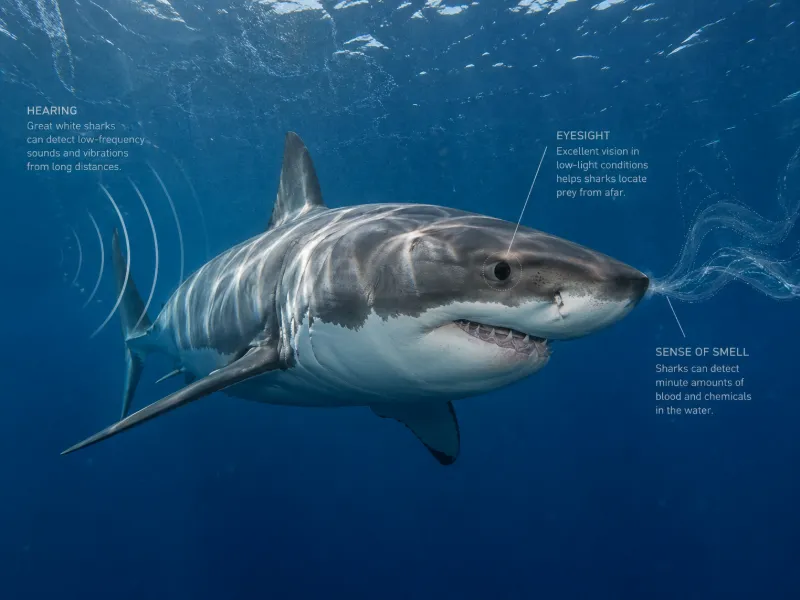
Many people think of sharks as simple killing machines, but their sensory world is far more sophisticated. Different shark species rely on different senses depending on where they live, what they eat, and whether they hunt in bright water, dark depths, or murky coastal habitats.
In this guide, you will learn how sharks use vision, smell, and hearing, which senses are strongest, and why these adaptations make them such effective ocean predators.
Quick answer
| Sense | How sharks use it | Best for |
|---|---|---|
| Vision | Sharks use light-sensitive eyes adapted for underwater conditions | Detecting movement, contrast, shape, and nearby prey |
| Smell | Water enters the nostrils and passes over sensory tissue that detects dissolved chemicals | Finding food trails, tracking scents, and detecting injured or stressed animals |
| Hearing | Inner ear structures detect low-frequency sound and water movement | Sensing struggling prey, distant activity, and approaching movement |
How shark vision works
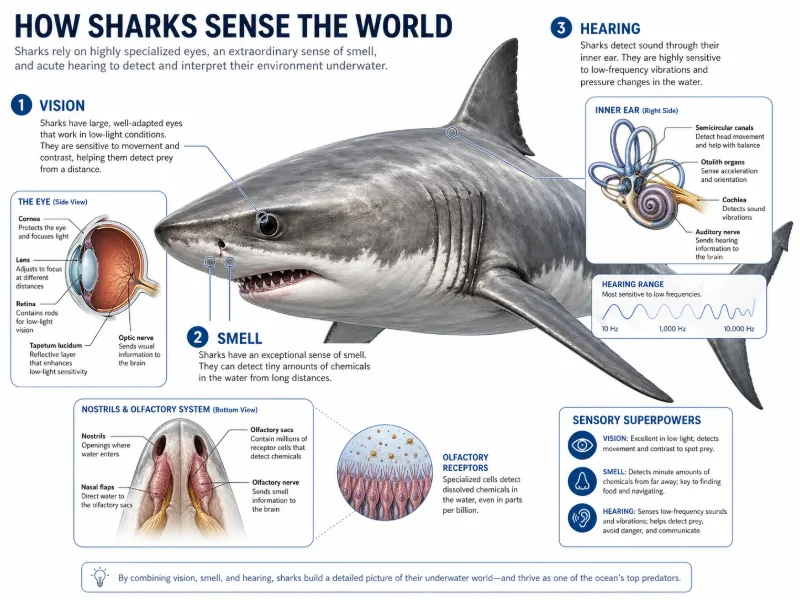
Sharks can see well underwater, although the exact quality of vision varies by species. Their eyes are built for aquatic life, where light behaves differently than it does in air. Water reduces clarity, color range, and visibility over distance, so shark eyes are especially useful for detecting contrast, motion, and general shape rather than fine detail at long range.
Many sharks have retinas with light-sensitive cells that help them function in dim conditions. In species that hunt at dawn, dusk, or in deeper water, this can be especially important. Some sharks also have a reflective layer behind the retina called the tapetum lucidum, which helps improve vision in low light by reflecting light back through the eye.
That does not mean all sharks see perfectly in darkness. Instead, it means many species are better adapted to low-light underwater conditions than humans are. A shark in murky or dark water may still rely heavily on other senses once it gets close to its target.
Do sharks see color?
Scientists have long debated how much color vision different shark species have. Evidence suggests that many sharks may have limited color vision and may rely more on contrast, brightness, and movement than on rich color differences.
In practical terms, a shark may not need to see the full range of colors the way a human does. In underwater hunting, noticing a moving silhouette, a flashing fish body, or the contrast between an animal and the background can matter more than seeing vivid color.
Some species may distinguish certain wavelengths better than others, but in general, it is safest to say that sharks are usually thought to depend more on motion and contrast than on complex color perception.
How sharp is a shark’s eyesight?
Shark eyesight is often good enough to detect prey, other animals, and obstacles in the surrounding water, but it is not identical to human vision. In many cases, sharks are better described as efficient underwater viewers rather than long-distance detail specialists.
At a distance, a shark may first notice movement, shape, or sound before it sees every detail of an object. As it comes closer, vision becomes more useful in confirming what the target is. This helps explain why sharks often rely on several senses in sequence rather than depending on one alone.
Some fast-swimming hunters in open water may use vision more heavily than bottom-dwelling or deep-water species, which often live where light is weaker or visibility is poorer.
How sharks smell underwater
A shark’s sense of smell is one of its most famous abilities. Sharks do not smell through their mouths. Instead, they use paired nostrils on the underside or front of the snout. These openings are for smelling, not for breathing.
Water flows into the nostrils and passes over folded sensory tissue that can detect dissolved chemicals. This lets sharks pick up scent traces from animals, body fluids, decaying matter, and other substances in the water.
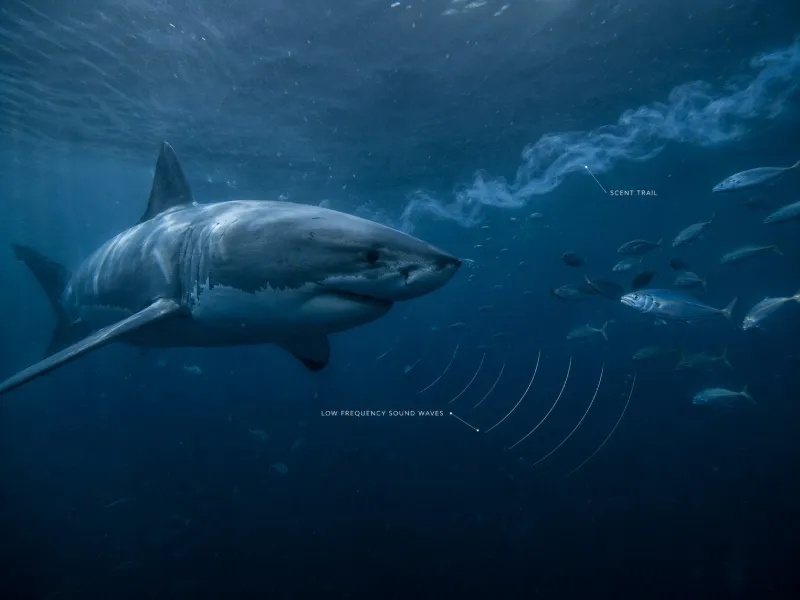
Because scent spreads in currents, smell helps sharks detect that something interesting is nearby even when they cannot yet see it clearly. A shark may then turn, follow the gradient of scent, and move closer until other senses take over.
Can sharks smell blood from far away?
Sharks can detect extremely small amounts of certain chemicals in the water, including substances associated with blood and injured animals. However, the popular idea that they instantly go wild from a single drop of blood anywhere in the ocean is exaggerated.
Smell depends on water movement, current direction, dilution, turbulence, and the species involved. A shark is not a magic detector with unlimited range. It still has to be in the right environment and in the path of the scent trail.
What makes shark smell impressive is not myth-level superpower, but real chemical sensitivity combined with the ability to track scent in moving water.
How sharks follow a scent trail
When a shark detects an odor, it does not simply swim straight to the source in a perfect line. Instead, it often samples the water repeatedly and adjusts its path as the scent becomes stronger or weaker.
Because each nostril can receive slightly different input depending on the direction of water flow, sharks may be able to compare scent information from both sides of the head. This can help them turn toward the stronger signal and refine their direction of travel.
Smell is especially useful at medium range, when prey is not yet visible but chemical clues are already present in the water column.
How sharks hear sounds and vibrations
Sharks do not have external ears like mammals, but they can still hear. Their hearing system is based mainly on inner ear structures that detect sound and movement through the water.
Sharks are generally most sensitive to low-frequency sounds. These are the kinds of sounds often produced by struggling fish, splashing prey, moving animals, or other disturbances in the water. Low-frequency signals travel well underwater, which makes them useful for an aquatic predator.
In simple terms, a shark may notice a struggling or injured animal before it can see it clearly, especially in murky water or at some distance.
Do sharks hear better than humans underwater?
In some ways, yes. Humans are not naturally built for underwater hearing, while sharks are fully adapted to aquatic sound transmission. Sharks are especially effective at detecting the kinds of underwater signals that matter most in their environment.
That does not mean sharks hear every sound better than every other animal. It means their hearing is specialized for what they need: low-frequency sounds, directional clues, and changes in their watery surroundings.
For a hunting shark, that can be more useful than broad, human-style hearing.
Which sense is strongest in sharks?
There is no single answer for every shark species. In general, smell is often described as one of the most powerful long-range senses in sharks, while vision becomes more important as they get closer to a target. Hearing helps alert them to activity and movement before they arrive.
In reality, sharks are most effective because they combine senses. A shark may first hear low-frequency movement, then detect a scent trail, then use vision to inspect the target at close range.
This layered sensory strategy is one reason sharks are such efficient predators. Each sense has a different role, and together they create a more complete picture of the environment.
Do all sharks sense the world the same way?
No. Shark sensory biology varies by species. A large open-ocean hunter may depend heavily on vision and long-distance movement cues, while a reef shark in complex coastal habitat may use a different balance of senses. Bottom-dwelling sharks in dim or cloudy environments may rely less on vision and more on smell and nearby sensory input.
Body shape, habitat, depth, prey type, and daily activity pattern all influence how a shark senses the world. A species active in bright shallow water does not face the same sensory challenges as one living in deep, dark, or muddy habitats.
So while the basic sensory toolkit is shared across sharks, the exact emphasis can differ from one species to another.
Why these senses make sharks effective predators
Sharks are effective predators not because one sense is unbelievably powerful, but because several senses work together. Vision helps them detect movement and shape. Smell helps them find chemical trails in the water. Hearing helps them notice low-frequency disturbances that may signal prey.
These abilities allow sharks to function in conditions where humans would struggle. Murky water, low light, long distances, and moving currents create challenges, but sharks are adapted to solve them.
This does not mean sharks are unstoppable or perfect hunters. They still make mistakes, investigate unfamiliar objects, and respond differently depending on species and environment. But their sensory system is extremely well suited to life in the ocean.
How shark senses compare to human senses
Humans are highly visual land mammals, while sharks are aquatic predators built for chemical detection, low-frequency hearing, and underwater motion tracking. A human entering the ocean loses many normal advantages because sight, sound, and movement all work differently in water.
Sharks, by contrast, are in their native medium. Their senses are tuned to the ocean’s conditions. That is why a shark may detect clues that a human would completely miss, such as faint scent gradients, subtle vibrations, or low-contrast movement in dim light.
In short, sharks do not experience the ocean the way we do. They live in a different sensory world.
Final takeaway
Sharks see, smell, and hear through a highly specialized set of underwater adaptations. Their eyes are built to detect contrast and movement in aquatic light, their nostrils sense dissolved chemicals that help them track food, and their hearing is tuned to low-frequency sound and vibration. No single sense explains shark success on its own. Instead, sharks combine vision, smell, and hearing to locate prey, navigate the sea, and survive in a wide range of ocean habitats.
FAQs
Do sharks have good eyesight?
Yes. Many sharks have good underwater vision, especially for detecting motion, contrast, and nearby shapes, although exact visual ability varies by species.
Can sharks smell a drop of blood?
Sharks can detect very small chemical traces in water, including substances associated with blood, but the popular version of this idea is often exaggerated.
Do sharks have ears?
Sharks do not have external ears, but they do have inner ear structures that allow them to detect underwater sound and movement.
Which sense is most important to sharks?
It depends on the species and situation, but smell is often very important at longer range, while vision and hearing help in different stages of detection and hunting.