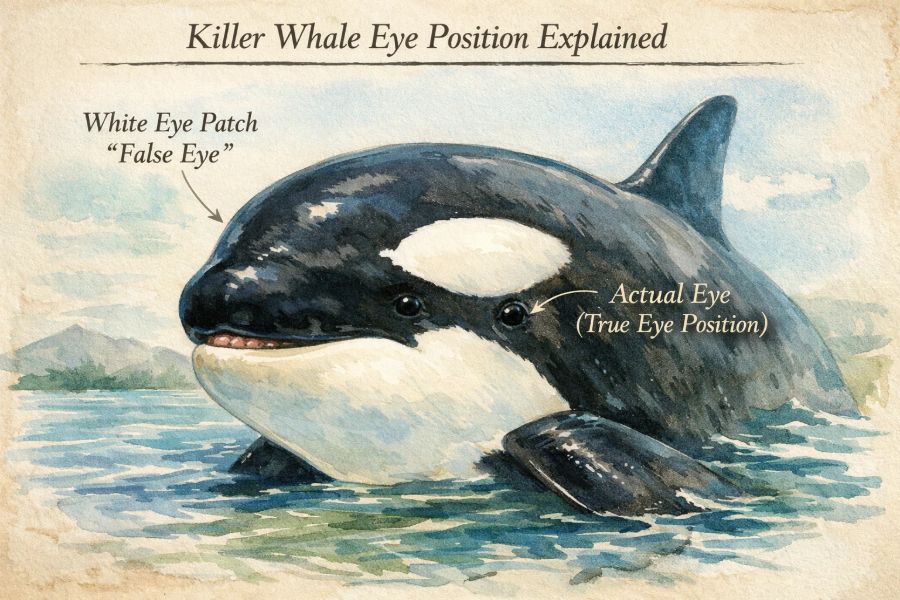
At first glance, many people assume the large white patch on each side of an orca’s head is the eye. It is not. An orca’s actual eye is a small dark eye located on each side of the head, just in front of the white eyespot and close to the corner of the mouth. NOAA states that the eye sits just below and in front of the eyespot, while SeaWorld describes it as just behind and above the corner of the mouth, and in front of the white eyespot. Those descriptions point to the same basic location: the real eye is the small dark opening near the mouth line, not the big white patch above it.
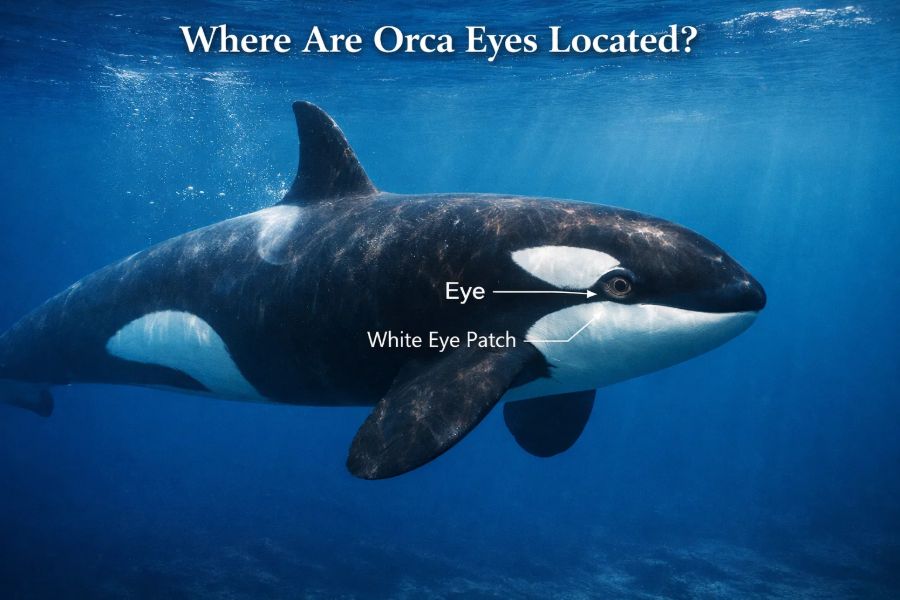
That confusion is understandable because the white eyespot is one of the most visually striking parts of an orca’s pattern. NOAA describes killer whales as black above, white below, with white patches near the eyes, and those patches vary among individuals and populations. In other words, the eyespot is a pigment marking, not the eyeball itself.
The short answer
If you want the simplest possible answer, it is this:
Orca eyes are on the sides of the head, low on the face, just in front of the white eyespot and near the corner of the mouth.
Why people mistake the white patch for the eye
The mistake happens because the eyespot looks exactly where many people expect an eye to be: large, high-contrast, and easy to notice from far away. But the real eye is much smaller and darker, so it blends into the black skin more easily. NOAA’s anatomy page explicitly separates the two, noting that the eye is located just below and in front of the eyespot.
Scientists do not fully agree on every function of the white eyespot, but it is widely treated as an important visual marking. NOAA notes that eye-patch size and shape vary among populations, and National Geographic has highlighted that some orca forms, such as type D, have unusually small eye patches compared with more typical killer whales. That variation suggests the patch is a meaningful external feature rather than a simple decorative mark.
Exactly where on the head are the eyes?
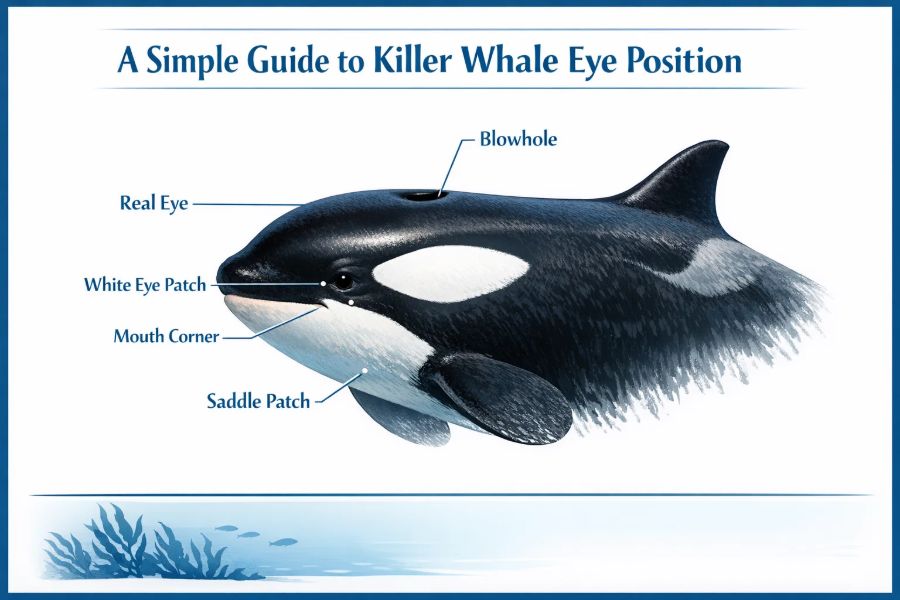
A useful way to picture the placement is to divide the side of the head into three landmarks:
the mouth corner
the white eyespot
the real eye
The real eye sits between the mouth corner and the white patch, slightly low on the head. SeaWorld says the eye is on each side of the head, just behind and above the corner of the mouth, and in front of the white eyespot. NOAA phrases it as just below and in front of the eyespot. Put those together, and the real eye is best understood as a small dark eye positioned on the side of the head in the black skin area adjacent to the white patch.
Do orcas have one eye on each side?
Yes. Like most vertebrates, orcas have two eyes, one on each side of the head. This side placement gives them a wide field of view. NOAA’s anatomy page notes that orcas have excellent eyesight both in and out of the water, and SeaWorld similarly states that killer whales see well in air and underwater.
Because the eyes are lateral rather than forward-facing like human eyes, an orca’s view of the world is arranged differently from ours. Side-placed eyes generally trade some degree of straight-ahead binocular overlap for wider overall awareness. That makes sense for a fast-swimming predator that must monitor its surroundings in three-dimensional water. This is an inference based on eye placement and marine-mammal visual anatomy.
Are orca eyes big or small?
Compared with the enormous size of the whale, the eyes are relatively small and easy to miss. SeaWorld says a killer whale’s eyes are about the same size as the eyes of a cow. That sounds large in everyday terms, but on the head of a several-meter-long whale, they still appear visually small.
Research on killer whale ocular anatomy also shows that the eye and retina are specialized for cetacean life. A published study on killer whale ocular anatomy found distinctive retinal features, including very large ganglion cells and a retinal layout adapted to the visual demands of a marine mammal.
Can orcas see well?
Yes. Orcas are not blind hunters that rely only on echolocation. NOAA says they have excellent eyesight in and out of the water, and SeaWorld says the same. That means vision is an important part of how they move, socialize, and interpret their surroundings.
At the same time, orcas are also famous for strong hearing and echolocation. NOAA notes that they have a well-developed sense of hearing and receive sound through receptors in their jawbones. So the best scientific picture is that orcas use multiple senses together: eyesight, hearing, and echolocation.
Why is the eye position useful?
Eye placement on the sides of the head helps an orca scan a broad area around it. In open water, that is useful for tracking pod members, prey, obstacles, and surface conditions. Since killer whales live in dynamic social groups and often coordinate movement closely, wide lateral awareness likely matters a great deal. That conclusion is an inference from anatomy and their known social behavior.
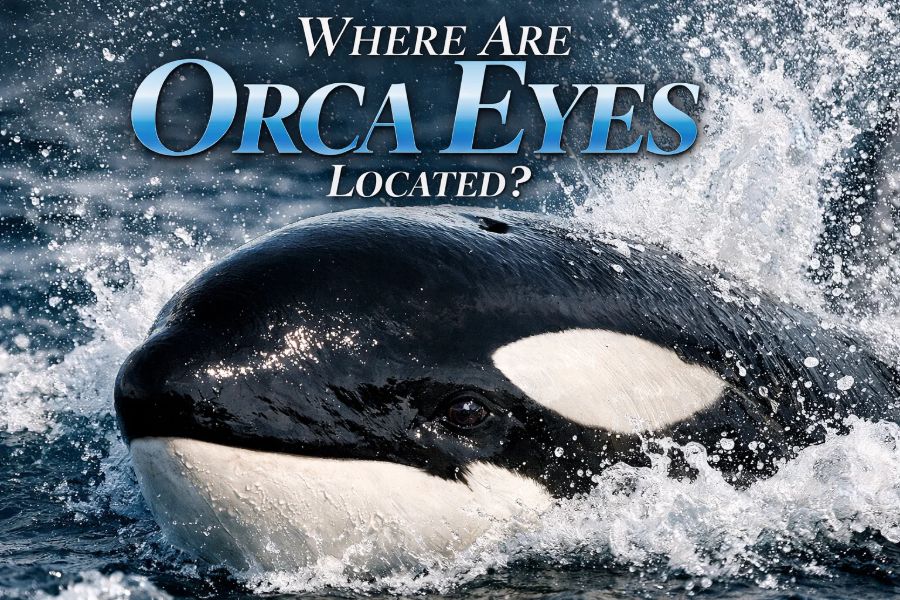
The real eye’s location also explains why close-up photos of orcas can look surprising. Once you know where to look, you can usually spot the small dark eye below the larger white patch.
Is the white eyespot just “fake camouflage”?
It is safer to say the white eyespot is a body marking with likely visual functions, rather than claim one single proven purpose. What we can say confidently is that it is not the actual eye, and that its shape varies among forms and populations. NOAA and National Geographic both support that much. Claims that it definitely tricks prey, mimics an eye, or serves one exact communication purpose are plausible, but they are less firmly established than the basic anatomical fact that the true eye lies in front of and below the patch.
A simple way to identify an orca’s real eye in photos
When looking at a side-view photo of an orca:
Find the large white oval or teardrop-shaped patch.
Then look just in front of it.
Look close to the corner of the mouth line.
The real eye is the small dark eye in that area.
This matches the locations described by NOAA and SeaWorld.
Final takeaway
The big white patch is not an orca’s eye. The real eye is small, dark, and located on the side of the head just in front of the white eyespot, near the mouth corner. Orcas see well both underwater and above the surface, and their eye placement helps give them broad lateral awareness while they also rely heavily on hearing and echolocation.
Quick reference table
| Question | Answer |
|---|---|
| Are the white patches the eyes? | No, they are eyespots/markings. |
| Where is the real eye? | Just in front of the white patch and near the mouth corner. |
| Do orcas have good vision? | Yes, in and out of water. |
| Are the eyes large? | About cow-eye sized, but small relative to the whale’s head. |
| Do eye patches vary? | Yes, among individuals and populations. |
References
NOAA Ocean Today. Killer Whale Anatomy. Eye location described as just below and in front of the eyespot.
NOAA Fisheries. Killer Whale species page. General appearance, including white patches near the eyes.
SeaWorld. All About Killer Whales – Physical Characteristics. Eye position described as on each side of the head, just behind and above the mouth corner, and in front of the white eyespot; eye size compared to a cow’s eye.
Mass, A. M. et al. Ocular Anatomy, Ganglion Cell Distribution and Retinal Resolution of a Killer Whale (Orcinus orca). Retinal and ocular specialization in killer whales.
National Geographic. Type D killer whale articles. Notes that eye-patch size varies and can be unusually small in some forms.