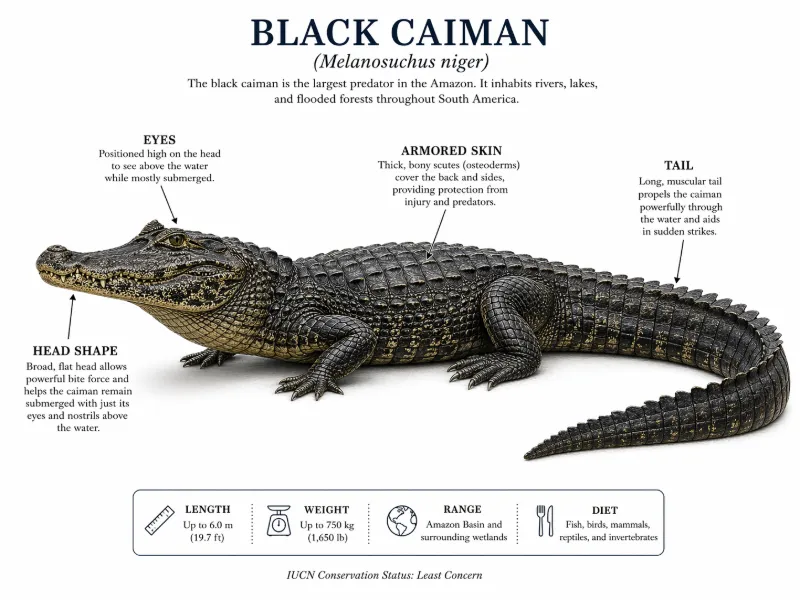
The black caiman is one of the largest and most powerful reptiles in South America. It is a huge crocodilian that lives in tropical wetlands, rivers, lakes, and flooded forests, where it hunts fish, birds, reptiles, and mammals.
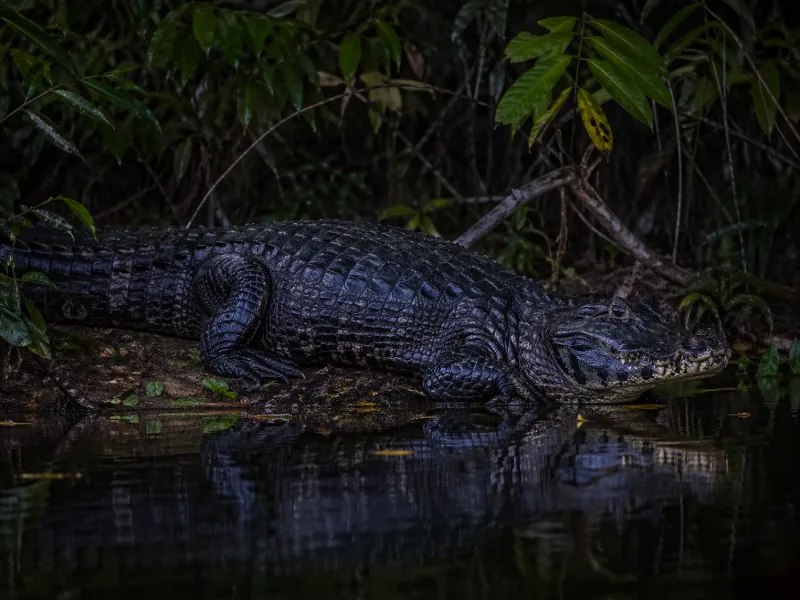
At first glance, the black caiman may look like a crocodile or an alligator, but it is actually a type of caiman in the alligator family. It is darker, often larger than most other caiman species, and plays the role of an apex predator in parts of the Amazon basin and other South American wetlands.
In this guide, you will learn the most important black caiman facts, including its size, habitat, diet, appearance, behavior, and conservation status.
Quick facts
| Feature | Black Caiman |
|---|---|
| Scientific name | Melanosuchus niger |
| Group | Caiman in the alligator family |
| Range | Northern and central South America |
| Habitat | Rivers, lakes, wetlands, flooded forests, marshes |
| Diet | Carnivorous |
| Typical prey | Fish, birds, reptiles, mammals |
| Maximum size | Very large; large males can exceed 4 meters and may reach around 5 meters or more in exceptional cases |
| Main trait | Large size, dark coloration, powerful predator |
What is a black caiman?
The black caiman is a large crocodilian native to South America. It belongs to the caiman branch of the alligator family, which means it is more closely related to alligators than to true crocodiles.
It is the largest caiman species and one of the largest predators in the Amazon and nearby wetland systems. Because of its size, strength, and position in the food chain, it is often considered one of the most important reptile predators in tropical South America.
The species name Melanosuchus niger reflects its dark appearance. Adult black caimans often look almost charcoal gray, dark brown, or blackish, especially in low light or muddy water.
How big is a black caiman?
The black caiman is the biggest living caiman and can become extremely large. Adult males are much larger than females, and the largest males are impressive apex predators.
Many adults are smaller than the maximum often mentioned online, but large males can exceed 4 meters in length. Exceptionally large individuals may approach or exceed about 5 meters, though reliable measurements of the very biggest animals are less common than dramatic claims suggest.
Females are smaller on average and usually do not reach the same massive size as the biggest males. Even so, a large female black caiman is still a powerful predator.
In general, the black caiman is larger than most other caimans and rivals some of the world’s largest freshwater crocodilians in size and power.
What does a black caiman look like?
The black caiman has a long, heavy body, a powerful tail, strong jaws, and tough armored skin. Adults are usually very dark in color, which is one reason for the common name.
Compared with some smaller caimans, the black caiman often looks broader, deeper-bodied, and more imposing. The head is large and powerful, and the snout is not as sharply pointed as in many crocodiles.
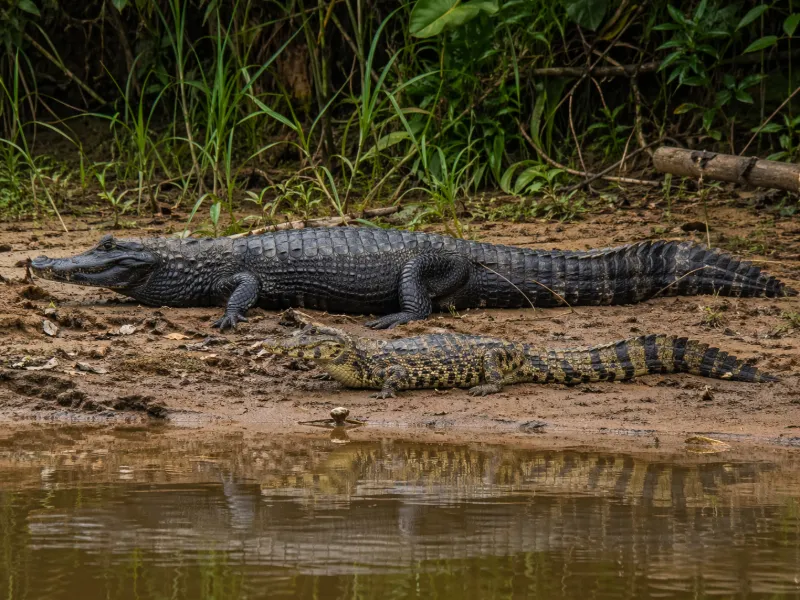
Young black caimans often show more visible banding or lighter markings, which may become less obvious as they grow. Adults tend to look darker and more uniform overall.
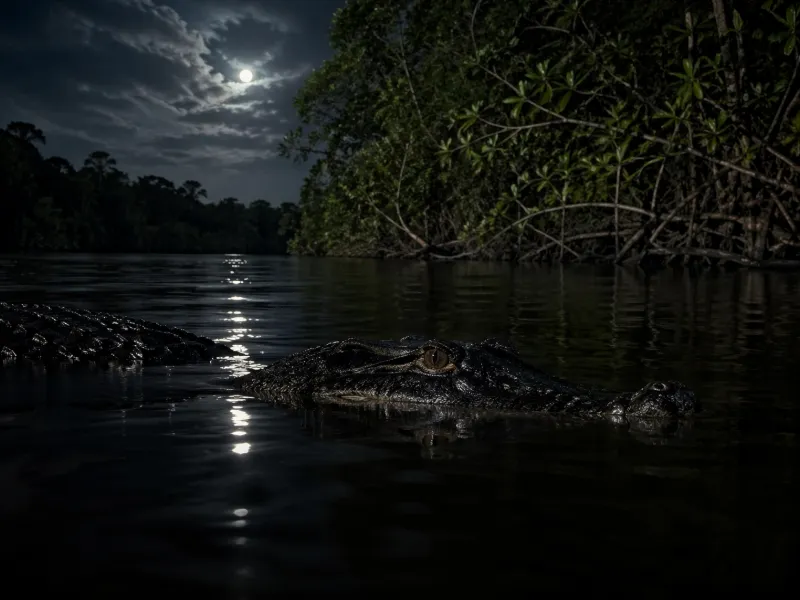
Like other crocodilians, the eyes and nostrils sit high on the head, allowing the animal to remain mostly submerged while watching prey or potential threats.
Where do black caimans live?
Black caimans live in northern and central South America. They are strongly associated with the Amazon basin and nearby river systems, but their range extends beyond a single habitat type.
They occur in countries such as Brazil, Peru, Ecuador, Colombia, Bolivia, Venezuela, and the Guianas, depending on local populations and habitat conditions. They are especially linked to tropical freshwater environments.
Typical black caiman habitat includes slow-moving rivers, oxbow lakes, marshes, swamps, flooded forests, and seasonally flooded wetlands. In places such as the Amazon and the Pantanal region, they may occupy rich aquatic environments full of fish, birds, turtles, and mammals.
Unlike many crocodiles, black caimans are not mainly animals of salty coastal habitats. They are primarily freshwater predators.
What does a black caiman eat?
The black caiman is a carnivore and an opportunistic predator. Its diet changes with age, size, season, and local prey availability.
Young black caimans often eat insects, crustaceans, small fish, frogs, and other small prey. As they grow, they begin taking larger animals.
Adults may eat fish, water birds, turtles, snakes, lizards, and mammals that come near the water’s edge. Large individuals are capable of taking sizable prey, including capybaras, monkeys, and other medium-sized animals under the right conditions.
Fish are often an important part of the diet, but the black caiman is not limited to one type of prey. It is a flexible ambush hunter that takes advantage of whatever suitable animals are available.
How does a black caiman hunt?
Like other crocodilians, the black caiman is mainly an ambush predator. It often waits with only its eyes and nostrils above the water, remaining almost invisible until prey comes close.
When the moment is right, it can launch a sudden, powerful attack with its jaws and body. Smaller prey may be swallowed quickly, while larger prey may be dragged into the water.
Black caimans often hunt at night, when their low profile and dark coloration make them even harder to detect. Their eyeshine is one reason they are often spotted during nighttime wildlife surveys.
Large adults have few natural enemies besides humans, and their size allows them to dominate many wetland food webs.
Are black caimans dangerous?
Yes. A black caiman is a large, powerful predator and should be considered dangerous.
It is not an animal that should ever be approached in the wild. Like other large crocodilians, it has tremendous jaw strength, fast striking ability, and the advantage of camouflage in murky water.
Serious attacks are not as widely discussed in global media as those involving some large crocodile species, but that does not make the black caiman harmless. A large individual is fully capable of injuring or killing large prey and can be dangerous to humans in the wrong situation.
The safest rule is simple: admire black caimans from a distance and never enter water in areas where large crocodilians are known to occur.
How is the black caiman different from other caimans?
The black caiman stands out because of its size. It is much larger than familiar species such as the spectacled caiman and is one of the dominant predators in its habitat.
It also tends to look darker and more imposing than many other caimans. While smaller caimans may be common in quieter waters and may feed heavily on smaller prey, a large black caiman can take much bigger animals and has a stronger ecological impact.
In simple terms, if a caiman looks huge, dark, and powerfully built in a South American wetland, it may be a black caiman.
Do black caimans live alone?
Black caimans are often seen alone, especially large adults, but this does not mean they are always completely solitary in every situation.
In good habitat, multiple individuals may occur in the same broader area, particularly where food is abundant and water levels create suitable resting or nesting sites. However, large crocodilians often maintain distance from one another, and big adults may dominate preferred areas.
Breeding season, nesting, and local water conditions can all affect how often they are seen near one another.
How do black caimans reproduce?
Like other crocodilians, black caimans reproduce by laying eggs. Females build nests, often using plant material and mud, and lay a clutch of eggs that develops in the warmth of the nest.
The female may guard the nest area, especially during the breeding season. After hatching, young caimans are vulnerable to many predators, including birds, fish, snakes, and mammals.
As a result, only a small number survive to adulthood. Those that do survive may eventually become top predators in their ecosystems.
What is the conservation status of the black caiman?
The black caiman was heavily hunted in the past for its skin, and in some areas populations declined sharply. Because it is such a large and impressive reptile, it became a major target during periods of intense crocodilian hunting in South America.
Since then, legal protection and conservation efforts have helped populations recover in parts of its range. Even so, local threats can still include habitat loss, illegal hunting, disturbance, and conflict with people.
Its conservation outlook varies by region, but the black caiman is often seen as an example of a large reptile that can recover when wetland habitat and legal protection are maintained.
Why is the black caiman important?
The black caiman is important because it helps regulate wetland food webs. As a large predator, it influences populations of fish, reptiles, birds, and mammals and contributes to the balance of river and marsh ecosystems.
It is also an important symbol of tropical South American wildlife. In many places, seeing a large black caiman is one of the most memorable signs that an ecosystem still supports major native predators.
Protecting the black caiman also helps protect the broader wetlands, rivers, and flooded forests where countless other species live.
Final takeaway
The black caiman is the largest caiman species and one of South America’s top freshwater predators. It lives in rivers, wetlands, lakes, and flooded forests, where it hunts fish, birds, reptiles, and mammals. Its dark color, great size, and powerful build make it one of the most impressive crocodilians in the Americas.
Although it may resemble a crocodile or an alligator at first glance, the black caiman is a distinct caiman species with an important role in tropical wetland ecosystems.
FAQs
Is a black caiman bigger than an alligator?
A black caiman can be very large, but the largest American alligators are also extremely big. In general, black caimans are among the largest caimans and overlap in size with large alligators, though individual size varies.
Where does the black caiman live?
The black caiman lives in freshwater habitats in South America, especially in the Amazon basin and nearby wetland systems.
What does a black caiman eat?
It eats fish, birds, reptiles, and mammals, with diet depending on age, size, and local prey availability.
Is the black caiman dangerous to humans?
Yes. It is a large and powerful predator and should always be treated as dangerous in the wild.