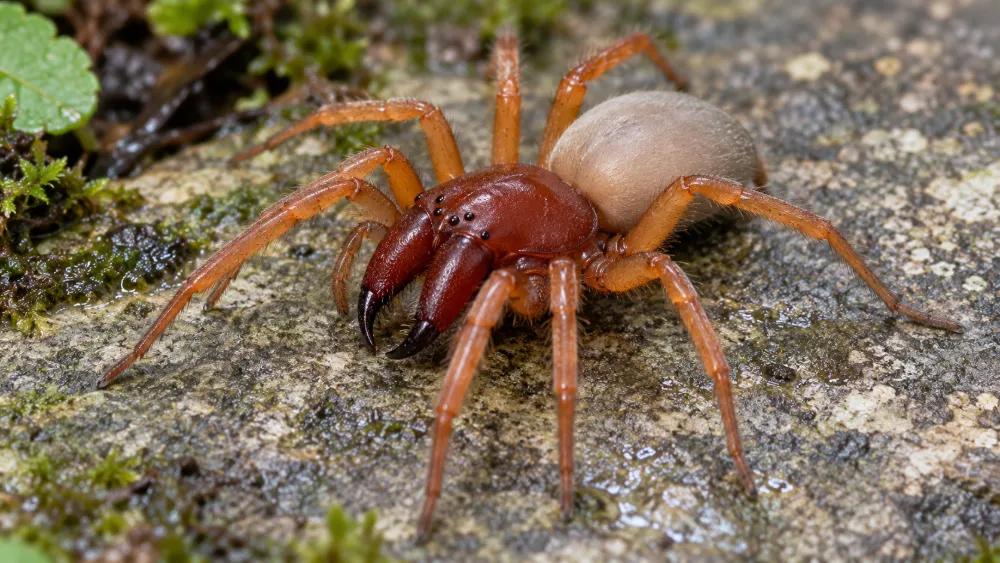
If you find a spider with a dark red head, orange-red legs, a pale gray abdomen and surprisingly large fangs, you may have found a woodlouse spider.
The woodlouse spider (Dysdera crocata) is a nocturnal hunting spider best known for preying on woodlice, also called sowbugs, pillbugs or roly-polies.
Its appearance can seem intimidating, especially because the jaws project dramatically in front of the head. However, despite those large fangs, verified bites have generally caused only short-lived local pain rather than serious medical effects.
Woodlouse Spider Facts at a Glance
| Feature | Woodlouse Spider |
|---|---|
| Scientific name | Dysdera crocata |
| Family | Dysderidae |
| Female body length | About 11–15 mm |
| Male body length | About 9–10 mm |
| Eye count | 6 |
| Main prey | Woodlice and other small arthropods |
| Hunting method | Active nocturnal hunter |
| Medical significance | Bites can hurt but are not generally considered medically dangerous |
How to Identify a Woodlouse Spider
The woodlouse spider has one of the more distinctive color combinations among spiders commonly found around homes and gardens.
Look for:
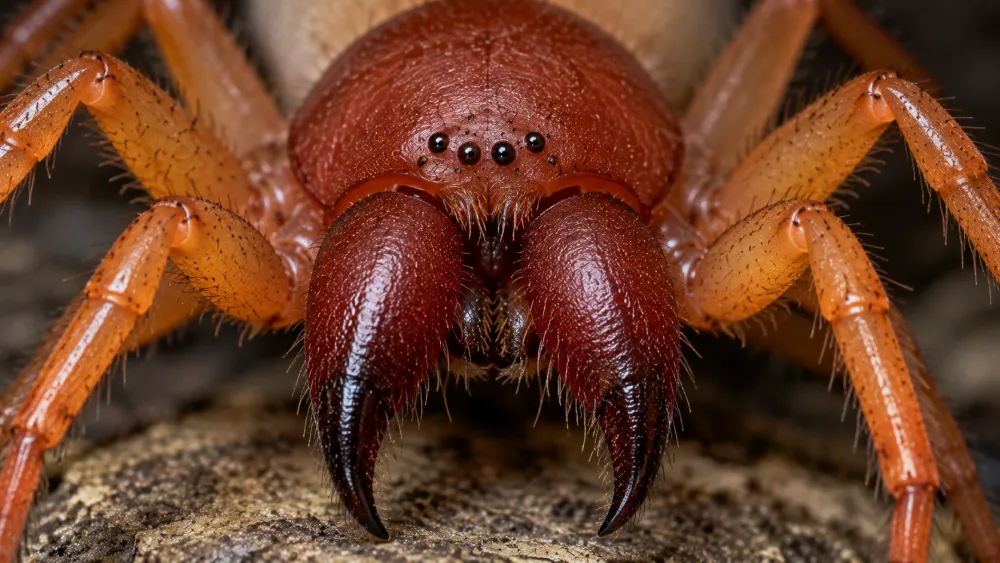
a glossy red to reddish-brown cephalothorax;
orange or red legs;
a smooth pale gray, cream or tan abdomen;
six small eyes;
and unusually large jaws projecting in front of the head.
The abdomen normally has little or no obvious patterning.
This two-tone combination—red front, pale rear—is often the quickest field clue.
How Big Is a Woodlouse Spider?
Woodlouse spiders are much smaller than close-up photographs often make them appear.
Adult females generally have a body length of about 11 to 15 millimeters, while males are usually about 9 to 10 millimeters.
The legs make the entire animal appear larger, but this is still a relatively small spider.
What makes it look formidable is not enormous body size—it is the disproportionately prominent mouthparts.
Why Does the Woodlouse Spider Have Such Large Fangs?
The answer is hidden in its name.
Woodlice are crustaceans with relatively hard, segmented exoskeletons.
That armor presents a challenge to a small predator.
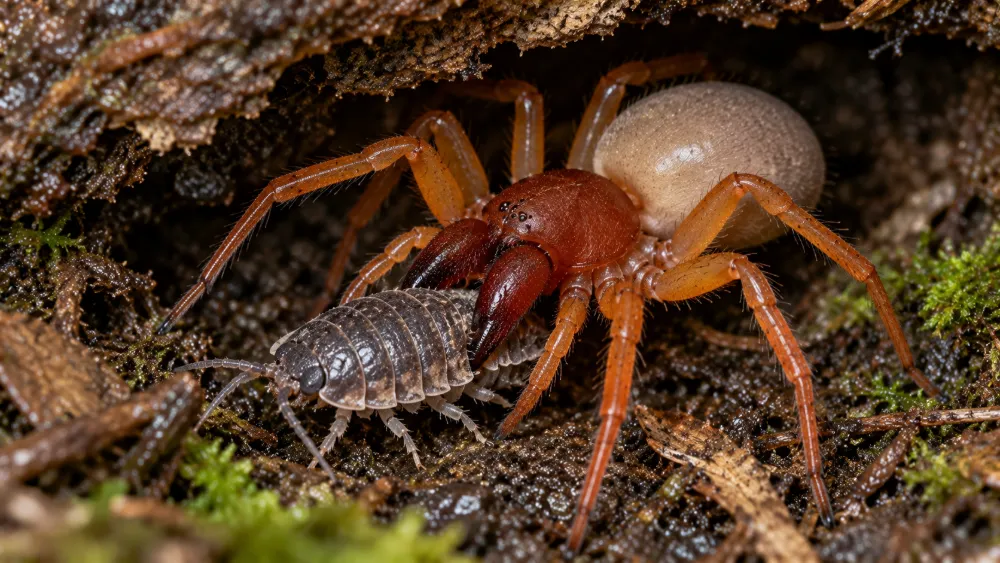
The woodlouse spider has large, strong chelicerae that project forward and allow it to grip and penetrate this tough prey.
These jaws are one of the most obvious examples of an animal's anatomy reflecting its feeding specialization.
The spider's fangs are therefore not oversized because it evolved to attack people. They are primarily tools for hunting hard-bodied invertebrates.
What Do Woodlouse Spiders Eat?
As their common name suggests, woodlice are their best-known prey.
These include animals commonly called:
woodlice;
sowbugs;
pillbugs;
roly-polies;
and slaters.
Woodlouse spiders can also take other small arthropods, so their diet is not necessarily limited to a single prey type.
However, their strong association with isopods is so distinctive that several of their common names refer directly to these prey animals.
Does a Woodlouse Spider Build a Web?
Not for catching prey.
The woodlouse spider is an active hunter.
It leaves its shelter after dark and searches on foot for prey.
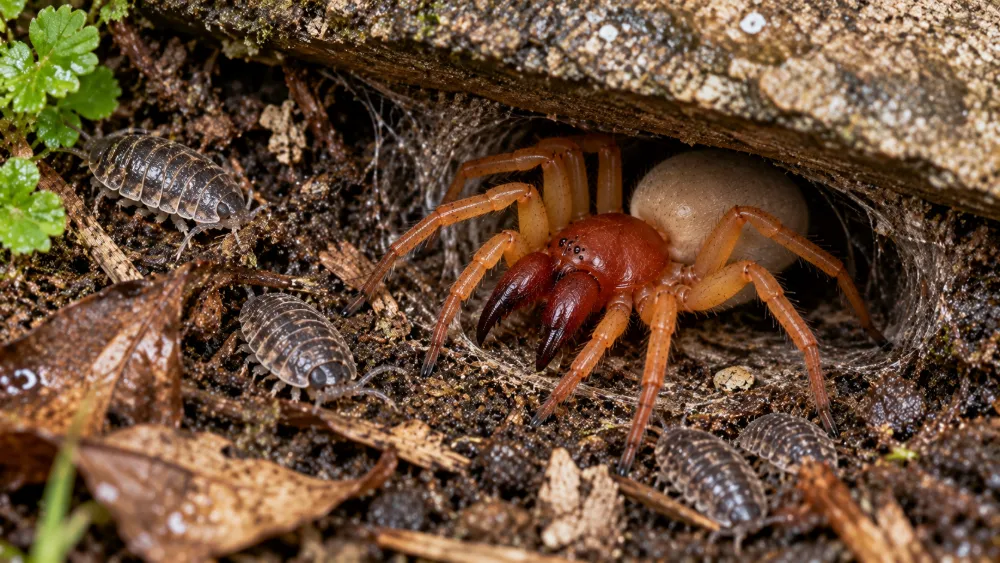
During the day, it usually hides in a small silken retreat beneath a protected object.
That means you may find silk around its hiding place even though it does not build the familiar sticky prey-catching web associated with orb weavers or house spiders.
Where Do Woodlouse Spiders Live?
They prefer sheltered places with relatively high moisture—exactly the conditions favored by woodlice.
Common hiding places include:
under rocks;
beneath logs;
under bark;
inside wood piles;
beneath garden pots;
under bricks or paving stones;
in mulch and leaf litter;
and occasionally in damp basements or other parts of buildings.
If your garden contains many woodlice, it may also provide food and shelter for their predators.
Where Are Woodlouse Spiders Found?
Dysdera crocata originated in the Old World, with strong associations with the Mediterranean and surrounding regions.
Human activity has introduced it to many other parts of the world.
Today it occurs in places including:
Europe;
North America;
South America;
South Africa;
Australia;
New Zealand;
and other introduced regions.
In North America it is widely established and frequently encountered around human-modified habitats.
Do Woodlouse Spiders Bite Humans?
Yes, they are physically capable of biting.
Their large fangs can penetrate human skin, particularly if a spider is trapped, squeezed or handled.
However, documented bites suggest that the effects are generally mild.
A scientific study of verified woodlouse spider bites found that the main symptom was local pain, typically lasting less than an hour.
The researchers suggested that much of the discomfort may come from the mechanical puncture caused by the spider's large fangs.
Is a Woodlouse Spider Bite Dangerous?
Woodlouse spiders are not generally considered a significant medical hazard.
Verified bites have most often produced symptoms such as:
brief pain;
minor local redness;
and sometimes itching.
That is very different from the serious tissue injury often associated in the public imagination with medically important recluse spiders.
As with any bite or sting, unusual or worsening symptoms should be medically evaluated, especially if there is severe swelling, breathing difficulty, signs of infection or uncertainty about the animal involved.
Is the Woodlouse Spider Venomous?
The spider uses venom as part of subduing prey, as many hunting spiders do.
But “venomous” does not automatically mean “dangerous to humans.”
In the case of Dysdera crocata, the available verified bite evidence does not show the kind of medically important toxicity associated with spiders such as widows or true recluse spiders.
Woodlouse Spider vs. Brown Recluse
Woodlouse spiders are sometimes mistaken for brown recluse spiders because both have six eyes and relatively plain bodies.
However, several visual differences are useful.
| Feature | Woodlouse Spider | Brown Recluse |
|---|---|---|
| Front body | Glossy reddish-brown | Tan to brown |
| Legs | Usually red-orange | Usually tan-brown |
| Abdomen | Pale cream, gray or tan | More uniformly brown |
| Fangs / jaws | Very large and project forward | Not similarly conspicuous |
| Eyes | 6, tightly grouped near front | 6 arranged in three separated pairs |
| Violin marking | Absent | May be visible on cephalothorax |
Eye arrangement is easiest to evaluate with a close photograph or magnification, so color and overall anatomy may be more practical clues for a casual observer.
Why Is It Sometimes Called a Sowbug Killer?
Woodlice have many regional names.
In Britain they are usually called woodlice, while North American English commonly uses names such as sowbug and pillbug.
As a result, Dysdera crocata has accumulated several common names, including:
woodlouse spider;
woodlouse hunter;
sowbug hunter;
sowbug killer;
pillbug hunter;
and slater spider.
These names generally refer to the same predator-prey relationship.
Are Woodlouse Spiders Beneficial?
In gardens, they can be considered part of the normal predatory community.
They hunt woodlice and other small arthropods rather than feeding on plants.
Utah State University Extension classifies them as beneficial and does not consider them a health hazard.
For that reason, finding one outdoors usually does not require any control.
Why Is a Woodlouse Spider in My House?
An individual may wander indoors while searching for shelter or prey.
Damp basements, garages and ground-level rooms can be especially attractive if woodlice are also present.
If woodlouse spiders repeatedly appear indoors, the more useful long-term steps are:
reduce excess moisture;
seal exterior cracks;
move damp wood and debris away from the building;
and reduce conditions that support large numbers of woodlice.
A single spider can simply be captured in a container and released outdoors if desired.
FAQ
What does a woodlouse spider look like?
It typically has a glossy red-brown front body and legs, a pale gray or cream abdomen, six eyes and very large jaws that project forward.
How big is a woodlouse spider?
Adult females are usually around 11–15 mm in body length, while males are about 9–10 mm.
Do woodlouse spiders bite?
Yes. They can bite if trapped or handled, and their large fangs can penetrate human skin.
Is a woodlouse spider bite dangerous?
Verified bites have generally caused local pain lasting less than an hour, sometimes with mild redness or itching. The species is not generally regarded as medically dangerous.
Are woodlouse spiders poisonous?
They use venom to subdue prey, but their venom has not been shown to pose a major health threat to humans in documented bites.
What do woodlouse spiders eat?
They specialize in hunting woodlice, sowbugs and pillbugs, although they may also eat other small arthropods.
Why are their fangs so big?
Their prominent jaws help them grip and pierce the tough exoskeleton of woodlice.
Do woodlouse spiders make webs?
They do not use webs to catch prey. They hunt actively at night but may create a small silken retreat for shelter during the day.
Is a woodlouse spider a brown recluse?
No. They are different spiders. Woodlouse spiders usually have a red-orange front body, pale abdomen and conspicuous large jaws, while brown recluses have different coloration and eye arrangement.
Final Answer
The woodlouse spider (Dysdera crocata) is a small but striking nocturnal predator recognizable by its red-orange front body, pale abdomen, six eyes and enormous forward-projecting jaws.
Those jaws are specialized for hunting woodlice and other hard-bodied prey, not for attacking people.
The spider can bite if handled or trapped, but verified human bites have generally caused only temporary local pain and mild irritation.
So although it may look intimidating, the woodlouse spider is better understood as a specialized garden predator than as a dangerous household spider.
Sources Used for Fact Checking
Penn State Extension — Woodlouse Hunter Spider
Utah State University Extension — Woodlouse Spider
Natural History Museum — Woodlouse Spider
British Arachnological Society — Dysdera crocata
UC Integrated Pest Management — Brown Recluse and Similar Spiders
Vetter & Isbister (2006), Toxicon — Verified Bites by the Woodlouse Spider