Pacu fish are famous online for one strange feature: their teeth can look surprisingly human.
But the teeth are only part of the story. Pacu are large South American freshwater fish related to piranhas, and some species can grow to more than 3 feet long. Instead of being specialized meat-cutters, many pacu use broad crushing teeth to eat fruits, seeds and other foods that fall into tropical rivers and flooded forests.
There is also an important naming detail: “pacu” is not the name of one single species. It is a common name applied to several related South American fishes, especially species in the genera Colossoma and Piaractus.
Pacu Fish Facts at a Glance
| Feature | Pacu |
|---|---|
| What is a pacu? | Common name for several related South American freshwater fishes |
| Family | Serrasalmidae |
| Close relatives | Piranhas and silver dollars |
| Native region | Tropical South America |
| Largest species | Can exceed 1 meter in total length |
| Diet | Omnivorous; often strongly fruit- and seed-based |
| Teeth | Broad, molar-like crushing teeth |
| Temperament | Generally much less aggressive than popular piranha stereotypes suggest |
What Is a Pacu Fish?
Pacu are freshwater fishes from tropical South America and belong to the same broader family as piranhas.
Several different fishes are commonly called pacu. Among the best known are:
Black pacu or tambaqui (Colossoma macropomum)
Red-bellied pacu or pirapitinga (Piaractus brachypomus)
Small-scaled pacu (Piaractus mesopotamicus)
Because the word covers more than one species, statements such as “a pacu grows exactly this large” or “all pacu eat exactly the same food” can be misleading.
Different species live in different South American river systems and differ in adult size, coloration and ecology.
Are Pacu Related to Piranhas?
Yes.
Pacu and piranhas belong to the freshwater fish family Serrasalmidae.
Young pacu can even resemble piranhas closely enough to create identification mistakes.
But their teeth provide an important clue.
Piranhas generally have sharp, serrated, cutting teeth adapted to slicing food. Pacu such as the red-bellied pacu have two rows of broader, molar-like teeth that are much better suited to crushing and processing hard plant material.
If you want to explore their more famous relatives, see our guide to piranhas.
Do Pacu Really Have Human-Like Teeth?
Pacu teeth can look oddly human at first glance, but calling them “human teeth” is obviously an exaggeration.
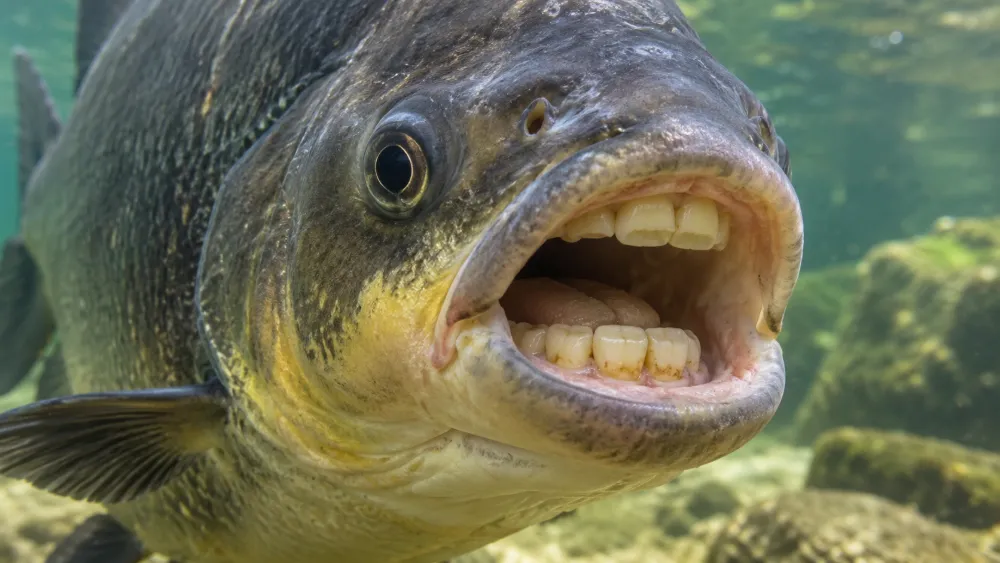
The resemblance comes from their shape.
Instead of triangular razor-like teeth, pacu have broad, blocky molariform teeth. Some are relatively flat and square, which can resemble human incisors or molars when seen from the front.
The functional reason is food processing.
Pacu encounter tough fruits, seeds and other plant material. Crushing these foods requires a very different dental design from the sharp slicing teeth of a predatory piranha.
A 2025 study examining fruit-eating serrasalmid fishes found that the dentition of specialized fruit-eating Colossoma performs in ways suited to puncturing and processing fruit tissues.
How Big Do Pacu Fish Get?
Much bigger than many first-time aquarium buyers expect.
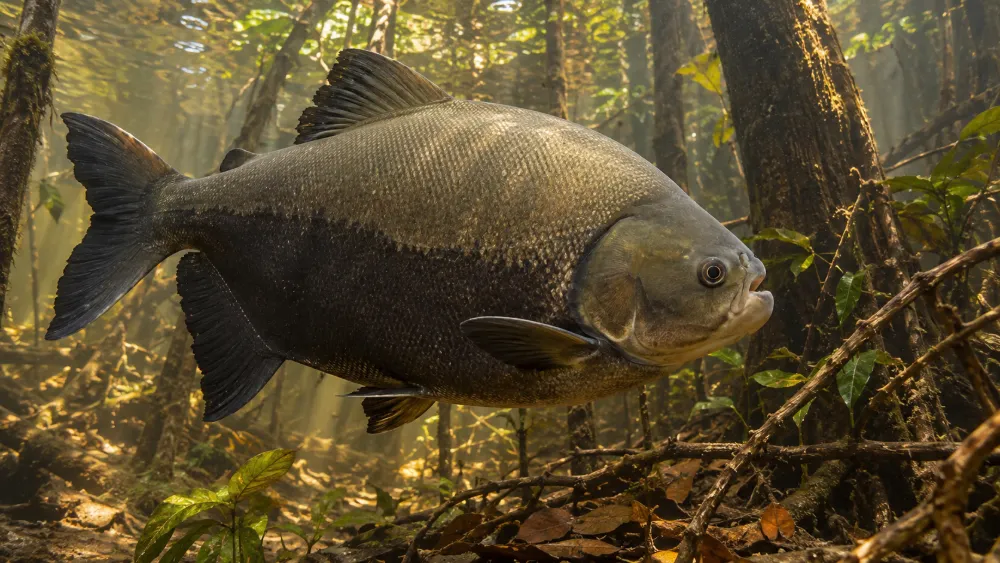
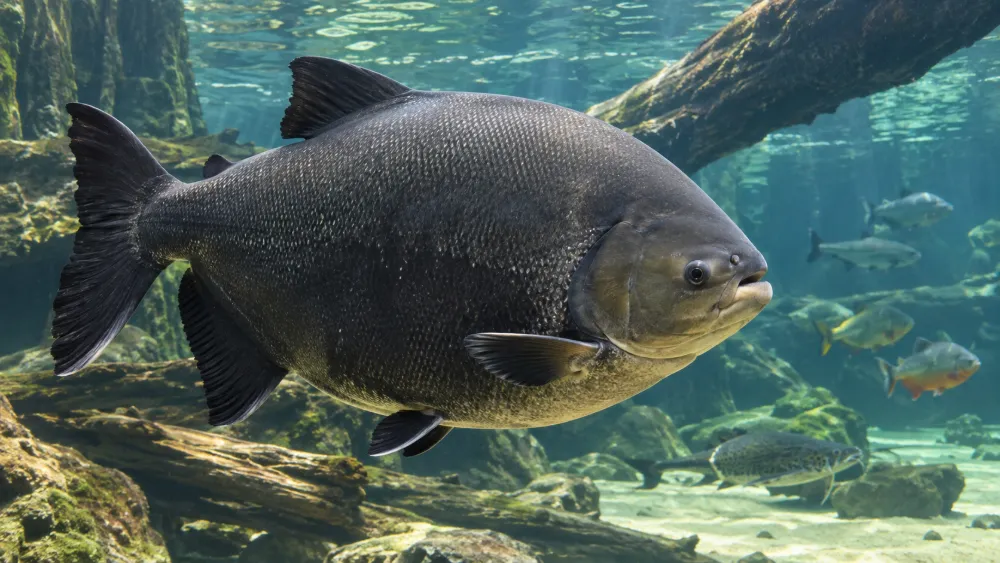
The black pacu, or tambaqui, is one of the largest members of the group.
FishBase records Colossoma macropomum reaching approximately 108 centimeters (42.5 inches) in total length, with a published maximum weight of about 40 kilograms (88 pounds).
Smithsonian's National Zoo gives a more general figure of around 3 feet in length and more than 65 pounds for black pacu.
The red-bellied pacu is also large. U.S. Geological Survey records indicate that Piaractus brachypomus can reach around 85 centimeters in standard length and about 20 kilograms.
So a juvenile pacu sold at only a few inches long should never be assumed to remain a small aquarium fish.
What Do Pacu Eat?
Pacu are generally omnivorous, but plant foods—especially fruits and seeds—can form a major part of the diet of several species.
Depending on species, age, habitat and season, pacu may eat:
fallen fruits;
seeds and grains;
plant material;
decaying vegetation;
zooplankton;
snails and other invertebrates;
crustaceans;
and occasionally smaller fish.
Red-bellied pacu, for example, consume large amounts of fruits and seeds during the wet season but may take more animal food during other parts of the year.
This is why describing pacu simply as “vegetarian piranhas” is catchy but not completely accurate.
Pacu Can Eat Fruit From Flooded Forests
One of the most fascinating parts of pacu biology appears during the annual flooding of South American rivers.
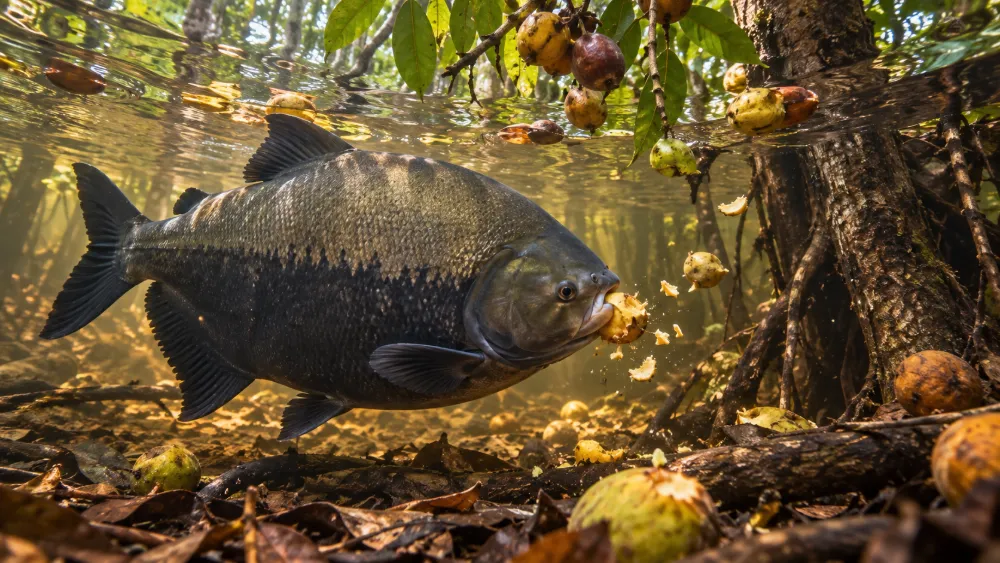
During high-water periods, rivers expand into surrounding forests. Trees that normally stand on dry ground may suddenly have water around their trunks.
Fruits and seeds fall directly into this temporary aquatic habitat.
Large pacu such as tambaqui enter these flooded forests and feed heavily on this seasonal resource.
The connection between fish and trees is surprisingly important.
Pacu Can Help Disperse Seeds
Some fruit-eating fish do more than consume fruit. They can also transport seeds.
Research on tambaqui has shown that viable seeds can survive passage through the fish and be carried significant distances before being released elsewhere.
This makes large fruit-eating fish part of the ecology of Amazonian floodplain forests.
In other words, a fish swimming between flooded trees can perform an ecological role more often associated with fruit-eating birds, monkeys or mammals.
For more animals from the same ecosystem, see 30 Animals of the Amazon.
Where Do Pacu Live?
Pacu are native to tropical South America.
The exact range depends on species.
Black pacu or tambaqui are native to the Amazon and Orinoco river basins.
Red-bellied pacu are native to the Amazon basin, while the small-scaled pacu is associated with the Paraná-Paraguay or La Plata river system farther south.
These fishes use rivers, floodplains, lakes and seasonally flooded forests.
Why Are Pacu Found in the United States?
Occasionally, anglers in the United States catch a strange fish that looks like a piranha but has blunt teeth.
Many of these fish turn out to be pacu.
They are not naturally native to U.S. freshwater systems.
USGS records pacu from numerous states and identifies aquarium release as the likely source of many occurrences.
Most records represent isolated catches rather than proof of permanent breeding populations.
This is one reason aquarium fish should never be released into rivers, lakes or ponds.
Are Pacu Aggressive?
Pacu generally do not behave like the bloodthirsty fish portrayed in sensational stories.
Smithsonian describes black pacu as peaceful and nonaggressive.
They are still powerful large fish, however.
A mature pacu has strong jaws and substantial crushing teeth. Any large animal can injure a person if handled carelessly, so the fact that pacu are usually peaceful does not mean their mouths should be treated like toys.
Do Pacu Attack Humans?
Pacu are not specialized predators of humans.
Stories describing them as routinely attacking people because of their unusual teeth exaggerate their normal behavior and diet.
Their dentition is strongly associated with crushing plant foods such as fruits and seeds, and black pacu are generally regarded as nonaggressive.
Still, a large captured or frightened fish should be handled carefully because its jaws are capable of producing an injury.
Can You Keep a Pacu as a Pet?
Pacu appear in the aquarium trade, but their adult size creates a serious problem.
A fish that looks manageable as a juvenile can eventually become several feet long and extremely heavy.
That means many pacu eventually require facilities closer to a very large custom aquarium, indoor pond or public-aquarium-scale enclosure than an ordinary household fish tank.
The Smithsonian specifically warns that pacu can rapidly outgrow aquariums and that unwanted aquarium fish should never be released into natural waterways.
Before buying any freshwater fish, see our fish care guide.
How Long Do Pacu Live?
Lifespan depends on species and conditions.
Smithsonian lists a lifespan of about 15 years for black pacu.
Other pacu kept in human care have been reported living longer, so one exact lifespan should not be applied to every species and individual.
Black Pacu vs. Red-Bellied Pacu
| Feature | Black Pacu | Red-Bellied Pacu |
|---|---|---|
| Scientific name | Colossoma macropomum | Piaractus brachypomus |
| Other name | Tambaqui | Pirapitinga |
| Native range | Amazon and Orinoco basins | Amazon basin |
| Maximum size | Can exceed 1 meter | Can exceed 80 cm |
| Diet | Fruit, seeds and varied omnivorous foods | Fruit and seeds plus animal foods seasonally |
FAQ
What is a pacu fish?
Pacu is a common name for several related freshwater fish from South America, especially species of Colossoma and Piaractus. They belong to the same family as piranhas.
Do pacu really have human teeth?
Their teeth are not actually human-like in structure, but many are broad, square and molar-like rather than triangular and razor sharp. This creates the famous visual resemblance.
How big can a pacu get?
Size depends on species. Black pacu can exceed 1 meter in total length, and published records list individuals weighing up to about 40 kilograms.
What do pacu fish eat?
They are omnivores. Fruits, seeds and plant material are particularly important for several species, but pacu may also eat insects, snails, zooplankton, crustaceans and other animal foods.
Is a pacu a piranha?
No. Pacu and piranhas are related members of the family Serrasalmidae, but they are different fishes with important differences in dentition, ecology and feeding behavior.
Are pacu dangerous?
They are not generally aggressive human predators. Black pacu are described as peaceful fish, but large individuals have powerful jaws and should still be handled carefully.
Can pacu live in an aquarium?
Juveniles are sold in the aquarium trade, but large pacu species can grow to several feet long. Their eventual space requirements make them unsuitable for most ordinary home aquariums.
Why are pacu caught in U.S. lakes?
Many nonnative U.S. records are believed to result from aquarium releases. A captured pacu does not automatically mean a reproducing population has become established.
Final Thoughts
Pacu are much more interesting than the internet nickname “fish with human teeth” suggests.
They are large relatives of piranhas whose broad crushing teeth are closely connected to a diet that can include fruits, seeds and other tough foods.
Some species move through flooded South American forests during seasonal high water, eating fruit that falls from trees and even helping transport seeds through the ecosystem.
They can also become enormous. A black pacu may exceed a meter in length, which explains why buying a tiny juvenile without understanding its adult size can create serious problems later.
The best way to understand a pacu is therefore not as a strange piranha imitation, but as a highly specialized group of South American freshwater fishes with their own remarkable ecology.
Sources Used for Fact Checking
Smithsonian's National Zoo and Conservation Biology Institute — Black Pacu
U.S. Geological Survey Nonindigenous Aquatic Species — Tambaqui and Pacu Species Profiles
FishBase — Colossoma macropomum
Animal Diversity Web — Piaractus brachypomus
Proceedings of the Royal Society / PubMed — Amazonian frugivorous fish seed dispersal research
Journal of the Royal Society Interface — Frugivorous fish dentition research
```