Quick answer
Animals leaving Yellowstone is usually not a sign of disaster. In most cases, it refers to normal wildlife movement, seasonal migration, or animals crossing park boundaries as part of their natural life cycle. Yellowstone is not a fenced zoo; it is part of a much larger ecosystem that stretches across parts of Wyoming, Montana, and Idaho.
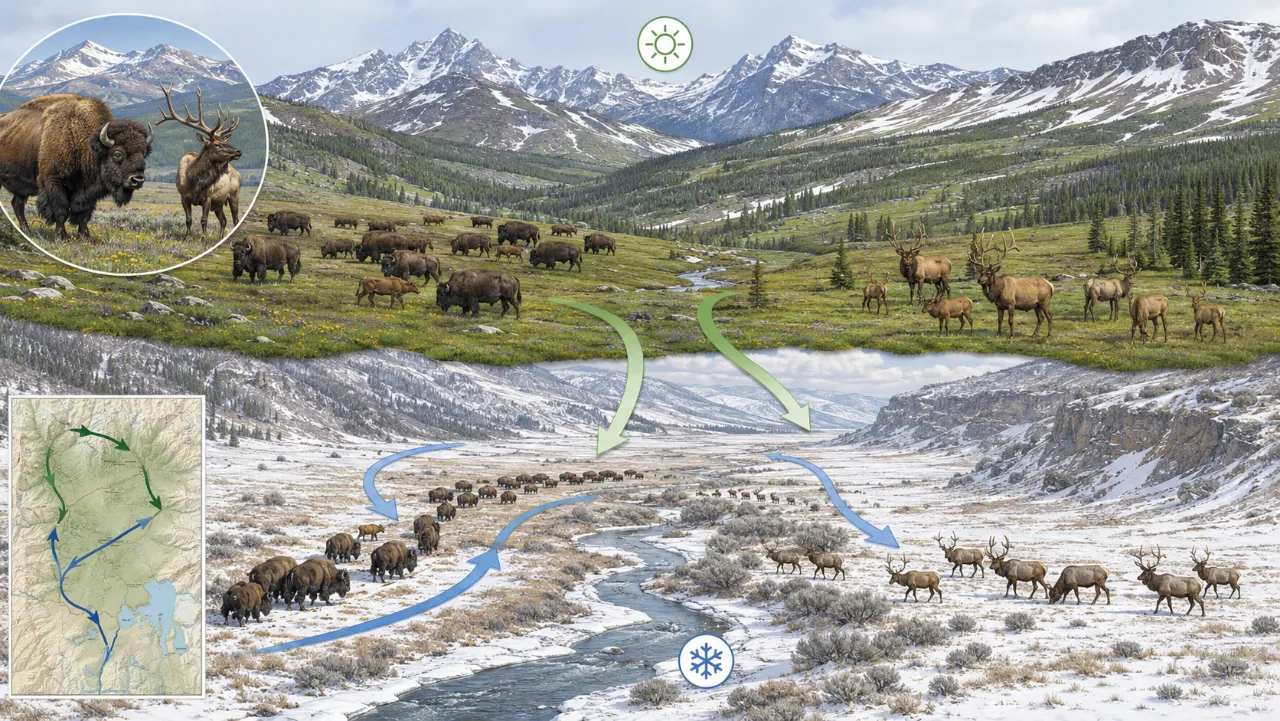
Large mammals such as bison, elk, mule deer, pronghorn, and bighorn sheep may move between summer and winter ranges. Carnivores such as wolves, bears, cougars, and coyotes may also travel widely as they search for food, mates, territory, or safe denning areas. These movements are expected in a healthy landscape.
Viral claims that animals are leaving Yellowstone because they sense an eruption, earthquake, or hidden danger should be treated carefully. Wild animals can respond to weather, snowpack, forage, predators, people, and habitat changes, but there is no good evidence that mass animal movement from Yellowstone is a reliable warning sign of a volcanic eruption.
Summary table
| Question | Scientific Explanation |
|---|---|
| Are animals really leaving Yellowstone? | Some animals naturally move across park boundaries, but there is no verified mass exodus. |
| Why do bison leave parts of the park? | They often move to lower elevations or different grazing areas as snow, food, and season change. |
| Why do elk migrate? | Elk generally follow seasonal food availability, snow depth, breeding needs, and safer habitat. |
| Do bears leave Yellowstone before eruptions? | No reliable evidence shows that bears leaving an area predicts a Yellowstone eruption. |
| Do wolves leave Yellowstone? | Wolves can travel widely, especially when dispersing, hunting, or establishing territory. |
| Is animal movement normal? | Yes. Seasonal movement is part of how many Yellowstone animals survive. |
| What causes misleading videos? | Old footage, unrelated locations, normal running behavior, edited clips, and viral exaggeration. |
| What should visitors do? | Watch wildlife from a safe distance and avoid disturbing animals during movement or feeding. |
Why the “animals leaving Yellowstone” story became popular
The phrase “animals leaving Yellowstone” often appears when videos of running bison, walking bears, or moving elk spread online. These clips can look dramatic when they are shown without context. A bison running down a road, a bear walking near cars, or elk moving in a large group may seem unusual to viewers who do not know Yellowstone wildlife behavior.
In reality, animals in Yellowstone move constantly. Bison run. Elk migrate. Bears travel long distances. Wolves patrol huge territories. A short video rarely shows the full story. The animal may be moving toward better food, escaping human disturbance, following a herd, responding to another animal, or simply traveling through its normal range.
Yellowstone’s volcanic reputation also makes the story more dramatic. Because the park sits above a famous volcanic system, some people quickly connect animal movement with eruption fears. This makes the rumor attractive online, but it does not make it scientifically accurate.
How Yellowstone wildlife migration works
Yellowstone is part of the Greater Yellowstone Ecosystem, one of the most important large wildlife landscapes in North America. Animals do not experience the park boundary the way humans do. A line on a map does not stop an elk, bison, wolf, or bear from moving into suitable habitat outside the park.
Migration usually means a seasonal, repeated movement between different ranges. Many ungulates move to higher elevations in spring and summer when fresh plants become available. In autumn and winter, they may move to lower elevations where snow is shallower and food is easier to reach.
Not every animal migrates in the same way. Some individuals travel long distances, while others remain closer to one area. Migration can vary by age, sex, weather, snowpack, food availability, predators, and learned routes passed through generations.
How bison move through Yellowstone
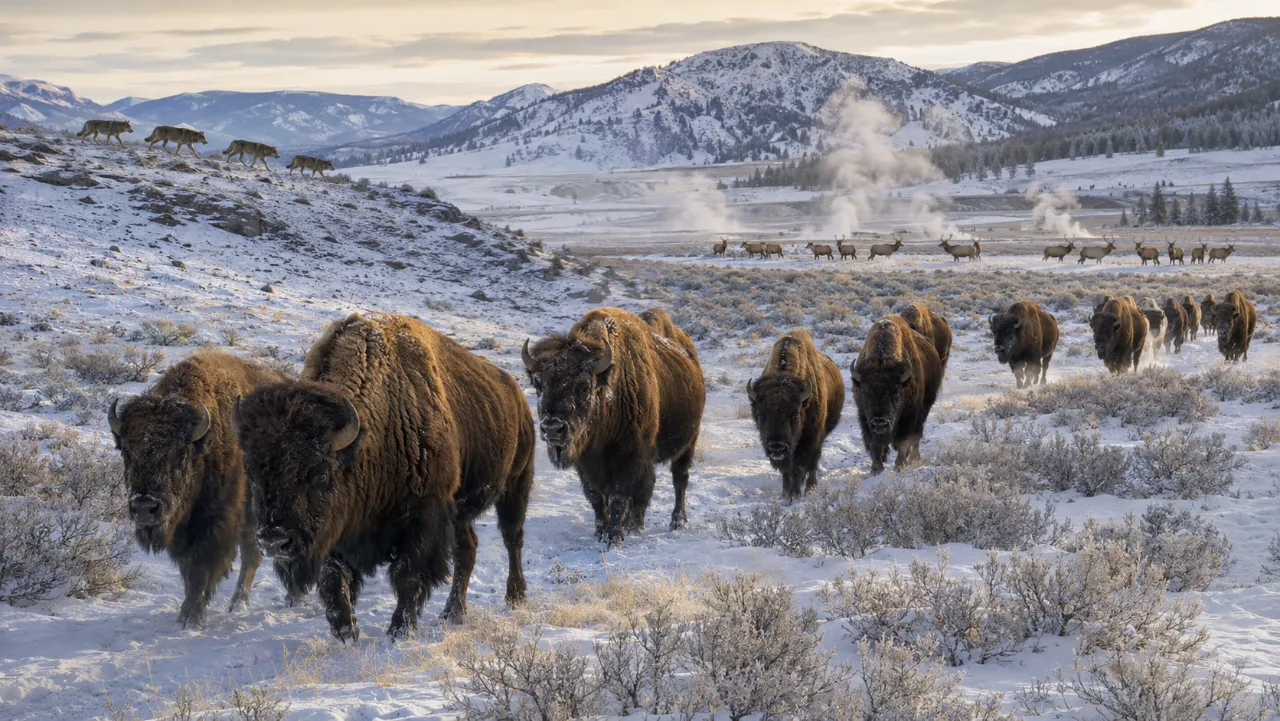
Bison are among the most visible animals in Yellowstone, so their movements often attract attention. A group of bison walking along a road or leaving one valley can easily be misunderstood as a dramatic escape. In many cases, it is simply seasonal movement.
Yellowstone bison generally feed on grasses, sedges, and other grass-like plants. During winter, snow can cover forage and make feeding more difficult. Bison may move toward lower elevations, geothermal areas, river valleys, or places where wind and terrain expose more vegetation.
Bison are also powerful herd animals. They may run because of social excitement, breeding behavior, disturbance, or movement between feeding areas. A running bison herd does not automatically mean danger from a volcano. It may be normal herd behavior seen out of context.
How elk migrate in and around Yellowstone
Elk are one of Yellowstone’s best-known migratory mammals. Many elk move seasonally between winter ranges and summer ranges. In spring, fresh plant growth often appears first at lower elevations and then gradually moves upward as snow melts. Elk may follow this changing “green wave” of nutritious vegetation.
In autumn, elk often return toward lower elevations as snow deepens and temperatures drop. These movements help them find food, avoid harsh conditions, and reach important seasonal habitats. Some elk may cross park boundaries during these migrations.
When people see elk leaving a particular area, it does not usually mean Yellowstone is becoming unsafe. It often means the animals are responding to food, snow, breeding season, or long-established migration routes.
How bears, wolves, and other predators move
Predators in Yellowstone also move widely, but their movements are usually different from ungulate migrations. Wolves travel through territories while hunting, patrolling boundaries, raising pups, and interacting with neighboring packs. Young wolves may disperse far from their birth pack to find mates or open territory.
Bears move according to food availability, season, reproduction, and denning needs. Grizzly bears and black bears may shift between areas as they feed on roots, berries, insects, carcasses, fish, ungulate calves, and other seasonal foods. Before winter, they often increase feeding to build fat reserves for hibernation.
Cougars, coyotes, foxes, badgers, and other carnivores also adjust their movements based on prey, shelter, competition, and human disturbance. These movements are normal parts of predator ecology, not signs that Yellowstone wildlife is abandoning the park.
Which animals are most likely to leave park boundaries
The animals most likely to cross Yellowstone’s boundaries are usually wide-ranging species. Elk, bison, pronghorn, mule deer, wolves, bears, and cougars can all move beyond the park during parts of the year. This is one reason Yellowstone wildlife management often involves agencies, landowners, tribes, and communities outside the park.
Smaller animals may also move, but their movements are less visible to people. Birds migrate in and out of the region seasonally. Amphibians may move between breeding ponds and nearby uplands. Small mammals may shift locally based on food, shelter, and snow conditions.
When large animals cross roads or gather near park entrances, visitors may notice them more. This visibility can make normal movement seem unusual, especially if a video shows only one dramatic moment.
Do all Yellowstone animals move for the same reason
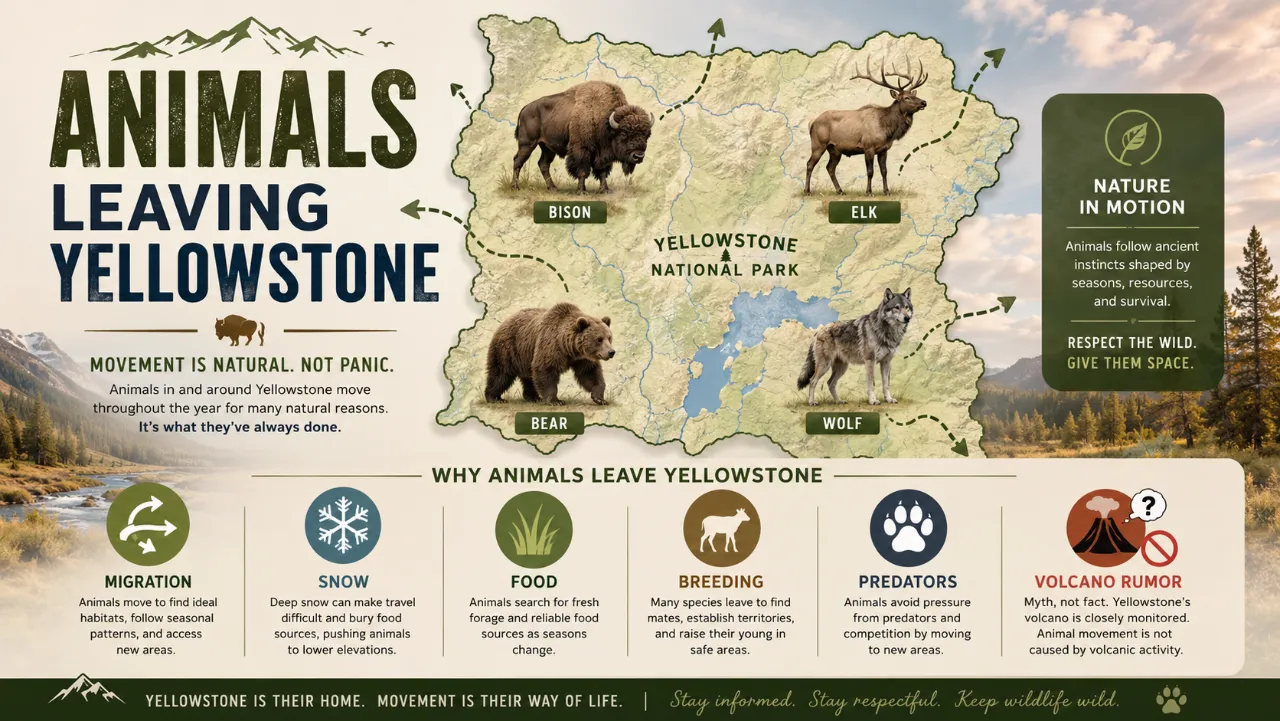
No. Yellowstone wildlife movement is not controlled by one single cause. Different animals move for different reasons, and even individuals of the same species may behave differently. One elk may migrate far, while another stays relatively close to the same valley. One bison herd may move toward lower winter range, while another uses a different route.
Weather is one major factor. Deep snow, hard ice crusts, drought, early spring warmth, or late storms can all influence where animals go. Food is another major factor. Animals often move toward the best available forage, prey, or feeding conditions.
Predation, breeding, human activity, disease risk, wildfire, and habitat change can also shape movement. Because many factors overlap, it is usually too simple to say that animals are leaving Yellowstone for one dramatic reason.
Why these movements help animals survive
Migration and seasonal movement help animals match their needs to a changing environment. Yellowstone has long winters, variable snowpack, high elevations, geothermal areas, open valleys, forests, rivers, and grasslands. No single place is ideal for every animal all year.
Moving allows herbivores to reach fresh plants, avoid deep snow, and find safer calving areas. It allows predators to follow prey, avoid competition, and establish territories. It allows scavengers to find carcasses and birds to use seasonal nesting or feeding areas.
In this sense, animals leaving one part of Yellowstone may actually be a sign of ecological function. Movement connects habitats, spreads grazing pressure, feeds predators, and helps maintain the natural rhythm of the ecosystem.
Volcano rumors and animal behavior
The idea that animals can predict disasters is popular, but it is often exaggerated. Some animals may detect subtle vibrations, smells, sounds, or environmental changes that humans miss. However, that does not mean a video of wildlife movement is proof of an earthquake or volcanic eruption.
Yellowstone’s volcanic system is closely monitored by scientists using instruments that measure earthquakes, ground deformation, gas emissions, temperature changes, and hydrothermal activity. These measurements are far more reliable than viral animal videos.
If animals were truly leaving Yellowstone in an unusual mass movement, wildlife biologists, park staff, and visitors would likely notice broad patterns across many species and areas. A few clips of moving animals do not provide that kind of evidence.
Common myths about animals leaving Yellowstone
One common myth is that bison running on a road means they are escaping an eruption. Bison can run for many ordinary reasons, including social behavior, disturbance, breeding activity, or movement between feeding areas.
Another myth is that bears walking near cars means they are fleeing the park. Bears naturally travel through large areas, especially when searching for food. A bear on a road or near vehicles may be moving through its normal habitat, not escaping a hidden threat.
A third myth is that all animals would leave before a major natural disaster. Wildlife behavior is complex, and different species respond differently to stress. There is no dependable rule that all animals flee before earthquakes, eruptions, storms, or other events.
How visitors should interpret wildlife movement
Visitors should treat Yellowstone wildlife movement as normal unless official sources say otherwise. Seeing animals on roads, near boundaries, or moving in groups can be exciting, but it should not automatically be interpreted as an emergency.
The best response is to observe calmly and safely. Animals in Yellowstone are wild and can be dangerous if approached. Bison, elk, bears, wolves, and other large animals need space. If an animal changes direction, stops feeding, looks stressed, or moves away because of people, the people are too close.
Wildlife movement can be one of the most impressive parts of visiting Yellowstone. Watching elk migrate, bison graze through snow, or wolves travel across a valley shows the ecosystem working as it should.
Final takeaway
Animals are not generally leaving Yellowstone in a mysterious mass escape. What people often call “animals leaving Yellowstone” is usually normal migration, seasonal movement, boundary crossing, or behavior shown without enough context.
Bison, elk, bears, wolves, pronghorn, deer, and other species move because landscapes change through the year. Snow depth, plant growth, breeding, food availability, predators, and habitat conditions all influence where animals go. These movements are part of a healthy Greater Yellowstone Ecosystem.
Viral claims about animals fleeing Yellowstone because of an eruption should be treated with skepticism. Wildlife movement is fascinating, but it is not a substitute for scientific monitoring. The real story is not panic; it is migration, adaptation, and the natural rhythm of one of North America’s greatest wildlife landscapes.
FAQs
Are animals really fleeing Yellowstone?
No verified evidence shows that animals are fleeing Yellowstone in a mass exodus. Some animals naturally move across park boundaries during migration or seasonal travel, but that is normal wildlife behavior.
Do animals leaving Yellowstone mean the volcano will erupt?
No. Animal movement is not a reliable warning sign of a Yellowstone eruption. Scientists monitor Yellowstone using earthquakes, ground movement, gas emissions, and hydrothermal changes, which are much more dependable than viral wildlife videos.
Why do bison and elk leave parts of Yellowstone?
Bison and elk often move because of snow depth, food availability, plant growth, breeding cycles, and seasonal habitat needs. Leaving one area of the park does not mean they are abandoning Yellowstone; it usually means they are following natural movement patterns.