Do squirrels remember where they bury nuts? Yes. Scientific experiments show that squirrels can remember the locations of food they have hidden, sometimes days or weeks after burying it. Their ability to recover nuts is not based entirely on luck or smell.
Eastern gray squirrels, for example, have been shown to retrieve significantly more nuts from their own hiding places than from locations used by other squirrels, even after delays of up to 12 days.
But squirrels are not perfect at finding everything they bury. Some caches are stolen, some are never recovered, and others may eventually produce new trees.
Quick answer: Squirrels use spatial memory, environmental landmarks and sometimes their sense of smell to locate stored food. Research also suggests that some species organize their hidden nuts in surprisingly sophisticated ways.
Why Do Squirrels Bury Nuts?
Squirrels bury nuts to store food for times when natural resources become harder to find.
In temperate regions of North America and Europe, autumn is an important season for collecting acorns, hazelnuts, walnuts and other energy-rich foods.
Many trees produce large numbers of seeds during a relatively short period. Squirrels take advantage of this temporary abundance by eating some food immediately and storing the rest.
The behavior is called food caching.
When an animal hides food in many different locations rather than concentrating it all in one place, scientists call the strategy scatter hoarding.
Scatter hoarding offers several possible advantages:
Food can remain available when fresh supplies are scarce.
Separating caches reduces the risk of losing an entire food supply at once.
Hidden nuts may be less visible to competitors.
Different storage locations provide opportunities to recover food throughout winter.
However, hiding food in many locations creates a problem: the squirrel must find those places again.
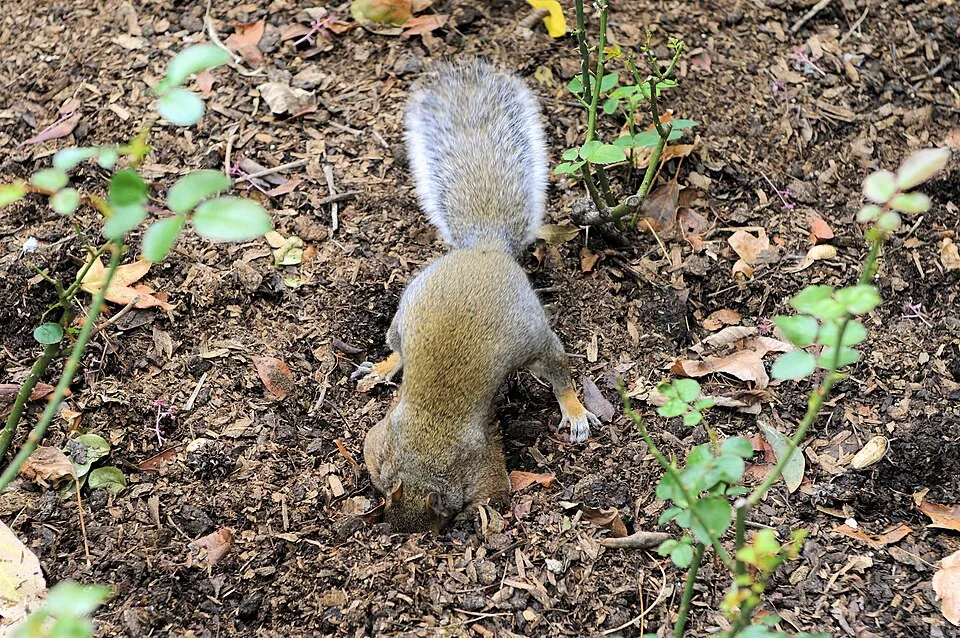
Eastern gray squirrel (Sciurus carolinensis) digging near St Paul's Cathedral, London. Photo: Son of Groucho / Wikimedia Commons, CC BY 2.0. The photograph shows digging behavior; the presence of a buried nut is not independently confirmed.
How Do Squirrels Remember Where They Buried Nuts?
One important mechanism is spatial memory: the ability to remember where something is located in an environment.
Spatial memory allows an animal to navigate between familiar places, locate shelter and return to previously discovered food sources.
For a squirrel that has hidden nuts across a forest or garden, remembering locations can make food recovery more efficient.
Scientists have tested this ability by allowing squirrels to bury food and later observing where they search.
If squirrels were relying only on chance or the smell of any buried nut, they would not necessarily return more often to their own caches.
However, experiments show that they can distinguish their own hiding locations from those used by other squirrels.
The 1991 Experiment: Can Gray Squirrels Find Their Own Nuts?
In a study published in Animal Behaviour in 1991, researchers Lucia Jacobs and Emily Liman tested the memory of eastern gray squirrels.
The researchers allowed captive squirrels to hide hazelnuts in an outdoor experimental area.
Each squirrel buried ten hazelnuts. The scientists later tested retrieval after delays of two, four or twelve days.
Importantly, the experimental area also contained cache sites made by other squirrels.
This helped researchers investigate whether the animals were simply detecting buried food or remembering where they had personally hidden it.
The squirrels recovered significantly more nuts from their own cache locations than from sites used by other squirrels.
That difference remained evident across the tested delays.
The result demonstrated that gray squirrels can use remembered spatial information to recover buried food.
It did not establish that a squirrel remembers every cache indefinitely or that smell plays no role.
Instead, it showed that memory contributes to recovery alongside other possible cues.
Original research: Jacobs and Liman (1991), Grey Squirrels Remember the Locations of Buried Nuts.
Do Squirrels Use Smell to Find Buried Nuts?
Yes. Smell can help squirrels detect food, particularly when a nut is hidden beneath soil, leaves or other loose material.
But smell and memory are not competing explanations that require only one correct answer.
A squirrel may remember the approximate location of a cache, travel toward it using familiar features of the environment and then use local sensory information to locate the nut.
The relative importance of these cues depends on conditions.
For example, soil moisture, snow cover, the depth of a buried nut and the availability of recognizable landmarks may affect how useful different cues are.
Research on scatter-hoarding rodents indicates that spatial information can guide searching even when smell is available.
Memory vs. Smell: What Does Each Contribute?
| Mechanism | What It Helps With | Limitations |
|---|---|---|
| Spatial memory | Returning to a previously visited hiding location | Memory may become less reliable or environmental conditions may change |
| Environmental landmarks | Orienting relative to trees, paths and other surrounding features | Some landmarks may be hidden or altered |
| Smell | Detecting food within a relatively local area | Odor signals vary with soil and weather conditions |
| Exploratory searching | Finding food in places that were not personally cached | Searching consumes time and energy |
The most accurate explanation is that squirrels can combine multiple sources of information.
Do Squirrels Organize Their Hidden Nuts?
Research suggests that some squirrels do more than remember isolated locations.
They may also organize caches in patterns related to the types of food they collect.
A 2017 study by researchers Mikel Delgado and Lucia Jacobs examined the caching behavior of 45 wild eastern fox squirrels (Sciurus niger) on the University of California, Berkeley campus.
The animals were presented with sequences of four nut types:
Almonds
Hazelnuts
Pecans
Walnuts
Researchers tracked the locations where squirrels buried the nuts.
Some squirrels received food repeatedly at one central location. Others obtained successive nuts from different locations.
When squirrels collected food from a single central source, they tended to separate their caches by nut species.
This pattern resembled a cognitive strategy known as chunking.
Chunking involves grouping related information into smaller categories, potentially making complex information easier to manage.
However, the squirrels did not show the same nut-type grouping pattern when food was collected from multiple locations.
That distinction is essential. The study showed context-dependent organization, not a universal rule that every squirrel sorts every nut into separate storage areas.
Original research: Delgado and Jacobs (2017), Caching for Where and What.
Do Squirrels Forget Where They Bury Their Nuts?
Yes, some buried food is never recovered by the squirrel that stored it.
However, a missing nut does not necessarily mean the squirrel forgot its location.
There are several possible explanations:
The squirrel may forget or fail to recognize the location.
Another squirrel or animal may steal the nut.
The original owner may die before returning.
The nut may decay or become unsuitable as food.
The squirrel may have enough food elsewhere and never need that cache.
Changes in the environment may make retrieval more difficult.
This matters because popular claims often suggest that squirrels forget a fixed percentage of their hidden nuts.
In reality, recovery rates vary among studies, species, environments and food types.
It is not scientifically accurate to say that all squirrels forget a particular percentage of their caches.
What researchers can say is that some nuts remain unrecovered, and this can have important ecological consequences.
Why Do Squirrels Sometimes Pretend to Bury Nuts?
Squirrels face another problem besides remembering their caches: food theft.
A buried nut can be discovered by another squirrel, a bird or a different animal searching for food.
To reduce this risk, some squirrels have been observed performing behavior that resembles burying a nut without actually leaving it in the ground.
This is sometimes described as deceptive caching or fake caching.
The apparent purpose is to make an observer investigate an empty location rather than the real cache.
The Woodland Trust reports that gray squirrels have been observed appearing to bury nuts to mislead other squirrels.
However, scientists should be cautious about assigning human-like intentions to an animal's behavior.
Observing a fake cache does not prove that a squirrel consciously thinks about deception in the same way humans do.
It shows that caching behavior can become more complicated when competitors are nearby.
Do Squirrels Move and Rebury Their Nuts?
Yes. Squirrels may retrieve food from one hiding place and store it somewhere else.
Recaching can change the distribution of food across an animal's territory.
Possible advantages include moving valuable food away from competitors or storing it in locations that appear safer.
Repeated handling and relocation may also influence how recently a squirrel has encountered a particular cache.
However, it would be too simple to claim that squirrels always rebury nuts specifically to refresh their memory.
Caching decisions are shaped by food value, competition, environmental conditions and other factors.
Do Squirrels Choose Which Nuts to Bury?
Squirrels do not necessarily treat every nut as equally valuable.
Different nuts vary in size, energy content, moisture, perishability and ease of handling.
Some foods are worth eating immediately. Others may provide greater value if stored for later.
Research published in 2014 on fox squirrels found that the animals changed how they assessed and handled food depending on its value and seasonal availability.
The researchers observed behaviors such as manipulating nuts with the paws and making head movements while evaluating food.
These observations suggest that squirrels adjust their caching effort rather than simply burying every food item in the same way.
Different species and food supplies may produce different decisions.
Research: Fox Squirrels Match Food Assessment and Cache Effort to Value and Scarcity.
Do Squirrels Bury Nuts in Autumn Only?
Autumn is particularly important for food caching in many temperate tree squirrels because trees produce large quantities of nuts and seeds at that time.
However, caching can also occur during other seasons.
The timing depends on the species, available food and local conditions.
For example, eastern gray squirrels and eastern fox squirrels may store food at different times when suitable resources are available.
The behavior is not controlled by a calendar alone.
Do Squirrels Hibernate After Burying Nuts?
Most familiar tree squirrels do not hibernate through winter.
Eastern gray squirrels and Eurasian red squirrels remain active during the colder months, although they may reduce activity during severe weather.
Stored nuts and other food sources help them survive when fresh resources are less abundant.
Some ground squirrel species, by contrast, enter true hibernation.
It is therefore inaccurate to describe all squirrels as hibernating animals.
| Animal | Typical Winter Strategy |
|---|---|
| Eastern gray squirrel | Remains active and uses stored food |
| Eurasian red squirrel | Remains active, with reduced activity during harsh weather |
| Eastern fox squirrel | Remains active and relies partly on cached food |
| Some ground squirrels | Enter seasonal hibernation, depending on the species |
This difference helps explain why people often see gray squirrels searching through soil or leaf litter during winter.
The Woodland Trust provides useful information about the winter behavior of both gray and red squirrels.
Can Squirrels Find Buried Nuts Under Snow?
They sometimes can.
A squirrel may use remembered locations and surrounding environmental features to approach a previously buried cache.
However, snow and frozen ground can make retrieving food more difficult.
The success of a search depends on how deeply the food was hidden, the condition of the ground, available sensory information and other factors.
It is not accurate to assume that every squirrel can detect any buried nut through thick snow.
In difficult weather, squirrels may also reduce their activity or rely on alternative food sources.
What Happens to Nuts That Squirrels Never Recover?
Some unrecovered nuts may eventually germinate and grow into new plants.
Oak trees are a familiar example.
An acorn contains the developing embryo of an oak. If it is buried in suitable conditions and survives predation, decay and other hazards, it may begin growing into a seedling.
By carrying acorns away from a parent tree and burying them in separate locations, squirrels can contribute to seed dispersal.
This may help new oak trees become established away from the tree that produced the acorn.
However, not every buried acorn becomes a tree. Germination and seedling survival depend on many environmental factors.
Interesting fact: A squirrel can unintentionally help a forest regenerate through a behavior that originally evolved to secure its own food.
Woodland Trust: How Trees Spread Their Seeds.
Can You Watch a Squirrel Burying Nuts?
Yes. Autumn is a particularly good season to observe food-caching behavior in parks, gardens and woodlands where squirrels are commonly found.
If you watch from a comfortable distance, you may notice a squirrel carrying a nut, examining the ground, digging a shallow hole and covering the location with soil or leaves.
Some individuals spend time searching for a suitable place before finally storing an item.
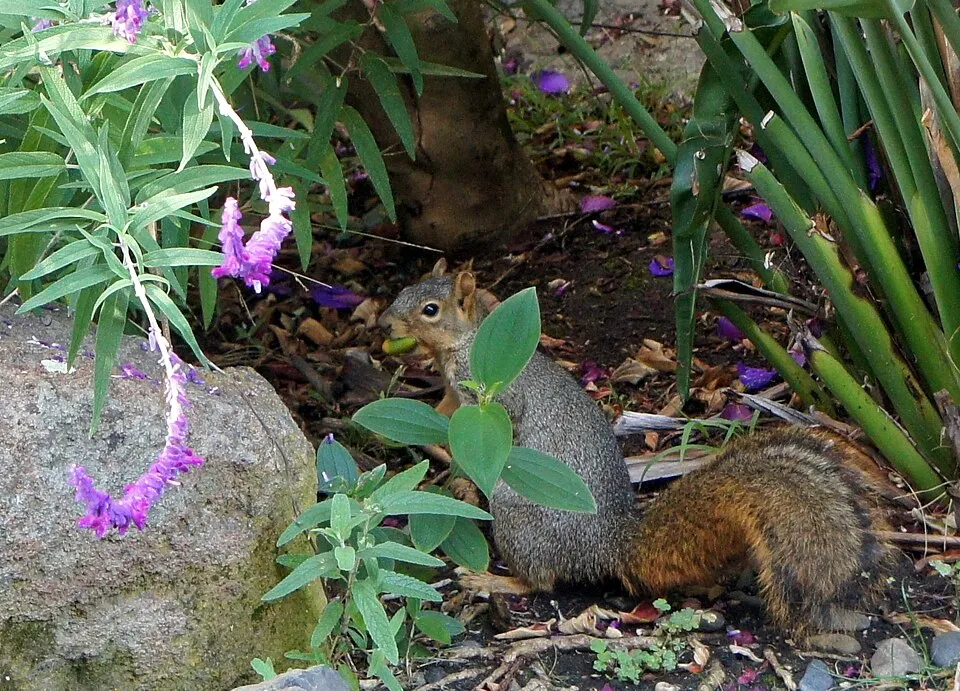
Eastern fox squirrel (Sciurus niger) holding an acorn in Berkeley, California. The photographer observed it investigating several potential hiding places before eventually burying the acorn. Photo: LMorland / Wikimedia Commons, CC BY-SA 4.0.
When observing squirrels, avoid disturbing the animals or digging up their caches.
You can learn a great deal by simply watching where an animal moves, how it handles food and whether it changes behavior when another squirrel approaches.
Are Gray Squirrels Smarter Than Red Squirrels?
There is no simple scientific ranking showing that one of these species is universally smarter than the other.
Eastern gray squirrels and Eurasian red squirrels differ in distribution, habitat use, social behavior and other ecological characteristics.
Both can store food and respond to environmental conditions.
Specific research studies may find differences in particular tasks, but those differences do not establish a single overall intelligence score.
For animal intelligence more broadly, see our comparison of animals with remarkable memory.
Can Other Animals Remember Hidden Food?
Yes. Squirrels are not the only animals that rely on food-caching memory.
Certain birds, including Clark's nutcrackers and several members of the crow family, also remember locations where they have stored food.
Some caching birds have evolved impressive abilities to locate seeds hidden across large areas.
However, different species use different strategies and face different ecological challenges.
Comparing squirrels with birds can help researchers investigate how spatial memory evolves in animals that depend on stored food.
Frequently Asked Questions
Do squirrels remember where they bury nuts?
Yes. Controlled experiments show that eastern gray squirrels can remember their own cache locations. Their ability to recover buried food depends partly on spatial memory.
How long can squirrels remember buried nuts?
One experimental study found reliable evidence of memory after delays of two, four and twelve days. Other studies of food-caching behavior suggest that some squirrels can retain useful location information for longer, but there is no universal maximum that applies to every squirrel.
Do squirrels find nuts by smell or memory?
Both can contribute. Spatial memory helps squirrels return to a stored location, while smell and other sensory cues may help them find food locally.
Do squirrels forget most of the nuts they bury?
Not necessarily. Some nuts are never recovered, but recovery rates vary. Unrecovered food may have been stolen, damaged, abandoned or forgotten. A fixed percentage should not be applied to all squirrels.
Why do squirrels bury nuts instead of eating them?
Burying nuts provides food reserves for periods when fresh food becomes scarce. This is especially useful during winter in temperate regions.
Do squirrels steal other squirrels' nuts?
Yes. Food theft is one reason squirrels may spread their caches across different locations and sometimes appear to perform deceptive caching behavior.
Do squirrels pretend to bury nuts?
Some squirrels have been observed performing fake-caching behavior, apparently leaving potential food thieves with misleading information about the location of stored food.
Do squirrels bury acorns in the same place?
Not always. Many tree squirrels scatter their caches across different locations. Fox squirrels have also shown nut-type grouping under particular experimental conditions.
Do squirrels hibernate during winter?
Most common tree squirrels, including eastern gray squirrels and Eurasian red squirrels, do not hibernate. Some ground squirrel species do hibernate.
Can buried acorns grow into oak trees?
Yes. Acorns that escape being eaten and remain in suitable conditions may germinate. Squirrel caching can therefore contribute to seed dispersal and forest regeneration.
Do squirrels use landmarks to remember their caches?
Research indicates that environmental information contributes to food-cache navigation. Landmarks and spatial relationships can help squirrels return to previously visited locations.
Should I dig up nuts buried by squirrels in my garden?
Generally, it is better to leave wild animals' food stores undisturbed. The cached food may help a squirrel survive during periods of limited food availability.
The Bottom Line
Squirrels really do remember where they bury nuts.
Scientific research demonstrates that spatial memory plays an important role in recovering food. Squirrels can also use sensory information, adjust their storage decisions and sometimes organize caches in ways that may make the information easier to manage.
They do not recover every nut, and that has benefits beyond the squirrels themselves.
Some forgotten or otherwise unrecovered acorns may eventually become new oak trees, helping forests regenerate.
The next time you see a squirrel burying an acorn, you may be watching a surprisingly sophisticated interaction between memory, survival and forest ecology.
Scientific Sources and Further Reading
Jacobs and Liman (1991). Grey Squirrels Remember the Locations of Buried Nuts. Animal Behaviour.
Fox Squirrels Match Food Assessment and Cache Effort to Value and Scarcity (2014).
University of California, Berkeley — Fox Squirrels Use Chunking to Organize Their Favorite Nuts.
Smithsonian Science Education Center — Why Do Squirrels Bury Nuts?
Woodland Trust — Grey Squirrel Facts and Behavior.
Woodland Trust — Seed Dispersal: Five Ways Trees Spread Seeds.
Photo Credits
Eastern Gray Squirrel Digging — Son of Groucho, CC BY 2.0. Original photograph.
Eastern Fox Squirrel with Acorn — LMorland, CC BY-SA 4.0. Original photograph.