Do humpback whales really save seals from orcas? Sometimes, yes. Scientists have documented humpback whales approaching killer whales during hunts, harassing the predators, and occasionally helping seals and other animals escape.
In one remarkable encounter in Antarctica, a humpback whale rolled onto its back and lifted a Weddell seal partly out of the water while killer whales were nearby. The seal eventually reached safety.
But the most interesting question is not whether this behavior happens. It is why humpback whales interfere with predators that are hunting other species.
A major scientific review of 115 humpback-orca encounters offers important clues, although researchers still cannot say whether these whales deliberately intend to rescue other animals.
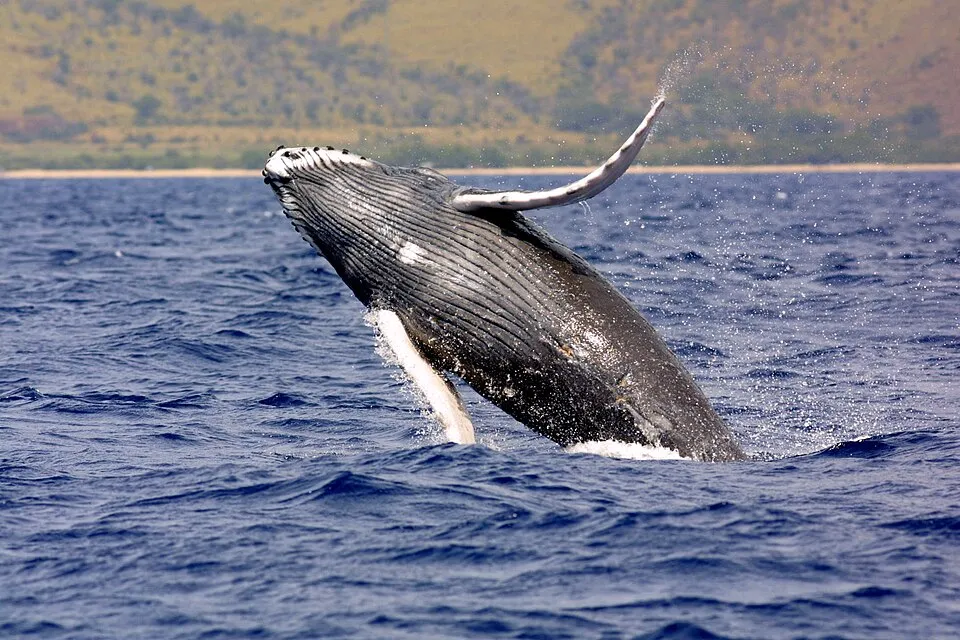
A humpback whale (Megaptera novaeangliae) breaching in the ocean. Photo: NOAA / Wikimedia Commons, Public Domain. This is a species illustration, not a photograph of a rescue event.
Did a Humpback Whale Really Rescue a Seal?
One of the best-known observations occurred in January 2009 near the Antarctic Peninsula.
Researchers Robert Pitman and John Durban were observing killer whales hunting near sea ice. The orcas targeted a Weddell seal that had been resting on an ice floe.
When the seal entered the water, it moved toward a nearby humpback whale.
The humpback rolled onto its back, and the seal ended up on the whale's chest and belly. As the seal began sliding off, the whale appeared to help keep it above the water with its pectoral flipper.
The seal eventually returned to the ice and escaped the immediate attack.
It was an extraordinary encounter because the humpback was not protecting its own calf or another humpback whale.
What we know: The whale's actions helped the seal survive that encounter.
What we do not know: Whether the whale understood that the seal needed protection or was responding to the presence and behavior of the killer whales.
What Did Scientists Find in 115 Whale Encounters?
To investigate these interactions, Robert Pitman and colleagues reviewed 115 recorded encounters between humpback whales and killer whales from different parts of the world.
The study, published in Marine Mammal Science in 2017, examined which animals approached, how the whales behaved, and what prey the killer whales were attacking.
Several results were particularly revealing.
| Research Finding | What It Suggests |
|---|---|
| 115 encounters reviewed | The behavior was not limited to one unusual observation. |
| 93% of killer whale groups approached by humpbacks were mammal-eating types | Humpbacks may respond selectively to predators associated with danger to young whales. |
| 89% of identified prey in relevant attacks were species other than humpbacks | Humpbacks often interfered when the orcas were targeting other animals. |
| Mobbing behavior occurred in at least 55% of 56 assessed interactions with attacking orcas | Humpbacks frequently took active measures against hunting killer whales. |
| Some prey escaped following interference | The behavior can sometimes change the outcome of an attack. |
The percentages apply to particular subsets of the 115 encounters, not to all humpback whales or every killer whale hunt.
These were reports gathered from observations rather than a controlled experiment. Researchers could not determine every animal's intention or reliably measure how often the behavior happens in all oceans.
Read the original scientific paper by Pitman and colleagues.
Why Do Humpback Whales Interfere With Orcas?
Scientists have proposed several possible explanations.
1. Defense Against Predators
Humpback whale calves can be vulnerable to attacks by mammal-eating killer whales.
Adult humpbacks may have evolved strong defensive responses to the sounds and behavior of these predators.
Even when the killer whales are hunting a seal, an adult humpback may respond as though a young humpback is in danger.
From an evolutionary perspective, a defensive response that helps protect calves can be advantageous.
2. Mobbing Behavior
Scientists use the term mobbing when an animal approaches, confronts, or harasses a potential predator.
Many birds mob owls, hawks, and other predators. Some mammals also cooperate to drive threats away.
Humpback whales can display something similar in the ocean.
They may approach orcas, slap the water with their tails, use their very long pectoral fins, or position themselves near an attack.
The purpose may be to disturb the predator rather than to protect a particular prey animal.
3. Responding to Killer Whale Sounds
Killer whales produce social calls that can provide information about their behavior.
The 2017 study proposed that humpbacks might respond to the sounds of mammal-eating killer whales during attacks.
By approaching the source of the sounds, a humpback could interrupt an attack without initially knowing which species was being hunted.
This hypothesis helps explain why humpbacks sometimes interfere when the prey is a seal, sea lion, or another marine animal.
However, researchers have not demonstrated a single universal trigger for all such encounters.
Are Humpback Whales Being Altruistic?
Altruism is a difficult concept to apply to wild animals because scientists must distinguish observable behavior from an animal's underlying motivation.
In biology, altruism generally refers to behavior that benefits another individual while imposing a cost on the animal performing it.
Interfering with hunting orcas may cost humpbacks time and energy. In some observations, whales traveled substantial distances to approach a hunting group.
When the prey belongs to another species, the humpback may receive no immediate obvious benefit.
That creates an intriguing possibility: the behavior could sometimes resemble interspecific altruism, meaning help directed toward another species.
But an unexpected benefit to a seal does not prove that a humpback intended to rescue it.
The safer scientific conclusion is that humpback whales sometimes disrupt killer whale attacks, and those disruptions can benefit other animals.
Which Animals Have Humpback Whales Helped?
The reviewed encounters included attacks on multiple species, not just seals.
| Animal Group | Why It Appears in the Research |
|---|---|
| Seals | Humpbacks sometimes interrupted killer whales hunting different seal species. |
| Sea lions | Some observations involved killer whales attacking or feeding on sea lions. |
| Gray whales | Humpbacks were reported interfering during attacks on young gray whales. |
| Porpoises and other cetaceans | Some encounters involved prey belonging to other whale and dolphin groups. |
| Ocean sunfish | One reported interaction involved killer whales attacking fish. |
Not every intervention was successful.
In several observed attacks on seals and sea lions, the killer whales still captured or killed their prey.
It would therefore be inaccurate to describe humpbacks as consistently protecting every animal they encounter.
How Can Humpback Whales Challenge Killer Whales?
Healthy adult humpback whales are extremely large animals with powerful bodies and long pectoral fins.
Unlike a young calf, a full-grown humpback is generally a difficult target for killer whales to attack successfully.
Its enormous flippers can be used for movement, positioning, and forceful surface displays.
A humpback may also slap its tail or move vigorously near an attacking group.
Such behavior can force killer whales to adjust their movements and may interfere with their ability to control prey.
These interactions can be dangerous and unpredictable, but adult humpbacks have physical advantages that smaller marine mammals do not.
Do All Orcas Hunt Seals and Whales?
No. Different killer whale populations have different diets and learned hunting traditions.
Some populations specialize in fish, including salmon. Others hunt marine mammals such as seals, porpoises, and whales.
The 2017 humpback study found that the killer whale groups approached by humpbacks were overwhelmingly mammal-eating groups.
This distinction matters because the risk posed to humpback calves depends partly on the killer whales' feeding ecology.
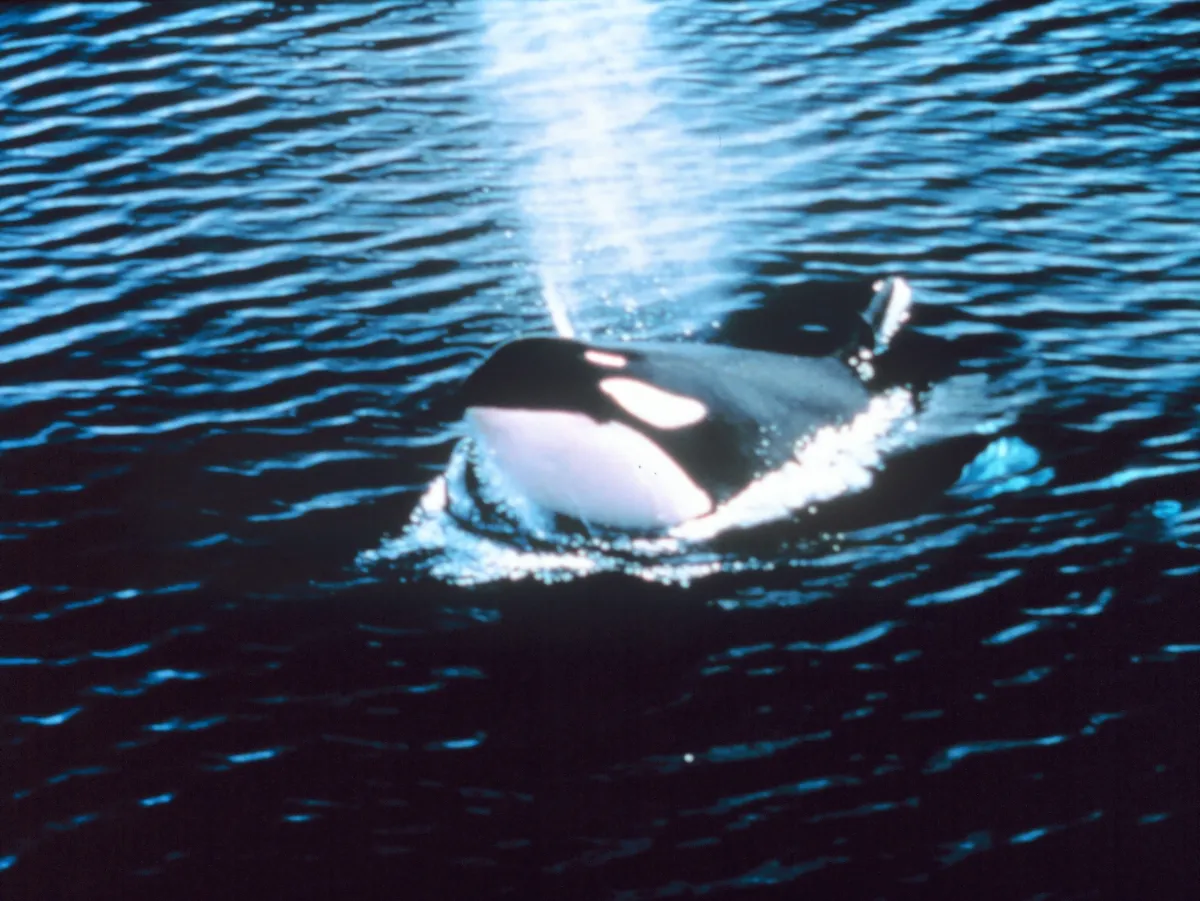
A killer whale (Orcinus orca) surfacing in the ocean. Photo: NOAA / Wikimedia Commons, Public Domain. The photograph is not from a humpback whale encounter, and the animal's dietary population is not identified.
Orcas are actually the largest members of the dolphin family, making them toothed whales.
Humpbacks, by contrast, are baleen whales. They filter small fish and krill through baleen plates rather than using teeth to capture large prey.
For more information on humpback anatomy and ecology, see our Humpback Whale Species Profile.
Do Humpback Whales Fight Orcas to Protect Their Calves?
Yes. Defensive behavior around calves is one of the clearest biological reasons why humpbacks may confront mammal-eating killer whales.
Calves are smaller, less experienced swimmers, and more vulnerable than healthy adults.
Mothers may position themselves between predators and their calves, move forcefully, or use their bodies and flippers in defense.
These encounters help explain why an adult humpback might react strongly to killer whale hunting activity even when the immediate prey is not a humpback.
The defense of offspring is well understood as an evolutionary strategy. The extension of similar behavior toward other species is what makes the subject scientifically interesting.
Why Are These Encounters Difficult to Study?
Wild whale interactions often occur far offshore and may last only a short time.
Researchers rarely know everything that happened before they arrived or what happened after the animals disappeared.
There are also important problems with observational evidence:
Unusual encounters may be reported more often than ordinary ones.
Observers may interpret whale movements differently.
Some encounters lack a clear record of the prey's fate.
It can be difficult to identify the exact killer whale population involved.
Researchers cannot directly measure a wild whale's intentions.
These limitations do not make the observations meaningless. They explain why scientists describe the behavior carefully rather than claiming humpbacks are consciously rescuing other species in every case.
What Can Whale Behavior Teach Us About Animal Intelligence?
Humpback whales demonstrate complex behavior, social interactions, communication, and remarkable adaptations to ocean life.
Their encounters with killer whales show that interactions between predators and other animals can be more complicated than a simple hunter-and-prey relationship.
However, complex behavior does not automatically establish human-like empathy, morality, or conscious heroism.
Researchers investigate animal behavior by comparing observations with plausible biological explanations and testing predictions when possible.
Learning to separate what animals actually do from what we imagine they are thinking is one of the most useful skills in wildlife science.
Frequently Asked Questions
Do humpback whales really save seals from killer whales?
Yes, there are documented encounters in which humpback interference helped seals escape killer whale attacks. Whether the whales intentionally set out to rescue the seals remains unknown.
Why would a humpback whale protect another species?
Scientists suggest that an evolved defensive response to mammal-eating killer whales may be triggered during attacks on other species. Mobbing behavior and possible interspecific altruism have also been discussed.
Are humpback whales afraid of orcas?
Killer whales can threaten humpback calves, but healthy adult humpbacks sometimes approach and confront hunting orcas. Their behavior depends on the circumstances.
Can orcas kill an adult humpback whale?
Killer whales are powerful predators, but attacks on healthy adult humpbacks are difficult and less typical than attacks on vulnerable calves or juveniles.
Do humpback whales attack humans?
Humpbacks are not predators of humans, but they are enormous wild animals. Their movements can be dangerous at close range, so people should follow responsible whale-watching guidelines.
Do all humpbacks defend seals?
No. The available research documents selected encounters, not a universal behavior shared by every humpback whale.
Is this proof that whales have empathy?
No. The observations show behavior that sometimes benefits other species, but they do not establish the animals' internal emotional states or conscious intentions.
The Bottom Line
Humpback whales really do sometimes interfere with killer whales hunting seals and other animals. In a few documented cases, the interference helped the prey escape.
What makes this behavior extraordinary is not that the whales always act as rescuers, but that their defensive reactions can extend beyond their own species.
Scientists continue to investigate whether these encounters arise from predator defense, mobbing, responses to killer whale calls, or additional social mechanisms.
The evidence offers a fascinating window into the complexity of marine mammal behavior, while reminding us to be cautious about assigning human motives to wild animals.
Scientific Sources and Further Reading
NOAA Fisheries — Humpback Whale Species Information.
Discover Wildlife — Do Humpback Whales Protect Other Animals? (October 2026).