Do spiders dream? Scientists still cannot say for certain. But new research published in October 2026 provides compelling evidence that at least one species of jumping spider experiences genuine sleep, including a stage with rapid eye movements and muscle twitches that resembles REM sleep in humans.
Researchers at the University of Bonn studied the fringed jumping spider, Portia fimbriata. They found two distinct sleep stages and showed that the spiders became less responsive to disturbances while sleeping. When their sleep was interrupted, they also displayed signs of catching up on lost rest.
These findings change how scientists understand sleep in animals with very different nervous systems. But there is an important distinction: REM-like sleep is not proof that spiders experience dreams.
Do Spiders Really Sleep?
Yes. Scientists now have strong experimental evidence that some spiders experience genuine, regulated sleep rather than simply resting without moving.
For years, researchers noticed that spiders had predictable periods of reduced activity. Some remained motionless in webs or silk retreats for extended periods.
However, being inactive does not necessarily mean an animal is asleep.
To establish that an animal is sleeping, researchers look for several behavioral characteristics:
Regular rest periods: Sleep follows a recognizable daily or biological rhythm.
Reduced responsiveness: The animal is harder to awaken than when it is active.
Reversibility: The animal can return to normal activity when sufficiently stimulated.
Sleep rebound: When sleep is disturbed, the animal may compensate with additional sleep.
The 2026 research on Portia fimbriata investigated these features experimentally. Its results provide particularly convincing evidence that spiders can experience regulated sleep.
Meet Portia fimbriata: The Spider Scientists Studied
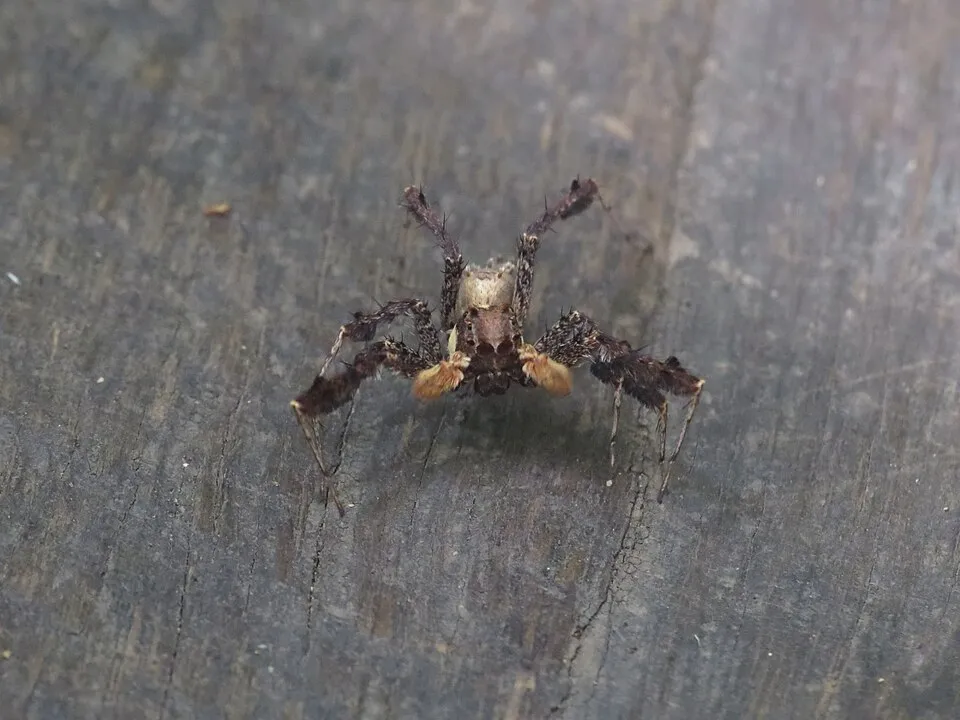
Fringed jumping spider (Portia fimbriata) photographed at Cairns Botanic Garden, Queensland, Australia. Photo: Donald Hobern / Wikimedia Commons, CC BY 2.0. This photograph does not show the laboratory sleep experiment.
Portia fimbriata belongs to the jumping spider family Salticidae. It is also known as the fringed jumping spider.
This species occurs in parts of Australia and neighboring regions. It is especially interesting to researchers because of its sophisticated hunting behavior.
Unlike spiders that rely primarily on a fixed web to catch insects, Portia species often hunt other spiders.
Some can imitate vibrations made by struggling insects in another spider's web. The web's owner may approach what seems to be trapped prey, only to encounter the hunting Portia.
Researchers have also documented flexible hunting strategies and learning-related behavior in these spiders.
These characteristics make Portia a useful subject for investigating the relationship between sleep, sensory processing and animal cognition.
For more information about the species, visit our Fringed Jumping Spider identification and biology guide.
What Did the 2026 Spider Sleep Study Discover?
The study, titled Behavioral evidence for two-stage sleep in spiders, was published online in the journal Proceedings of the National Academy of Sciences (PNAS) on October 26, 2026.
The researchers monitored Australian Portia fimbriata jumping spiders using high-resolution recordings during day and night.
Nighttime monitoring included infrared cameras, allowing the scientists to observe behavior without relying on bright visible lighting.
The researchers found two distinguishable sleep-related states.
| Sleep State | Observed Behavior | Scientific Interpretation |
|---|---|---|
| Quiescent sleep | Prolonged resting and reduced movement | A period of behavioral sleep with reduced responsiveness |
| REM-like sleep | Eye movements and brief muscle or limb twitches | A distinct sleep state sharing some features with vertebrate REM sleep |
These states were not identified simply because a spider appeared motionless. The scientists also measured responses to disturbances and investigated whether sleep loss changed later behavior.
The combined evidence supported the conclusion that these spiders experience genuine, regulated sleep with at least two stages.
Read the original 2026 PNAS research.
What Is REM-like Sleep in Spiders?
REM stands for rapid eye movement. In humans, REM sleep is a distinct sleep stage associated with characteristic brain activity, eye movements and many vivid dreams.
Scientists have also observed REM or REM-like characteristics in a range of other animals.
In jumping spiders, researchers have documented periods of retinal movement accompanied by limb twitches and unusual resting postures.
Jumping spiders have a distinctive visual system. Their large forward-facing principal eyes contain retinal structures that can move internally to change the direction of their gaze.
When the animals are resting, movements in this visual system can sometimes be detected and analyzed.
However, scientists are careful to use the term REM-like rather than assuming the spider's sleep is identical to human REM sleep.
Spiders have very different nervous systems, and the 2026 researchers did not directly measure the brain activity associated with these sleep stages.
How Can Scientists Tell Whether a Spider Is Asleep?
One of the most revealing parts of the 2026 research involved testing how spiders responded to sounds.
The scientists compared the animals' responses while they were awake and during different resting states.
A spider in a genuine sleep state should generally be more difficult to arouse than a fully alert spider.
The study found increased arousal thresholds during sleep, particularly during the REM-like state.
This means the spiders responded more slowly to certain external disturbances, or sometimes did not respond to them during the observation period.
That finding is significant because it helps distinguish sleep from ordinary stillness.
A motionless spider might be waiting for prey, avoiding a predator or conserving energy. Reduced responsiveness combined with other sleep-related patterns provides stronger evidence.
What Happens When a Spider Loses Sleep?
Another important discovery involved sleep rebound.
In many animals, missing sleep creates pressure to sleep later. This can lead to longer or more intense periods of rest once the animal is able to sleep normally again.
The researchers disrupted the spiders' sleep and monitored their subsequent behavior.
They observed compensatory changes consistent with sleep rebound.
This provides evidence that spider sleep is biologically regulated rather than simply being an optional period of inactivity.
The result does not prove that spiders experience tiredness in the same subjective way humans do.
It does, however, suggest that sleep fulfills important biological functions in these animals.
Do Spiders Dream Like Humans?
We do not know.
The discovery of REM-like sleep makes the question scientifically interesting, but researchers have not demonstrated that spiders experience dreams.
Dreaming refers to an internal experience. Scientists can ask humans to describe what they remember after waking, but they cannot ask spiders to report what happened during sleep.
Researchers can observe eye movements, muscle activity, responsiveness and other measurable features.
Those observations may resemble aspects of human REM sleep, but similar outward behavior does not necessarily imply identical mental experiences.
| Question | Current Scientific Answer |
|---|---|
| Do spiders rest? | Yes, resting behavior is widely observed. |
| Can spiders experience real sleep? | Yes, experimentally supported in Portia fimbriata. |
| Do jumping spiders show REM-like behavior? | Yes, studies have documented eye and limb movements. |
| Do spiders have distinct sleep stages? | At least two stages were documented in the 2026 Portia study. |
| Do spiders experience dreams? | Not yet established. |
| Do all spiders sleep in the same way? | Unknown; sleep has not been studied equally across species. |
The most accurate conclusion is that some jumping spiders experience complex, regulated sleep. Whether that includes subjective dreaming remains an open scientific question.
What Did Scientists Discover About Spider Sleep in 2022?
The 2026 findings built upon an earlier study published in PNAS in August 2022.
That study examined young jumping spiders of the species Evarcha arcuata.
Researchers observed periodic retinal movements during nighttime rest, together with limb twitching and characteristic curling of the legs.
The study suggested that these animals might experience a state resembling REM sleep.
However, it did not provide the same comprehensive experimental testing of regulated sleep later performed in the 2026 Portia fimbriata research.
The distinction between these studies is important:
| Study | Species | Main Contribution |
|---|---|---|
| 2022 | Evarcha arcuata | Documented periodic retinal movements and other REM-like behaviors during rest. |
| 2026 | Portia fimbriata | Provided experimental evidence of regulated sleep and distinct sleep stages, including REM-like behavior. |
Read the original 2022 jumping spider research.
Why Do Jumping Spiders Have Such Large Eyes?
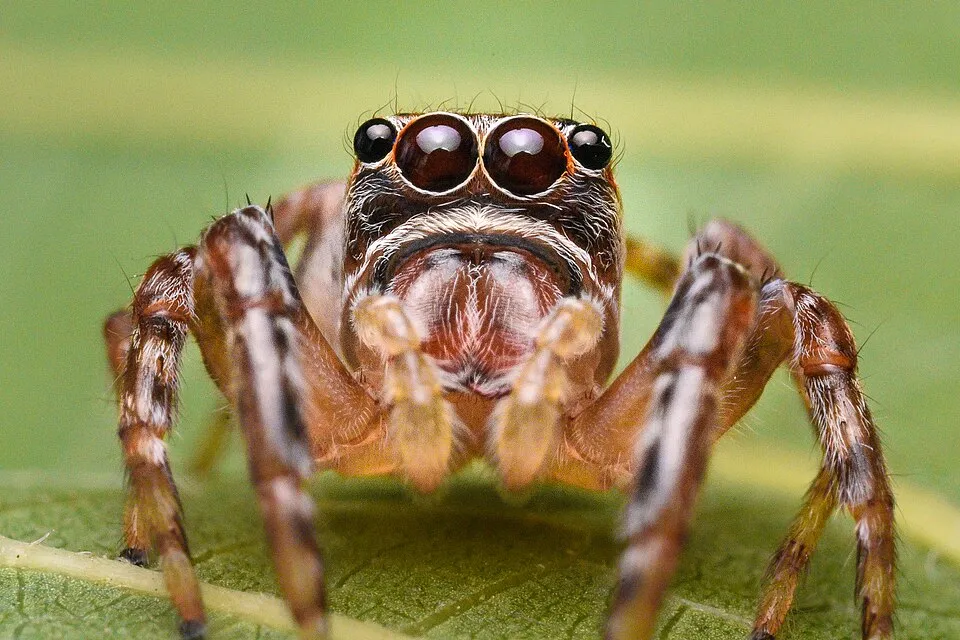
Close-up of a jumping spider in the family Salticidae. Photo: Emman Asuncion Foronda / Wikimedia Commons, CC BY-SA 4.0. This is an illustrative jumping spider photograph, not the Portia fimbriata studied in 2026.
Jumping spiders are highly visual predators.
Their large principal eyes provide detailed information that helps them identify prey, judge positions and perform accurately directed jumps.
Additional eyes contribute to detecting movement and monitoring their surroundings.
Unlike the freely rotating eyes of many vertebrates, jumping spider eyes have relatively fixed outer lenses, while internal retinal structures can change their position.
This unusual anatomy makes some jumping spiders especially valuable for scientific studies of visual processing and sleep.
Their large eyes also make them popular subjects for wildlife macro photography.
Explore our Jumping Spiders guide for more information about their hunting, eyesight and everyday behavior.
Where Do Jumping Spiders Sleep?
Jumping spiders commonly use silk to create retreats or resting shelters.
Depending on the species, they may rest beneath leaves, inside crevices or in small silk structures attached to vegetation.
The Portia fimbriata individuals studied in 2026 adopted a recognizable nighttime posture, hanging upside down beneath silk structures.
This posture helped the researchers recognize resting periods and study the animals under controlled conditions.
Not every spider sleeps in the same position. The behavior described in a particular jumping spider species should not be applied automatically to tarantulas, orb-weavers, wolf spiders or other spider groups.
Do Spiders Close Their Eyes When They Sleep?
No. Spiders do not have eyelids like humans.
They cannot close their eyes in the familiar way that people do when falling asleep.
A resting spider may instead reduce movement, adopt a characteristic body posture or retreat into a sheltered location.
The absence of eyelids does not mean that the spider remains fully awake.
Sleep is a biological state, not simply the act of closing one's eyes.
Do Spiders Sleep During the Day or at Night?
It depends on the species.
Many jumping spiders are primarily active during the day. They use their vision to locate prey and may spend extended periods resting at night.
Other spiders are more active after dark, including numerous web-building and wandering species.
Different daily activity schedules may also depend on temperature, light levels, predators and available prey.
The fact that Portia fimbriata displayed regular nighttime sleep does not mean every spider species follows the same schedule.
Why Is Spider Sleep Important to Scientists?
Sleep is found across a surprisingly wide variety of animals, but many questions about its evolutionary origins and biological functions remain unanswered.
Studies of mammals and birds have contributed much of what scientists know about sleep. However, those groups share relatively similar nervous system organization compared with much more distant animal lineages.
Spiders provide an opportunity to explore how sleep operates in a nervous system that evolved along a very different path.
If scientists discover similar sleep-related features across widely separated branches of the animal kingdom, it may help identify fundamental functions of sleep.
Researchers are particularly interested in how sleep relates to sensory processing, learning, memory and nervous system maintenance.
However, the 2026 research did not establish that jumping spiders dream, replay memories or improve their learning while asleep.
Those remain questions for future experiments.
Could Artificial Light Affect Spider Sleep?
Artificial lighting at night may interfere with the normal daily rhythms of some animals.
The University of Bonn researchers identified artificial light at night as an important subject for future spider sleep studies.
For a day-active jumping spider, changes in the natural light-dark cycle could potentially influence activity and resting behavior.
But the 2026 experiment did not establish a universal rule about how household lighting affects all spiders.
Researchers still need to investigate different species, natural environments and lighting conditions.
Frequently Asked Questions
Do spiders sleep?
Yes. A 2026 study provided comprehensive experimental evidence of genuine, regulated sleep in the jumping spider Portia fimbriata, including reduced responsiveness and compensatory sleep after disruption.
Do spiders dream?
Scientists do not yet know. REM-like movements have been observed in jumping spiders, but there is no direct evidence that they experience subjective dreams.
Do jumping spiders have REM sleep?
Researchers have identified a REM-like sleep stage with eye movements and muscle twitches. The term REM-like is important because scientists have not demonstrated that spider sleep is neurologically identical to human REM sleep.
How can you tell if a spider is sleeping?
A spider may remain in a characteristic resting posture and respond less readily to disturbances. However, appearance alone is not enough to distinguish genuine sleep from ordinary inactivity.
Do spiders have eyelids?
No. Spiders do not close their eyes with eyelids. They can still experience resting and sleeping states without closing their eyes.
Can spiders lose sleep?
Yes, experimentally disrupted Portia fimbriata spiders showed compensatory changes consistent with sleep rebound, suggesting that their sleep is biologically regulated.
Do tarantulas dream?
There is currently no convincing direct evidence demonstrating dreaming in tarantulas. Results from jumping spider experiments cannot automatically be generalized to all spiders.
Are spiders insects?
No. Spiders are arachnids, whereas insects belong to a different arthropod group. Spiders generally have eight legs, while adult insects have six. Read our guide to insects and animal classification for more information.
The Bottom Line
Spiders really can sleep, but whether they dream remains unknown.
The 2026 University of Bonn study demonstrates that the jumping spider Portia fimbriata experiences regulated sleep with two distinct stages, including a REM-like state involving eye movements and muscle twitches.
Combined with earlier research, these findings suggest that sophisticated sleep patterns are not restricted to mammals, birds or other familiar vertebrates.
They also remind us that scientific discoveries often begin by questioning something that once seemed obvious: perhaps even a tiny spider resting in its silk retreat is doing far more than simply remaining still.
Scientific Sources and Photo Credits
University of Bonn (October 27, 2026). How deeply do spiders sleep?
Museum of New Zealand Te Papa Tongarewa — Do spiders sleep?
Photo 1: Donald Hobern — Portia fimbriata, CC BY 2.0.
Photo 2: Emman Asuncion Foronda — Jumping Spider, CC BY-SA 4.0.