Sea snakes do not normally drink seawater to stay hydrated. Research on yellow-bellied sea snakes and several sea krait species shows that they depend on fresh water, even while living in or around the ocean. For a yellow-bellied sea snake far from shore, the solution can arrive from above: heavy rain creates a temporary, less salty layer at the sea surface that the snake can drink.
Sea Snake Drinking: Quick Facts
| Question | Evidence-based answer |
|---|---|
| Do sea snakes drink salt water? | Studied yellow-bellied sea snakes and sea kraits refused seawater and drank fresh or very dilute water instead. |
| How do ocean-dwelling sea snakes find fresh water? | Heavy rainfall can form temporary low-salinity surface layers, sometimes called freshwater lenses. |
| Can sea snakes become dehydrated? | Yes. Yellow-bellied sea snakes have been found dehydrated during seasonal drought. |
| Do all sea snakes use the same water source? | No single drinking pattern should be assumed for every species; sea kraits can also access rainwater on land. |
| Do salt glands mean they can drink seawater? | No. Salt-excreting glands help manage salt, but they do not eliminate the need for fresh water in the species studied. |
Why Can't Sea Snakes Simply Drink the Ocean?
It sounds strange: a snake can be surrounded by water and still become thirsty. But seawater contains far more dissolved salt than a terrestrial animal's cells can tolerate without specialized regulation. Taking in seawater is not automatically a useful way to replace lost body water.
Marine snakes have ways to manage salt absorbed from their environment and prey. However, having salt-excreting glands is not proof that an animal can rely on full-strength seawater as drinking water. Experiments on yellow-bellied sea snakes (Hydrophis platurus) found that dehydrated animals rejected seawater but accepted fresh water. Researchers also observed a similar freshwater requirement in three studied species of amphibious sea kraits (Laticauda).
That distinction matters because sea snakes are not just aquatic animals. They are air-breathing reptiles with their own water-balance challenges. To learn how to distinguish them from fish with a similar body shape, see our sea snake vs. eel identification guide.
How Rainwater Forms a Drinkable Layer on the Sea
Rain is fresh water. When a strong storm falls over the ocean, the relatively fresh water entering the surface can temporarily lower the salinity of the uppermost layer. Scientists refer to this feature as a freshwater lens or a low-salinity surface layer.
It does not mean that an entire patch of ocean becomes fresh. Waves, currents and mixing gradually blend that water into the saltier sea below. The opportunity to drink is temporary and depends on local conditions.
How the freshwater lens works
1. Rain falls: Stormwater arrives at the sea surface with relatively little salt.
2. A temporary layer develops: Under suitable conditions, surface water becomes less salty than the water underneath.
3. A sea snake may drink: Yellow-bellied sea snakes can use these short-lived freshwater opportunities to rehydrate.
This is an explanation of the process, not a claim that every rainfall event creates a drinkable lens. For other adaptations of these animals, our sea snake species and characteristics guide covers swimming, habitat and reproduction.
What Scientists Discovered About Thirsty Sea Snakes
A 2019 study led by University of Florida biologist Harvey Lillywhite followed yellow-bellied sea snakes in the Gulf of Papagayo, Costa Rica, during the transition from a long dry season to the first rains. The researchers captured snakes on successive days and offered fresh water in controlled tests.
Before the rains, about 80% of the sampled snakes drank fresh water when offered it; by the eighth day after rain began, the percentage was about 13%. The decline is consistent with snakes obtaining water in the ocean as rainfall created low-salinity surface patches. It was an indirect field-and-laboratory line of evidence, rather than a video observation of each snake drinking at sea.
Earlier work also found that yellow-bellied sea snakes become dehydrated during prolonged dry periods. The findings overturned the simple assumption that these fully marine reptiles could maintain water balance by drinking seawater whenever they wanted.
One striking implication is that rainfall patterns may matter to an animal that otherwise spends its life in open ocean. Researchers have raised concerns that extended drought and changing precipitation could affect where certain sea snakes persist. The precise consequences, however, depend on species and region.
Meet the Yellow-Bellied Sea Snake
Hydrophis platurus, the yellow-bellied sea snake, is an unusually ocean-going reptile. Unlike many other snakes, it does not need to visit land as a normal part of its life cycle. It swims with a laterally compressed, paddle-shaped tail and hunts small fish at sea.
Its black or dark upper body and yellow underside are distinctive, although color varies and should never be the only basis for identifying a snake. The species can turn up on beaches after rough weather, but a stranded snake should not be approached or handled.
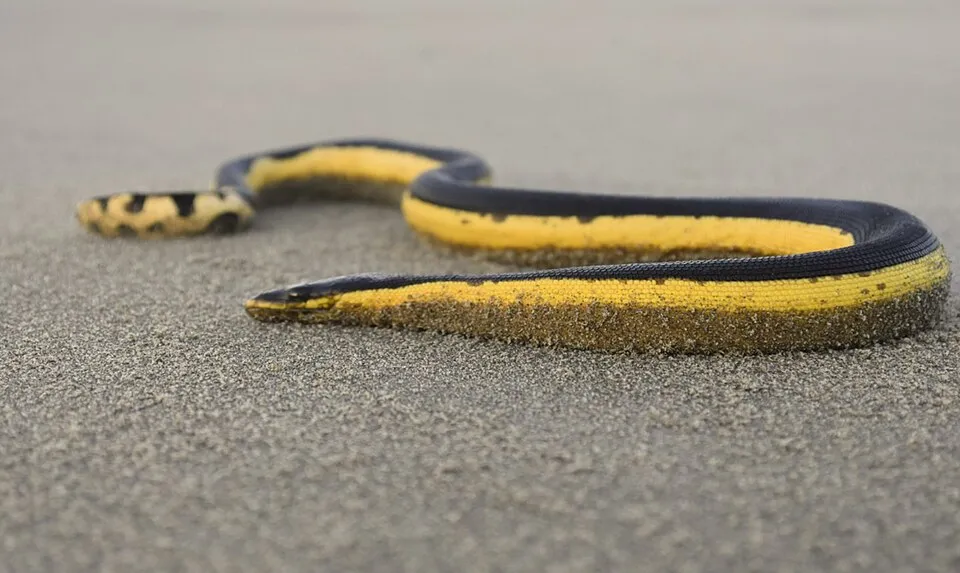
Real photo: Yellow-bellied sea snake (Hydrophis platurus) photographed on sand; this is not a photograph of the animal drinking. Photo: Luis Correa / Wikimedia Commons, CC BY 4.0. Unmodified image.
For its distribution, diet and body features, read our yellow-bellied sea snake species profile.
What About Sea Kraits That Go Onto Land?
Sea kraits are marine snakes that regularly come ashore. This gives them potential access to freshwater sources such as rain-filled pools or wet terrestrial refuges, unlike a fully pelagic snake living far offshore.
In a study of three Laticauda species, researchers found that dehydrated sea kraits rejected normal seawater but drank fresh water or sufficiently dilute brackish water. These results show that freshwater dependence is not limited to the yellow-bellied sea snake, even though the exact conditions and drinking behavior vary.
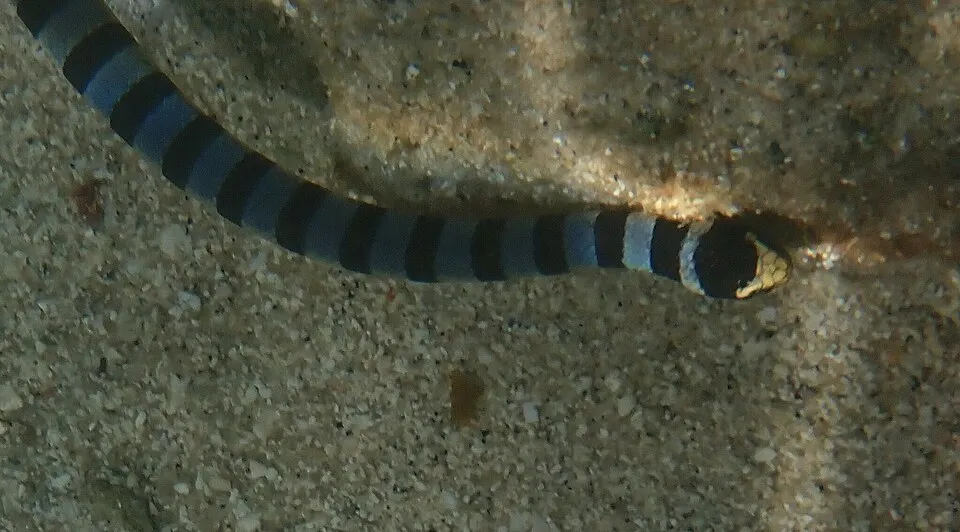
Real photo: Yellow-lipped sea krait (Laticauda colubrina) underwater in Thailand. Photo: wingwatcher48 / Wikimedia Commons, CC0 1.0. This is a species photo, not a drinking observation.
Do Sea Snakes Get Water From Their Food?
Like other animals, sea snakes obtain some water through prey and metabolism. But those sources do not necessarily replace all water losses. In the sea snake species that scientists tested, dehydrated animals still displayed a strong response when fresh water became available.
The important lesson is not that every marine snake drinks in exactly the same way. Rather, living in the sea does not necessarily remove dependence on freshwater. Yellow-bellied sea snakes have become a particularly revealing example because their water supply is tied to rainfall over the open ocean.
Frequently Asked Questions
Can sea snakes drink ocean water?
Studies of yellow-bellied sea snakes and several sea krait species found that dehydrated individuals would not drink ordinary seawater. Fresh water, or in some experiments very dilute brackish water, was accepted.
Where do yellow-bellied sea snakes get freshwater?
They can obtain it from temporary low-salinity water at the ocean surface following heavy rainfall. Such opportunities are especially important after drought.
Do sea snakes have salt glands?
Sea snakes possess specialized salt-excreting glands that help them handle excess salt. But these glands do not mean that the studied species can meet all their drinking needs by consuming full-strength seawater.
Can sea snakes become dehydrated in the ocean?
Yes. Researchers have measured seasonal dehydration and freshwater-seeking behavior in yellow-bellied sea snakes living at sea.
Do sea kraits drink rainwater?
Sea kraits require freshwater and may access it on land after rainfall. They differ from fully ocean-going sea snakes because they can leave the water.
Are sea snakes dangerous to touch?
Sea snakes and sea kraits include venomous species. Do not handle an unidentified snake in the water or on a beach. Keep a safe distance and contact local wildlife professionals if assistance is needed.
The Bottom Line
Sea snakes have evolved to live in salt water, but at least some species still depend on freshwater to drink. For the yellow-bellied sea snake, a passing rainstorm can create the brief window needed to replenish body water. It is a compelling reminder that the survival of an ocean animal can depend on a resource that arrives from the sky.
Scientific Sources and Further Reading
Lillywhite, H. B., et al. (2019). Drinking by sea snakes from oceanic freshwater lenses at first rainfall ending seasonal drought. PLOS ONE 14(2): e0212099.
Lillywhite, H. B., et al. (2008). Sea snakes (Laticauda spp.) require fresh drinking water. Physiological and Biochemical Zoology.
Lillywhite, H. B., et al. (2014). Pelagic sea snakes dehydrate at sea. Proceedings of the Royal Society B.
University of Florida (2014). Sea snakes need fresh water for drinking.