Deer do not need to make a sound to communicate. A sudden foot stomp, stiff-legged walk, sharp snort or raised white tail can tell another deer—and an observant human—that something has changed. But not every movement means the same thing. A buck with its ears back may be challenging another deer, while a doe swiveling her ears may simply be listening.
This photo-based guide focuses on the white-tailed deer (Odocoileus virginianus) of North America. Its signals are well documented by wildlife agencies. Other deer, including mule deer, elk and roe deer, may communicate differently, so do not treat this as a universal dictionary for every deer species.
Deer Body Language at a Glance
Start with the combination of the ears, eyes, tail, legs, sounds and surroundings—not one isolated gesture.
| What you notice | Most likely interpretation | What else to check |
|---|---|---|
| 1. Ears swivel or point forward | Listening or investigating | Is the deer still feeding or suddenly frozen? |
| 2. One front hoof stamps | Uncertainty or suspected danger | Head bobbing, fixed gaze, a following snort |
| 3. Loud snort or blow | Alarm; a warning to nearby deer | Stomping, abrupt movement, retreat |
| 4. White tail lifts and flashes | High alert, often while escaping | Bounding or rapid departure |
| 5. Head bobs or sways | Trying to identify a suspicious object | Repeated staring and foot stomping |
| 6. Ears pin back; head lowers | Possible threat or social dominance | Stiff posture and another deer nearby |
| 7. Stiff-legged, deliberate approach | Possible challenge, especially between adults | Antlers lowered, bristled hair, rival nearby |
| 8. Upper lip curls upward | Scent investigation, often linked to breeding | Rut season; recent scent marks or other deer |
Important: These interpretations are tendencies, not guarantees. An individual deer can jump straight from stillness to running without performing the whole sequence.
Photos: Recognizing Deer Posture in the Field
The photos below are verified real wildlife photographs, not AI-generated scenes. Only the raised-tail photo directly illustrates the named signal. The others show animals and body parts relevant to identification; they should not be mistaken for documented instances of foot stamping, fighting or charging.
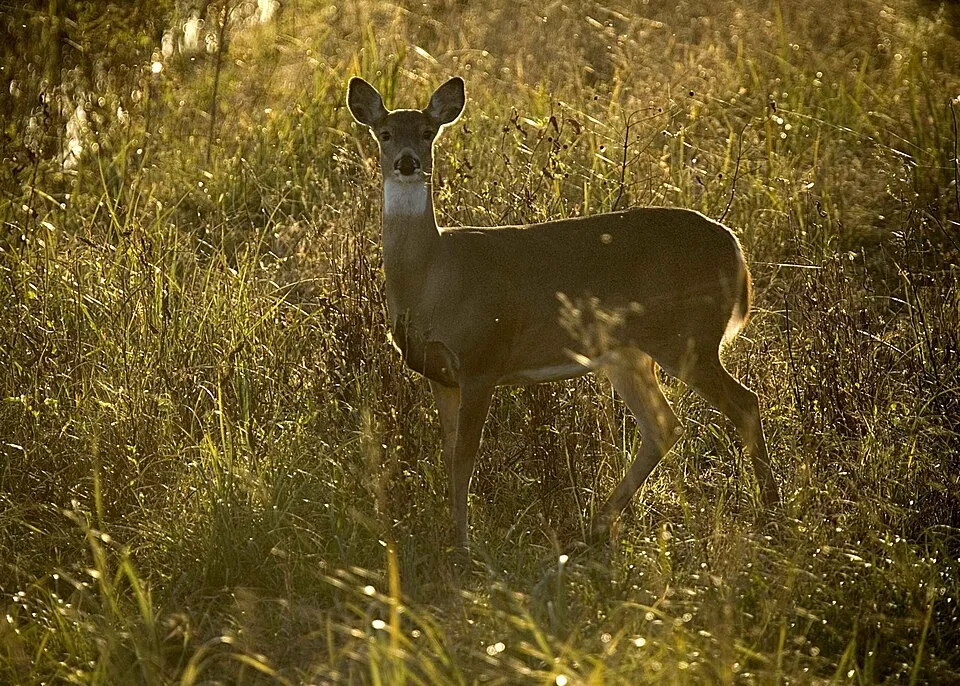
An alert white-tailed doe looking out from low brush; an example of attentive posture. Photo: Steve Hillebrand / U.S. Fish and Wildlife Service · Public Domain. Original photo and rights.
The raised-tail example appears in section 4 below.
1. Ears Forward or Constantly Turning: The Deer Is Listening
A white-tailed deer's large ears pivot independently to track sounds. A relaxed animal may move its ears while browsing, but a sudden halt, erect head and ears fixed toward one location often mean the deer is paying close attention.
Look at the entire sequence. Does the deer resume eating after a few seconds, or does it stop moving, stare and shift its weight? The second pattern suggests increasing concern. Ear position alone is not a reliable measure of whether an animal is about to attack.
Field clue: Ears turning by themselves are normal. Ears forward plus rigid stillness and a fixed gaze are more informative.
2. Front-Foot Stomping: “What Is That?”
When a deer notices something unfamiliar but cannot identify it, it may lift a forefoot and stamp the ground. It sometimes repeats the action or alternates feet. This may help trigger movement from a concealed source of danger and may also contribute to communication through scent released near the hoof.
For that reason, a deer stomping toward your direction is not automatically charging or angry. The more likely explanation is that it is wary and attempting to assess the situation. However, it is still a signal to give the animal space.
See the related question in more detail below: What should you do if a deer stomps at you?
3. Snorting or Blowing: An Audible Alarm
A white-tailed deer may make a forceful, explosive snort or blow when alarmed. The sound can accompany head movements and foot stamping; nearby deer may respond even before they have located the threat themselves.
Snorting does not mean the deer is trying to communicate with a person. It is part of its normal reaction to something suspicious or frightening. The Missouri Department of Conservation describes a combination of visual, scent and vocal signals during alarm behavior.
Field clue: A snort plus stomping and a tense body is a stronger indication of alarm than a single ear flick.
4. Tail Raised Like a White Flag: Escape and Warning
The name white-tailed deer makes sense when you watch one flee. The animal lifts its tail and exposes the bright white underside. The conspicuous patch may act as a visual alarm signal to other deer. Many observers first notice the white flash rather than the deer itself.
According to Texas Parks and Wildlife, tail flagging is an especially strong alarm display. Yet there is no rule that a deer must stomp or snort before raising its tail. A suddenly startled animal can skip the earlier signals and escape immediately.

A white-tailed doe with the white underside of her tail displayed—the tail-flagging signal. Photo: Steve Hillebrand / U.S. Fish and Wildlife Service · Public Domain. Original photo and rights.
Do not confuse this with ordinary tail flicking. A brief relaxed twitch is different from the prominent upright white flag displayed during flight.
5. Head Bobbing or Swaying: Trying to Identify Something
White-tailed deer sometimes bob or sway their heads when they are suspicious of something that is not moving clearly. The change in viewing angle may help them assess its shape and distance. Wildlife agencies describe the behavior occurring alongside staring and stomping.
A head movement on its own can have other explanations. Look for a repeated pattern directed at the same unfamiliar object. Never deliberately move, wave or approach to test whether the deer will react; observation should not become harassment.
6. Ears Pinned Back and Head Lowered: A Social Warning
In interactions between deer, flattened ears, a low head, bristled hair or a direct approach can indicate tension or dominance. A deer directing such posture at another deer is not expressing the same thing as one that simply turns an ear toward a noise.
These displays can occur around feeding opportunities, social rank and breeding activity. Context matters: a young animal, an adult doe near a fawn and a mature buck during the rut face different pressures.
7. Stiff-Legged Walking or Lowered Antlers: Possible Challenge
During social confrontations, a deer may move with a deliberate stiff-legged gait. Bucks may also lower their antlers, turn sideways or posture before a fight. This is different from the cautious one-foot stomp of an animal investigating danger.
Antlers are not an everyday threat indicator by themselves; healthy bucks carry them throughout part of the year. The relevant warning is the behavior—a purposeful approach, lowered head, rigid posture or conflict with another deer.
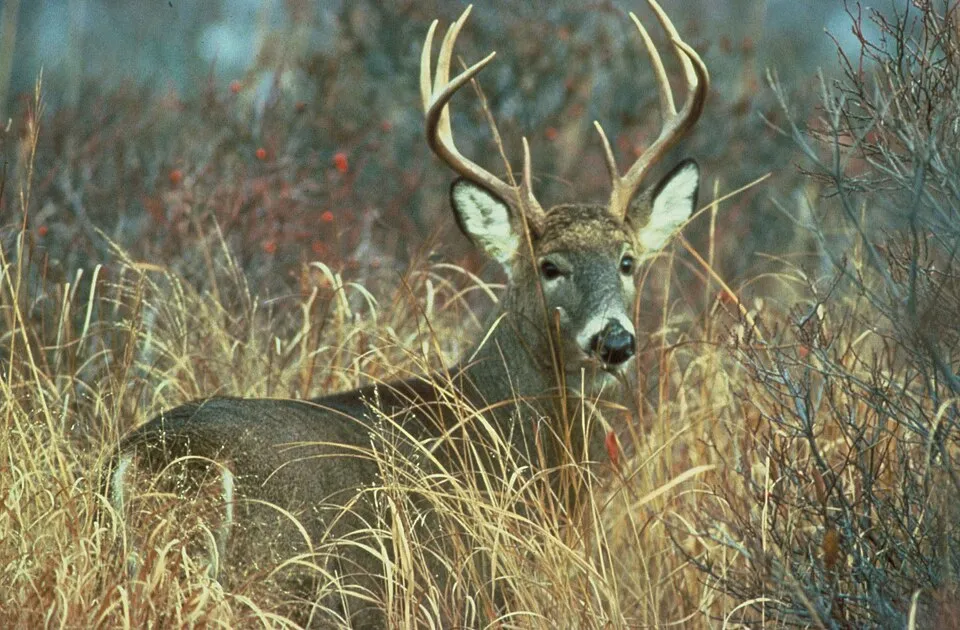
Adult male white-tailed deer; useful for identifying antlers and general body posture, not evidence of aggression. Photo: U.S. Fish and Wildlife Service · Public Domain. Original photo and rights.
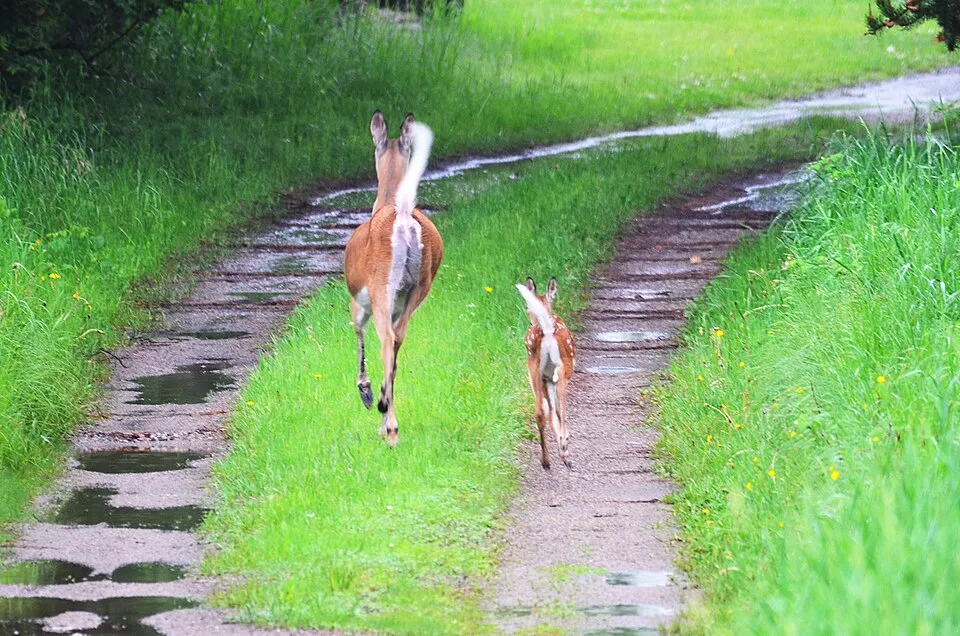
An adult doe and a fawn moving away with white tails raised; this is not a documented charge. Photo: U.S. Fish and Wildlife Service – Midwest Region · Public Domain. Original photo and rights.
If a deer approaches rather than moving away, do not assume it is tame. Wildlife officials advise against approaching or feeding deer, especially near fawns or during the breeding season.
8. Upper-Lip Curling: Investigating Scent, Not a Snarl
A deer, especially a buck during the breeding season, may raise its nose and curl its upper lip. This is often called the flehmen response. It helps the animal sample chemical cues associated with other deer. Similar scent-investigating behavior occurs in other hoofed mammals.
A curled lip may look like an angry expression to a human observer, but it should not be interpreted as proof of aggression. It is a good example of why animal body language cannot be translated into human emotions one gesture at a time.
Alarm or Aggression? A Simple Way to Tell the Difference
| Situation | More suggestive of alarm | More suggestive of a challenge |
|---|---|---|
| Attention | Fixed gaze toward unfamiliar sound or object | Focused approach toward another deer |
| Hooves | One forefoot repeatedly stomps | Whole body moves stiffly toward a rival |
| Sound | Sharp alarm snort or blow | Social vocalizations, including buck-associated sounds |
| Tail | White flag raised during flight | No single tail position reliably proves aggression |
| Best response for a person | Stop approaching; give space | Retreat calmly; provide an escape route |
No table can predict exactly what a wild animal will do next. The safest choice is to remain at a respectful distance and never force an encounter.
What Should You Do if a Deer Stomps at You?
Do not approach. A deer that is already alarmed needs room, not a closer camera angle.
Slowly move away without blocking its path into cover. Avoid running at, cornering or attempting to touch it.
Keep dogs under control. A dog can intensify the animal's stress and make an encounter unpredictable.
Be extra cautious near fawns or during the rut. A protective doe or breeding buck may behave differently from a solitary, relaxed deer.
Observe from a distance. If you want a photograph, use a long lens instead of moving closer.
The National Park Service recommends moving back whenever wildlife changes its behavior because of your presence. Oregon wildlife officials similarly advise never approaching deer and caution that aggressive encounters can occur, particularly around young or during the breeding season.
How Deer Communicate Without Sound
Visual signals are only one part of deer communication. White-tailed deer also use scent from glands on different parts of their bodies. The interdigital glands, located between the toes, are relevant to communication through tracks and stamping; glands on the face and legs contribute to other scent-marking behaviors.
Deer also communicate through social spacing, touch and vocalizations. See our guide to deer herds and social groups for background on how deer associate with one another.
Does This Guide Apply to Elk, Mule Deer and Other Deer?
Not exactly. Deer are members of the family Cervidae, which includes white-tailed deer, mule deer, elk, moose, reindeer and other species. Many use ear movements, posture, scents and sounds, but the specific appearance and meaning of displays can vary.
For species differences, see our Elk vs Deer comparison. To identify a young deer and understand why fawns sometimes remain hidden, read What Is a Baby Deer Called?
Frequently Asked Questions
What does it mean when a deer looks at you and stomps?
Usually the deer has noticed something suspicious and is trying to determine whether it is dangerous. Give it space rather than trying to make it react.
Why does a deer stomp and snort at the same time?
The combination strongly suggests alarm. Stomping is a visible signal and may help identify a threat, while a forceful snort is an audible warning.
Do deer stomp their feet when angry?
Stomping by itself is usually better described as vigilance or uncertainty, not human-style anger. A deer can also show threat postures in social conflicts, so look at the entire body and situation.
What does it mean when a deer raises its tail?
In white-tailed deer, a prominently raised white tail often accompanies flight and functions as a conspicuous alarm signal. A casual tail twitch is not the same thing.
Why do deer bob their heads when they see you?
They may be trying to see an uncertain object from different angles. Repeated staring, stamping and head bobbing together suggest heightened attention.
Does a deer with its ears back want to attack?
No single ear position can predict an attack. Ears pinned back together with a lowered head, stiff posture and forward movement can indicate social tension or a possible threat.
Can a deer charge a person?
Yes, although deer generally avoid people. Do not approach deer, especially near fawns or during the breeding season. Give animals room to leave.
Why does a buck curl its lip?
It may be investigating scent cues through the flehmen response, especially during mating season. That expression is not necessarily aggression.
The Takeaway
Deer body language is most useful when you read a sequence of signals. A stamped hoof or sharp snort often means a white-tailed deer is suspicious. An upright white tail is a much clearer alarm display. Stiff walking or a lowered head toward another deer can signal a social challenge, while a curled upper lip may simply mean scent investigation.
The best wildlife watching does not require getting close enough to provoke any of these reactions. Watch calmly from a distance, and let the deer choose what it does next.