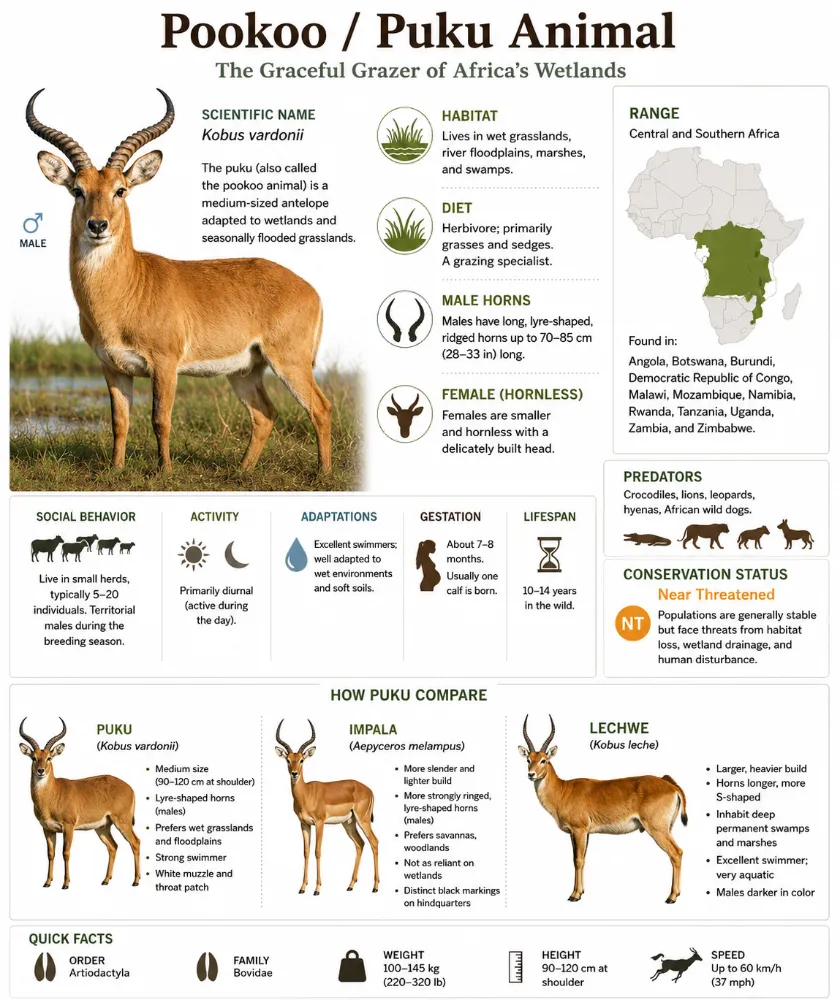
The “pookoo animal” usually refers to the puku, a medium-sized African antelope scientifically known as Kobus vardonii. Pukus live mainly in wet grasslands, floodplains, dambos, and river-edge habitats in parts of central and southern Africa. They are sandy-brown grazers, usually stay close to water, and males have ridged, lyre-shaped horns. Although not as famous as impalas or gazelles, the puku is an important wetland antelope.
Quick Facts About the Pookoo Animal
| Feature | Pookoo / Puku Antelope |
|---|---|
| Common names | Puku, pookoo, puku antelope |
| Scientific name | Kobus vardonii |
| Animal group | Mammal, antelope, bovid |
| Family | Bovidae |
| Genus | Kobus |
| Native region | Central and southern Africa |
| Main habitat | Wet grasslands, floodplains, dambos, river edges, marshy savannas |
| Typical shoulder height | About 80–90 cm |
| Typical weight | Females often lighter; males may reach around 70–90 kg |
| Coat color | Sandy brown, golden brown, or reddish-brown with paler underside |
| Horns | Males have ridged, backward-curving, lyre-shaped horns |
| Diet | Mainly grasses |
| Activity pattern | Often active in early morning and late afternoon |
| Conservation status | Near Threatened |
What Is a Pookoo Animal?
The pookoo animal is better known in modern zoology as the puku antelope. Its scientific name is Kobus vardonii. It is a medium-sized antelope that belongs to the same broader family as cattle, goats, sheep, buffalo, and many other antelopes.
The spelling “pookoo” is an older or less common spelling, while “puku” is the standard common name used in most wildlife guides. Both names refer to the same animal: a wetland-loving African antelope with a warm brown coat, sturdy body, and strong connection to grassy floodplain habitats.
Pukus are not deer, goats, or gazelles. They are true antelopes in the bovid family. Their closest relatives include other water-associated antelopes such as kob, lechwe, and waterbuck.
Appearance and Identification
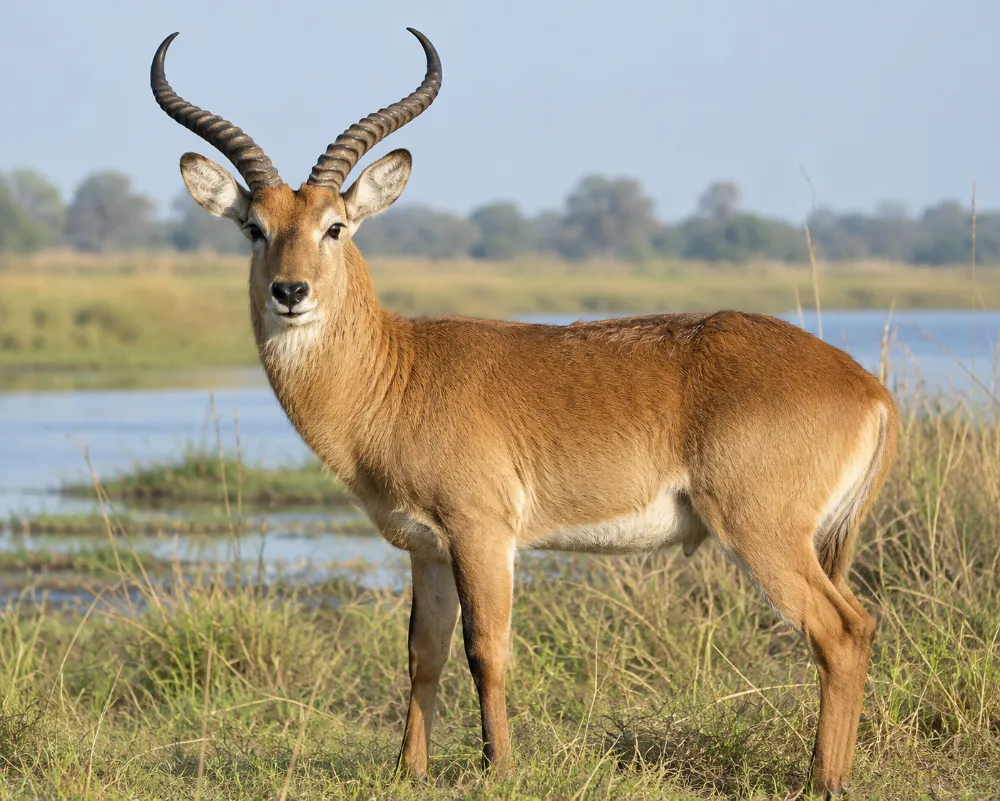
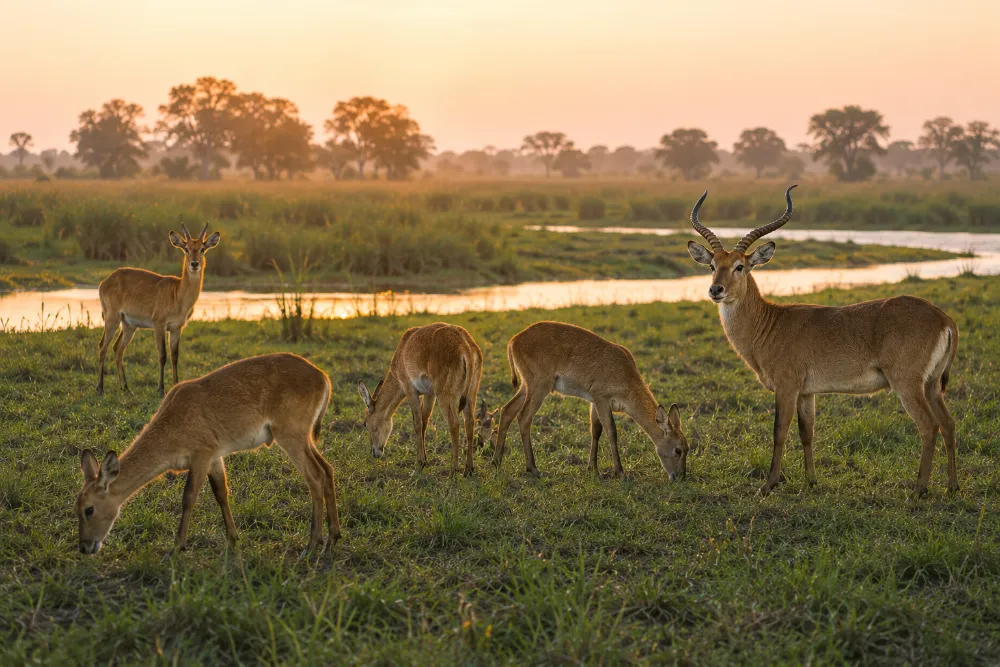
The puku is a compact, strong-looking antelope with a sandy-brown to reddish-brown coat. Its underside is usually paler than the back and sides. Compared with some sleek antelopes, the puku’s coat can look slightly rougher or shaggier.
The head is relatively short, the ears are rounded and furry, and the body is built for grazing in open wet grasslands. The legs are strong but not extremely long, giving the animal a sturdy appearance.
Only male pukus have horns. The horns are ridged, slightly curved backward, and often described as lyre-shaped. Females do not have horns and are usually smaller and lighter than males.
Where Do Pukus Live?
Pukus live in parts of central and southern Africa. They are strongly associated with grasslands near water, especially floodplains, dambos, marsh edges, and river systems. They are not desert antelopes and are rarely found far from suitable wet grassland habitat.
Important puku populations occur in countries such as Zambia, Tanzania, Botswana, the Democratic Republic of Congo, and nearby regions where suitable habitat remains. Their distribution is patchy because they depend on specific wetland and floodplain environments.
Unlike more generalist antelopes that can use dry savannas or woodland edges, pukus are more habitat-specific. They prefer places where grazing is good and water is nearby.
Habitat: Why Wet Grasslands Matter
The puku is a grassland specialist, but not just any grassland will do. It is especially linked to moist, seasonally flooded, or water-adjacent grassland. These habitats provide fresh grasses, visibility for detecting predators, and access to water.
Dambos are one important habitat type for pukus. A dambo is a seasonally wet grassland or shallow drainage area common in parts of south-central Africa. These open grassy areas can support excellent grazing during parts of the year.
Floodplains are also important. During seasonal flooding, pukus may move to slightly higher ground. During drier periods, they remain close to water and green forage. This seasonal movement helps them survive in landscapes where water levels and grass quality change through the year.
Diet and Feeding Behavior
Pukus are mainly grazers. Their diet consists mostly of grasses, especially fresh and nutritious grasses growing in wetland and floodplain habitats. They may be selective when high-quality grasses are available, but they can also adjust their feeding depending on season and local plant growth.
Because they depend heavily on grass, pukus are sensitive to habitat change. If wet grasslands are converted to farmland, overgrazed by livestock, or altered by water management, puku feeding areas can decline.
Like other ruminants, pukus have a specialized digestive system that allows them to process fibrous plant material. They swallow grass, later bring it back up as cud, and chew it again to break it down more effectively.
Behavior and Daily Activity
Pukus are often most active during cooler parts of the day, especially early morning and late afternoon. During hotter hours, they may rest, ruminate, or stay in areas with some cover.
They are alert animals and rely on open sightlines to detect danger. When alarmed, a puku may give a sharp whistle-like call and flee toward safer cover or open space. This alarm behavior helps warn nearby individuals of predators.
Pukus are not usually solitary animals. Females and young often form small groups, while males may defend territories in areas used by females. Herd size can vary depending on season, habitat quality, and predator pressure.
Social Structure
Puku society is shaped by sex, territory, and access to grazing areas. Females often move in small herds with their young. These herds may shift across the landscape depending on water, grass quality, and safety.
Adult males can be territorial. A male may defend a patch of good habitat and attempt to keep females within or near his territory long enough to mate. Territorial males often advertise their presence through posture, scent marking, vocalizations, and horn displays.
Young males may form bachelor groups or remain on the edges of breeding areas until they are strong enough to compete for territories. This pattern is common in many antelope species.
Reproduction and Calves
Pukus can breed throughout the year in some areas, but births may peak when food conditions are best. Rainy seasons often provide fresh grass, which helps females produce milk and gives calves a better chance of survival.
After mating, the female gives birth to a single calf. Like many antelope calves, a young puku may spend its earliest days hidden in vegetation while the mother returns to nurse it. This hiding strategy helps reduce the risk of predation.
As the calf grows stronger, it begins to follow its mother and join other females and young in small groups. Young pukus must learn quickly how to recognize alarm calls, stay near the herd, and respond to predators.
Predators and Defense
Pukus are prey animals, and their main defense is alertness, speed, group vigilance, and access to open habitat. Predators may include lions, leopards, hyenas, wild dogs, crocodiles, and large eagles that may threaten young calves.
Adults rely on strong running ability and early detection. Their open wetland habitats allow them to spot danger at a distance. A puku that sees a predator early has a much better chance of escaping.
Calves are more vulnerable than adults. Their best protection is concealment, maternal care, and eventually joining the herd as they become more mobile.
Puku vs Impala
Pukus are sometimes confused with impalas because both are medium-sized African antelopes with brownish coats. However, the two are not the same.
Impalas are generally slimmer, more elegant, and more adapted to mixed savanna and woodland habitats. Male impalas have long, graceful, lyre-shaped horns, and the species often forms large herds in many famous safari areas.
Pukus are stockier, more water-dependent, and more closely linked to wet grasslands and floodplains. Their coat can look rougher, their build is heavier, and they are less widespread than impalas.
Puku vs Lechwe
Pukus are also related to lechwe, another wetland antelope in the genus Kobus. Both are associated with water-rich habitats, but they use wetlands differently.
Lechwe are often more strongly adapted to shallow water and swampy environments. They may run through wet ground and waterlogged areas with ease. Some lechwe species have longer, more dramatic horns and more specialized wetland behavior.
Pukus prefer wet grasslands and areas near water but usually avoid deep standing water. They are more floodplain grazers than true swamp antelopes.
Puku vs Kob
The puku is closely related to the kob, and the two can look similar to people unfamiliar with African antelopes. Both belong to the genus Kobus and are medium-sized grazers.
Kobs are often associated with grasslands and floodplains, but their range and social systems differ by region. Male kobs may gather in display arenas called leks in some populations, where females visit to choose mates.
Pukus are usually identified by their stockier build, wet grassland preference, sandy-brown coat, and specific geographic range. In areas where both occur, local habitat and horn shape can help separate them.
Conservation Status
The puku is generally considered Near Threatened. This means it is not currently in the highest danger categories, but its long-term future requires attention. The species has declined in parts of its historical range and now depends heavily on remaining strongholds and protected habitats.
Main threats include habitat loss, conversion of floodplains to agriculture, competition with livestock, hunting, human settlement expansion, and changes to wetland ecosystems. Because pukus rely on specific wet grassland habitats, they can be affected quickly when those habitats are degraded.
Protected areas, responsible land management, anti-poaching work, and wetland conservation are all important for the future of the species.
Why the Puku Matters
The puku is more than just another brown antelope. It is part of the ecological fabric of African wet grasslands. As a grazer, it helps shape plant communities. As prey, it supports large carnivores and scavengers. As a wetland specialist, it also indicates the health of floodplain ecosystems.
When puku populations decline, it may signal deeper problems in wetland and grassland habitats. Protecting pukus also helps protect many other species that depend on the same landscapes, including birds, amphibians, reptiles, fish, and other mammals.
For wildlife watchers, the puku is a rewarding species because it is distinctive, beautiful, and strongly tied to some of Africa’s most productive floodplain habitats.
Common Myths About the Pookoo Animal
Myth: The pookoo is a deer
This is false. The puku is an antelope, not a deer. Antelopes belong to the bovid family, while deer belong to the cervid family.
Myth: Pukus live in deserts
This is false. Pukus are strongly associated with wet grasslands, floodplains, and river-edge habitats. They are not desert specialists.
Myth: Both male and female pukus have horns
This is false. In pukus, only males have horns. Females are hornless.
Myth: Pukus are the same as impalas
This is false. Pukus and impalas are different antelope species. Pukus are stockier and more water-dependent, while impalas are generally slimmer and more widespread in savanna habitats.
Simple Identification Checklist
| Question | Likely Puku |
|---|---|
| Is it a medium-sized African antelope? | Yes, pukus are medium-sized antelopes. |
| Is it found near wet grasslands or floodplains? | Yes, this is a strong puku clue. |
| Is the coat sandy brown or reddish-brown? | Yes, pukus usually have warm brown coats with paler undersides. |
| Does the male have ridged, curved horns? | Yes, adult males have ridged, backward-curving horns. |
| Is the animal more compact than an impala? | Yes, pukus look stockier and less delicate than impalas. |
| Does it stay close to water but avoid deep swamp? | Yes, pukus prefer wet grassland and floodplain edges. |
Final Verdict: What Is the Pookoo Animal?
The pookoo animal is the puku antelope, Kobus vardonii, a medium-sized African antelope adapted to wet grasslands and floodplain habitats. It has a sandy-brown coat, a sturdy body, and strong grazing habits. Males have ridged, lyre-shaped horns, while females are hornless.
The puku is not as globally famous as the impala, gazelle, or wildebeest, but it is an important species in African wetland ecosystems. Its dependence on water-rich grasslands makes it especially vulnerable to habitat loss, agriculture, livestock pressure, and wetland degradation. Protecting the puku means protecting some of Africa’s most valuable floodplain habitats.
FAQs About the Pookoo Animal
What is a pookoo animal?
A pookoo animal usually means the puku antelope, a medium-sized African antelope scientifically known as Kobus vardonii.
Is pookoo the same as puku?
Yes. “Pookoo” is an alternate or older spelling, while “puku” is the standard common name used in most modern wildlife guides.
Where do puku antelopes live?
Pukus live in parts of central and southern Africa, especially in wet grasslands, floodplains, dambos, and river-edge habitats.
What does a puku look like?
A puku is a sturdy, sandy-brown antelope with a paler underside, rounded ears, and a compact body. Males have ridged, curved horns, while females do not.
What do pukus eat?
Pukus are mainly grazers. They feed mostly on grasses growing in wet grasslands and floodplain areas.
Are pukus related to impalas?
They are both antelopes, but they are not the same species. Pukus are stockier and more water-dependent, while impalas are slimmer and more common in savanna and woodland habitats.
Do female pukus have horns?
No. Female pukus are hornless. Only males have the ridged, backward-curving horns typical of the species.
Are pukus endangered?
Pukus are generally listed as Near Threatened. They are not yet among the most endangered antelopes, but habitat loss and population fragmentation are serious concerns.
What animals eat pukus?
Predators may include lions, leopards, hyenas, African wild dogs, crocodiles, and large birds of prey that may target young calves.
Why are pukus important?
Pukus help maintain wet grassland ecosystems through grazing and serve as prey for large carnivores. Their presence also reflects the health of floodplain habitats.