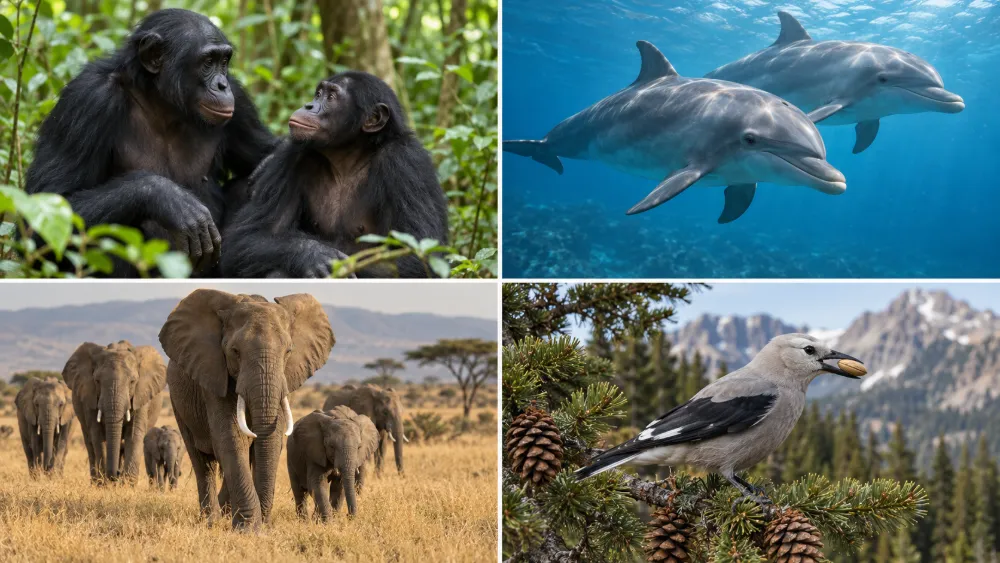
If you have spotted a large yellow and black butterfly, there is a good chance you are looking at a swallowtail—but several North American species can appear surprisingly similar at first glance.
The fastest way to identify one is not to look at color alone. Pay attention to black stripes versus yellow spots, the number of tails, blue or orange hindwing markings, body size and where you saw the butterfly.
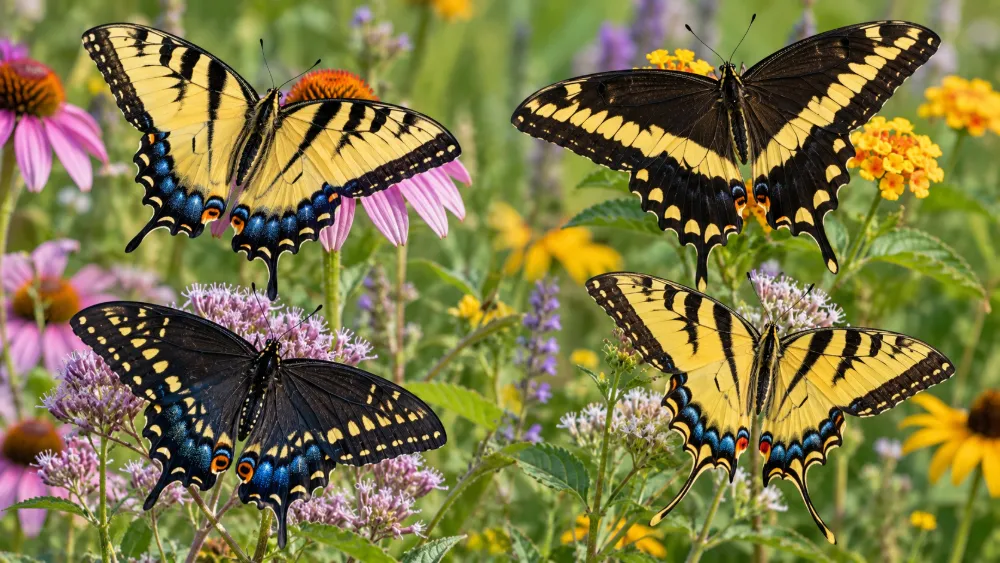
In eastern North America, a bright yellow butterfly with bold black tiger stripes is often an Eastern Tiger Swallowtail. In western regions, Western Tiger, Two-tailed and Anise Swallowtails become important possibilities. A very large mostly black butterfly crossed by yellow bands may instead be a Giant Swallowtail.
Quick Yellow and Black Butterfly Identification
| Species | Best Identification Clue | Approx. Wingspan | Main Region |
|---|---|---|---|
| Eastern Tiger Swallowtail | Bright yellow with bold black tiger stripes | 2.5–4.5 in | Eastern North America |
| Western Tiger Swallowtail | Yellow tiger pattern in western North America | 2.75–4 in | Western North America |
| Canadian Tiger Swallowtail | Smaller, broad black stripes, northern range | 2.6–3.1 in | Canada and northern U.S. |
| Two-tailed Swallowtail | Two tails on each hindwing | 3.5–5 in | Western North America |
| Giant Swallowtail | Huge, mostly black above with diagonal yellow bands | 4–6.25 in | Much of eastern and southern North America |
| Black Swallowtail | Mostly black with rows of yellow spots | 3.25–4.25 in | Much of North America |
| Anise Swallowtail | Black and yellow with yellow-orange hindwing eyespot | 2.75–3.5 in | Western North America |
1. Eastern Tiger Swallowtail
The Eastern Tiger Swallowtail (Papilio glaucus) is one of the first species to consider if you see a large yellow butterfly with black stripes in eastern North America.
Males are bright yellow with four bold black tiger-like stripes extending downward across each forewing.
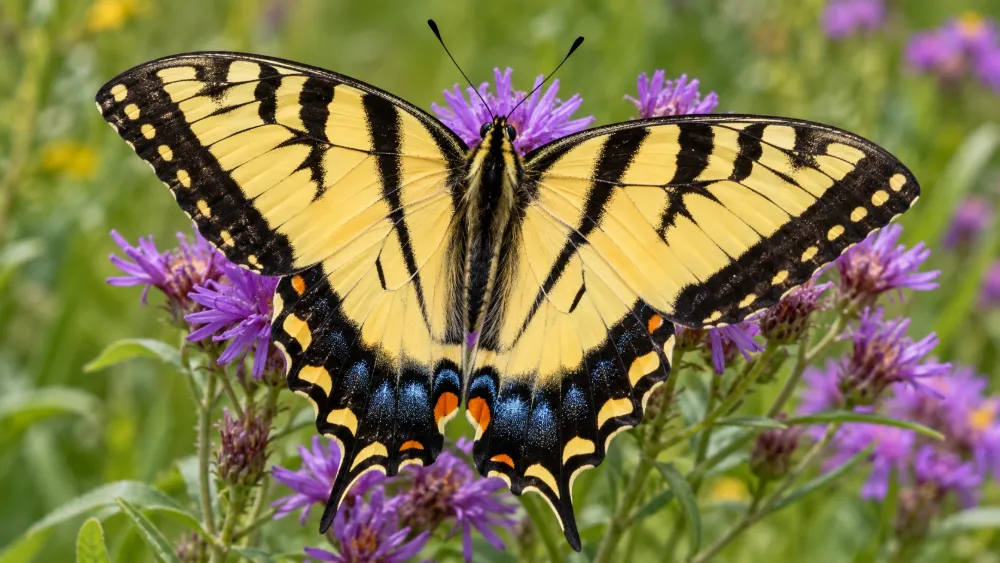
The hindwings have black margins, tails and small blue and orange markings.
Butterflies and Moths of North America gives the wingspan as approximately 2.5 to 4.5 inches.
The species ranges across eastern North America from Ontario south to the Gulf Coast and west into parts of Texas and the Great Plains.
Important: females are not always yellow
Female Eastern Tiger Swallowtails occur in two forms.
Some look much like males, with yellow-and-black tiger markings. Others are predominantly black.
The dark female form can therefore be mistaken for Black Swallowtails, Spicebush Swallowtails or Pipevine Swallowtails.
Dark females still retain subtle traces of the tiger pattern and typically show substantial blue scaling on the hindwings.
For more about this species, see our Tiger Swallowtail Life Cycle guide.
2. Western Tiger Swallowtail
If you are in western North America and see a yellow butterfly with black tiger stripes, the Western Tiger Swallowtail (Papilio rutulus) is an important candidate.
Its general appearance is very similar to the Eastern Tiger Swallowtail:
yellow background;
bold black forewing stripes;
black wing borders;
and a tail on each hindwing.
Butterflies and Moths of North America lists a wingspan of about 2.75 to 4 inches.
The species occurs from British Columbia south through much of the western United States and into Baja California, with its range extending east into parts of the Great Plains and Rocky Mountain region.
Eastern vs. Western Tiger Swallowtail
Location is one of the easiest first clues.
Western Tiger Swallowtails are characteristic of western North America, while Eastern Tiger Swallowtails dominate farther east.
Experts can also use details of the marginal wing spots and the underside of the hindwing, but photographs showing the exact region are often much easier to identify than a butterfly photographed without location information.
3. Canadian Tiger Swallowtail
The Canadian Tiger Swallowtail (Papilio canadensis) is another yellow-and-black tiger swallowtail, but it is generally smaller than its Eastern and Western relatives.
Butterflies and Moths of North America lists a wingspan of only about 2.6 to 3.1 inches.
Useful clues include:
relatively broad black tiger stripes;
yellow marginal spots on the underside of the forewing that can merge into a continuous band;
numerous orange scales on the hindwing;
and a strongly northern distribution.
The species ranges from central Alaska across much of Canada and into the northern Great Lakes and New England regions.
If you live well south of that range, an Eastern Tiger Swallowtail is usually a more likely identification.
4. Two-Tailed Swallowtail
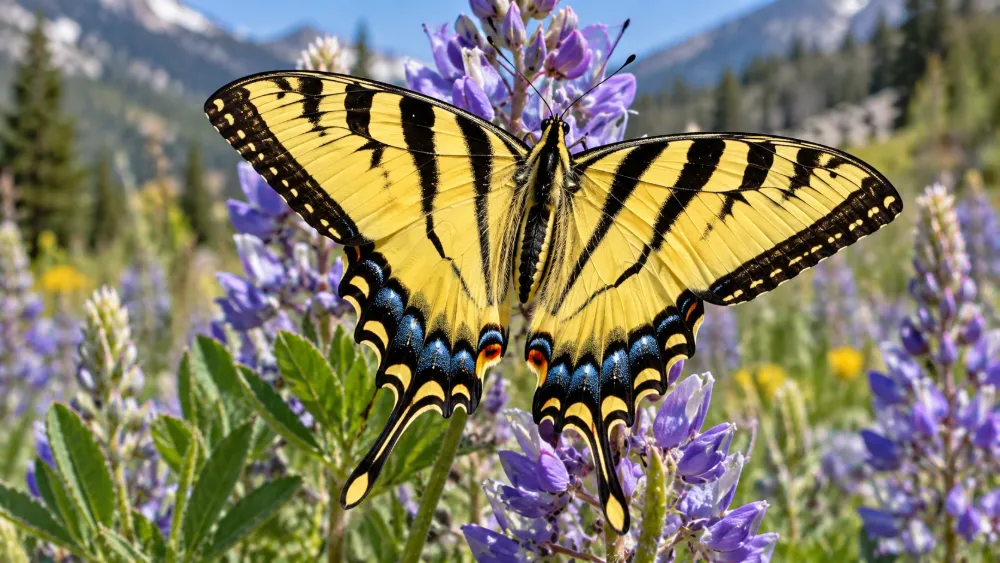
The Two-tailed Swallowtail (Papilio multicaudata) is one of the easiest tiger swallowtails to recognize if you get a clear view of the hindwings.
As the name suggests, each hindwing has two tails.
The wings are yellow with narrow black tiger stripes, and the butterfly can be large, reaching roughly 3.5 to 5 inches across.
It occurs mainly in western North America, including western Canada, the western United States and Mexico.
The species is often seen around:
canyons;
streamsides;
woodland;
parks;
suburbs;
and city gardens.
If a yellow tiger-striped butterfly appears unusually large and you can clearly see two tails on one hindwing, Two-tailed Swallowtail is a strong possibility.
5. Giant Swallowtail
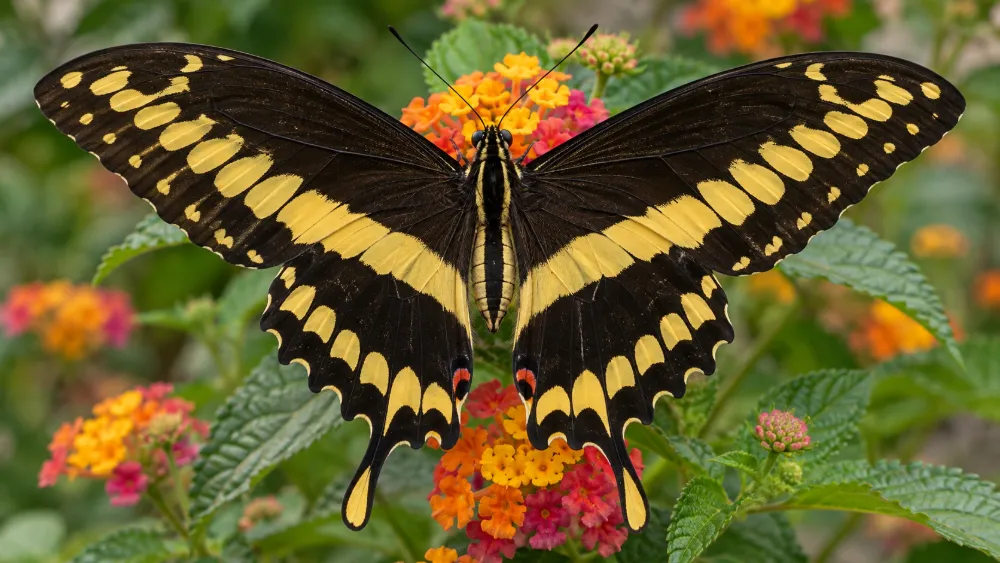
The Giant Swallowtail (Papilio cresphontes) looks very different from the yellow tiger swallowtails.
From above, its wings are mostly dark brown to black rather than mostly yellow.
A broad diagonal row of yellow spots crosses each forewing, with additional yellow markings continuing through the hindwings.
Size is another major clue.
Butterflies and Moths of North America gives Giant Swallowtails a wingspan of approximately 4 to 6.25 inches, making them among the largest butterflies commonly encountered in North America.
The tails themselves are dark-edged with yellow filling.
Giant Swallowtail caterpillars use plants in the citrus family, which is why adults are often encountered around citrus-growing regions and gardens where citrus relatives occur.
6. Black Swallowtail
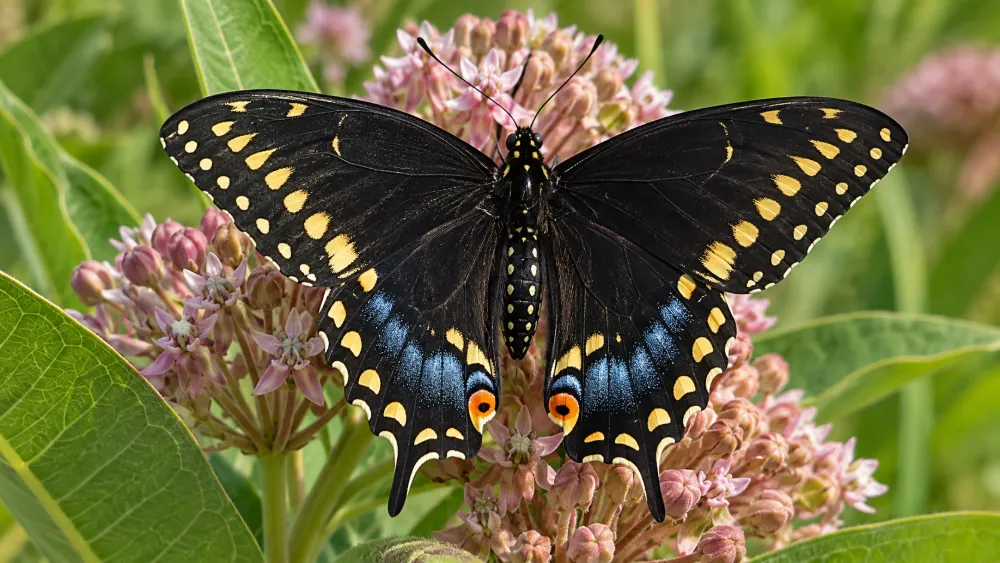
Despite its name, the Black Swallowtail (Papilio polyxenes) belongs in a yellow-and-black identification guide because yellow markings are one of its main field marks.
The upper wings are mostly black.
Males have a conspicuous yellow band near the outer edges of the wings. Females usually have a row of smaller yellow spots and more prominent blue coloration on the hindwings.
One useful identification feature is the orange spot near the inner edge of the hindwing. In the Black Swallowtail, that orange spot contains a distinct black center.
The wingspan is approximately 3.25 to 4.25 inches.
Check your garden plants
Black Swallowtail caterpillars commonly feed on plants in the parsley family, including:
dill;
parsley;
carrot;
celery;
and Queen Anne's lace.
If a black-and-yellow swallowtail is laying eggs around dill or parsley, Black Swallowtail becomes an especially strong candidate.
7. Anise Swallowtail
The Anise Swallowtail (Papilio zelicaon) is an important western species that can look like a black-and-yellow counterpart to the Black Swallowtail.
Its wings combine large areas of black and yellow, with tails on the hindwings.
A particularly useful clue is the yellow-orange eyespot near the hindwing tail. Butterflies and Moths of North America describes this spot as having a round black center that does not connect with the hindwing margin.
The wingspan is approximately 2.75 to 3.5 inches.
Anise Swallowtails occur across much of western North America, from British Columbia south through California, Arizona and New Mexico.
Like Black Swallowtails, their caterpillars commonly use plants in the parsley family.
What About the Zebra Swallowtail?
If the butterfly looks black and very pale yellow, cream or greenish white rather than strongly yellow, check the Zebra Swallowtail.
The Zebra Swallowtail has dramatic black stripes across a pale background and exceptionally long tails.
Its wingspan ranges from about 2.5 to 4 inches.
Another important clue is habitat and host plant. Zebra Swallowtail caterpillars feed on pawpaw plants.
The species occurs primarily in eastern North America.
Because its background color is often more white-green than yellow, it should not automatically be grouped with true yellow tiger swallowtails.
Fastest Way to Identify a Yellow and Black Butterfly
Use these five questions in order.
1. Is the butterfly mostly yellow or mostly black?
Mostly yellow with black tiger stripes:
Eastern Tiger Swallowtail;
Western Tiger Swallowtail;
Canadian Tiger Swallowtail;
Two-tailed Swallowtail.
Mostly black with yellow spots or bands:
Giant Swallowtail;
Black Swallowtail;
Anise Swallowtail.
2. Does it have tails?
Most species in this guide have at least one tail on each hindwing.
If there are clearly two tails on each hindwing, check Two-tailed Swallowtail first.
3. Are the black markings stripes or spots?
Strong vertical tiger-like stripes on a yellow wing suggest a Tiger Swallowtail.
A mostly black wing with rows of yellow dots suggests Black or Giant Swallowtail instead.
4. How large is it?
An exceptionally large butterfly approaching six inches across strongly suggests Giant Swallowtail.
Canadian Tiger Swallowtails, by contrast, are generally noticeably smaller.
5. Where did you see it?
Geography can eliminate several possibilities immediately.
Eastern U.S.: Eastern Tiger, Black, Giant and Zebra Swallowtails are important possibilities.
Western U.S.: Western Tiger, Two-tailed and Anise Swallowtails become especially important.
Canada and northern U.S.: Canadian Tiger Swallowtail deserves close attention.
Eastern Tiger vs. Black Swallowtail
These two can seem confusing because female Eastern Tiger Swallowtails sometimes occur in a dark form.
A typical yellow Eastern Tiger is easy: yellow wings with heavy black tiger stripes.
The dark female Eastern Tiger can be trickier.
Look for:
faint tiger-striping still visible within the dark forewings;
strong blue scaling across the hindwing;
differences in orange hindwing spots;
and overall larger tiger-swallowtail proportions.
A Black Swallowtail instead has the characteristic rows of pale yellow spots around mostly black wings.
Giant Swallowtail vs. Tiger Swallowtail
From above, these are usually easy to separate.
A Tiger Swallowtail is primarily yellow with black stripes.
A Giant Swallowtail is primarily black or very dark brown with a broad diagonal chain of yellow spots.
The Giant is also exceptionally large.
Butterfly Identification From a Photo
If you photograph an unknown butterfly, try to capture:
the upper surface of the wings;
the underside of the wings;
the entire hindwing and tails;
any blue or orange spots;
and a side view if possible.
Also record:
state or province;
month;
approximate size;
the flower it was visiting;
and any plant on which it laid eggs.
A photograph without location can make closely related tiger swallowtails much harder to identify.
Are Yellow and Black Butterflies Poisonous?
Color alone cannot tell you that.
Some swallowtails obtain chemical protection from their caterpillar host plants, while others participate in mimicry systems in which one species resembles another.
Butterflies and Moths of North America notes that swallowtails include both distasteful species and species that mimic distasteful butterflies.
That does not mean every yellow-and-black butterfly is toxic or dangerous.
Adult swallowtail butterflies are harmless to people.
FAQ
What is the large yellow butterfly with black stripes?
In eastern North America, it is often an Eastern Tiger Swallowtail. In the West, Western Tiger or Two-tailed Swallowtail may be more likely. Location and the number of hindwing tails help narrow the identification.
What butterfly is yellow with four black stripes?
A bright yellow butterfly with several bold black tiger-like stripes is likely one of the tiger swallowtails. Eastern Tiger Swallowtail is the common eastern species.
What butterfly is black with yellow spots?
Possibilities include Black Swallowtail, Giant Swallowtail and Anise Swallowtail. Giant Swallowtails are especially large and have broad diagonal yellow spot bands, while male Black Swallowtails show a more marginal yellow band.
What is the biggest black and yellow butterfly?
Among common North American species, the Giant Swallowtail is one of the largest, with a wingspan reaching approximately 6.25 inches.
What yellow and black butterfly has two tails?
The Two-tailed Swallowtail is a strong candidate. Each hindwing has two tails, and the butterfly has yellow wings with narrow black tiger stripes.
What yellow and black butterfly lays eggs on dill?
Black Swallowtail and Anise Swallowtail caterpillars both use plants in the parsley family. Which species is more likely depends strongly on your location.
Are Eastern Tiger Swallowtails always yellow?
No. Males are yellow, but females occur in both yellow and dark forms. Dark females can appear almost black.
How can I identify a butterfly from a picture?
Compare wing pattern, tails, blue or orange markings, size, geographic location and date. Photographs of both the upper and lower wing surfaces are especially useful.
Final Identification Checklist
If your butterfly is:
bright yellow with bold black tiger stripes in the East: check Eastern Tiger Swallowtail;
yellow and tiger-striped in the West: check Western Tiger Swallowtail;
small, yellow and tiger-striped in the far North: check Canadian Tiger Swallowtail;
large, yellow and carrying two tails on each hindwing: check Two-tailed Swallowtail;
enormous and mostly black with diagonal yellow bands: check Giant Swallowtail;
mostly black with yellow marginal spots, blue and orange: check Black Swallowtail;
black and yellow in western North America with a yellow-orange eyespot: check Anise Swallowtail.
Color is only the starting point. For a reliable identification, combine the wing pattern with geography, size and tail shape.
If the butterfly you saw was a tiger swallowtail, continue with our Tiger Swallowtail Life Cycle guide.
Sources Used for Fact Checking
Butterflies and Moths of North America — Eastern Tiger Swallowtail
Butterflies and Moths of North America — Western Tiger Swallowtail
Butterflies and Moths of North America — Canadian Tiger Swallowtail
Butterflies and Moths of North America — Two-tailed Swallowtail
Butterflies and Moths of North America — Giant Swallowtail
Butterflies and Moths of North America — Black Swallowtail
Butterflies and Moths of North America — Anise Swallowtail
Butterflies and Moths of North America — Zebra Swallowtail
```