Why do thresher sharks have such long tails? Because their tails are not just for swimming. Thresher sharks can use the extraordinarily long upper part of their tail fin like a whip, striking schools of fish with enough force to stun or injure prey.
In some thresher sharks, the upper tail lobe accounts for roughly half of the animal's total length. This gives them one of the most distinctive body shapes of any living shark.
But the most remarkable fact is that scientists have actually filmed thresher sharks hunting with their tails. Instead of relying only on a bite, they can disable several small fish with a single strike and then return to eat them.
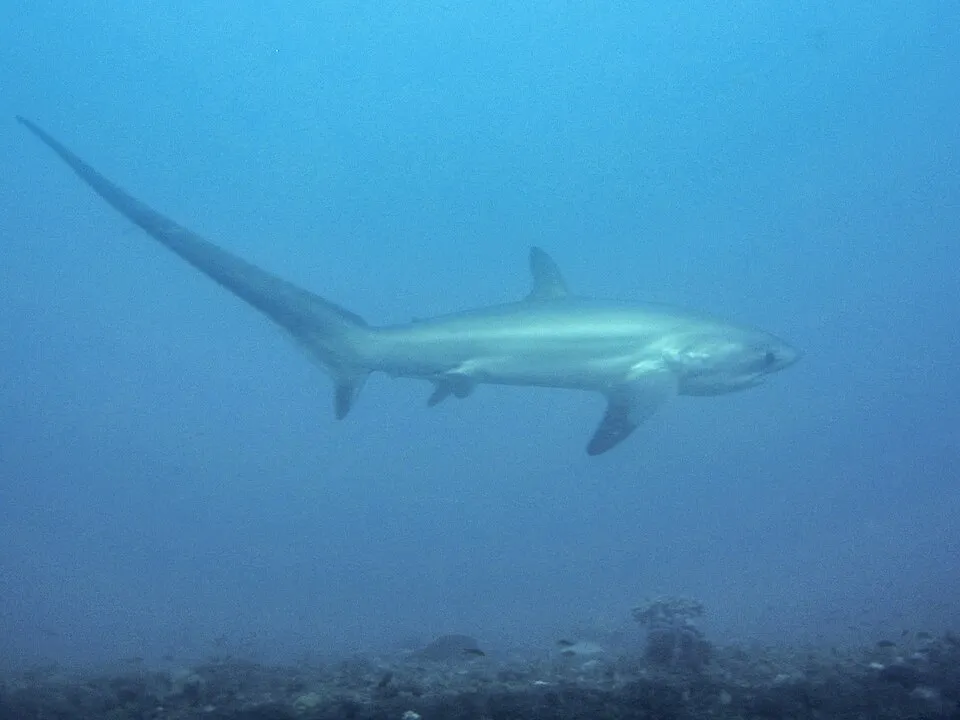
Pelagic thresher shark (Alopias pelagicus) at Monad Shoal, Malapascua, Philippines. Photo: Petter Lindgren / Wikimedia Commons, CC BY-SA 3.0.
What Makes a Thresher Shark's Tail Different?
Most sharks have an asymmetrical tail fin, meaning the upper and lower lobes are different sizes. This structure is called a heterocercal caudal fin.
In thresher sharks, however, the upper lobe is exceptionally elongated. It forms a narrow, curved structure that resembles a scythe or whip.
This feature is found in all three living species of thresher shark:
Common thresher: Alopias vulpinus
Pelagic thresher: Alopias pelagicus
Bigeye thresher: Alopias superciliosus
The long upper lobe is not a separate appendage. It is part of the shark's tail fin and is connected to the muscular movements of the body and tail.
NOAA Fisheries explains that the upper tail lobe may be approximately as long as the rest of the shark's body, giving the animal an unusual hunting advantage.
How Do Thresher Sharks Hunt With Their Tails?
Thresher sharks can hunt small fish by striking them with their tails rather than trying to catch each fish individually in their jaws.
In 2013, researchers published direct observations of this hunting strategy in the scientific journal PLOS ONE.
The team studied pelagic thresher sharks hunting sardines near Pescador Island in the Philippines. Their research described four main stages of a tail-slap attack.
Step 1: Approach a School of Fish
The shark approaches a group of small fish, such as sardines.
Schooling fish often swim close together, which creates an opportunity for a predator capable of striking more than one fish at a time.
The thresher does not always need to chase an individual fish over a long distance.
Step 2: Prepare the Tail Strike
The shark changes its posture as it approaches the prey.
In the observed overhead strikes, the pectoral fins move inward, changing the shark's body position and helping raise the rear part of its body.
This motion prepares the long upper tail lobe for a rapid strike.
Step 3: Whip the Tail Toward the Fish
The shark rapidly accelerates its tail through the water.
The forceful movement can strike, stun or injure fish in the surrounding school.
The movement is not an electrical attack. It is a physical strike made with the shark's powerful tail.
Step 4: Collect the Disabled Prey
After the strike, the shark slows and turns toward the affected fish.
It can then capture fish that have been stunned or injured.
The researchers observed that a successful attack could allow a shark to feed on more than one sardine.
What Did the Scientific Study Actually Prove?
The 2013 study, titled Thresher Sharks Use Tail-Slaps as a Hunting Strategy, was led by Simon P. Oliver and colleagues.
Researchers recorded 61 observations of pelagic thresher sharks hunting and analyzed 25 hunting events in detail.
The findings confirmed that thresher sharks were deliberately using their elongated tails to disable prey.
| Scientific Observation | What Researchers Found |
|---|---|
| Species studied | Pelagic thresher shark |
| Study location | Pescador Island, Philippines |
| Prey | Schooling sardines |
| Detailed hunting events analyzed | 25 |
| Main technique | Rapid tail slaps, frequently delivered overhead |
| Result | Fish were stunned or injured before being captured |
The study also described occasional sideways tail strikes. These were much less common in the observed hunting events.
The researchers concluded that the elongated tail is an important adaptation for capturing schooling prey.
Read the original open-access research in PLOS ONE.
Can a Thresher Shark Stun Several Fish at Once?
Yes. This is one of the advantages of tail-slap hunting.
When small fish gather in dense schools, a rapid strike can affect several fish close together.
The shark can then collect vulnerable prey rather than having to catch every fish during a high-speed chase.
However, not every tail strike is successful, and scientists have not established one universal number of fish stunned by each attack.
Success depends on prey position, strike timing, the shark's movements and other conditions.
How Long Is a Thresher Shark's Tail?
Thresher sharks have some of the longest tail fins relative to body length among sharks.
The upper lobe of the caudal fin may account for approximately half the shark's total length.
For example, a thresher shark measuring 4 meters from the snout to the tip of the tail may have a very substantial portion of that measurement contributed by its elongated upper tail lobe.
This does not mean every thresher has the same proportions. Tail shape and body proportions vary by species, age and individual.
The important distinction is that shark length measurements already include the tail. You should not add the tail length to a reported total length.
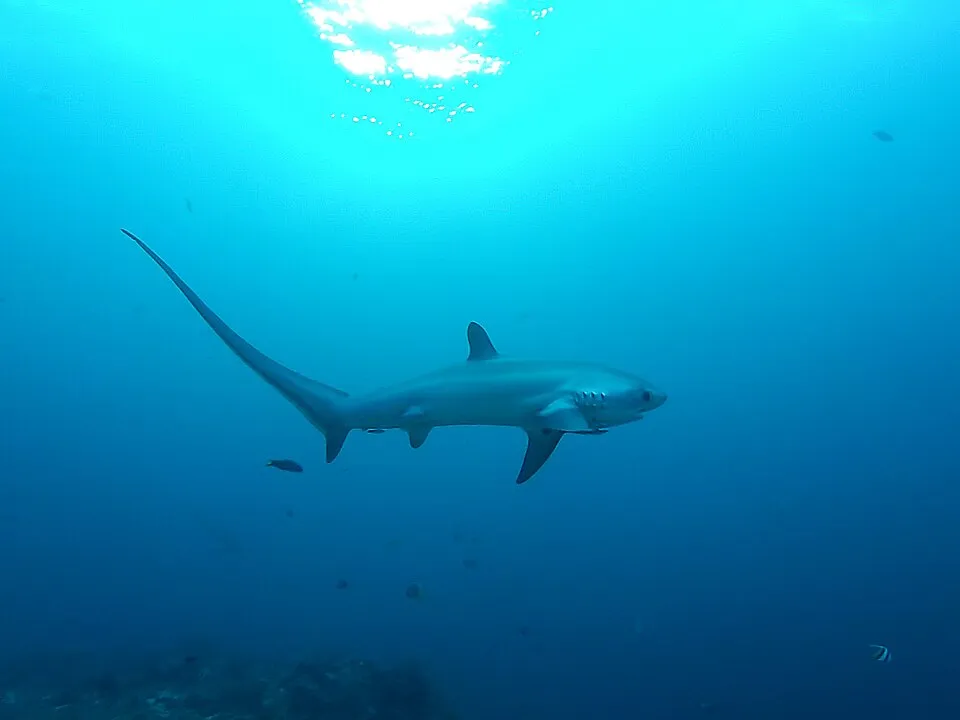
Pelagic thresher shark showing its elongated tail fin. Photo: Thomas Alexander / Wikimedia Commons, CC BY-SA 4.0.
Do Thresher Sharks Also Use Their Tails for Swimming?
Yes. The tail remains an essential swimming structure.
Like other sharks, thresher sharks generate propulsion through movements of their bodies and caudal fins.
Their unusually elongated upper tail lobe also provides a specialized structure for striking prey.
That makes the tail multifunctional: it contributes to normal movement through water and can be used during hunting.
Scientists continue to study the detailed mechanics and energetic costs of these unusual tail movements.
Are All Three Thresher Shark Species Tail-Slap Hunters?
All three living thresher shark species share the distinctive elongated upper tail lobe.
There is direct evidence of tail-assisted hunting in common and pelagic thresher sharks.
For the bigeye thresher, similar hunting behavior is biologically plausible, but published direct observations have been more limited.
It would therefore be misleading to claim that scientists have documented every detail of tail-slap hunting equally well in all three species.
| Species | Distinctive Feature | Hunting Evidence |
|---|---|---|
| Common thresher | Robust body and extremely long tail | Tail-assisted prey strikes documented |
| Pelagic thresher | Slender body and elongated upper tail lobe | Overhead and sideways tail strikes studied in the wild |
| Bigeye thresher | Very large eyes adapted to lower-light environments | Long tail suggests similar capability; direct evidence is more limited |
For a broader introduction to the three species, their distribution and physical characteristics, see the AnimalsTop Thresher Sharks species profile.
What Do Thresher Sharks Eat?
Thresher sharks feed primarily on other marine animals.
Their diets vary by species and region, but common prey includes:
Sardines
Anchovies
Herring
Mackerel
Other schooling fish
Squid and other cephalopods
NOAA Fisheries identifies small schooling fish as important prey for common thresher sharks.
The tail-slap technique is particularly useful in situations where many small prey animals are concentrated together.
Can a Thresher Shark's Tail Hurt a Human?
A powerful thresher shark tail could cause injury if it struck someone at close range.
However, thresher sharks are not known for deliberately hunting humans. They are generally considered shy around people.
When diving or snorkeling, the safest approach is to observe sharks without chasing, touching or attempting to block their movements.
The long tail is an adaptation for normal life and hunting, not a specialized weapon evolved to attack people.
Why Are Thresher Sharks Vulnerable to Fishing?
Thresher sharks can be particularly vulnerable to fishing pressure because of their biological characteristics.
They grow relatively slowly, mature later than many bony fish and produce comparatively few offspring.
Commercial fishing and accidental capture can affect thresher shark populations.
Their long tails can also become entangled or hooked during fishing operations.
Management measures differ among regions and species. Sustainable fishery practices, bycatch reduction and effective monitoring are important for conservation.
Protecting thresher sharks also protects an unusual hunting strategy that has evolved in marine ecosystems over millions of years.
Frequently Asked Questions
Why is a thresher shark's tail so long?
The elongated upper tail fin helps the shark swim and provides a specialized structure for striking and stunning schooling fish during hunting.
Do thresher sharks really whip their prey?
Yes. Scientific field observations and video evidence have documented thresher sharks using rapid tail strikes to stun or injure fish before eating them.
Can thresher sharks kill fish with their tails?
A sufficiently powerful tail strike can seriously injure prey. Researchers have documented sharks disabling fish with tail slaps, but the precise outcome varies between strikes.
Is a thresher shark's tail longer than its body?
The elongated upper lobe can approach the length of the rest of the shark in some individuals. It is often about half the animal's total length, but proportions vary.
Do all sharks hunt by slapping fish with their tails?
No. Shark species use many hunting methods, including biting, ambushing, filter feeding and pursuing prey. The highly specialized tail-slap hunting technique is particularly associated with thresher sharks.
Are thresher sharks dangerous to divers?
Thresher sharks are generally shy and are not known for hunting humans. However, they are powerful wild animals and should always be observed from a respectful distance.
The Bottom Line
Thresher sharks have exceptionally long tails because these structures are useful for more than ordinary swimming.
By rapidly striking schooling fish with the elongated upper lobe of the tail, a thresher shark can disable prey and then collect it.
Scientific observations have confirmed this behavior, making the thresher shark one of the ocean's most unusual predators.
Its tail is a striking example of how animal anatomy can evolve to support a highly specialized way of finding food.
Scientific Sources and Photo Credits
Oliver et al. (2013). Thresher Sharks Use Tail-Slaps as a Hunting Strategy. PLOS ONE.
NOAA Fisheries — Fascinating Shark Facts.
NOAA Fisheries — Pacific Common Thresher Shark.
Florida Museum of Natural History — Thresher Shark Species Profile.
Smithsonian Ocean — The Thrashing Thresher Shark.
Photo: Petter Lindgren — Pelagic Thresher Shark, CC BY-SA 3.0.