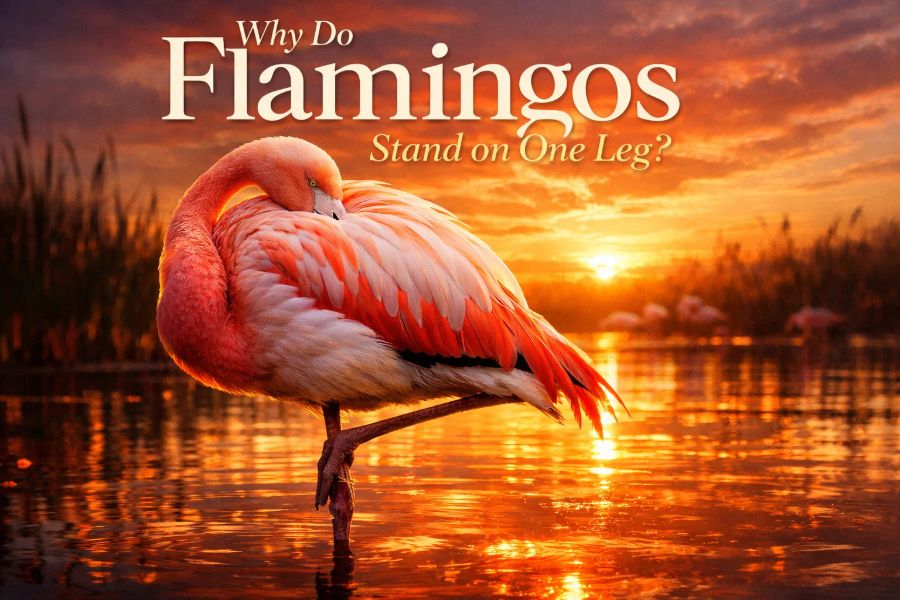
Flamingos standing on one leg look strange, elegant, and a little mysterious. For a long time, people assumed this posture must have one simple explanation. But the science suggests something more interesting: flamingos probably stand on one leg for more than one reason, with the strongest evidence pointing to a mix of reduced heat loss and a mechanically efficient resting posture that may require very little muscular effort.
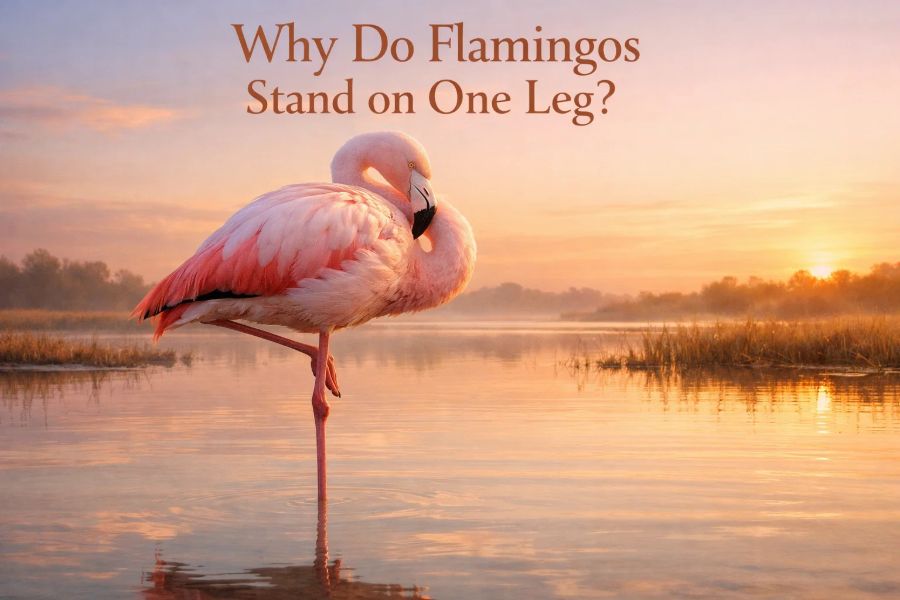
In other words, the best current answer is not “because they are cold” or “because it is just comfortable.” It is closer to this: one-legged standing appears to be an energy-saving resting strategy, and in cool conditions it likely also helps conserve body heat.
The short answer
If you want the simplest takeaway, it is this:
Flamingos stand on one leg because it is an efficient resting posture, and it may also help them lose less body heat, especially when standing in water or cool air.
Why scientists used to debate this
For years, several explanations competed with each other. Some people suggested flamingos stand on one leg to reduce muscle fatigue. Others argued it was mainly about thermoregulation, meaning heat conservation. Still others proposed that one-legged standing simply felt stable and comfortable for a bird built the way a flamingo is. Even modern zoo summaries still note that scientists are not unanimous on one single cause.
That debate happened because flamingos use the posture in more than one setting. They do it while resting on land, while standing in water, and even while sleeping. So any good explanation has to fit more than one behavioral context.
The strongest evidence: it can reduce heat loss
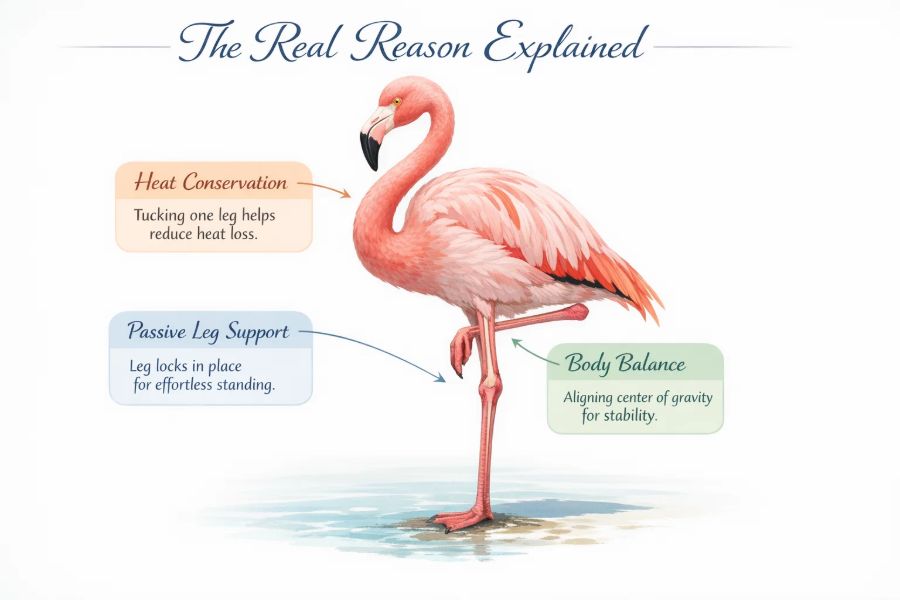
One of the most influential field studies found that flamingos were more likely to rest on one leg in colder conditions and more likely to do so when standing in water than on land. The same study found a negative relationship between temperature and one-legged resting: as temperature rose, one-legged standing became less common. Those results strongly support the idea that the behavior helps with thermoregulation.
This makes biological sense. Flamingos have very long, mostly unfeathered legs. If both legs are exposed to cool air or cool water, more body heat can leave the body. By pulling one leg up into the feathers, a flamingo reduces the amount of exposed surface area and may cut down on heat loss.
That said, thermoregulation is probably not the whole story, because flamingos also stand on one leg in warm regions and under conditions where simple heat conservation does not seem like the only explanation. That is one reason the mechanical explanation became so important.
The second major idea: it is mechanically efficient
A major 2017 biomechanics study changed the conversation by showing that flamingos can support their body on one leg with very little active muscular force. The researchers found that flamingo cadavers could passively support body weight on one leg in a stable posture resembling that of live flamingos, but could not be stably held in a two-legged pose the same way. The authors concluded that flamingos appear to use a kind of passive gravitational stay apparatus when standing on one leg.
That result is striking because it suggests one-legged standing may actually be less demanding, not more demanding, than standing on two legs. The same study also found that live flamingos standing quietly on one leg showed reduced body sway, which means they may need less active balancing effort in that posture.
So rather than constantly tensing muscles to avoid falling, a flamingo may be able to “stack” its body over one leg in a way that lets gravity and joint alignment do much of the work. In plain language, one leg may be the lazy, low-effort option when a flamingo is resting.
Why one leg might be better than two
At first this sounds backwards. Humans usually feel more stable on two legs than one. But flamingos are not built like humans. Their hips, knees, ankles, tendons, and body balance are arranged for a very different kind of standing posture. The 2017 study suggests that when a flamingo’s center of mass lines up properly over one leg, the joints can settle into a stable configuration that does not demand much muscular correction.
That does not mean flamingos never need muscle activity. It means that during quiet, resting one-legged posture, they may need less active effort than we would expect. This is especially plausible in a bird that spends long periods standing still in shallow water.
Does it help prevent fatigue?
Older ideas suggested flamingos might alternate legs simply to prevent one leg from becoming tired. But the 2010 Zoology/Biology study argued against the idea that one-legged resting mainly helps with muscle fatigue reduction or faster escape readiness. In that study, flamingos took longer to begin moving after resting on one leg than after resting on two, which makes the escape-readiness idea less convincing.
So the current evidence points away from “they do it because two legs are tiring” and more toward “they do it because one leg can be an energetically efficient resting posture, and in some conditions it also helps save heat.”
Why they often switch legs
Flamingos do not permanently use only one leg. Observational work found no strong individual or group-wide side preference in resting leg use, and birds divided resting time across both legs. That suggests they are not “left-legged” or “right-legged” in any simple fixed way for this behavior.
Switching legs probably helps distribute use over time, but the evidence does not support the simple idea that they are doing it because standing on one leg is a difficult balancing act. The biomechanics work suggests the opposite: once they are settled, it may actually be quite cheap mechanically.
Does water matter?
Yes, probably a lot. Flamingos spend much of their time standing in shallow water while feeding or resting. Water can draw heat away from the body faster than air, so a long bare leg standing in water is a potential heat-loss pathway. The 2010 study found that flamingos were more often on one leg in water than on land, which fits the heat-conservation idea well.
This does not prove that water is the only reason. But it strongly suggests that environmental conditions influence how often flamingos use the posture, and that standing in water makes one-legged resting even more useful.
Is it “just comfortable”?
Zoo educators sometimes describe the posture as possibly being comfortable, and that is not necessarily wrong. If a posture is mechanically stable and low-effort, then it may very well feel comfortable to the bird. The problem is that “comfortable” is not a full scientific explanation by itself. The better interpretation is that flamingos may find the posture comfortable because it is mechanically efficient and sometimes thermally beneficial.
So the comfort idea is best treated as a summary of the underlying mechanism, not as a competing explanation that replaces biomechanics or thermoregulation.
Do other birds do this too?
Yes. Flamingos are the most famous example, but other birds can also rest on one leg. That tells us the posture is not uniquely “weird,” even if flamingos have made it iconic. What makes flamingos especially interesting is the combination of very long legs, wetland life, and a body design that appears particularly suited to this passive one-legged stance.
So what is the best modern explanation?
The best current scientific explanation is a combined one:
One-legged standing can reduce heat loss, especially in cooler conditions and when the bird is standing in water.
One-legged standing appears mechanically efficient, allowing flamingos to rest with little active muscular force.
The behavior is therefore likely a form of energy-saving rest posture, with thermoregulation adding extra benefit in many situations.
That is more satisfying than older one-factor answers because it explains why flamingos use the pose so often and in more than one context.
Quick reference table
| Question | Best-supported answer |
|---|---|
| Why do flamingos stand on one leg? | Probably to save energy in a mechanically efficient posture, and often to reduce heat loss. |
| Is it mainly for warmth? | Heat conservation is strongly supported, especially in cold conditions and water, but it is probably not the only reason. |
| Is one-legged standing tiring? | The evidence suggests it may actually require very little muscular effort in flamingos. |
| Do they prefer one side? | Not strongly; they seem to divide resting time across both legs. |
| Do scientists fully agree? | Not on one single explanation, but thermoregulation plus passive mechanical support currently has the strongest evidence. |
Conclusion
Flamingos do not stand on one leg just to look elegant. The best evidence suggests that this famous posture is a smart biological solution: it can help reduce heat loss, and it may let the bird rest with surprisingly little muscular effort. So the real reason is not magic and not pure mystery. It is a clever combination of physics, anatomy, and energy economy.
References
Anderson, M. J., & Williams, S. A. 2010. Why do flamingos stand on one leg? Zoological Biology. Field evidence supporting a thermoregulation role, especially in colder temperatures and when birds stand in water.
Chang, Y.-H., & Ting, L. H. 2017. Mechanical evidence that flamingos can support their body on one leg with little active muscular force. Biology Letters. Biomechanical evidence for a passive stay mechanism and low muscular effort during one-legged standing.
San Diego Zoo Wildlife Alliance. Flamingo species page. General public-facing summary noting uncertainty and the heat-loss explanation.
Britannica. Flamingo. General overview noting multiple proposed explanations, including temperature regulation and energy conservation.