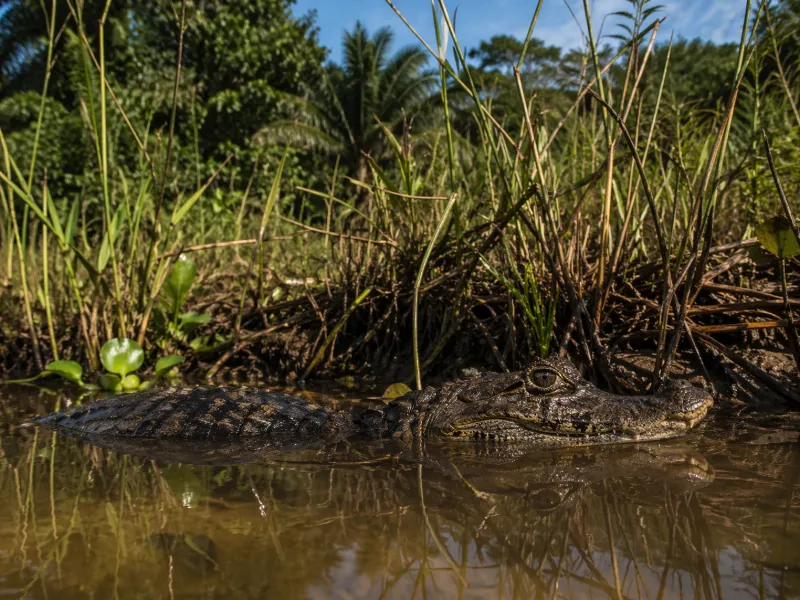
Caimans live in Central and South America, where they occupy a wide range of freshwater habitats such as rivers, marshes, swamps, lakes, flooded forests, and seasonally flooded grasslands. Some species are common in broad wetlands, while others prefer smaller forest streams and sheltered waterways.
Although caimans are often compared with crocodiles and alligators, they have their own distribution and ecological role. They are especially important in tropical wetland ecosystems, where they help regulate food webs as predators of fish, amphibians, reptiles, birds, and small mammals.
In this guide, you will learn where caimans live, which countries they are found in, what kinds of habitats they prefer, and how they are adapted to life in and around water.
Quick answer
| Question | Answer |
|---|---|
| Where do caimans live? | Caimans live in Central and South America |
| Main habitat type | Freshwater rivers, marshes, swamps, lakes, wetlands, and flooded forests |
| Do they live in salt water? | Mostly no, although some tolerate brackish water better than others |
| Do all caimans live in the same habitat? | No, different species prefer different wetland and river systems |
| Where are they most famous? | The Amazon, the Pantanal, and other tropical wetland regions |
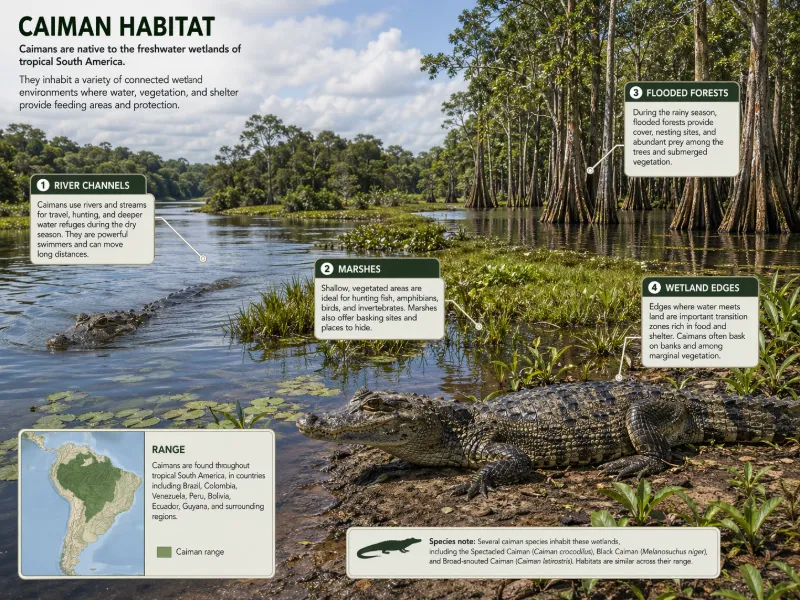
Caimans live in the Americas
Caimans are native to the Americas and do not naturally occur in Africa, Asia, or Australia. Their range stretches from parts of Central America into much of northern and central South America.
Different species live in different parts of this range. Some occur in broad tropical lowlands and major river basins, while others are associated with particular wetland regions or forest-linked waterways.
In general, if you are looking for caimans in the wild, you should think of tropical and subtropical freshwater habitats in Latin America rather than coastal Africa or Southeast Asia, which are more associated with crocodiles.
Countries where caimans are found
Caimans are found in a number of countries across Central and South America. Depending on the species, their range can include places such as southern Mexico, Belize, Guatemala, Honduras, Nicaragua, Costa Rica, Panama, Colombia, Venezuela, Brazil, Ecuador, Peru, Bolivia, Paraguay, Argentina, Guyana, Suriname, and French Guiana.
Not every species occurs in every country. Some have a very broad distribution, while others are more limited to certain river systems, forest regions, or wetland landscapes.
That is why identifying the exact species matters. A spectacled caiman may live across a wider range of habitats and countries than a dwarf caiman, while a yacare caiman is especially associated with central South American wetlands.
Most caimans live in freshwater habitats
Caimans are mainly freshwater reptiles. They are most commonly found in rivers, slow-moving streams, marshes, swamps, oxbow lakes, ponds, lagoons, flooded forests, and seasonally flooded plains.
These habitats provide the things caimans need most: water, prey, basking areas, cover, and nesting sites. Shallow edges, reeds, floating vegetation, muddy banks, and fallen branches all create useful hunting and resting areas.
Some caimans can tolerate brackish water better than others, especially in lowland tropical systems, but they are not as strongly associated with salty coastal environments as many crocodiles are. Overall, caimans are best understood as freshwater wetland predators.
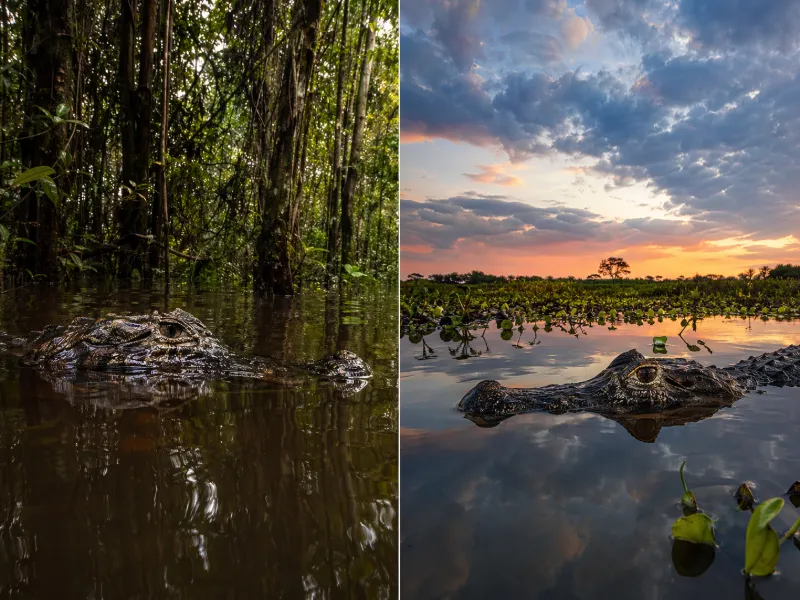
Rivers are one of their main habitats
Many caimans live in rivers, especially slow-moving tropical rivers with muddy banks, side channels, backwaters, and rich aquatic life. Rivers provide year-round water and connect many other habitats such as marshes, floodplains, and flooded forest.
Large river systems such as those in the Amazon basin are especially important because they support huge food webs. Fish, birds, turtles, amphibians, and mammals all gather around these waters, creating excellent hunting opportunities for caimans.
Different species use rivers in different ways. Large caimans may dominate deeper channels and broad river edges, while smaller species may stay closer to sheltered margins, roots, or side streams.
Marshes, swamps, and wetlands are also important
Caimans are especially well known from wetlands such as marshes, swamps, flooded grasslands, and shallow lagoons. These environments often hold large amounts of prey and provide warm basking sites and protected nesting areas.
In places such as the Pantanal, caimans may be one of the most visible predators in the landscape. During certain seasons, they can gather in impressive numbers where water remains and prey becomes concentrated.
Wetlands are important not only because they provide food, but also because they change through the year. Seasonal flooding can open new feeding grounds, while dry periods can force prey and predators into smaller water bodies.
Flooded forests are key habitat for some species
Not all caimans live in open marshes. Some species, especially smaller or more secretive ones, are closely linked to flooded forests, forest streams, and shaded tropical waterways.
These habitats offer shelter from branches, roots, overhanging vegetation, and dark water. Smaller caimans and dwarf caimans often use these places to hide, hunt, and avoid exposure.
Flooded forests can look very different from open wetlands, but they are just as important. They support fish, amphibians, insects, crustaceans, and many other prey items that help small and medium-sized caimans survive.
The Amazon is one of the most important caiman regions
The Amazon basin is one of the best-known caiman strongholds in the world. Its enormous network of rivers, flooded forests, lakes, and wetlands provides ideal habitat for several caiman species.
Black caimans, spectacled caimans, dwarf caimans, and other species can all be associated with parts of this immense region, depending on local conditions and geography. The Amazon offers warm temperatures, abundant water, and an enormous prey base.
Because the landscape changes seasonally, caimans in the Amazon often move within a shifting mosaic of rivers, flooded forest, side channels, and temporary wet areas.
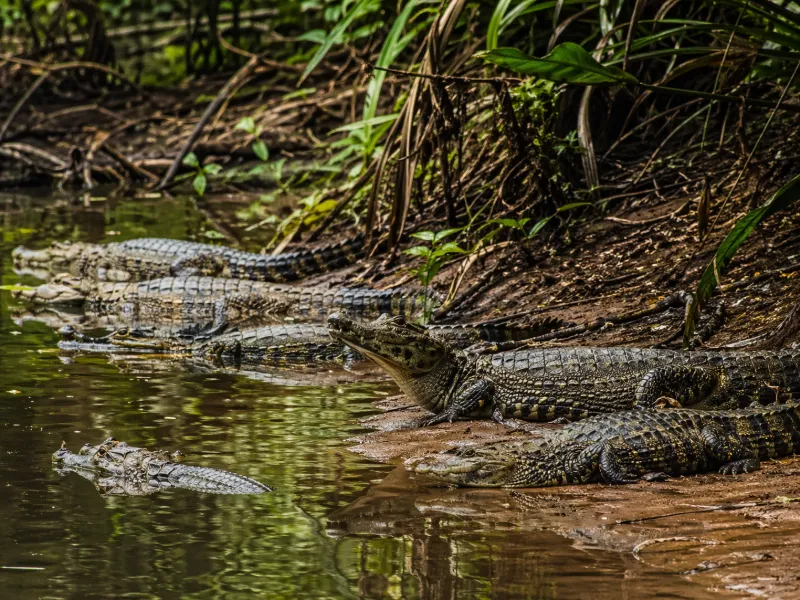
The Pantanal is famous for large caiman populations
The Pantanal, which spans parts of Brazil, Bolivia, and Paraguay, is one of the world’s largest tropical wetlands and one of the most famous places to see caimans.
This region is especially associated with the yacare caiman, which can occur in large numbers in suitable habitat. The Pantanal’s shallow water, flooded grasslands, marshes, and seasonal pools create ideal conditions for fish, birds, and other prey.
For wildlife watchers, the Pantanal is one of the easiest places to understand just how closely caimans are tied to wetland ecosystems.
Different caiman species use different habitats
Not all caimans live the same way. Some are more adaptable and use a wide range of freshwater habitats, while others are more closely tied to forest streams or particular wetland systems.
The spectacled caiman is often seen as one of the most adaptable species and can live in many different kinds of rivers, ponds, marshes, canals, and disturbed wetlands. The black caiman is larger and often dominates richer South American wetlands and river systems.
The yacare caiman is strongly linked to central South American floodplains and marshes, especially the Pantanal and nearby basins. Dwarf caimans, including Cuvier’s dwarf caiman and Schneider’s dwarf caiman, are more often associated with smaller forest waterways, shaded streams, and sheltered freshwater habitats.
This species-level difference is one reason the question “Where do caimans live?” has more than one simple answer.
How caimans are adapted to wetland life
Caimans have several features that make them effective wetland predators. Their eyes and nostrils sit high on the head, allowing them to remain almost fully submerged while still watching prey and breathing.
Their tails are powerful and help them move through the water quickly. Their skin is heavily armored, which offers protection, and their dark or olive coloration helps them blend into muddy banks, vegetation, and shadowy water.
They also use ambush hunting. Instead of chasing prey over long distances, they usually wait quietly until a fish, bird, reptile, or mammal comes close enough to seize.
These adaptations make caimans highly effective in rivers, marshes, and flooded forest environments.
Do caimans live in salt water?
Most caimans are mainly freshwater animals and are not strongly adapted to marine life. They do not generally occupy open coastal saltwater habitats in the same way that some crocodiles do.
However, some individuals may use brackish or slightly salty environments in certain places, especially where freshwater and coastal systems mix. This is still not the typical image of a caiman habitat.
If you picture the classic caiman home, think of tropical inland wetlands, slow rivers, marshes, flooded forests, and shallow freshwater systems rather than beaches or open sea coasts.
Do caimans move between habitats?
Yes. Many caimans shift their location depending on rainfall, flooding, food supply, breeding season, and water level. In wet seasons, they may spread into newly flooded areas, forest pools, or temporary wetlands.
In dry periods, they may concentrate in deeper rivers, lakes, lagoons, or permanent water bodies. This movement helps them stay close to prey and suitable shelter.
Because tropical wetlands often change dramatically through the year, flexible movement is an important part of how caimans survive.
Where do caimans sleep and rest?
Caimans often rest at the edge of the water, on muddy banks, on floating vegetation, or in shallow water where most of the body remains submerged. Some species also use dense vegetation, roots, or log jams as sheltered resting spots.
They may bask during the day to regulate body temperature, especially in cooler morning conditions. Others remain hidden in shadowy water and become more active at night.
The exact resting place depends on species, season, temperature, local disturbance, and how much cover is available.
Why caiman habitat matters for conservation
Caimans depend on healthy freshwater ecosystems. When rivers are polluted, wetlands are drained, forests are cut, or floodplains are heavily altered, local caiman populations can suffer.
These reptiles are important predators, so changes in their populations can affect fish, amphibians, invertebrates, and other animals in wetland food webs. Protecting caimans also means protecting the broader habitats they depend on.
In many parts of Latin America, conserving marshes, rivers, flooded forests, and tropical wetlands helps not only caimans, but also birds, fish, mammals, and countless other species.
Final takeaway
Caimans live in Central and South America, mainly in freshwater rivers, marshes, swamps, wetlands, flooded forests, lakes, and seasonally flooded plains. Different species use different habitats, from broad open wetlands such as the Pantanal to shaded forest streams in the Amazon and beyond.
They are highly adapted to life in and around water, and their survival depends on healthy tropical freshwater ecosystems.
FAQs
Do caimans live in the Amazon?
Yes. Several caiman species live in parts of the Amazon basin, where they use rivers, flooded forests, lakes, and wetlands.
Do caimans live in the Pantanal?
Yes. The Pantanal is especially famous for large numbers of yacare caimans.
Do caimans live in salt water?
Mostly no. Caimans are mainly freshwater reptiles, though some may tolerate brackish water in certain areas.
Where are dwarf caimans found?
Dwarf caimans are mainly found in South American forest streams, rivers, flooded forests, and other sheltered freshwater habitats.