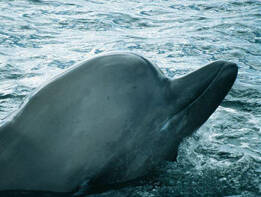
The false killer whale (Pseudorca crassidens) is a large oceanic dolphin with a sleek dark body, a blunt rounded head and no obvious beak. Its English name comes from a skull shape that resembles the orca (the “killer whale”), even though it belongs to the dolphin family (Delphinidae). In the water it is a fast, powerful swimmer, often seen traveling in tight social groups and sometimes bow-riding near vessels.
False killer whales are widely distributed in warm oceans around the world. They are typically associated with deep offshore waters but may also occur around oceanic islands, seamounts and shelf edges where prey concentrates. Highly social by nature, they form long-lasting relationships and can cooperate while foraging. As predators of medium to large fish and squid, they play an important role near the top of marine food webs.
Taxonomy and naming
This species is a toothed whale (Odontocete) in the family Delphinidae (oceanic dolphins). It is the only living species in the genus Pseudorca, making it both the representative and sole extant member of that genus.
Physical characteristics
False killer whales are long, muscular and streamlined. Adults are commonly about 4.3–5.6 m long, with the largest individuals approaching 6 m; males are generally larger than females. Body mass is often in the 1–2 tonne range, though size varies between ocean regions and populations. Colour is typically black to very dark grey, sometimes slightly paler underneath but usually appearing uniformly dark at sea.
The head is rounded and tapering, without a distinct beak. The dorsal fin is tall and swept back, and the flippers are relatively long with a characteristic “elbow-like” bulge along the leading edge. Strong conical teeth help grip slippery fish and squid. Close views may reveal scars and tooth rakes, which can result from social interactions, prey handling or contact with fishing gear.
Distribution and habitat
False killer whales occur throughout tropical and warm-temperate oceans worldwide. They are most often encountered in deep offshore habitats, but they can be frequent near islands, seamounts, channels and outer shelf edges where prey is abundant. In some regions, evidence suggests more resident coastal or island-associated groups, while in others the species is primarily pelagic.
Because much of their life occurs far from shore, monitoring is difficult and many questions remain about abundance, population structure and movement patterns in different basins.
Behaviour and lifestyle
This is a highly social dolphin. Groups commonly include 10–50 animals, and larger aggregations can form. Social bonds can be strong and long-lasting, and coordinated behavior is common. False killer whales may travel quickly at the surface, leap, or ride waves, and they are known to interact with other dolphin species on occasion.
During foraging, they may cooperate to chase schooling fish or undertake deeper dives in squid-rich waters. Like other toothed whales, they use echolocation to navigate and locate prey, especially in low light or deeper water.
Diet
False killer whales mainly eat medium to large fish and also take squid and other cephalopods. Diet varies by region and season depending on local prey availability. In some areas they interact with fisheries—especially longline operations—by taking hooked fish or bait, which can increase the risk of hooking, entanglement or injury.
Reproduction and life cycle
Females give birth to a single calf after a long pregnancy (typical of toothed whales). Calves have an extended dependency period and learn feeding and social skills within the group. Age at maturity varies among populations, but it generally occurs from late juvenile stages into early adulthood.
Lifespan can reach many decades. Females typically live longer than males, and some individuals are estimated to exceed 60 years. Because reproduction is relatively slow, elevated adult mortality from fisheries interactions or pollution can make recovery difficult for small or isolated populations.
Relationship with humans
False killer whales are not generally aggressive toward humans, but they may approach fishing vessels and take fish from lines, which can lead to accidental hooking or entanglement. The species has also been involved in mass stranding events, likely influenced by strong social cohesion, group-following behavior, local geography and health conditions.
In some regions, particular local populations face much higher risk. For example, a small insular population around the Main Hawaiian Islands has been the focus of intensive monitoring and management because of low numbers and fisheries interactions.
Conservation status and threats
At a global scale, the false killer whale is commonly assessed as Near Threatened (NT). Key concerns include limited reliable global trend data combined with known pressures in parts of its range. Major threats include accidental capture or injury in fisheries (hooking and entanglement), disturbance from underwater noise (which can interfere with echolocation and communication), accumulation of pollutants (such as heavy metals and persistent organic chemicals), and ship strikes.
Effective conservation typically focuses on reducing fisheries interactions (gear modifications and safer practices), improving monitoring in key habitats, reducing marine pollution inputs, and managing vessel and noise impacts in important areas.