The short answer is that a water bug and a roach are usually not the same insect, even though people often use the names interchangeably. A true water bug is an aquatic insect that lives in or around water and often preys on other animals. A roach, or cockroach, is a land-dwelling scavenging insect that commonly lives in buildings, sewers, kitchens, and other human environments. The confusion is mostly caused by everyday language, not by biology.
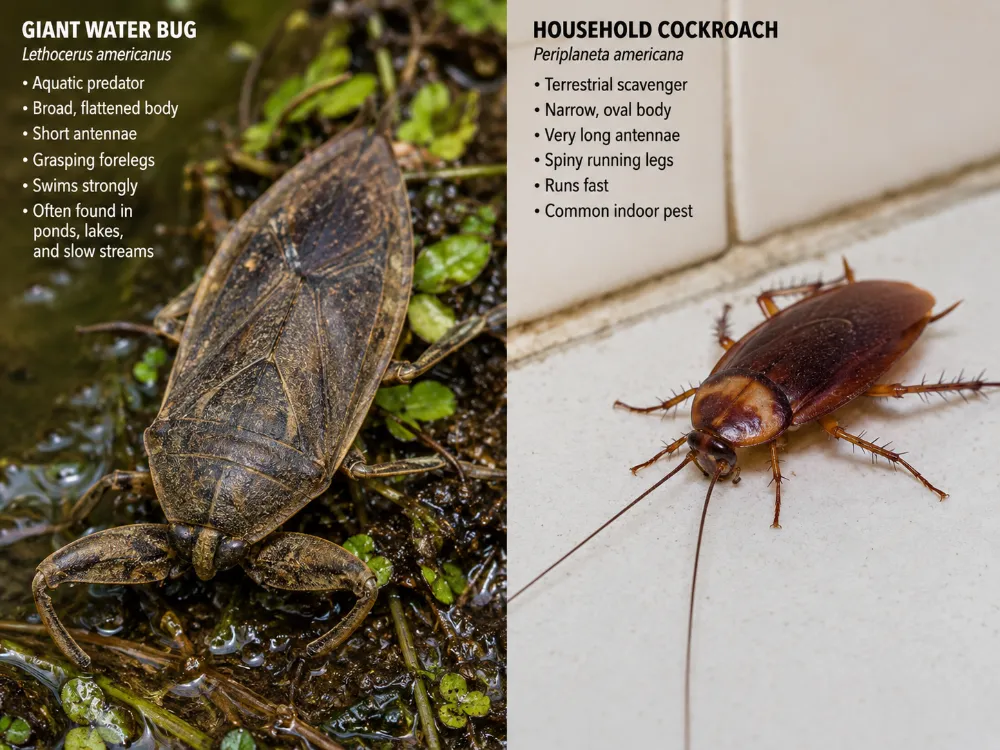
Many people call large dark cockroaches “water bugs,” especially in parts of the United States. That nickname is common, but it is not scientifically precise. True water bugs are a different group of insects with different anatomy, habitat, feeding habits, and behavior.
In this guide, you will learn what separates a real water bug from a roach, why the names get mixed up, and how to identify each one more accurately.
Quick comparison table
| Feature | Water Bug | Roach |
|---|---|---|
| Basic meaning | A true aquatic bug, often a predatory insect | A cockroach, a land-dwelling scavenging insect |
| Main habitat | Ponds, lakes, marshes, slow water, edges of freshwater habitats | Homes, basements, kitchens, sewers, walls, leaf litter, urban spaces |
| Lifestyle | Usually aquatic or strongly water-associated | Mainly terrestrial |
| Diet | Often predatory, feeding on insects, tadpoles, or small aquatic animals | Omnivorous scavenger, feeding on crumbs, waste, organic material, and many household foods |
| Body shape | Usually flatter, more specialized for aquatic life | Oval, flattened, fast-running, classic cockroach body |
| Front legs or mouthparts | Often adapted for grabbing prey | Not specialized for aquatic predation |
| Human home association | Usually accidental if found indoors | Often a real household pest |
| Best quick clue | Aquatic habitat and predatory bug features | Fast-running cockroach shape in houses or buildings |
What is a water bug?
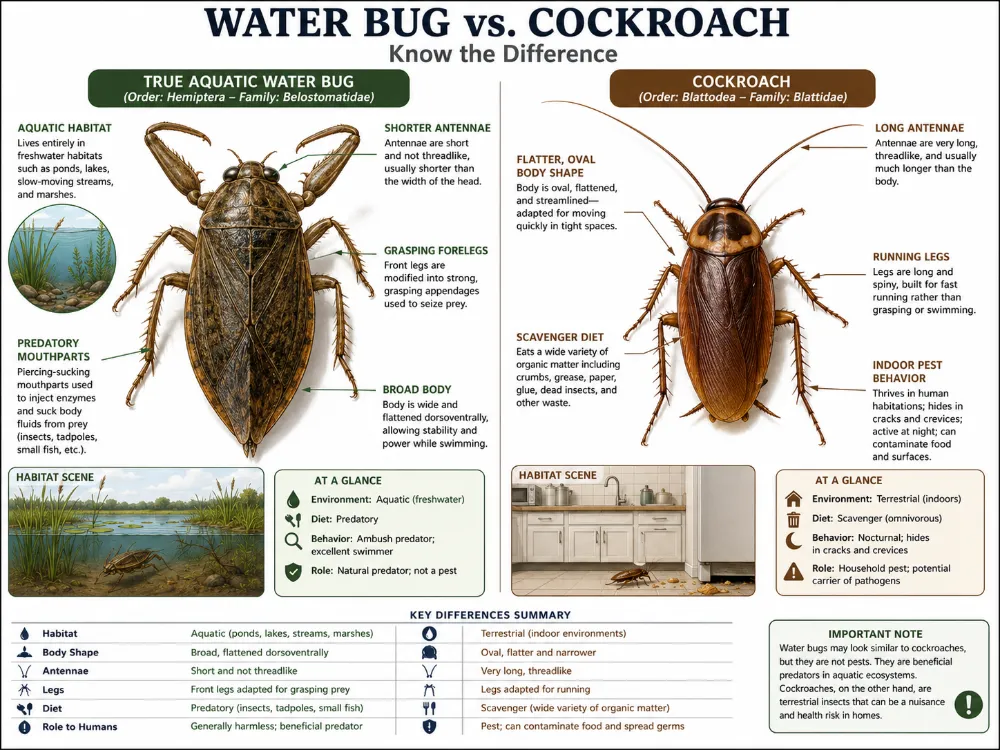
In biology, a water bug is an insect that belongs to a group of true bugs adapted for life in water or around freshwater habitats. These insects are not cockroaches. They belong to a different branch of the insect world and often show strong adaptations for swimming, floating, or hunting in aquatic environments.
Some of the best-known true water bugs include giant water bugs, water boatmen, and backswimmers. Not all look identical, but they share one important point: they are real aquatic insects rather than household scavengers.
So when zoologists use the term water bug, they usually mean an insect that truly belongs to a water-associated bug group, not a roach from a basement.
What is a roach?
A roach is a cockroach. Cockroaches are insects in a completely different order from true water bugs. They are mainly land-dwelling and are famous for being fast-moving scavengers that can exploit many environments, especially those shaped by humans.
Roaches are often associated with kitchens, restaurants, garbage areas, wall voids, drains, basements, and warm sheltered spaces. Some species live mostly outdoors, while others are notorious indoor pests.
So when people say “roach,” they are talking about a cockroach, not a true aquatic insect.
Why people call roaches “water bugs”
The confusion usually comes from common speech rather than science. In many places, especially in casual conversation, people call large dark cockroaches “water bugs” because they are found near drains, pipes, damp basements, crawl spaces, or bathrooms.
This nickname is especially common for larger roach species such as the American cockroach or the Oriental cockroach. Because they may appear near moisture and can survive in humid places, people start using “water bug” as a softer or more familiar name.
Biologically, though, a cockroach near a sink is still a cockroach, not a true water bug.
They belong to different insect groups
True water bugs and cockroaches are not closely interchangeable insect types. They belong to different major insect lineages and have different mouthparts, body adaptations, and ecological roles.
Water bugs are part of the true bug world and often have piercing mouthparts adapted for feeding on liquid or soft tissue. Cockroaches belong to a different order and are built more as generalist scavengers with chewing mouthparts.
This means the difference is not just about where they live. It is also about basic anatomy and evolutionary history.
Habitat is one of the biggest differences
If the insect truly lives in ponds, marshes, ditches, or freshwater habitats, it is much more likely to be a real water bug. True water bugs are built for aquatic life and often spend most of their active time in or on the water.
Roaches, by contrast, are mainly land insects. Even species that like moisture usually do not live as true aquatic animals. They may hide in damp places, but they are not swimming predators in a pond ecosystem.
This is one of the simplest and most practical differences: real water bugs belong to water habitats, while roaches belong mostly to land-based environments.
Water bugs are often predators
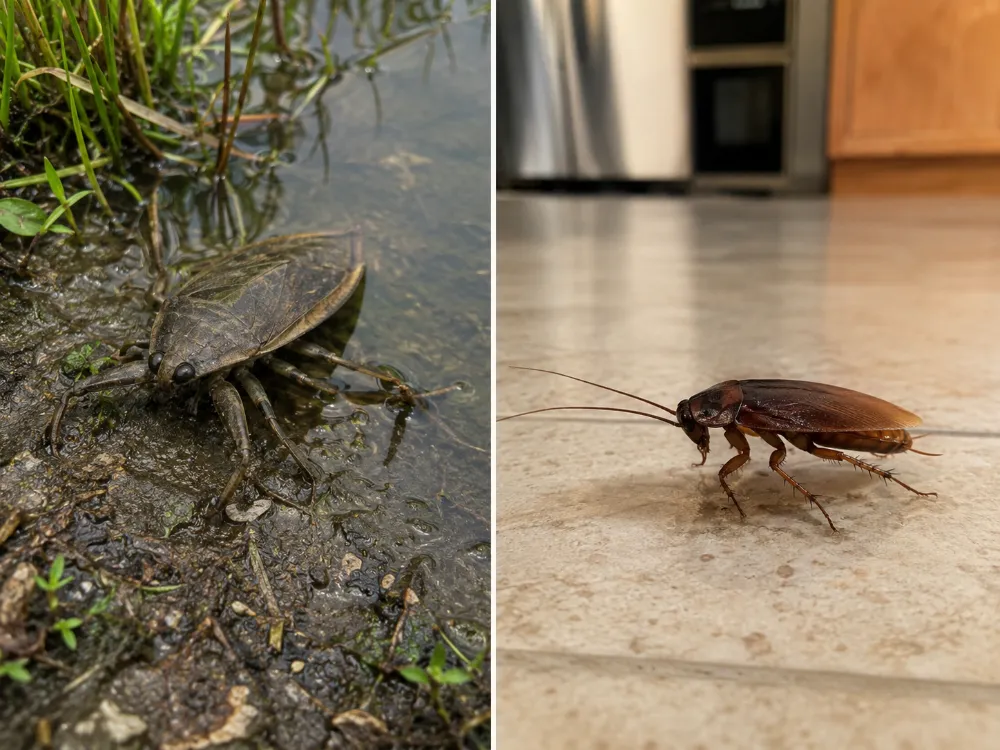
Many true water bugs are hunters. Giant water bugs, for example, can prey on insects, small fish, tadpoles, and other aquatic animals. They often wait quietly and then grab prey with strong front limbs before feeding.
This predatory lifestyle is very different from that of a cockroach. A water bug is not usually wandering around looking for kitchen scraps. It is behaving more like a small aquatic predator.
That is one reason true water bugs may look more intimidating than people expect when they see them up close.
Roaches are usually scavengers and opportunists
Cockroaches are best known as scavengers. They eat a wide range of organic materials, including crumbs, grease, pet food, paper residues, decaying matter, and many other food sources. Their success comes from flexibility rather than specialized predation.
This ability to eat almost anything is one reason roaches thrive in human environments. A kitchen, restaurant, garbage area, or storage space can provide many opportunities.
So if the insect is living off household waste or stored food, it is behaving like a roach, not a true water bug.
Body shape can help identify them
Roaches usually have the classic cockroach look: a flattened oval body, long antennae, fast-running legs, and a shield-like area behind the head. Their body is built for squeezing into cracks, running quickly, and surviving in cluttered environments.
Water bugs can also look flattened, but many have more obviously specialized aquatic features. Depending on the species, they may have raptorial front legs, oar-like hind legs, or a body shape better suited for moving through water than darting across a kitchen floor.
So the body outline may overlap a little in casual viewing, but the details tell a different story.
Roaches usually have very long antennae
Cockroaches are famous for their long, obvious antennae. These are important sensory tools for moving through dark spaces, finding food, and navigating cracks and corners.
True water bugs can have antennae too, but in many common species the antennae are less visually dominant or are shaped and positioned differently from those of a typical cockroach.
If the insect strongly resembles the classic long-antenna household roach shape, cockroach becomes much more likely.
True water bugs can bite
One surprise for many people is that some true water bugs can deliver a painful bite if handled. Giant water bugs in particular are known for this. They do not bite because they want to attack humans, but because they are predators with piercing mouthparts and can defend themselves when disturbed.
Cockroaches are much less famous for biting people. Although a roach can technically use its mouthparts if forced into odd conditions, roaches are not generally known for delivering the same kind of painful defensive bite that true water bugs can.
This is another major ecological difference between the two.
Finding one indoors means different things
If you find a roach indoors, especially repeatedly, it may indicate a real indoor population or pest problem. Cockroaches are well known for infesting buildings, reproducing indoors, and using human structures as stable habitat.
If you find a true water bug indoors, it is more often an accidental visitor, especially if it was attracted by lights or wandered in from nearby water. A single water bug indoors does not usually mean the same thing as repeated roach sightings in a kitchen.
This is why correct identification matters so much in practical pest discussions.
Not all large dark insects near water are true water bugs
This is where many mistakes happen. People often see a large brown or black insect near a drain, foundation, bathroom, or basement and assume “water bug.” But many of these are simply roaches using humid, sheltered spaces.
The word water bug can make the insect sound less like a pest, but the biology does not change. A cockroach living near plumbing is still a cockroach. Moisture preference does not turn it into an aquatic bug.
So habitat detail matters. Damp indoor space is not the same thing as true freshwater habitat.
Behavior is different too
Roaches usually run quickly across floors, walls, and cluttered surfaces. Their behavior often looks like darting, hiding, and squeezing into cracks. They are built for terrestrial escape and survival in dark, narrow spaces.
True water bugs often move in or on water and may behave more like sit-and-wait hunters or swimming insects. Their movement style reflects aquatic life rather than indoor scavenging.
If the insect behaves like a fast indoor runner, roach is often the better guess. If it behaves like a water-associated predator, true water bug becomes more likely.
Why the confusion matters
The difference matters because the ecological role and practical meaning are not the same. A true water bug is part of a freshwater food web and may be an interesting aquatic predator. A roach in a home is often a sanitation and pest-management issue.
Using the wrong name can also lead to misunderstanding. Someone who says “I found a water bug in my kitchen” may actually be describing a cockroach infestation, while someone who finds a giant water bug near a pond may be talking about a completely different insect.
So accurate naming helps both science and everyday life.
How to tell them apart quickly
If you need a fast identification guide, use these clues together:
Water bug: true aquatic habitat, predatory behavior, water-adapted body features, often associated with ponds or marshes
Roach: terrestrial scavenger, long antennae, classic cockroach body, common in homes, kitchens, basements, and urban structures
If it is living in your wall, pantry, or under your sink, it is much more likely to be a roach than a true water bug.
Final takeaway
The main difference between a water bug and a roach is that a true water bug is an aquatic insect, often a predator, while a roach is a cockroach, a land-dwelling scavenger that commonly lives around people. The confusion happens because many people use “water bug” as a nickname for large roaches, especially those found near damp spaces. In biology, however, they are different insects with different habitats, behaviors, and body design.
FAQs
Is a water bug the same as a roach?
Not usually. A true water bug is an aquatic insect, while a roach is a cockroach.
Why do people call roaches water bugs?
Because some large cockroaches are found in damp places such as basements, drains, and bathrooms, and the nickname became common in everyday speech.
Do true water bugs bite?
Some can, especially large predatory species such as giant water bugs, and the bite can be painful.
If I find one in my kitchen, is it probably a water bug or a roach?
If it is regularly appearing in a kitchen or other indoor living space, it is much more likely to be a roach.