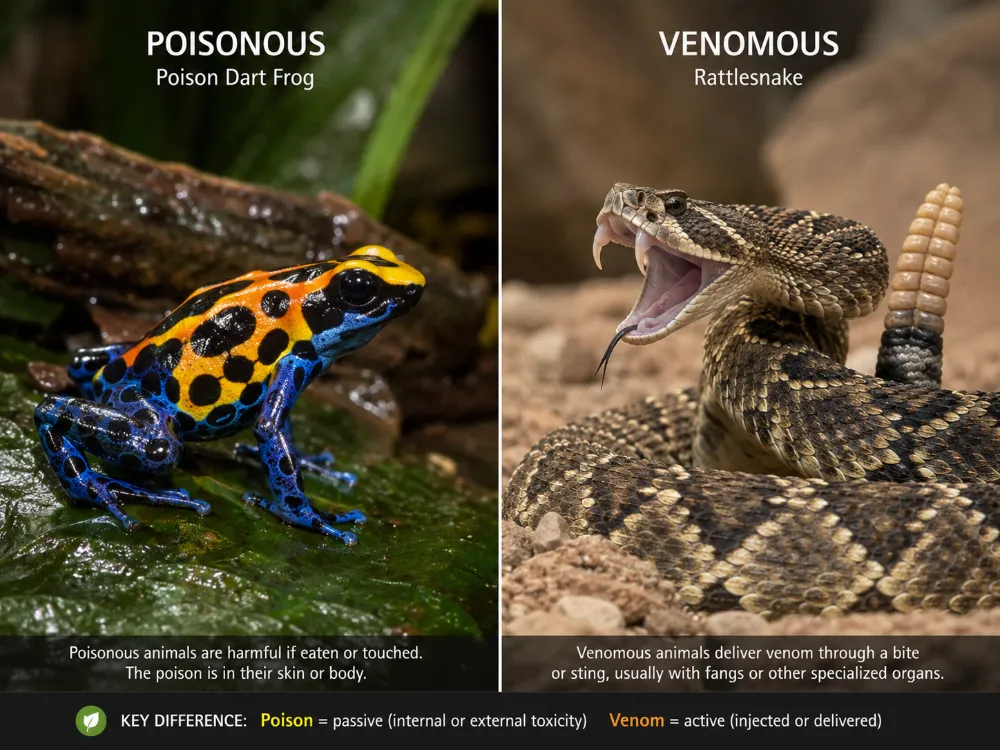
Poisonous and venomous do not mean the same thing. A venomous animal delivers toxins by biting, stinging, or injecting them, such as a rattlesnake, bee, spider, or scorpion. A poisonous animal causes harm when its toxins are touched, eaten, or absorbed, such as a poison dart frog, cane toad, or pufferfish. Simply put: venom is injected; poison is touched, eaten, or absorbed.
| Feature | Poisonous | Venomous | Easy Rule |
|---|---|---|---|
| How the toxin enters the body | Through touch, swallowing, inhaling, or absorption | Through injection by bite, sting, spine, fang, or harpoon-like structure | Poison is taken in; venom is delivered in. |
| Animal action | Usually passive defense | Usually active defense or prey capture | Poison waits; venom strikes. |
| Common examples | Poison dart frogs, cane toads, pufferfish, rough-skinned newts | Rattlesnakes, cobras, bees, wasps, spiders, scorpions, cone snails | Frogs are often poisonous; snakes are often venomous. |
| Main purpose | Prevents predators from eating or touching the animal | Subdues prey or defends against threats | Poison discourages attack; venom can stop prey. |
| Delivery structures | Skin glands, toxic organs, tissues, secretions | Fangs, stingers, spines, barbs, modified teeth | Venom needs a delivery tool. |
| Can the animal hurt you by biting? | Not usually because of poison, unless it also has venom or harmful bacteria | Yes, if venom is injected | A venomous bite is medically important. |
| Can the animal hurt you if you eat it? | Yes, if its tissues contain poison | Sometimes, but venom often works mainly when injected | A poisonous animal may be dangerous to eat. |
| Common confusion | People may call poisonous snakes “poisonous,” but most dangerous snakes are venomous | People may call venomous spiders “poisonous,” but the correct term is venomous | Most biting and stinging animals are venomous, not poisonous. |
The Simple Difference Between Poisonous and Venomous
The difference between poisonous and venomous is based on how the toxin enters another animal’s body. If the toxin harms you when you touch, eat, inhale, or absorb it, the organism is poisonous. If the toxin is injected into you through a bite, sting, spine, or similar structure, the organism is venomous.
A classic shortcut is:
If you bite it and you get sick, it is poisonous.
If it bites you and you get sick, it is venomous.
This rule is useful, but not perfect. Some animals are both poisonous and venomous. Some toxins can cause different effects depending on how they enter the body. Some animals are dangerous to touch, while others are dangerous only if they inject venom.
Still, the main idea is simple: poison is usually a defensive toxin that waits to be touched or eaten; venom is usually an active toxin delivered through a specialized weapon.
What Does Poisonous Mean?
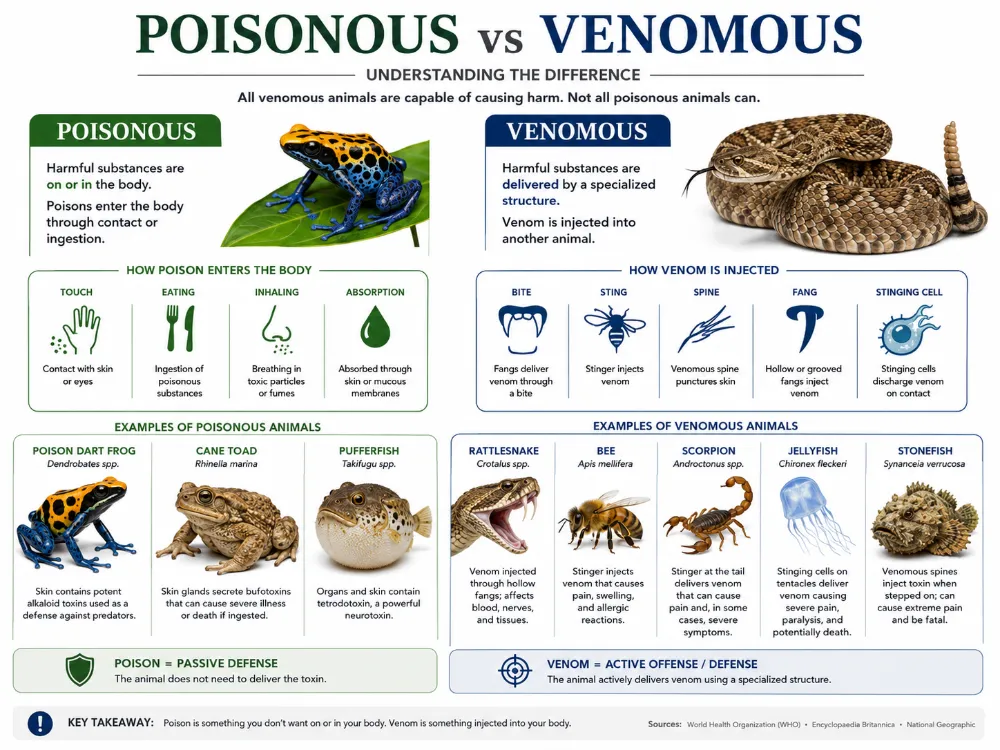
A poisonous animal contains or secretes toxins that cause harm when another animal touches it, eats it, licks it, or absorbs the toxin through skin or mucous membranes. Poisonous animals usually do not need to bite or sting to deliver their toxin.
Many poisonous animals use toxins as a defense against predators. The predator learns that the animal tastes bad, causes sickness, burns the mouth, or can even be deadly. Bright warning colors often advertise this danger.
Common poisonous animals include:
Poison dart frogs
Cane toads
Rough-skinned newts
Pufferfish
Some salamanders
Some butterflies and caterpillars
Some reef fish
Some sea slugs
Poisonous animals often rely on warning signals. Bright colors such as red, orange, yellow, blue, or black can tell predators, “Do not eat me.” This is called warning coloration, or aposematism.
What Does Venomous Mean?
A venomous animal produces toxins and actively delivers them into another animal’s body. This is usually done through fangs, stingers, spines, barbs, modified teeth, or harpoon-like structures.
Venom can be used for defense, hunting, or both. A rattlesnake uses venom to subdue prey and defend itself. A bee uses venom mainly for defense. A cone snail uses venom to immobilize prey. A spider uses venom to subdue insects and begin digestion.
Common venomous animals include:
Rattlesnakes
Cobras
Vipers
Black widow spiders
Brown recluse spiders
Scorpions
Bees
Wasps
Fire ants
Jellyfish
Stonefish
Cone snails
Gila monsters
Venom is often a complex mixture of proteins, enzymes, peptides, and other molecules. Different venoms affect the body in different ways. Some damage blood and tissue, some affect nerves, some cause severe pain, and some interfere with heart or muscle function.
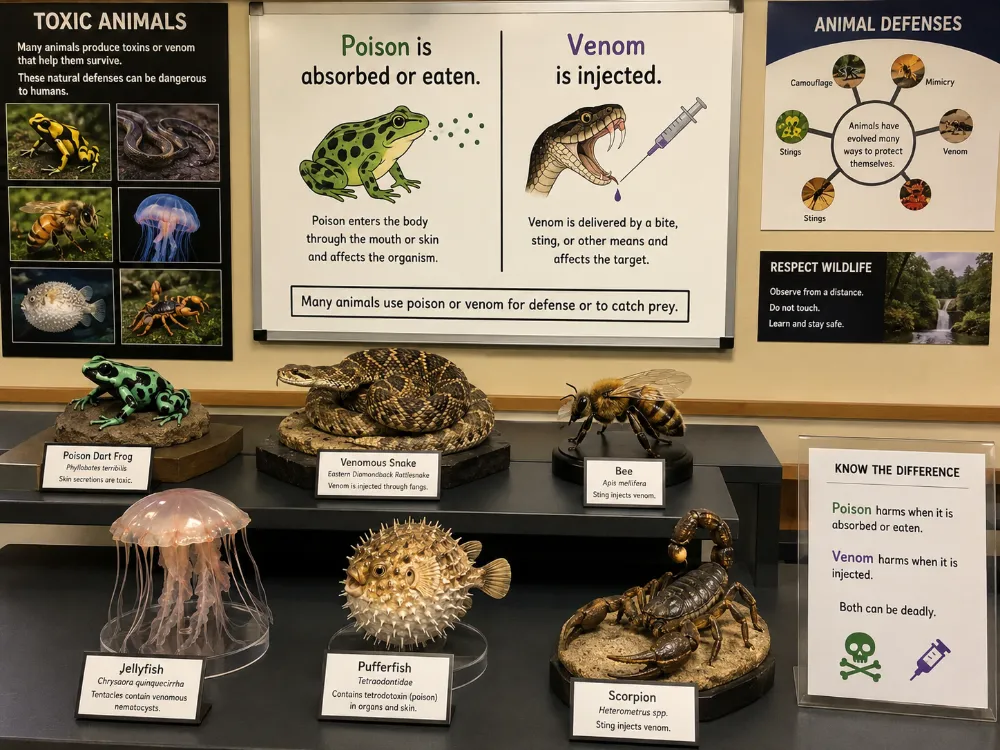
Poisonous vs Venomous Examples
| Animal | Poisonous or Venomous? | How the Toxin Works |
|---|---|---|
| Poison dart frog | Poisonous | Toxins are carried in skin secretions and can harm predators that touch or eat the frog. |
| Rattlesnake | Venomous | Venom is injected through hollow or grooved fangs during a bite. |
| Honey bee | Venomous | Venom is injected through a stinger. |
| Cane toad | Poisonous | Toxic glands behind the eyes release poison that can harm predators. |
| Black widow spider | Venomous | Venom is injected through tiny fangs. |
| Pufferfish | Poisonous | Powerful toxins may be present in organs and tissues, making the fish dangerous to eat if prepared incorrectly. |
| Scorpion | Venomous | Venom is delivered through the stinger at the end of the tail. |
| Stonefish | Venomous | Venom is injected through sharp dorsal spines when stepped on or handled. |
| Rough-skinned newt | Poisonous | Toxin in the skin can poison predators that try to eat it. |
| Box jellyfish | Venomous | Venom is delivered by stinging cells on the tentacles. |
Why People Confuse Poisonous and Venomous
People often use “poisonous” as a general word for any dangerous animal toxin. That is why many people say “poisonous snake” or “poisonous spider.” In everyday conversation, people may understand what they mean. Scientifically, however, most dangerous snakes and spiders are venomous, not poisonous.
The confusion happens because both poison and venom are toxins. Both can harm the body. Both may cause pain, illness, paralysis, organ damage, or death in severe cases. The key difference is not whether the toxin is dangerous, but how it is delivered.
For accurate animal writing, use these terms carefully:
Venomous snake is usually correct.
Venomous spider is usually correct.
Poisonous frog is usually correct.
Poisonous toad is usually correct.
Poisonous fish is correct when the danger comes from eating toxic tissues.
Venomous fish is correct when the danger comes from spines or stings.
Can an Animal Be Both Poisonous and Venomous?
Yes. Some animals can be both poisonous and venomous, although this is less common than being one or the other. An animal can be poisonous if its body contains toxins and venomous if it can actively inject toxins.
Some examples are debated or depend on the exact species, but several animals show mixed toxin strategies. Certain amphibians have toxic skin secretions and may also use sharp body parts to force toxins into a predator’s skin. Some animals may be toxic to eat while also having venomous defensive structures.
This is why the simple “bite it vs it bites you” rule is helpful but not absolute. Nature is more flexible than human categories.
Are Snakes Poisonous or Venomous?
Most medically dangerous snakes are venomous, not poisonous. Cobras, vipers, rattlesnakes, coral snakes, kraits, taipans, and many sea snakes inject venom through specialized teeth or fangs.
Snake venom may contain different toxin types:
Neurotoxins: Affect nerves and may cause paralysis.
Hemotoxins: Affect blood, clotting, or blood vessels.
Cytotoxins: Damage cells and tissues near the bite.
Myotoxins: Damage muscle tissue.
Some snakes are harmless to humans, and some have mild venom that is not medically significant. A few snakes may be unsafe to eat because of toxins accumulated from prey, but the main danger from famous snakes such as cobras and rattlesnakes is venom injection, not poison.
Are Frogs Poisonous or Venomous?
Many toxic frogs are poisonous rather than venomous. Poison dart frogs are the best-known example. Their toxins are found in skin secretions, and predators can be harmed by touching or eating them.
In the wild, some poison dart frogs get their toxins from their diet, especially tiny arthropods such as ants and mites. In captivity, many become much less toxic because they no longer eat the same wild prey.
Most frogs do not inject venom. Their defense is usually passive: they are toxic, taste bad, or irritate the mouth of a predator. That makes them poisonous, not venomous.
Are Toads Poisonous or Venomous?
Many toads are poisonous. They have poison glands, often located behind the eyes, that can release milky toxic secretions when the toad is threatened, bitten, or handled roughly.
Cane toads are a famous example. Their toxin can harm dogs, cats, snakes, and other predators that try to bite or eat them. A pet that mouths a cane toad may drool, vomit, shake, or show serious symptoms.
Toads are not usually venomous because they do not inject venom through fangs or stingers. Their toxin works when another animal contacts or ingests it.
Are Spiders Poisonous or Venomous?
Spiders are venomous, not poisonous. They use fangs to inject venom into prey. For most spiders, venom helps immobilize insects and begin the feeding process.
Although nearly all spiders have venom, most are not dangerous to humans. Many have fangs too small to pierce human skin, venom too weak to cause serious harm, or shy behavior that makes bites unlikely.
Medically important spiders vary by region, but well-known examples include black widows and brown recluse spiders. These spiders are venomous because the toxin is injected through a bite.
Are Bees and Wasps Poisonous or Venomous?
Bees, wasps, hornets, yellow jackets, and many ants are venomous. They deliver venom through a stinger. The sting can cause pain, swelling, redness, and itching. In allergic people, it can trigger a serious reaction.
Honey bees usually sting once and leave the stinger behind, while many wasps and hornets can sting multiple times. The venom delivery method is still the same: injection through a stinger.
These insects are not called poisonous in the strict sense because the main danger is not from eating or touching them, but from being stung.
Are Jellyfish Poisonous or Venomous?
Jellyfish are venomous. Their tentacles contain microscopic stinging cells called nematocysts. When triggered, these cells fire tiny harpoon-like structures that inject venom into the skin or prey.
This means a jellyfish sting is a venomous injury, even though people may casually say “poisonous jellyfish.” The venom may cause pain, welts, burning, nausea, muscle cramps, or more serious effects depending on the species.
Box jellyfish and some other species have particularly dangerous venom. Even dead jellyfish tentacles can sometimes still sting, so they should not be handled casually.
Are Fish Poisonous or Venomous?
Fish can be poisonous, venomous, or both depending on the species. Pufferfish are poisonous because dangerous toxins may be found in their organs and tissues. Eating them can be deadly if they are not handled correctly.
Stonefish, lionfish, and stingrays are venomous because they deliver venom through spines or barbs. The venom enters through a puncture wound, often when a person steps on or handles the fish.
| Fish | Toxin Type | How It Harms |
|---|---|---|
| Pufferfish | Poisonous | Toxin may be dangerous when eaten. |
| Stonefish | Venomous | Venom is injected through sharp spines. |
| Lionfish | Venomous | Venom is delivered through fin spines. |
| Stingray | Venomous | Venom is delivered by a tail barb. |
| Some reef fish | Poisonous | Toxins may accumulate in tissues and cause illness when eaten. |
How Poisonous Animals Defend Themselves
Poisonous animals usually rely on defense rather than attack. Their toxins make them dangerous, unpleasant, or unprofitable for predators to eat. The predator may experience burning, vomiting, paralysis, or death, depending on the toxin and dose.
Many poisonous animals advertise their danger with warning colors. This helps predators learn to avoid them. A brightly colored poison dart frog does not need to outrun every predator if predators recognize that it is unsafe to eat.
Common poisonous defense strategies include:
Toxic skin secretions
Bad taste
Bright warning colors
Toxins stored in organs or tissues
Poison glands
Foaming or milky secretions when threatened
How Venomous Animals Use Venom
Venomous animals often use venom as a tool. Some use it mainly to catch food. Others use it mainly to defend themselves. Some use it for both.
Venom can help small animals overpower larger prey, reduce the risk of injury during hunting, and begin digestion. For example, a spider can subdue a struggling insect with venom before eating it. A snake can bite a rodent and then wait for the venom to take effect.
Venom delivery systems include:
Snake fangs
Spider fangs
Bee and wasp stingers
Scorpion stingers
Fish spines
Stingray barbs
Cone snail harpoons
Jellyfish stinging cells
Poison, Venom, and Toxin: What Is the Difference?
A toxin is a harmful natural substance produced by a living organism. Poison and venom are both types of toxins, but they differ by delivery method.
| Term | Meaning | Example |
|---|---|---|
| Toxin | A harmful biological substance | Tetrodotoxin in pufferfish, venom compounds in snakes |
| Poison | A toxin that harms when eaten, touched, inhaled, or absorbed | Poison dart frog skin toxin |
| Venom | A toxin that is injected by a specialized structure | Rattlesnake venom injected through fangs |
In simple terms, “toxin” is the broad word. “Poison” and “venom” describe how that toxin reaches the victim.
Why the Difference Matters
The difference between poisonous and venomous is not just a vocabulary detail. It affects safety, first aid, animal identification, medical treatment, and how people understand wildlife.
For example, a venomous snakebite may require urgent medical evaluation and sometimes antivenom. A poisonous toad exposure in a dog may require rinsing the mouth and emergency veterinary care. A pufferfish poisoning case involves ingestion of toxin, not a bite or sting.
The difference also helps people avoid unnecessary fear. A bright poisonous frog may be dangerous to touch or eat, but it is not going to chase and inject venom. A venomous snake may be dangerous if handled or stepped on, but it is not “poisonous” in the same way a toxic frog is.
Warning Colors in Poisonous and Venomous Animals
Many toxic animals use warning colors to advertise danger. This can include red, yellow, orange, blue, black, or strong contrast patterns. Warning coloration is common in poisonous animals, but it can also appear in venomous animals such as wasps, hornets, and coral snakes.
Examples include:
Poison dart frogs with bright blue, yellow, orange, or red colors
Cane toads with visible poison glands
Monarch butterflies with orange and black warning colors
Wasps and yellow jackets with black and yellow stripes
Coral snakes with red, yellow, and black bands
Warning colors are not a guarantee that an animal is dangerous, and not all dangerous animals are brightly colored. Some harmless species mimic toxic or venomous animals to gain protection from predators.
Can Venom Be Poisonous If Swallowed?
Venom is designed to work best when injected, but that does not mean swallowing venom is always safe. Many venoms are made of proteins and peptides that may be broken down by digestion, so they may be less dangerous in the stomach than in the bloodstream. However, venom can still be risky if there are cuts, ulcers, or damaged tissue in the mouth or digestive tract.
It is never safe to intentionally drink or taste venom. Real-life venom exposure should be treated seriously. The “venom must be injected” rule explains biology, not a safety recommendation.
Can Poison Be Injected?
Some poisons can be extremely dangerous if injected, but a poisonous animal usually does not have a specialized system to inject them. That is the main distinction. Poison describes exposure by contact, ingestion, inhalation, or absorption; venom describes active injection by an animal.
In laboratory or medical contexts, a poison could be introduced in many ways. In animal biology, however, the terms are based on how the organism naturally uses or delivers the toxin.
Common Mistakes in Animal Writing
Writers often misuse poisonous and venomous when describing animals. For an animal website, using the correct word improves scientific accuracy and reader trust.
| Incorrect or Casual Phrase | More Accurate Phrase | Why |
|---|---|---|
| Poisonous snake | Venomous snake | Most dangerous snakes inject venom through fangs. |
| Poisonous spider | Venomous spider | Spiders inject venom through fangs. |
| Poisonous bee | Venomous bee | Bees inject venom through a stinger. |
| Venomous pufferfish | Poisonous pufferfish | The main danger is eating toxic tissues. |
| Venomous poison dart frog | Poisonous poison dart frog | The toxin is mainly in skin secretions, not injected by fangs. |
| Poisonous jellyfish | Venomous jellyfish | Jellyfish inject venom through stinging cells. |
What to Do Around Poisonous Animals
The safest approach around poisonous animals is to avoid touching, licking, eating, or handling them. Many poisonous animals are not aggressive. They become dangerous when a person or predator makes contact with their toxins.
Basic safety tips include:
Do not handle brightly colored wild frogs, newts, or salamanders.
Do not let pets mouth or chew toads.
Do not eat wild animals unless they are known to be safe and legally harvested.
Wash hands after handling amphibians, even non-toxic species.
Teach children not to touch unfamiliar animals.
Keep dogs away from toxic toads and suspicious wildlife.
What to Do Around Venomous Animals
The safest approach around venomous animals is to avoid provoking, trapping, stepping on, or handling them. Most venomous animals do not want to waste venom on humans. Bites and stings often happen when the animal is surprised, threatened, stepped on, or handled.
Basic safety tips include:
Do not pick up snakes, spiders, scorpions, or unknown marine animals.
Watch where you step in snake, scorpion, or stonefish habitat.
Wear shoes outdoors in risky areas.
Shake out shoes, gloves, and stored clothing in scorpion regions.
Do not put hands into holes, rock piles, or wood piles without looking.
Give snakes and other venomous animals space to escape.
Seek urgent medical care for serious bites or stings.
Poisonous and Venomous Pets
Some exotic pets are poisonous, venomous, or potentially dangerous if handled incorrectly. This includes certain tarantulas, scorpions, venomous reptiles, toxic amphibians, and marine aquarium animals.
For most pet owners, venomous animals are not appropriate pets because they require expert handling, secure enclosures, legal permits, emergency planning, and specialized veterinary knowledge. Even mildly venomous or irritating species can cause serious problems for allergic people, children, or other pets.
Poisonous amphibians should also be handled carefully. Some species have skin secretions that can irritate eyes, mouth, or broken skin. Good hygiene and species-specific care are essential.
Final Takeaway
Poisonous and venomous animals both use toxins, but the delivery method is different. A poisonous animal harms you when you touch it, eat it, inhale it, or absorb its toxin. A venomous animal harms you by injecting venom through a bite, sting, spine, fang, or similar structure.
Poison dart frogs, cane toads, rough-skinned newts, and pufferfish are classic poisonous animals. Rattlesnakes, cobras, spiders, bees, scorpions, jellyfish, stonefish, and cone snails are classic venomous animals.
The easiest rule is still the best starting point: if you bite it and get sick, it is poisonous; if it bites or stings you and you get sick, it is venomous. Just remember that nature has exceptions, and some animals can blur the line.
FAQs About Poisonous vs Venomous
What is the difference between poisonous and venomous?
Poisonous animals cause harm when their toxins are eaten, touched, inhaled, or absorbed. Venomous animals inject toxins through a bite, sting, spine, fang, or similar structure.
Is a snake poisonous or venomous?
Most dangerous snakes are venomous, not poisonous. They inject venom through fangs when they bite. Examples include rattlesnakes, cobras, vipers, and coral snakes.
Are frogs poisonous or venomous?
Many toxic frogs are poisonous. Poison dart frogs, for example, carry toxins in their skin secretions. They do not inject venom through fangs or stingers.
Are spiders poisonous or venomous?
Spiders are venomous. They inject venom through fangs. Most spiders are not dangerous to humans, but medically important species exist in some regions.
Are bees poisonous or venomous?
Bees are venomous because they inject venom through a stinger. Wasps, hornets, yellow jackets, and many ants are also venomous.
Are jellyfish poisonous or venomous?
Jellyfish are venomous. Their tentacles contain stinging cells that inject venom into prey or into the skin of a person who touches them.
Is a pufferfish poisonous or venomous?
A pufferfish is poisonous because dangerous toxins may be present in its organs or tissues. The main risk is eating it, not being bitten or stung by it.
Can an animal be both poisonous and venomous?
Yes. Some animals can be both poisonous and venomous if they contain toxins that are dangerous when touched or eaten and also have a way to actively deliver toxins.
Why do people say poisonous snake?
People often use “poisonous” casually to mean toxic or dangerous. Scientifically, “venomous snake” is usually more accurate because the danger comes from injected venom.
Can you die from venom?
Yes, some venoms can be deadly, especially from certain snakes, jellyfish, scorpions, cone snails, or other highly venomous animals. The outcome depends on the species, dose, bite location, victim size, and speed of medical care.
Can you die from poison?
Yes, some natural poisons can be deadly when eaten, touched, or absorbed. Examples include certain pufferfish toxins, poison dart frog toxins, and toxins from some newts or toads.
Is venom safe to swallow?
Venom is most dangerous when injected, but it should never be swallowed or tasted. It may still be risky if there are cuts, ulcers, or damaged tissue in the mouth or digestive tract.
What is a toxin?
A toxin is a harmful natural substance produced by a living organism. Poison and venom are both types of toxins, but they differ in how they enter the body.
Are poisonous animals usually aggressive?
Most poisonous animals are not aggressive. Their toxins are usually defensive and work when a predator touches or eats them. Many rely on warning colors instead of attack.
Are venomous animals always dangerous to humans?
No. Many venomous animals are too small, too mild, or too reluctant to harm people seriously. However, some species are medically important and should be avoided or treated with caution.