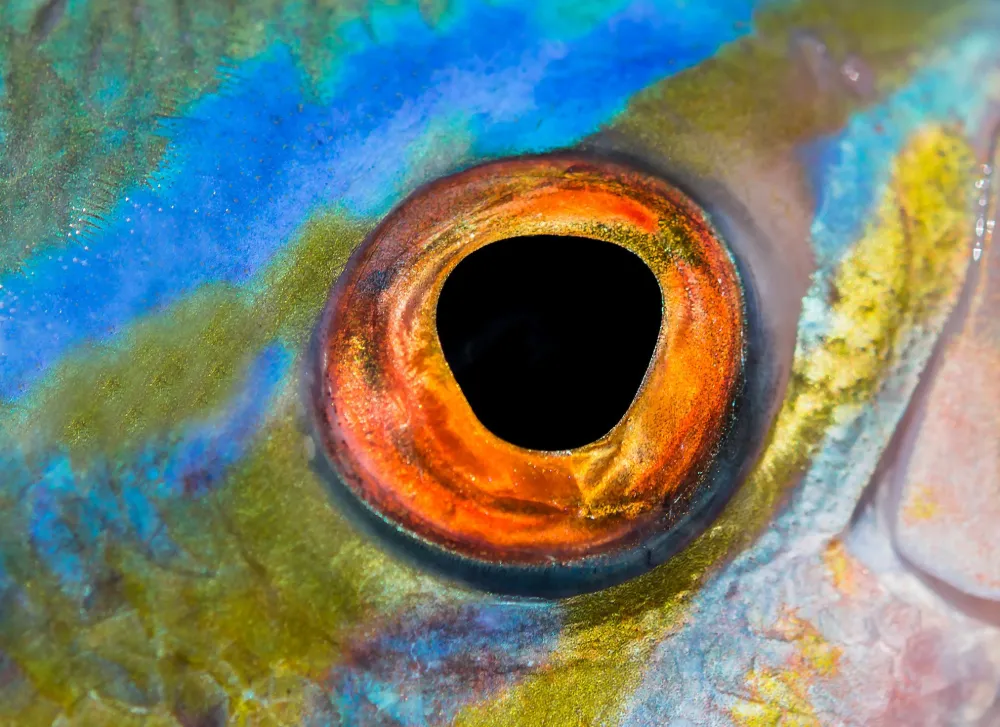
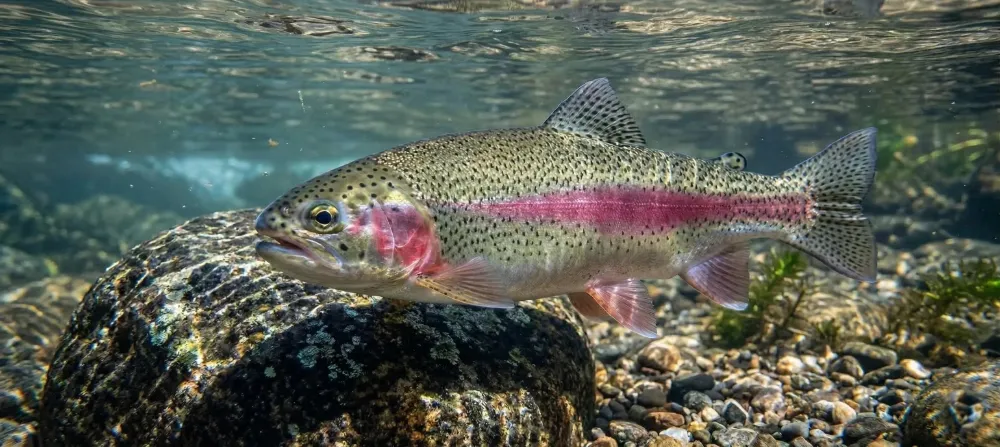
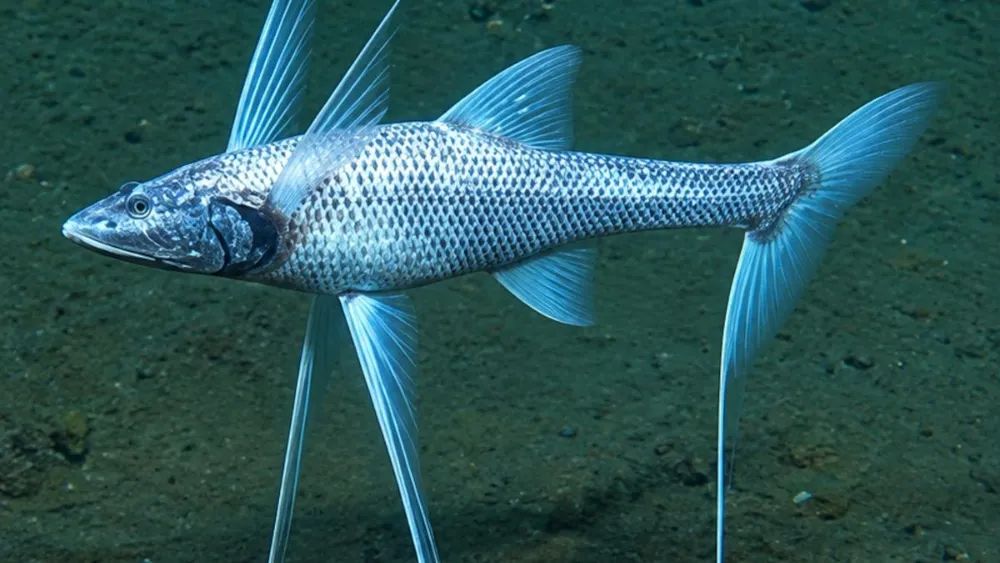
Fish can see objects, particles, bubbles, light patterns, and boundaries in water, but they probably do not perceive uniformly clear water as a separate visible object. Just as humans normally look through clean air without noticing the air itself, fish see their surroundings through the water around them. However, water strongly influences what fish can see by absorbing and scattering light. Fish also have specially adapted eyes, usually with nearly spherical lenses, that help them focus images underwater.
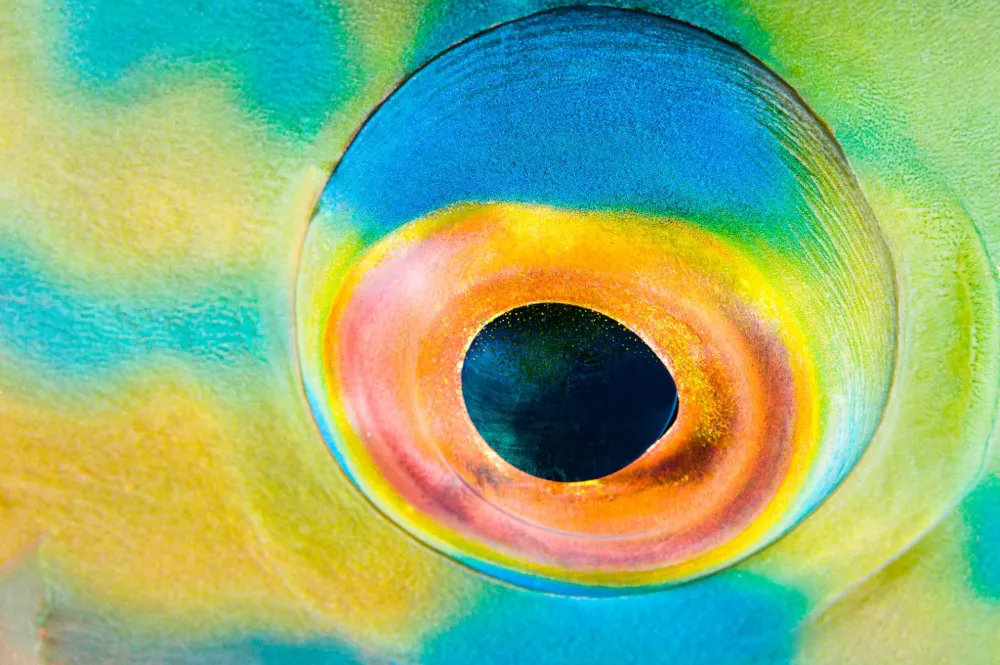
Fish eyes are adapted to forming images underwater, where light behaves differently than it does in air.
Can Fish See Water?
Fish can detect many visible features of their aquatic surroundings, but clear water itself does not normally present a distinct outline.
An eye forms images from patterns of light reaching the retina.
If a region of water is highly transparent and visually uniform, it may provide little contrast that would allow an animal to identify the water as a separate object.
However, real water is rarely perfectly uniform.
Fish may see suspended sediment, plankton, bubbles, sunlight patterns, shadows, or the boundary between water and air.
They can also experience changes in brightness and color caused by the water through which light travels.
Therefore, the claim that fish simply cannot see water is too broad.
A more accurate answer is that fish usually look through transparent water while detecting its visible contents and optical effects.
Do Fish See Water the Same Way Humans See Air?
The comparison between fish in water and humans in air is useful, but it is not exact.
Humans normally do not see clean air as a distinct object because it is largely transparent in ordinary conditions.
We can, however, see fog, smoke, dust, clouds, and other visible changes in the atmosphere.
Similarly, fish do not necessarily perceive clear water as a continuous visible surface surrounding them.
But they can detect particles and optical effects within it.
Water also absorbs and scatters light much more strongly than clean air over comparable distances.
This means the aquatic environment can significantly change visibility even when there is no obvious boundary in front of the fish.
The analogy is therefore helpful for understanding transparency, but fish vision must also be understood through the physics of underwater light.
How Do Fish See Underwater?
Fish have eyes that form images using incoming light.
Light enters the eye and passes through optical structures before reaching the retina.
The retina contains photoreceptor cells that respond to light.
Neural signals are then processed by the visual system.
In many bony fishes, the eye contains a nearly spherical crystalline lens.
This lens provides most of the optical focusing power.
The cornea generally contributes much less focusing power underwater than the human cornea does in air.
This difference exists because the optical properties of water and the tissues around the cornea are relatively similar.
The fish lens is therefore particularly important for producing a focused image on the retina.
Why Are Fish Eyes Different From Human Eyes?
Humans and fishes share a broad vertebrate eye organization, but their eyes are adapted to different environments.
Human eyes normally focus light entering from air.
The difference between the refractive index of air and that of the cornea creates substantial bending of light.
When a human opens their eyes underwater without goggles, the refractive relationship changes.
The cornea loses much of its normal focusing contribution.
This is one reason underwater images usually appear blurry to humans.
Many fishes have more spherical and optically powerful crystalline lenses.
These lenses are particularly effective in water, allowing the eye to focus without depending strongly on the cornea.
Washington State University explains this difference in its educational article about fish vision.
Why Do Fish Have Round Lenses?
A nearly spherical lens can provide strong optical focusing power in an aquatic environment.
Because the cornea does relatively little focusing underwater, the lens must bend light sufficiently to create an image on the retina.
Fish lenses also possess complex internal optical properties.
In many species, the refractive index varies from the center toward the outer layers.
This is known as a graded refractive index.
The variation helps reduce optical aberrations that would otherwise blur the image.
A 1992 study in Vision Research investigated the optical performance of spherical fish lenses and modeled how their refractive-index gradients affect image formation.
Later studies of cichlid fishes have further examined how lens properties relate to color sensitivity and underwater vision.
How Do Fish Focus Their Eyes?
Many bony fishes focus on objects at different distances by moving the crystalline lens within the eye.
This process is called accommodation.
In humans, accommodation mainly involves changing the shape of the crystalline lens.
In many fishes, specialized muscles shift the relatively firm lens forward or backward.
The movement changes where incoming light is focused.
This allows the animal to obtain clearer images of objects at different distances.
However, accommodation mechanisms vary among fish groups.
Sharks, rays, and certain specialized fishes may use somewhat different anatomical arrangements.
It is therefore inaccurate to claim that every fish eye focuses in precisely the same way.
Can Fish See Clearly Underwater?
Many fish can form clear underwater images, but visual performance varies greatly among species.
Some fish rely heavily on vision to locate prey, avoid predators, and recognize other individuals.
Others live in environments where light is scarce and depend more strongly on nonvisual senses.
Visual clarity also depends on the surrounding water.
Clear, shallow water can provide high-contrast views of nearby objects.
Murky water reduces visibility because suspended particles scatter and absorb light.
Even an animal with an optically well-adapted eye cannot see unlimited distances through highly turbid water.
Therefore, the question of how clearly fish see requires considering both eye anatomy and environmental conditions.
Can Fish See Water Bubbles?
Yes. Air bubbles can be visible underwater because they create optical boundaries and distort surrounding light.
Light changes direction when it passes between materials with different refractive indices.
The boundary between air and water can therefore produce strong visual effects.
Bubbles may appear bright, dark, reflective, or distorted depending on the illumination and viewing angle.
A fish with suitable vision can detect bubbles when they are large enough and sufficiently contrasting.
However, visibility depends on their size, distance, and the surrounding water conditions.
Can Fish See the Water Surface?
Yes. The water surface is an important optical boundary that can create recognizable light patterns.
Light entering water from air is refracted, or bent, at the surface.
Some light is reflected.
Depending on viewing angle and conditions, the surface may reveal the world above the water or reflect underwater surroundings.
Many fish can see a region of the above-water environment through a special optical effect sometimes called Snell's window.
The visibility of this region is influenced by refraction and the angle at which light reaches the surface.
Surface waves can distort these images.
Fish near the surface may therefore receive useful visual information about objects above the water.
What Is Snell's Window?
Snell's window is an optical phenomenon visible to observers underwater looking toward the surface.
Because of refraction, much of the above-water scene is compressed into a circular region.
Outside that region, the underwater side of the surface may act more like a mirror because of total internal reflection.
This effect follows the physical principles described by Snell's law.
Harvard University's natural sciences demonstrations explain how changes in refractive index cause light to bend at boundaries between materials.
However, the exact appearance of Snell's window depends on the observer's position, water clarity, and surface conditions.
It should not be imagined as a physical hole in the water.
Can Fish See Air?
Fish near the surface may see objects above the water, but clear air itself is generally transparent.
As with the question of seeing water, an animal detects light patterns, objects, and boundaries rather than necessarily perceiving a transparent medium as a distinct object.
Some fishes have specialized adaptations for viewing both above and below the surface.
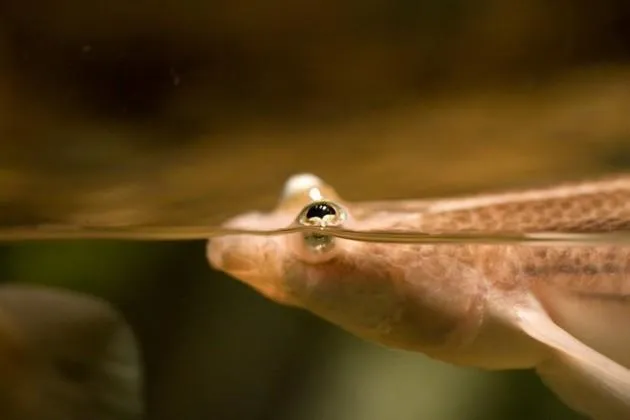
The four-eyed fish, genus Anableps, is a particularly interesting example.
These fishes swim near the water surface with their eyes positioned to view the environments above and below.
However, the common name four-eyed fish is misleading if interpreted literally.
Each animal has two eyes, but each eye is specialized to receive images from two different visual regions.
How Do Four-Eyed Fish See Above and Below Water?
Four-eyed fishes have unusual eyes adapted for vision at the boundary between air and water.
The eye is divided into specialized optical regions that allow light from above and below the surface to be processed.
The lens and other optical structures accommodate the different refractive demands.
When these fishes swim near the surface, part of each eye can receive light from the air while another part receives light from underwater.
Washington State University highlights this adaptation as an example of the diversity of fish vision.
However, these fishes are unusual and should not be treated as typical representatives of all fish eyes.
Can Fish See Colors Underwater?
Many fish can see colors, although the range and sensitivity of color vision differ among species.
Color vision depends partly on the types of light-sensitive pigments present in retinal photoreceptors.
These pigments are known as opsins.
Different opsins respond to different parts of the light spectrum.
Some fishes have several distinct cone photoreceptor classes.
Others have fewer classes or visual systems specialized for dim environments.
Research on cichlid fishes has shown substantial variation in visual pigment expression, lens transmission, and spectral sensitivity.
Therefore, it is incorrect to say that all fish are color-blind or that all fish perceive exactly the same colors humans do.
Can Fish See Ultraviolet Light?
Some fish species can detect ultraviolet wavelengths.
However, ultraviolet sensitivity depends on multiple factors.
The retina must contain appropriate photoreceptors and visual pigments.
The optical structures of the eye must also transmit the relevant wavelengths.
Research on cichlid fishes has demonstrated differences in ultraviolet transmission among species.
Some lenses allow more ultraviolet light to reach the retina, while others absorb or block much of it.
The ecological benefits of ultraviolet sensitivity vary.
Possible functions include detecting prey, recognizing signals, or distinguishing features of the environment.
However, ultraviolet vision should not be assumed to occur in every fish species.
Why Does Water Change the Colors Fish See?
Water does not transmit all wavelengths of light equally.
Some wavelengths are absorbed more strongly than others.
As light travels deeper, the available spectrum changes.
Red wavelengths often diminish relatively rapidly in clear ocean water.
Blue wavelengths can penetrate to greater depths under many oceanic conditions.
However, the exact pattern depends on water composition, dissolved organic material, particles, and other factors.
Freshwater lakes and coastal waters can have very different spectral environments from clear open-ocean water.
Smithsonian Tropical Research Institute explains how these properties influence underwater visual signals and the apparent colors of marine animals.
Why Does the Ocean Look Blue?
The color of the ocean results from the interaction between sunlight and water.
Water absorbs different wavelengths at different rates.
In clear, sufficiently deep water, the remaining light often gives the scene a blue appearance.
However, the color of a water body also depends on reflection, scattering, plankton, sediment, and dissolved substances.
Coastal waters may appear green or brown rather than blue.
Fish experience the resulting underwater light environment through visual systems adapted to their habitats.
The color visible to a human observer above the surface is not necessarily identical to the spectral information received by a fish below it.
Can Fish See in Murky Water?
Some fish are adapted to environments with limited visibility.
However, suspended particles and dissolved substances can reduce the distance at which visual details can be detected.
Fish living in murky water may rely more strongly on nearby contrast, movement, or other senses.
Catfish, for example, possess specialized chemical and tactile sensory abilities that can help them locate food when visibility is poor.
Many fishes also use the lateral line system to detect mechanical disturbances in the surrounding water.
These systems complement vision rather than replacing it in every situation.
The relative importance of each sense depends on the species and habitat.
What Is the Lateral Line in Fish?
The lateral line is a sensory system present in many fishes.
It contains mechanosensory organs called neuromasts.
These structures detect water movement and mechanical disturbances near the body.
The lateral line can provide information about nearby objects, swimming animals, and water flow.
However, it is not a visual organ.
A fish detecting a movement through its lateral line is not seeing the movement in the same sense that its retina detects light.
This distinction is important because popular explanations sometimes describe all sensory abilities as forms of seeing.
Fish perceive their aquatic environment using several interacting sensory systems.
Can Fish See in Complete Darkness?
No ordinary light-dependent eye can form a visual image when there are no detectable photons.
Some deep-sea fishes are highly adapted to extremely low levels of light.
Their eyes may have large pupils, specialized photoreceptors, or other adaptations that improve sensitivity.
Some detect light produced by bioluminescent organisms.
However, seeing very faint light is not the same as seeing in absolute darkness.
Fish that live where usable light is absent may rely more heavily on other sensory systems.
Research on the visual ecology of deep-sea fishes demonstrates that optical sensitivity varies according to habitat and ecological role.
Do Deep-Sea Fish Have Better Eyes Than Shallow-Water Fish?
There is no single answer.
Deep-sea fishes have evolved different strategies.
Some possess large or highly sensitive eyes that detect extremely weak light.
Others have reduced eyes because vision provides limited benefit in their environment.
Shallow-water fishes may instead prioritize color discrimination, spatial detail, or recognition of complex reef habitats.
These are different kinds of visual specialization.
A fish adapted to detecting faint bioluminescent flashes is not necessarily better at recognizing detailed colorful objects in bright sunlight.
The meaning of good vision depends on the animal's environment and the task being measured.
Can Fish See Better Than Humans Underwater?
Many fish are optically better adapted than unaided human eyes for focusing underwater.
Their nearly spherical lenses provide strong refractive power in water.
Humans usually experience blurred vision underwater without goggles because the cornea loses much of its normal focusing ability.
However, overall vision cannot be reduced to a single comparison.
Human visual acuity, color discrimination, and other abilities differ from those of individual fish species.
Some fish may be more sensitive to certain wavelengths, while humans may resolve greater detail under particular conditions.
The correct comparison depends on the environment and visual task.
How Far Can Fish See Underwater?
The distance at which a fish can detect an object depends on several factors.
Important variables include:
Water clarity and suspended particles
Light intensity
Object size
Object contrast against the background
Fish eye anatomy
Visual processing capabilities
Depth and available wavelengths
A large, high-contrast object may be visible farther away than a small, low-contrast one.
In murky water, visual range can be much shorter than in clear ocean water.
There is no universal maximum distance that applies to every fish.
Do All Fish See the Same Way?
No. Fish represent an extremely diverse collection of vertebrates.
They occupy habitats ranging from shallow tropical reefs to muddy rivers and deep ocean trenches.
Some rely heavily on color vision and detailed visual patterns.
Others specialize in detecting movement, low light, or particular spectral wavelengths.
Still others have reduced eyes and rely more on nonvisual senses.
Research on cichlid fishes demonstrates that even related species can differ in their visual pigments and lens transmission properties.
Therefore, broad statements about what fish see should include appropriate qualifications.
Fish Vision Compared With Human Vision
| Feature | Typical Bony Fish | Humans |
|---|---|---|
| Main visual environment | Underwater | Air |
| Lens shape | Usually nearly spherical | Less spherical, flexible |
| Main focusing structure underwater | Crystalline lens | Human cornea loses much of its usual focusing power |
| Typical accommodation | Lens movement in many species | Lens shape change |
| Color vision | Highly species-dependent | Usually trichromatic |
| Ultraviolet sensitivity | Present in some species | Normally limited by ocular filtering |
| Other water-motion sensing | Lateral line in many species | No lateral line |
Fish visual diversity is considerable, so the typical fish column is a broad simplification rather than a description of every species.
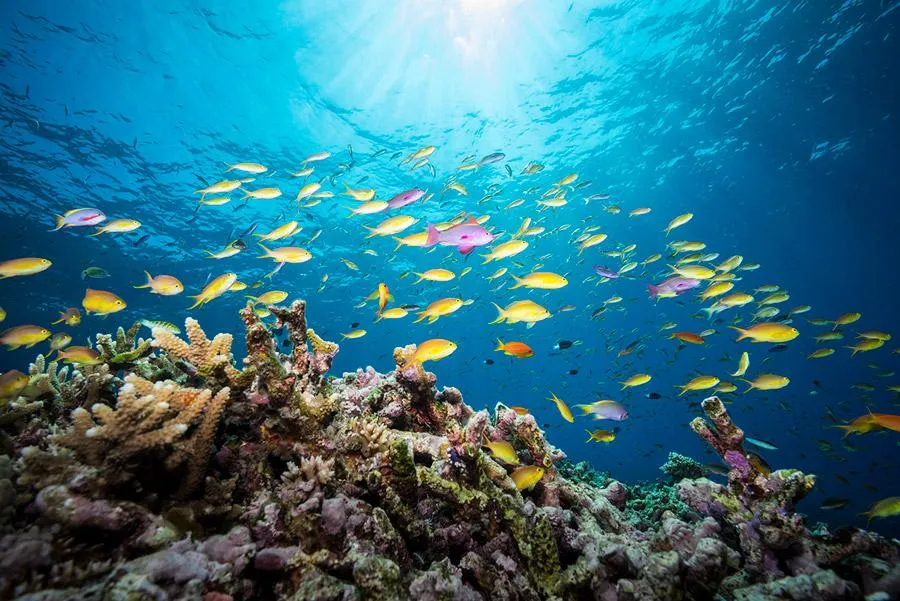
Underwater light changes with depth, clarity, and wavelength, shaping the colors and contrasts fish can detect.
Can Fish Recognize Other Fish?
Many fishes can use visual information to respond to members of their own species or other species.
Visual cues may include body shape, color patterns, movement, and distinctive markings.
In some species, visual recognition plays a role in mating, territorial interactions, and group behavior.
However, recognition mechanisms differ.
Some fish also use chemical, acoustic, or other sensory information.
Seeing another fish does not necessarily mean identifying it as a particular individual.
Scientists use behavioral experiments to distinguish simple species recognition from more advanced forms of individual recognition.
Can Fish Recognize Human Faces?
Some experiments suggest that certain fish can learn to distinguish human faces or images of human faces.
For example, archerfish have been studied in laboratory tasks involving visual discrimination.
However, experimental recognition of face images is not the same as proving that all fish naturally identify individual humans in everyday life.
Learning ability and visual discrimination vary among species.
The results nevertheless demonstrate that some fishes have sophisticated visual processing capabilities.
Do Fish See Their Aquarium Glass?
Fish may detect aquarium glass indirectly through reflections, visual boundaries, or objects seen on the other side.
However, clean transparent glass can be difficult to distinguish under some lighting conditions.
Light reflecting off the glass may create mirror-like images.
Some fish respond to their own reflection as if it were another animal.
Others may learn the location of the tank boundary through repeated experience.
The response depends on species, lighting, aquarium design, and individual behavior.
Do Fish See Water as Blue?
Fish do not necessarily perceive water itself as uniformly blue.
The appearance of an underwater scene depends on the available light spectrum, water composition, depth, and the visual system of the fish.
Clear ocean water often produces a blue-dominated light environment at depth.
Shallow coral reefs may contain a broader range of visible colors.
Freshwater habitats can appear green, brown, or otherwise different because of sediments, dissolved substances, and biological activity.
Some fish may detect wavelengths that humans cannot normally see.
Therefore, the subjective appearance of the scene cannot be assumed to match a human underwater photograph.
Frequently Asked Questions
Can fish see water?
Fish can see objects, particles, bubbles, boundaries, and optical effects in water, but uniformly clear water may not appear as a separate visible object.
Can fish see underwater?
Yes. Most fishes have eyes adapted to underwater vision, including specialized lenses that focus incoming light.
Do fish see water like humans see air?
The comparison is helpful because both can be transparent, but water absorbs and scatters light much more strongly than clean air over comparable distances.
Can fish see air?
Fish near the surface can see objects above water, but clear air itself is generally transparent.
Why do fish have round eyes?
Many fish have nearly spherical lenses that provide strong focusing power in water, where the cornea contributes relatively little.
Do fish see colors?
Many fish do, but color vision varies considerably among species.
Can fish see ultraviolet light?
Some fish can detect ultraviolet wavelengths if their eye structures and photoreceptors allow it.
Can fish see in the dark?
Some are adapted to very low light, but light-dependent vision cannot function without detectable photons.
Can fish see the water surface?
Yes. The surface creates reflections and refracted images, including the optical effect known as Snell's window.
Can fish see water bubbles?
Yes. Bubbles can create visible optical boundaries and contrasting patterns.
How far can a fish see?
Visual range varies with water clarity, light, object contrast, and species-specific eye anatomy.
Can fish see better than humans underwater?
Many fish focus more effectively underwater than unaided human eyes, but overall visual performance depends on the task and species.
Can deep-sea fish see?
Some deep-sea species have sensitive eyes for detecting faint light, while others have reduced eyes and rely more on nonvisual senses.
Can fish see through aquarium glass?
Yes, fish can see objects through aquarium glass, although reflections and lighting can affect how the boundary appears.
The Bottom Line
Fish can see through water and detect its contents and visible effects, but clear water itself does not usually appear as a distinct object.
Their eyes are adapted to underwater conditions, with specialized lenses that help focus light despite the limited refractive power of the cornea in water.
Fish vision varies widely across species. Some detect colors or ultraviolet light, while others specialize in dim environments.
Water clarity, depth, and light absorption also influence what fish can see.
Understanding fish vision therefore requires considering both the biology of their eyes and the optical properties of the aquatic environment.
Sources & Further Reading
Washington State University — How Can Fish See in the Water?. Explains how fish lenses focus underwater and why human eyes become blurry without goggles.
Jagger (1992) — The Optics of the Spherical Fish Lens. Peer-reviewed research examining the refractive-index gradient and optical performance of fish lenses.
Proximate and Ultimate Causes of Variable Visual Sensitivities: Insights from Cichlid Fish Radiations (2016). Scientific review of fish visual pigments, color sensitivity, and lens transmission.
Smithsonian Tropical Research Institute — Through the Eyes of a Fish. Explains how water depth, color absorption, and visual signals shape fish perception.
Harvard University — Relative Indices of Refraction. Demonstrates why optical focusing changes when a lens is immersed in water.
The Visual Ecology of a Deep-Sea Fish, the Escolar Lepidocybium flavobrunneum (2014). Research on underwater optical sensitivity and deep-sea fish vision.
Smithsonian Ocean — Built-in Underwater Polarized Lenses?. Introduces polarized-light sensitivity in some aquatic animals, including fishes.