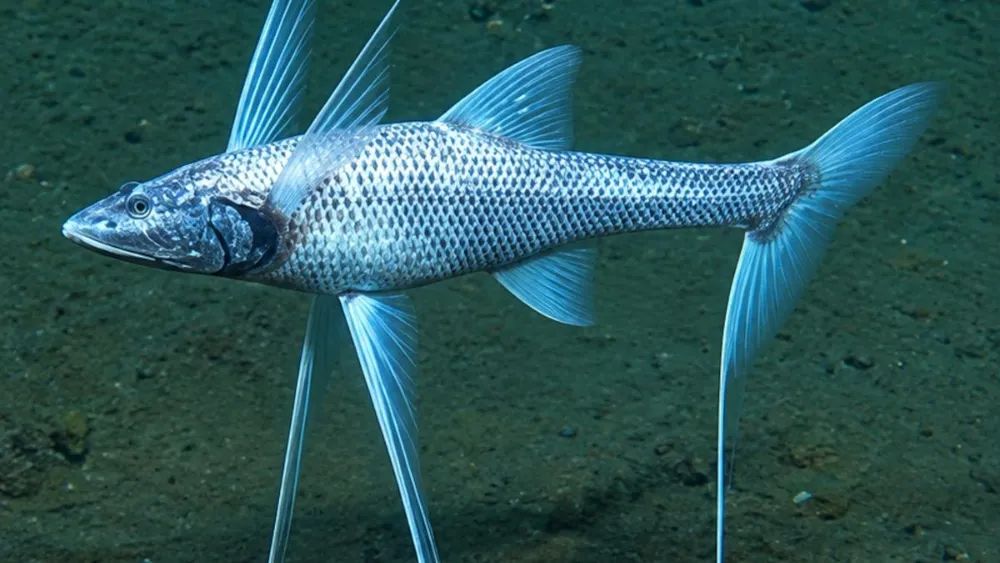
The tripod fish is a remarkable deep-sea fish that can stand above the ocean floor using three extraordinarily long fin extensions. One of the best-known species, Bathypterois grallator, rests on two elongated pelvic-fin rays and an extended ray from the lower part of its tail fin. It faces into the current and uses sensitive pectoral fins to detect tiny animals drifting past. Despite its strange appearance, the tripod fish does not have legs. Its stilts are modified parts of ordinary fish fins, adapted for life in the dark, food-scarce deep ocean.
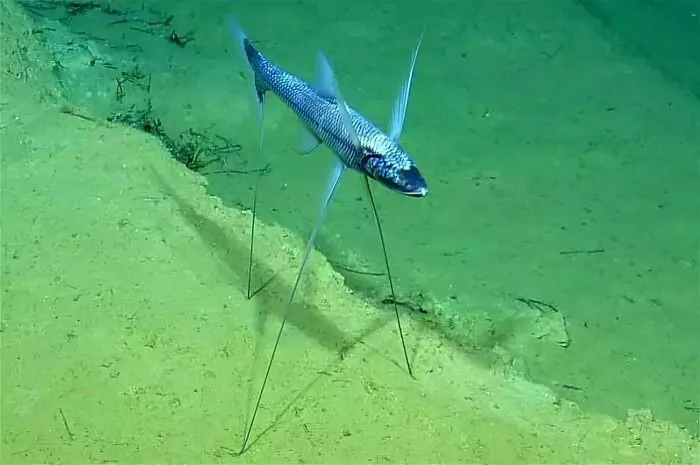
The tripod fish supports itself above the seafloor using three elongated fin rays rather than true legs.
What Is a Tripod Fish?
The tripod fish, also called the tripod spiderfish, is a deep-sea ray-finned fish known for its exceptionally long fin extensions.
The species Bathypterois grallator belongs to the family Ipnopidae, a group of unusual deep-water fishes.
Its most distinctive feature is its ability to support itself above soft seafloor sediment.
Two elongated rays from its pelvic fins and one from the lower lobe of its tail form a three-point support system.
When the fish settles on the seabed, these structures give it the appearance of an animal standing on stilts.
The posture is useful because it raises the mouth and sensory fins above the sediment, into the water moving just above the bottom.
Small drifting animals can then be detected and captured without continuous active swimming.
Although the common name tripod fish is sometimes applied to other members of the genus Bathypterois, this article focuses on B. grallator unless otherwise stated.
Tripod Fish Quick Facts
| Feature | Tripod Fish Facts |
|---|---|
| Scientific name | Bathypterois grallator |
| Other common name | Tripod spiderfish |
| Family | Ipnopidae |
| Order | Aulopiformes |
| Animal group | Ray-finned fish |
| Habitat | Deep ocean floor |
| Reported depth | Approximately 878–4,720 meters |
| Maximum reported total length | 43.4 centimeters |
| Main prey | Small drifting crustaceans and other planktonic animals |
| Special adaptation | Three elongated supporting fin rays |
| Reproductive biology | Simultaneous hermaphroditism |
| Conservation assessment | Least Concern, based on the assessment reported by FishBase |
Depth and size records refer to reported observations or specimens and do not mean that every individual lives at exactly the same depth or grows to the same size.
Why Is It Called a Tripod Fish?
The name comes from the fish's unusual three-point support structure.
A tripod is an object supported by three legs, such as a camera stand.
When Bathypterois grallator rests on the seafloor, its two elongated pelvic-fin rays and one elongated tail-fin ray support the body in a similar arrangement.
This gives the fish its recognizable elevated posture.
The scientific species name grallator comes from Latin and refers to someone who walks on stilts.
However, the comparison with a tripod is descriptive.
The supporting structures are not independently jointed walking legs.
They are specialized extensions of fish fins.
Does the Tripod Fish Really Have Three Legs?
No. The tripod fish has fins, not true legs.
Its three long supports are elongated fin rays.
Fin rays are structural elements that support and shape fish fins.
In most familiar fishes, fin rays form part of the flexible surfaces used for swimming and steering.
In tripod fishes, certain rays have become extremely long and can support the animal while it rests.
The arrangement allows the fish to stand above the sediment without evolving land-animal limbs.
The long supporting rays are distinct from the pectoral-fin structures the fish uses to detect passing prey.
This distinction is important because diagrams and AI-generated images sometimes confuse the sensory and supporting fins.
How Does a Tripod Fish Stand on the Ocean Floor?
A tripod fish lowers its elongated supporting fin rays toward the seafloor.
When their tips contact the sediment, the fish can raise its body into a stable elevated position.
The three supports provide a relatively broad base.
This allows the body to remain above the bottom while the fish faces into the current.
Specialized structures near the ends of the supporting rays help distribute contact with the soft sediment.
Fishes of Australia describes pads on the tips of the elongated pelvic and caudal rays.
The supporting rays have been observed behaving differently when the animal is perched and when it is swimming.
They appear more rigid during the resting posture and more flexible when the fish moves through the water.
Scientists are still investigating the detailed mechanical control of these specialized structures.
Are Tripod Fish Fin Rays Rigid or Flexible?
The elongated supporting fin rays are not permanently rigid sticks.
Observations indicate that they can be flexible during swimming but function as supports when the fish is perched.
This ability is essential because permanently stiff structures would be difficult to maneuver through the water.
The fish must be able to change between a swimming posture and a bottom-resting posture.
The exact mechanism responsible for differences in stiffness has not been completely established in living animals.
Explanations involving pressure changes inside fin structures should therefore be presented cautiously unless supported by direct experimental evidence.
What is well documented is the functional result: the fin rays support the fish above the bottom during resting and are compatible with movement when it swims.
Where Does the Tripod Fish Live?
Bathypterois grallator lives in the deep ocean, particularly near the seafloor.
FishBase reports this species at depths of approximately 878 to 4,720 meters.
It occurs in deep-water environments associated with continental slopes, continental rises, oceanic ridges, and abyssal habitats.
These environments are far below the sunlit upper layers of the ocean.
The fish typically occupies areas of relatively soft sediment where its long fin rays can make contact with the bottom.
The species has a broad geographic distribution, with records from the Atlantic, Indian, and Pacific oceans.
However, its occurrence is patchy, and researchers do not know the exact abundance of the species throughout every part of its range.
How Deep Does the Tripod Fish Live?
The recorded depth range for Bathypterois grallator extends from about 878 meters to approximately 4,720 meters.
That places the species in deep-sea environments where sunlight is extremely weak or absent.
The fish must cope with high hydrostatic pressure, low temperatures, and relatively unpredictable food availability.
These challenges are common features of deep-ocean life.
However, conditions are not identical at every depth.
Water temperature, oxygen concentration, current strength, and the availability of drifting prey vary geographically.
The tripod fish's body plan is suited to a life in which energy-efficient feeding and sensing are particularly important.
Can Tripod Fish Survive Deep-Sea Pressure?
Yes. Tripod fish naturally inhabit environments under very high water pressure.
Hydrostatic pressure increases with ocean depth because of the weight of the water above.
Deep-sea fishes possess biological characteristics that allow their cells and tissues to function under the conditions of their natural habitats.
However, these adaptations should not be described as an external pressure-resistant shell or a special suit surrounding the animal.
Pressure adaptation involves many aspects of physiology, including proteins, cell membranes, and the organization of tissues.
Researchers do not have complete species-specific measurements for every aspect of B. grallator pressure tolerance.
The strongest evidence is that the species naturally occupies these deep environments.
Can Tripod Fish Swim?
Yes. Tripod fish can swim.
Their long supporting rays do not permanently attach them to the seabed.
They can leave the resting posture and move through the water when necessary.
Observations indicate that the elongated rays become more flexible during swimming.
However, Bathypterois grallator is primarily associated with the deep seafloor rather than continuous high-speed swimming in open water.
Its anatomy is adapted to a combination of movement and prolonged bottom-oriented feeding.
Therefore, the statement that tripod fish cannot swim is incorrect.
Do Tripod Fish Walk on the Ocean Floor?
Tripod fish can move while using their elongated fin rays near the seafloor, and researchers have observed trails associated with this movement.
Fishes of Australia describes remotely operated vehicle observations of tracks made by tripod spiderfish moving over the bottom.
However, calling the behavior walking is an analogy.
The fish does not have jointed legs like a terrestrial vertebrate.
Its movements involve specialized fins and the surrounding water.
The term walking helps describe the unusual visual appearance, but it should not imply that the fish uses the same biomechanics as a land animal.
Why Does the Tripod Fish Stand Still?
Remaining relatively motionless above the seafloor may help reduce the energy required to obtain food.
In deep-ocean environments, potential prey can be widely dispersed.
Swimming continuously to search for food may be costly.
A tripod fish can instead position itself in a current and wait for drifting animals to pass nearby.
This is often described as a sit-and-wait or ambush-feeding strategy.
By raising its body above the bottom, the fish places its mouth and sensory fins in the moving water.
It can then respond when suitable prey enters the feeding area.
However, direct measurements of the exact energetic savings have not been established for every tripod fish species.
How Does a Tripod Fish Find Food in the Dark?
Tripod fish rely heavily on sensory information other than ordinary vision.
In the deep ocean, very little sunlight is available.
Bathypterois grallator has greatly reduced eyes and specialized sensory structures associated with its fins.
The pectoral fins can extend forward or outward from the body.
These fins contain sensory structures that help detect movement or physical contact associated with nearby prey.
NOAA Ocean Exploration describes the fish as having sensitive pectoral-fin feelers.
These feelers help it detect small animals drifting close enough to capture.
The fish can therefore feed in a habitat where vision provides limited information.
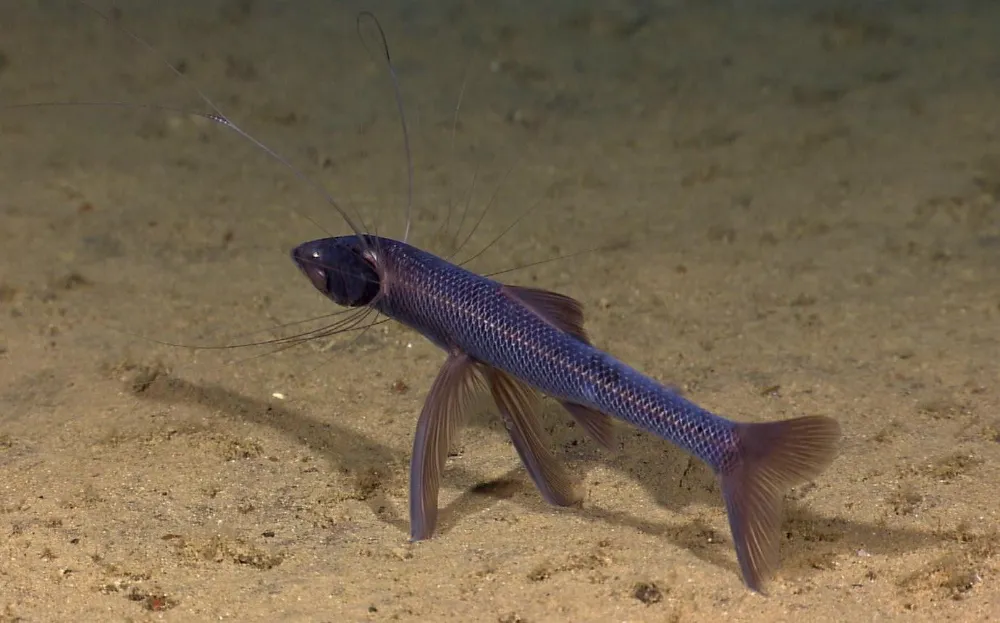
The tripod fish uses different fin structures for supporting its body and detecting prey moving through the water.
Are Tripod Fish Blind?
Tripod fish have very small, reduced eyes, and visual information is likely to play a limited role in the deepest habitats they occupy.
NOAA has described Bathypterois grallator as a blind ambush predator.
However, the precise level of visual sensitivity should not be assumed to be identical across every species commonly called a tripod fish.
The Australian Museum describes the eyes of spiderfishes as extremely small and discusses their sensory reliance on fin structures.
Some species may retain limited light-detection abilities.
For educational purposes, the safest conclusion is that tripod fishes are adapted to living with little or no useful ambient light and depend strongly on nonvisual sensory information.
What Do Tripod Fish Eat?
Bathypterois grallator feeds mainly on small animals drifting in the water near the ocean floor.
FishBase lists copepods and other small planktonic crustaceans among its prey.
Fishes of Australia also identifies small crustaceans and gelatinous plankton as important food items.
The fish faces into the current and holds its sensory fins forward.
When prey passes within range, the fish can detect it and capture it with its mouth.
Its diet therefore reflects the food available in deep benthic and near-bottom waters.
However, the detailed proportions of prey types may vary between locations and individuals.
What Are Copepods?
Copepods are small crustaceans found in marine and freshwater environments.
Many live as part of the plankton, drifting or swimming through the water.
They are important components of aquatic food webs.
In the deep ocean, copepods and other small organisms can provide food for predators that occupy the water just above the seafloor.
Tripod fishes take advantage of these drifting food resources.
Instead of chasing large prey at high speed, they can use the current to deliver small animals within reach of their sensory and feeding structures.
Why Do Tripod Fish Face Into the Current?
Facing into the current helps tripod fish encounter food carried by moving water.
The forward-facing posture places sensory fins where they can detect small drifting organisms.
It also brings potential prey toward the mouth.
This strategy can reduce the need for constant searching.
However, the current must be suitable for the fish to maintain its resting position.
Extremely strong or changing flows may affect the stability of the posture.
The relationship between current strength and feeding efficiency has not been measured in every natural population.
What is directly observed is that tripod fish commonly orient into the current while perched.
What Are the Long Fins on a Tripod Fish For?
Tripod fish have two major categories of elongated fin structures with different functions.
The pelvic and lower caudal-fin rays act as supports.
The pectoral-fin rays are associated with detecting prey.
Confusing these structures is one of the most common anatomical errors in popular illustrations.
| Fin Structure | Main Function | Position |
|---|---|---|
| Elongated pelvic-fin rays | Support the fish above the seabed | Lower body, in paired positions |
| Elongated lower caudal-fin ray | Forms the third supporting point | Lower portion of the tail fin |
| Sensory pectoral-fin rays | Detect nearby drifting prey | Near the front sides of the body |
| Other fin structures | Help maintain body orientation and movement | Various positions along the body |
The arrangement allows the fish to remain elevated and monitor passing water without relying on large eyes.
How Big Is a Tripod Fish?
Bathypterois grallator is not a giant deep-sea animal.
FishBase reports a maximum recorded total length of 43.4 centimeters.
That measurement includes the long fin extensions.
The body itself can appear much smaller than the total height or length of the animal's extended supporting structures.
Fishes of Australia reports a maximum standard length of approximately 37 centimeters.
Standard length and total length are different measurement methods.
This difference is important when comparing size records.
Photographs can also exaggerate the apparent size of a tripod fish if there is no visible scale reference.
What Color Is a Tripod Fish?
The appearance of tripod fishes varies by species.
Fishes of Australia describes Bathypterois grallator as uniformly black.
Other related spiderfish species may appear pale, brownish, or otherwise different in coloration.
Under deep-sea research lighting, the apparent color of an animal may also depend on camera exposure and artificial illumination.
For that reason, photographs of different Bathypterois species should not be used interchangeably without checking identification.
The combination of elongated supporting rays, fin arrangement, head shape, and other anatomical features is more reliable than color alone.
How Do Tripod Fish Reproduce?
Tripod fishes have an unusual reproductive biology.
They are described as simultaneous hermaphrodites.
This means an individual possesses functioning male and female reproductive tissue during the same general stage of life.
Fishes of Australia describes a reproductive organ called an ovotestis containing both male and female tissue.
This differs from animals that change sex between life stages.
Simultaneous hermaphroditism may be advantageous in environments where encounters between potential mates are relatively uncommon.
However, scientists still have limited direct observations of natural mating behavior in many deep-sea fishes.
Can a Tripod Fish Reproduce by Itself?
Tripod fishes are simultaneous hermaphrodites, but that does not automatically prove that individuals routinely fertilize their own eggs.
Having male and female reproductive tissue is not the same as confirmed self-fertilization.
Popular descriptions sometimes suggest that tripod fish reproduce alone because mates are difficult to find in the deep sea.
However, detailed natural reproductive observations remain limited.
The scientific evidence strongly supports simultaneous hermaphroditism.
Claims about the frequency or necessity of self-fertilization require more specific evidence.
It is therefore safer to explain their reproductive anatomy without claiming that every tripod fish reproduces independently.
Why Would Hermaphroditism Be Useful in the Deep Sea?
The deep ocean presents challenges for animals searching for mates.
Populations may be widely dispersed, and movement between suitable habitats can be energetically expensive.
Simultaneous hermaphroditism increases the potential reproductive compatibility of encounters between mature individuals.
If two compatible hermaphroditic fish meet, each may possess the reproductive structures needed for male and female roles.
However, this potential advantage does not establish the complete mating system of every tripodfish species.
Researchers need additional observations and reproductive data to determine how frequently individuals mate and which strategies they actually use.
Do Baby Tripod Fish Live in the Deep Sea?
Some spiderfish larvae have been observed in much shallower water than their adult habitats.
The Australian Museum documents a probable Bathypterois larva photographed only about five meters below the surface.
Many deep-sea fishes have early life stages that occupy shallower waters before moving deeper as they develop.
This process is called ontogenetic vertical migration.
However, the specific developmental pathway of every Bathypterois grallator population is not fully documented.
Observations of related spiderfish larvae provide useful context but should not be treated as definitive evidence that every larva of this species follows the same depth trajectory.
Are Tripod Fish Rare?
Tripod fish are rarely seen by ordinary people because they live far below recreational diving depths.
However, an animal being difficult to observe does not necessarily mean that it is biologically rare.
Deep-sea observations require specialized equipment, including remotely operated vehicles and scientific sampling systems.
FishBase lists Bathypterois grallator as Least Concern under the IUCN assessment recorded for the species.
That designation does not mean every local population is well studied or free from environmental threats.
It also does not provide a precise population count.
Abundance estimates remain limited for many deep-sea species.
How Do Scientists Study Tripod Fish?
Researchers investigate tripod fish using several methods.
Remotely operated vehicles, or ROVs, can observe animals directly on the seafloor.
High-resolution cameras provide information about posture, movement, and surrounding habitat.
Scientific specimen collections allow examination of anatomy, classification, and reproductive structures.
Researchers also use distribution records to investigate geographic range and depth preferences.
In 2019, NOAA Ocean Exploration recorded a tripod fish identified as Bathypterois grallator resting on its specialized fins.
The observation provided a clear example of how the species uses its support rays and sensory pectoral fins while waiting for prey.
Such observations are especially useful because many aspects of deep-sea behavior cannot be inferred reliably from preserved specimens alone.
What Did NOAA Observe About Tripod Fish?
NOAA Ocean Exploration has documented tripod fishes during multiple deep-sea research expeditions.
A 2019 observation identified Bathypterois grallator resting on the seafloor with its body elevated.
NOAA described the animal as an ambush predator using sensitive pectoral fins to detect nearby prey.
During later expeditions, researchers documented additional tripod fishes in the genus Bathypterois.
However, not every NOAA image identified as a tripod fish represents B. grallator.
Some show different species.
This distinction matters when selecting images for a species-specific article.
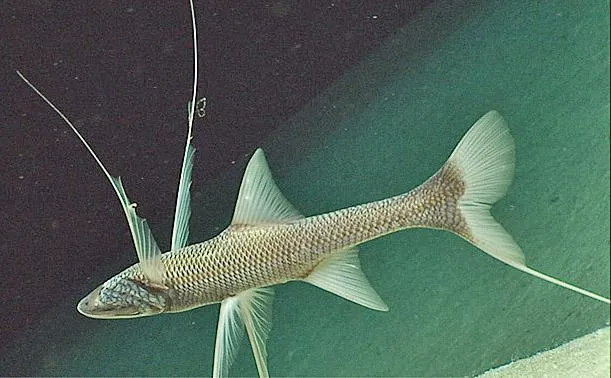
Deep-sea research cameras allow scientists to observe tripod fish in their natural bottom-resting posture.
Are Tripod Fish Dangerous to Humans?
There is no evidence that Bathypterois grallator presents a normal danger to humans.
FishBase classifies the species as harmless.
It lives far below depths accessible to ordinary swimmers and recreational divers.
Its specialized anatomy is adapted to capturing small drifting organisms, not attacking large animals.
Although the fish has teeth, their presence does not indicate that it is dangerous to people.
Can Tripod Fish Live in an Aquarium?
Tripod fish are highly specialized deep-sea animals.
Their natural habitat includes extreme pressure, cold temperatures, and very different feeding conditions from those in ordinary aquariums.
There is no established basis for treating them as suitable home aquarium fish.
Maintaining natural deep-sea conditions would require specialized scientific infrastructure.
Tripod fish should therefore be understood as wild deep-ocean animals rather than aquarium pets.
Tripod Fish vs. Other Deep-Sea Fish
The tripod fish is unusual because it stands above the bottom using elongated fin rays.
Other deep-sea fishes use different strategies.
Anglerfishes may attract prey using specialized structures associated with their dorsal fins.
Some bottom-dwelling fishes remain close to the sediment and detect prey through their mouths or sensory systems.
Other species swim through the water column in search of food.
Tripod fishes combine a stable bottom-resting posture with sensory structures that detect drifting prey.
This illustrates the remarkable diversity of feeding adaptations in the deep ocean.
Frequently Asked Questions
What is a tripod fish?
A tripod fish is a deep-sea fish with extremely long fin rays that allow it to stand above the seafloor. A well-known species is Bathypterois grallator.
Does the tripod fish really have legs?
No. Its three supports are elongated pelvic- and tail-fin rays, not true legs.
Where do tripod fish live?
Bathypterois grallator lives near the deep ocean floor, with records from the Atlantic, Indian, and Pacific oceans.
How deep do tripod fish live?
The reported depth range for Bathypterois grallator is approximately 878–4,720 meters.
Why does the tripod fish stand on the seafloor?
Standing allows the fish to raise its body and sensory fins into the current, where it can detect small drifting prey.
Can tripod fish swim?
Yes. Their elongated supporting rays can be flexible during swimming, allowing them to move away from the resting posture.
Are tripod fish blind?
They have strongly reduced eyes and depend heavily on nonvisual sensing, although the exact visual capacity varies among related species.
What do tripod fish eat?
They feed primarily on small drifting organisms, including copepods and other planktonic crustaceans.
How big can a tripod fish get?
FishBase reports a maximum total length of 43.4 centimeters for Bathypterois grallator, including its long fin extensions.
Are tripod fish hermaphrodites?
Yes. Tripod fishes are simultaneous hermaphrodites, possessing male and female reproductive tissue.
Can tripod fish reproduce alone?
Simultaneous hermaphroditism does not by itself prove that self-fertilization routinely occurs. Their natural mating behavior remains incompletely documented.
Are tripod fish endangered?
FishBase reports a Least Concern assessment for Bathypterois grallator, but detailed population information remains limited.
Can humans encounter tripod fish?
Ordinary divers are extremely unlikely to encounter them because they live in the deep ocean. Scientists observe them using specialized equipment.
The Bottom Line
The tripod fish is one of the deep ocean's most unusual animals.
Bathypterois grallator uses two elongated pelvic-fin rays and one extended tail-fin ray to hold its body above the seafloor.
It faces into the current and uses specialized sensory pectoral fins to detect small drifting prey.
The species also has reduced eyes, unusual reproductive anatomy, and adaptations for life in deep, dark waters.
Despite its appearance, the tripod fish does not have true legs and can still swim.
Its remarkable body structure demonstrates how evolution can modify familiar fish fins for a very different way of life.
Sources & Further Reading
Fishes of Australia — Tripod Spiderfish, Bathypterois grallator. Species-specific anatomy, feeding, coloration, reproductive biology, and distribution.
NOAA Ocean Exploration — Tripod Fish, Windows to the Deep 2019. Confirmed observation of B. grallator resting on the seafloor and detecting prey with sensory pectoral fins.
Australian Museum — Spiderfishes, Bathypterois spp.. Overview of deep-sea spiderfish anatomy, habitat, sensory fins, and larval biology.
FishBase — Bathypterois grallator. Scientific classification, recorded depth range, maximum size, diet, and conservation assessment.
Museums Victoria — Bathypterois grallator Specimen Record. Museum documentation of an identified tripod spiderfish specimen.