The phrase “blind as a bat” is one of the most common animal myths in English, but it is wrong. Bats are not blind. In fact, all bats can see, and many species use vision together with hearing, smell, and—when they have it—echolocation. The real scientific story is more interesting than the myth: bats are mammals with working eyes, but many of them live and hunt in conditions where hearing becomes even more important than sight.
A more accurate headline would be this: bats can see, but many species navigate and hunt mainly by echolocation, especially at night or in dark spaces such as caves. Some bats have fairly modest night vision, while others—especially fruit bats and flying foxes—have very good eyesight. So the answer is not just “no, bats aren’t blind,” but also “their vision differs a lot from one bat group to another.”
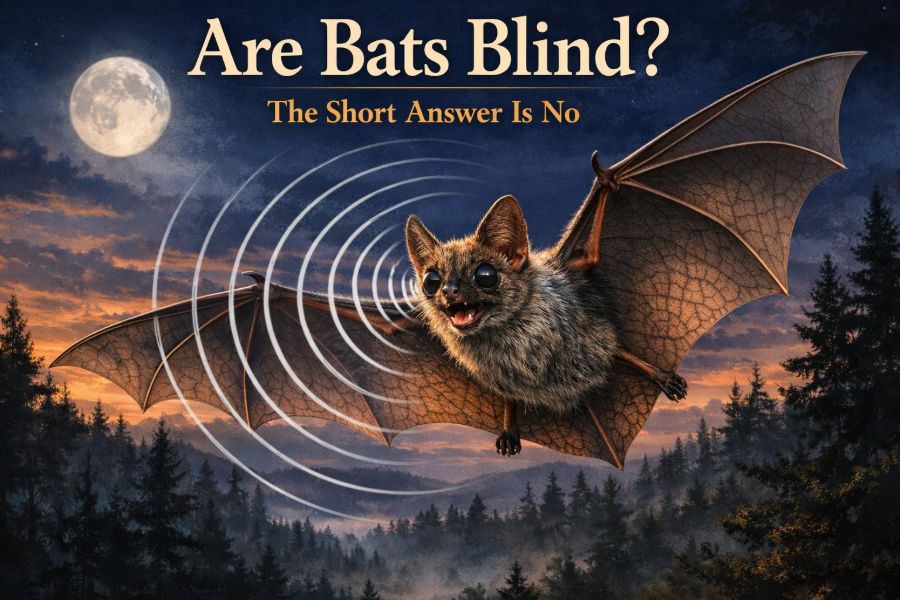
The short answer
If you want the simplest possible answer:
Are bats blind? No.
Do bats use sound more than vision in many situations? Yes.
Why people think bats are blind
The myth probably survived because many bats are nocturnal, fly quickly in darkness, and famously use echolocation. To human observers, that can make them seem like animals that “see with their ears” instead of their eyes. Britannica notes that bats are generally not blind at all, and the misconception comes from their night-active lifestyle and reliance on echolocation for pinpointing prey and obstacles.
National Park Service sources make the same point in plainer language: bats are not blind, but many rely on a “high-tech” sound-based system to orient themselves. So the myth contains one tiny grain of truth—echolocation is very important—but draws the wrong conclusion from it.
Bats do have eyes, and they use them
Like other mammals, bats have eyes and use them. Smithsonian states this clearly: all bats can see, even if vision may be less important than other senses in many species. Bat Conservation Trust also says that all bat species are able to see, though not all have the same eyesight.
This means bats do not live in total visual darkness the way the myth suggests. They can use vision to detect the horizon, identify roost openings, orient at dusk, avoid large obstacles, and in some species locate food. National Park Service guidance also notes that bats use ordinary eyesight together with echolocation, especially for seeing beyond echolocation range.
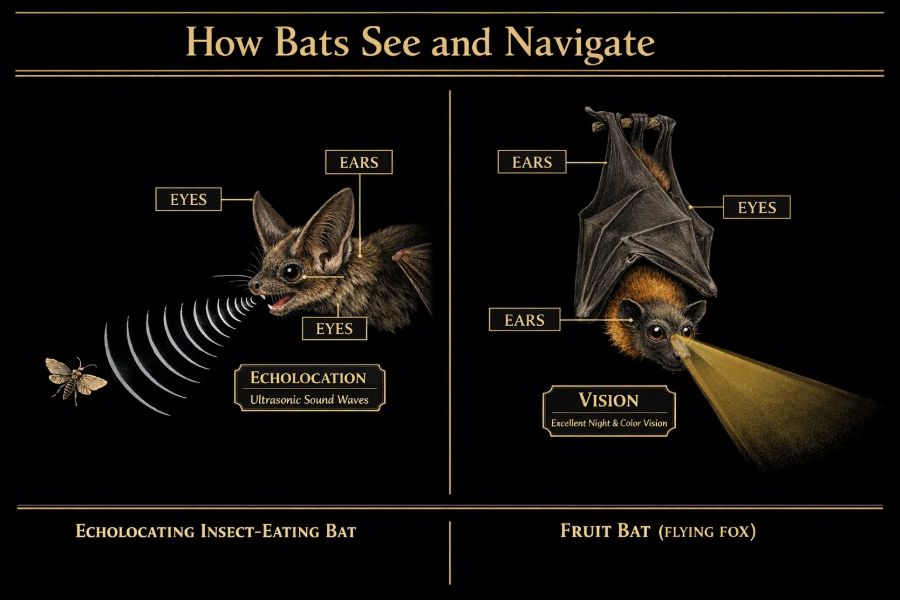
Not all bats use echolocation in the same way
Another common oversimplification is that all bats use echolocation equally. They do not. Some bats use echolocation to navigate and hunt insects, while others rely much more on vision and smell. Bat Conservation Trust explicitly says that some bats use echolocation to navigate and hunt, while others rely on smell and vision to find food.
This is especially important for fruit bats and flying foxes. Bat Conservation Trust notes that some species, such as flying foxes, have great night vision, and species that feed on nectar or pollinate flowers can even see ultraviolet light. So if you imagine all bats as cave-dwelling insect hunters using sonar, you are missing a huge part of bat diversity.
Echolocation is powerful, but it does not replace vision completely
Insect-eating bats often use echolocation as their main short-range navigation and hunting system. Smithsonian explains that insectivorous bats emit high-frequency sounds through the mouth or nose and detect prey from the returning echoes. This allows them to locate insects and avoid obstacles in darkness.
But echolocation does not make eyes useless. National Park Service guidance says bats use echolocation together with regular eyesight, and that eyesight helps them see farther than echolocation alone can. In simple terms, echolocation is excellent for fine detail at short range, while vision can still help with broader orientation and longer-range awareness.
Do bats have good eyesight?
The answer depends on the species. Bat Conservation Trust says that UK bat species do not have especially good night vision and rely heavily on echolocation, but also notes that some bats elsewhere have excellent vision. Britannica goes further and says bats are believed to have eyesight keener than that of most humans in some cases.
So the scientifically correct answer is not “bats see badly.” It is: some bats see moderately well, some see very well, and many still depend more on sound than sight when hunting at night.
Why hearing matters so much in bats
Bats are flying mammals that often move through cluttered environments at night—forests, cave entrances, insect swarms, and narrow flight corridors. In these settings, sound can provide fast, precise spatial information. Smithsonian describes echolocation as an acoustic orientation system that lets bats detect prey and obstacles from echoes.
That sensory strategy is so effective that bats can fly in darkness and still capture tiny moving insects. This does not mean vision failed; it means evolution favored a multisensory system in which hearing became exceptionally important.
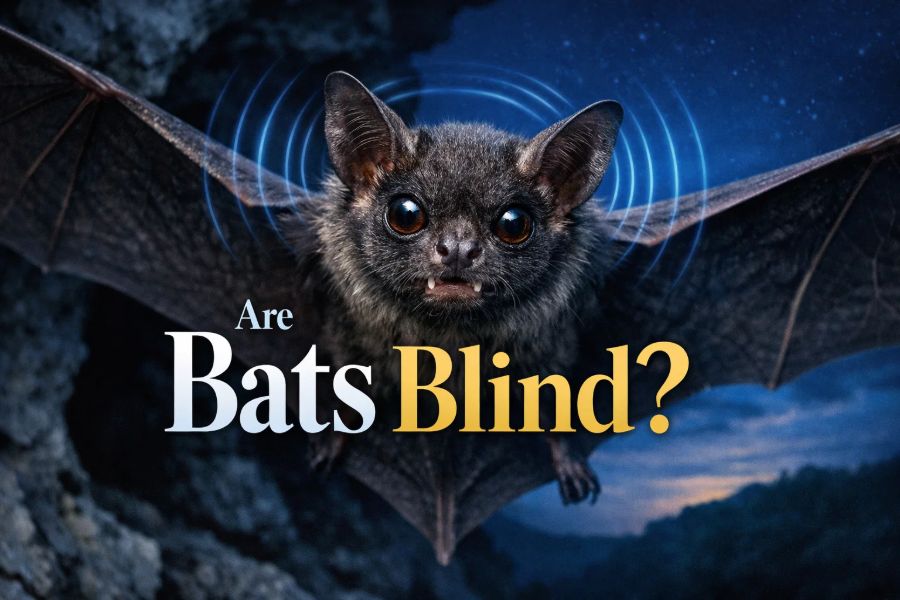
Fruit bats help explain why the myth fails
One of the strongest reasons the “blind bat” myth collapses is that many fruit bats are obviously visual animals. Bat Conservation Trust notes that flying foxes have great night vision, and National Park Service materials also say some bats rely more on smell and vision than on echolocation.
That makes ecological sense. A fruit bat locating large fruits, blossoms, or tree canopies in twilight and moonlight benefits a lot from seeing well. In those species, good vision is not optional decoration—it is part of how they feed and move through the world.
Why bats still collide with things sometimes
Some people assume that if bats can echolocate, they should never hit windows, walls, or nets. But animal senses have limits, and behavior can produce mistakes. Britannica notes that sight can sometimes override echolocation in larger bats, which may contribute to collisions such as flying into windows when light cues are misleading.
So bats are neither blind nor perfect. They are highly specialized animals using a combination of senses, and like any animal, they can still make errors in human-altered environments.
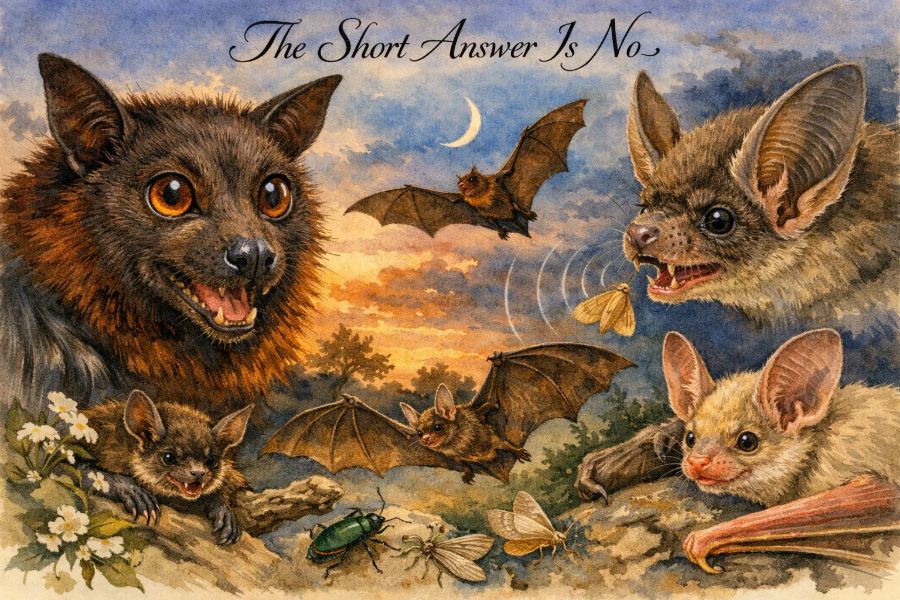
Quick reference table
| Question | Best short answer |
|---|---|
| Are bats blind? | No. All bats can see. |
| Do all bats echolocate? | No, not all use echolocation the same way; some rely more on smell and vision. |
| Do insect-eating bats use echolocation? | Yes, many do, especially for hunting and navigation in darkness. |
| Do some bats have good vision? | Yes. Flying foxes and some other bats have very good night vision. |
| Why does the myth exist? | Because bats are nocturnal and many rely heavily on echolocation. |
The best modern explanation
The myth should really be replaced with a better sentence:
Bats are not blind; they are multisensory animals that often rely heavily on hearing, especially echolocation, but still use their eyes.
That statement fits insect-eating bats, fruit bats, cave-roosting bats, and flying foxes much better than the old saying does. It also reflects what the evidence actually shows: eyes matter, ears matter, and the balance between them changes from species to species.
Conclusion
So, are bats blind? No. The phrase is a myth. Bats can see, some of them see very well, and many combine vision with echolocation rather than replacing one with the other. What makes bats extraordinary is not blindness, but the fact that evolution turned them into mammals that can fly, hear the world in echoes, and still use sight at the same time.
References
Smithsonian Institution. Bat Facts. States that “blind as a bat” is false and that all bats can see; explains echolocation in insectivorous bats.
U.S. National Park Service. Bats in Great Basin National Park. States that bats are not blind and can see, while also using echolocation.
Bat Conservation Trust. Bat facts. Notes that bats are not blind, all bat species can see, flying foxes have great night vision, and some species can see ultraviolet light.
Britannica. Are Bats Really Blind? Explains that bats are generally not blind and may have eyesight keener than most humans.
U.S. National Park Service. Bats: A Junior Ranger’s Perspective. Notes that some bats use echolocation while others rely on smell and vision to find food.
Bat Conservation Trust. Flight, food and echolocation. Explains that bats are not blind, but their ears are often more important than their eyes at night.
U.S. National Park Service. Bats Resource Brief. States that bats are not blind, have good eyesight, but most species do not rely on eyesight alone to hunt at night.
U.S. National Park Service. Bats – El Malpais National Monument. Explains that echolocation is used together with regular eyesight and that no bat is completely blind.
Britannica. 5 Surprising Facts About Bats. Notes that only smaller species mainly use echolocation and that bigger bats can see very well.