If you search for the dog with the strongest bite, one breed appears again and again: the Kangal.
It is frequently claimed that a Kangal can bite with a force of about 743 PSI.
There is one major problem with that answer.
Science has not established a standardized, peer-reviewed bite-force ranking for all dog breeds, and the famous 743 PSI figure attributed to the Kangal does not come from a well-documented comparative breed study.
The Kangal is unquestionably a large and powerful livestock guardian, but calling it the scientifically proven strongest-biting dog goes beyond the available evidence.

What Dog Has the Strongest Bite?
The most accurate answer is:
We do not currently know which dog breed has the strongest bite under standardized scientific testing.
The Kangal Shepherd Dog is the breed most commonly named online, but a reliable scientific study has not tested Kangals against Cane Corsos, Mastiffs, Rottweilers and other large breeds under identical conditions to establish a champion.
What researchers do know is that bite force tends to increase with:
larger body size;
larger skull size;
greater skull width;
some skull-shape characteristics;
and biting closer to the rear teeth.
Does a Kangal Really Have a 743 PSI Bite?
The figure 743 PSI is repeated across thousands of websites and social-media posts.
However, the original standardized scientific measurement behind that number is difficult to identify.
Published veterinary bite-force research generally reports force in Newtons and does not provide a verified table ranking every major breed by PSI.
So it is reasonable to describe a Kangal as a very powerful dog, but not to present 743 PSI as an established laboratory fact.
Why Is the Kangal Associated With a Powerful Bite?
The Kangal is a large livestock guardian breed originating in Turkey.
The Fédération Cynologique Internationale recognizes the Kangal Shepherd Dog as a Molossoid mountain-type dog traditionally used for guarding sheep.
It was developed to work in demanding conditions and protect livestock.
Large body size, a substantial skull and strong jaw musculature all make it biologically reasonable to expect a powerful bite.
But “powerful” and “743 PSI” are not the same scientific statement.
What Does PSI Mean?
PSI means pounds per square inch.
It is a unit of pressure rather than simply a unit of force.
Pressure depends on both:
how much force is being applied;
and how large the contact area is.
This creates a problem when comparing dog breeds using internet PSI figures.
A bite involves teeth contacting material over changing and very small areas.
Without accurately measuring both the force and the contact area, converting a bite into one simple PSI value can be misleading.
How Do Scientists Measure Dog Bite Force?
Researchers have used several approaches.
1. Direct Bite Measurements
A dog can bite a force-measuring device.
This sounds simple, but the result depends heavily on how motivated the animal is to bite.
A dog chewing voluntarily may produce much less than its theoretical maximum force.
2. Electrically Stimulated Jaw Muscles
Some research has measured bite force in anesthetized dogs while stimulating the jaw-closing muscles.
This allows more controlled comparisons but does not perfectly reproduce a voluntary natural bite.
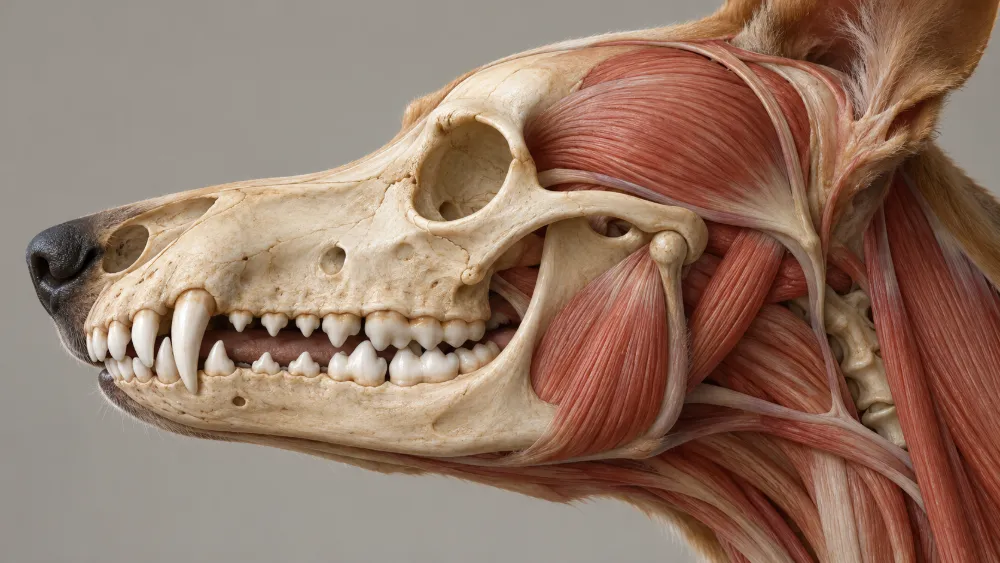
3. Skull-Based Mechanical Models
Researchers can estimate bite force from:
skull dimensions;
jaw lever mechanics;
muscle attachment areas;
and estimated muscle forces.
These models are useful for comparisons, but estimates are not identical to directly measured maximum bites.
What Has Actually Been Measured in Dogs?
One important scientific study measured bite forces in 20 domestic dogs of mixed breed and body form.
The researchers electrically stimulated the jaw muscles while the dogs were under general anesthesia.
Observed bite forces ranged from approximately:
147 to 946 Newtons at the canine region;
524 to 3,417 Newtons at the second molar.
The purpose was to calibrate methods for estimating bite force from skull anatomy.
It was not a competition between dog breeds.
Why Is Bite Force Stronger at the Back Teeth?
The jaw acts as a lever.
The rear teeth are positioned closer to the jaw joint and the major jaw-closing muscles.
This gives them a mechanical advantage.
As a result, a dog can generally generate much greater force around the molars and carnassial region than at the front of the mouth.
This is why one dog cannot accurately be assigned a single bite-force number without also specifying where and how the bite was measured.
Does Dog Size Affect Bite Force?
Yes.
Scientific modeling of domestic dog skulls has found a strong relationship between body or skull size and predicted bite force.
Larger dogs generally have the potential to generate more absolute bite force than smaller dogs.
Important size measurements include:
skull length;
skull width;
body size;
and jaw-muscle dimensions.
Size was a particularly strong predictor in published analyses.
Does Skull Shape Affect Bite Force?
Yes, but the relationship is more complicated than saying “short-faced dogs bite harder.”
Dogs vary enormously in skull shape.
Broadly, skulls are often described as:
brachycephalic — relatively short-faced;
mesaticephalic — intermediate;
dolichocephalic — relatively long-faced.
Studies suggest that skull shape interacts with skull size when influencing estimated bite force.
In medium and large dogs, shorter and broader skull configurations can sometimes provide biomechanical advantages.
But body and skull size remain extremely important.
Which Dog Breeds Probably Have Powerful Bites?
Large, heavily built dogs with substantial skulls are reasonable candidates for high absolute bite force.
Examples often discussed include:
Kangal Shepherd Dog;
English Mastiff;
Cane Corso;
Boerboel;
Rottweiler;
Dogo Argentino;
and other large working or guardian breeds.
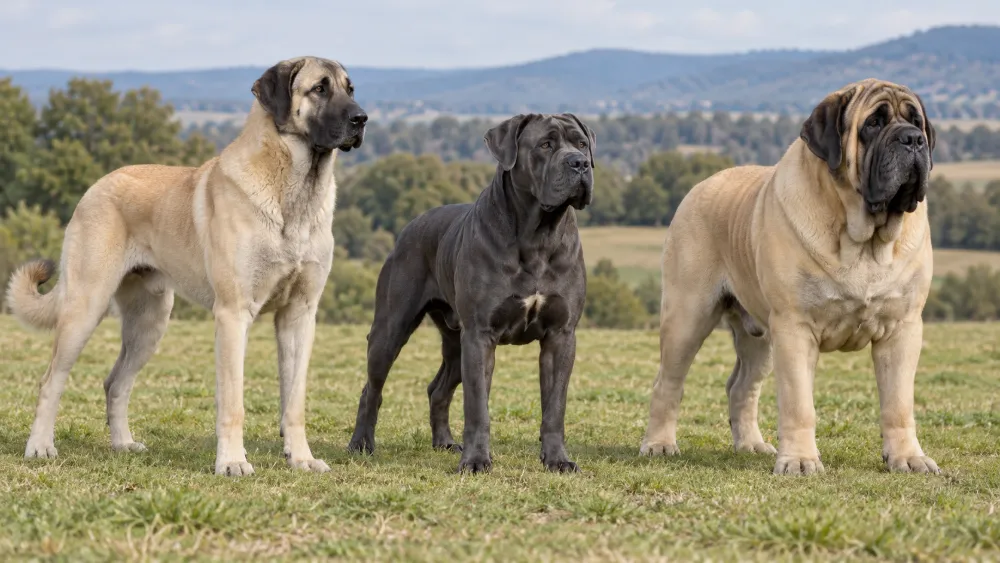
This does not mean there is reliable evidence supporting the precise PSI numbers commonly assigned to each breed online.
Is the Cane Corso's Bite Really 700 PSI?
Figures around 650–700 PSI are widely circulated for Cane Corsos.
But the same evidence problem applies.
There is no widely accepted standardized peer-reviewed experiment demonstrating that Cane Corsos as a breed have a precisely measured average bite of 700 PSI.
The breed is large and muscular and is capable of a powerful bite, but the viral number should not be treated as a laboratory-established breed constant.
What About Mastiffs?
Mastiffs are among the heaviest domestic dog breeds and possess massive skulls.
Biomechanically, their size supports the potential for large absolute bite forces.
But again, there is no comprehensive scientific breed tournament demonstrating one universal Mastiff PSI value.
What Is a Pit Bull's Bite Force?
Precise PSI figures commonly assigned to pit bull-type dogs online should be treated cautiously for the same reason.
“Pit bull” itself can refer to several types or breeds depending on context.
More importantly, peer-reviewed veterinary bite-force literature does not provide the type of standardized PSI leaderboard commonly reproduced on popular websites.
Does the Strongest Bite Mean the Most Dangerous Dog?
No.
Mechanical bite-force potential and behavior are different subjects.
A dog's behavior is affected by many factors, including:
genetics;
early socialization;
training;
environment;
fear;
pain;
human handling;
and previous experiences.
A dog having the physical ability to bite hard does not mean that individual dog is unusually likely to bite.
Does a Bigger Dog Always Bite Harder?
Not always in every individual measurement.
Size strongly influences potential bite force, but a real bite also depends on:
motivation;
tooth position;
jaw opening angle;
health;
age;
muscle condition;
and measurement technique.
A voluntary bite from a large dog that is barely interested in a sensor can measure lower than a highly motivated bite from a smaller dog.
Can Bite Force Be Predicted From Body Weight?
Body size provides useful information, but it is not enough by itself.
Published domestic-dog research found that skull length and skull width were also strongly related to predicted force.
Two dogs of similar weight can have different jaw mechanics because their skulls are shaped differently.
Why Are Online Dog Bite PSI Charts So Different?
Because many combine numbers from different sources and methods.
One chart may use:
a voluntary bite test;
a skull-model estimate;
a television demonstration;
an uncited website;
or a number copied from another article.
Those values cannot simply be placed next to one another as if every breed was tested in the same laboratory using the same method.
What Would a Real Strongest-Bite Test Require?
To establish a scientifically convincing breed ranking, researchers would need:
multiple healthy dogs from each breed;
similar ages and conditions;
a standardized measurement device;
the same bite location;
the same measurement protocol;
large enough sample sizes;
and statistical analysis of individual variation.
No comprehensive study meeting those conditions has established a definitive strongest-biting domestic dog breed.
Is the Kangal Still a Powerful Dog?
Absolutely.
Rejecting the unsupported 743 PSI number does not mean Kangals have weak jaws.
Kangals are large working livestock guardians recognized by the FCI and traditionally used to protect sheep.
The scientifically careful distinction is:
Kangals are powerful dogs, but their exact maximum breed-wide bite pressure has not been established by standardized comparative research.
FAQ
What dog has the strongest bite?
No dog breed has been scientifically established as the universal strongest-biting breed under standardized testing. The Kangal is the breed most often named online.
Does a Kangal have a 743 PSI bite?
The 743 PSI figure is widely repeated, but it is not supported by a clear standardized peer-reviewed breed measurement. It should be treated as an unverified claim rather than established fact.
Which dog breed has the strongest jaw?
Large guardian and Mastiff-type dogs are reasonable candidates for very high absolute bite force, but there is no definitive standardized ranking identifying one breed as the proven winner.
Is Kangal bite force stronger than Cane Corso?
There is not enough standardized scientific breed data to make a precise PSI comparison between Kangals and Cane Corsos.
Is dog bite force measured in PSI?
Scientific studies commonly report force in Newtons. PSI measures pressure and also depends on the contact area over which the force is applied.
How strong can a dog's bite be?
In one controlled study of 20 mixed domestic dogs, measured forces ranged from 147 to 946 N near the canine teeth and from 524 to 3,417 N near the second molar.
Why are dog molar bites stronger?
The rear teeth are closer to the jaw joint and jaw-closing muscles, giving them greater mechanical leverage.
Do large dogs have stronger bites?
On average, larger body and skull size are strongly associated with greater bite-force potential, although real individual bites vary substantially.
Does a strong bite mean a dog is aggressive?
No. Bite-force capability describes biomechanics, not temperament or the likelihood that a dog will bite.
Are online dog bite-force rankings accurate?
Many should be treated cautiously because they mix unverified numbers, different measurement methods and poorly sourced PSI claims.
Final Answer
The Kangal is the dog most often claimed to have the strongest bite, but there is currently no scientifically verified breed champion.
The famous Kangal figure of 743 PSI is widely repeated online without a standardized peer-reviewed comparative measurement establishing it as a breed record.
What scientific research does support is that dog bite force tends to increase with body and skull size, is influenced by skull shape, and is much greater at the rear teeth than at the canines.
Controlled research has measured several thousand Newtons of force at the molars in some dogs, demonstrating that large domestic dogs are capable of extremely powerful bites.
But assigning every breed one precise PSI number creates more certainty than the science currently supports.
So the best evidence-based answer is:
Kangals are among the large breeds capable of powerful bites, but no standardized scientific study has proven that the Kangal—or any other breed—has the strongest bite of all dogs.
Related Reading
Sources Used for Fact Checking
Journal of Anatomy — Cranial Dimensions and Forces of Biting in the Domestic Dog
Journal of Anatomy — Calibration of Estimated Biting Forces in Domestic Canids
Frontiers in Veterinary Science — Bite Forces and Their Measurement in Dogs and Cats
Fédération Cynologique Internationale — Kangal Shepherd Dog Standard