Quick answer
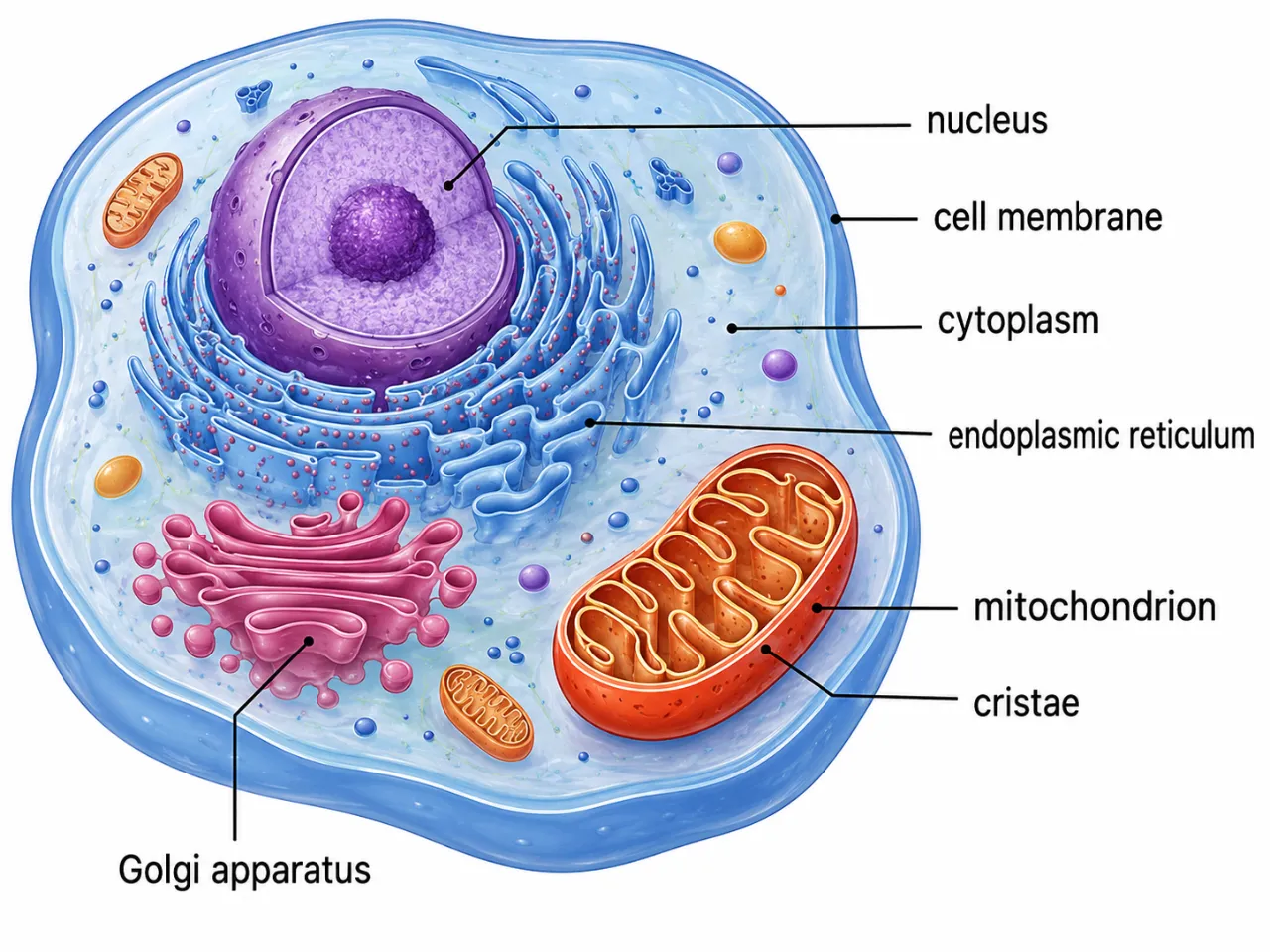
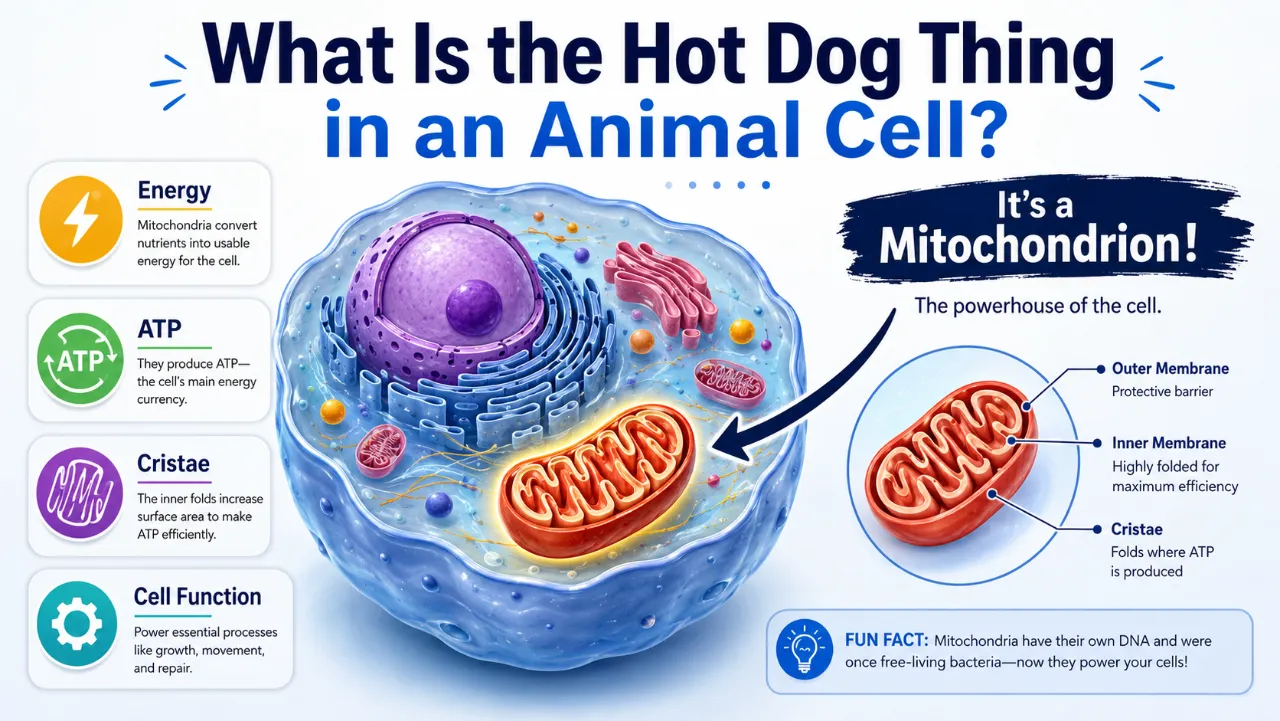
The hot dog-shaped structure in an animal cell is most likely the mitochondrion. In many school diagrams, mitochondria are drawn as small red, orange, or pink oval shapes with wavy lines inside. Their shape can look like a tiny hot dog, bean, peanut, or sausage.
A mitochondrion is an organelle, which means it is a specialized structure inside the cell. Its main job is to help produce ATP, a molecule that cells use for energy. Animal cells need ATP for movement, growth, repair, communication, and many other life processes.
The wavy lines inside the mitochondrion represent folds of the inner membrane. These folds are called cristae. They increase the surface area inside the mitochondrion, helping the organelle carry out energy-producing reactions more efficiently.
Summary table
| Question | Answer |
|---|---|
| What is the hot dog thing in an animal cell? | Usually the mitochondrion |
| Why does it look like a hot dog? | It is often drawn as an oval or bean-shaped organelle with folded lines inside |
| What are the squiggly lines inside? | Cristae, which are folds of the inner mitochondrial membrane |
| Main function | Helping the cell produce ATP, a usable energy molecule |
| Found in animal cells? | Yes, most animal cells contain mitochondria |
| Found in plant cells? | Yes, plant cells also have mitochondria |
| Nickname | “Powerhouse of the cell” |
| Important note | Real mitochondria are dynamic and may not always look like simple hot dog shapes |
What the hot dog-shaped organelle really is
In most animal cell diagrams, the hot dog-shaped organelle is the mitochondrion. If there is more than one, they are called mitochondria. The word “mitochondrion” refers to one organelle, while “mitochondria” refers to many.
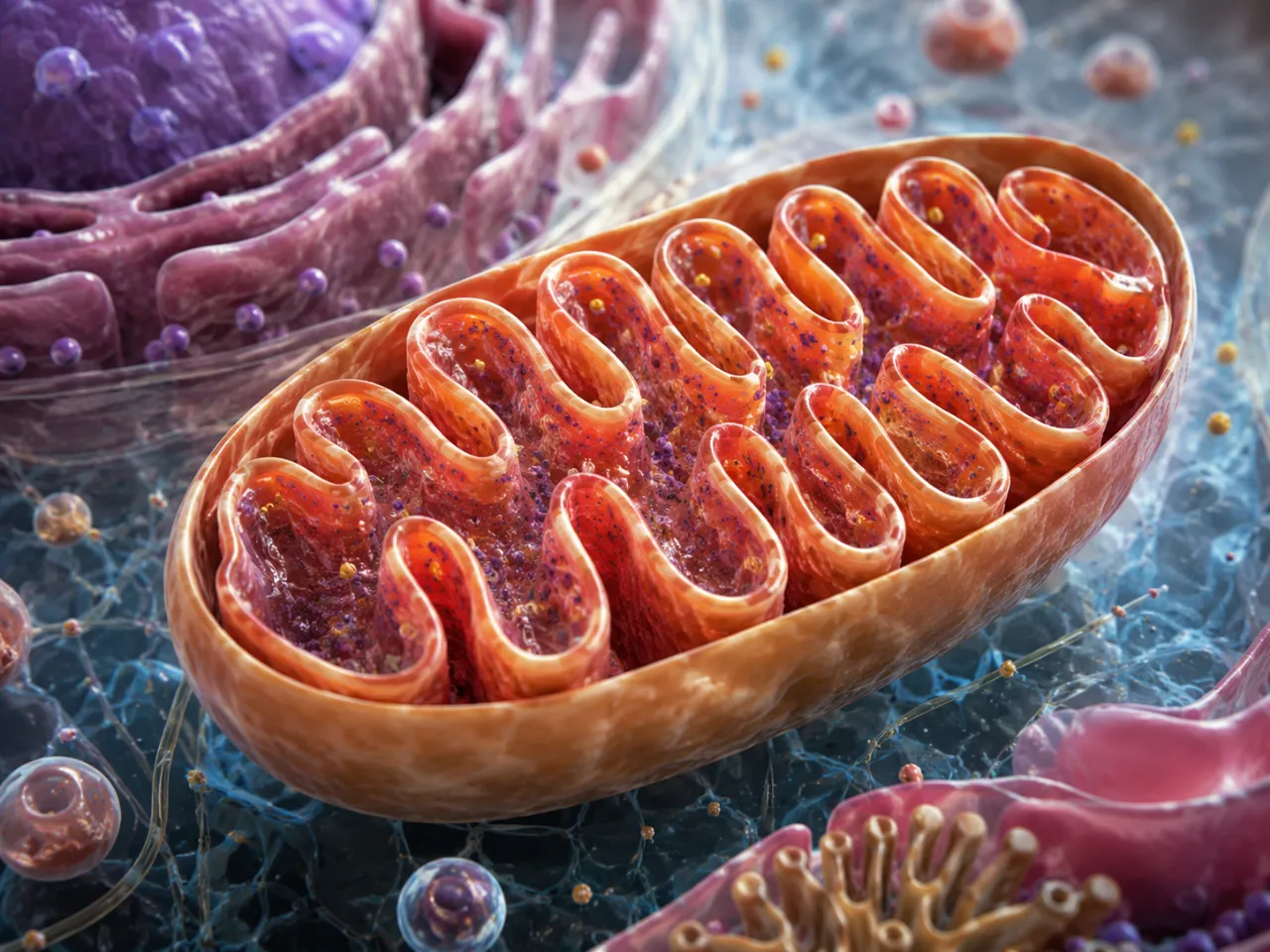
Mitochondria are commonly shown as rounded cylinders or ovals with a double membrane. The outer membrane forms the smooth outside boundary. The inner membrane is folded into cristae, which are usually drawn as squiggly, wavy, or maze-like lines inside the organelle.
These drawings are simplified. Real mitochondria can change shape, divide, merge, stretch, and form networks inside living cells. They may look like short ovals in a textbook, but in real cells they can be more flexible and dynamic.
How mitochondria work
Mitochondria help animal cells convert energy from food into ATP. ATP stands for adenosine triphosphate. It is often described as the cell’s usable energy currency because many cell processes require ATP to run.
The process that produces most ATP in mitochondria is called cellular respiration. In a simplified explanation, food molecules such as glucose are broken down, and oxygen helps release energy from those molecules. The mitochondria then help capture that energy in the form of ATP.
This does not mean mitochondria create energy from nothing. Instead, they transform energy from nutrients into a form the cell can use. This is why the “powerhouse of the cell” nickname is useful, even though it is a simplified phrase.
How animal cells use energy
Animal cells use ATP for many everyday activities. Muscle cells use large amounts of ATP to contract. Nerve cells use ATP to maintain electrical signals and communicate with other cells. Cells in the digestive system use ATP to transport molecules and build new materials.
Even when an animal is resting, its cells still need energy. They must repair damage, maintain membranes, move substances, copy genetic information, and produce proteins. Without enough ATP, cells cannot maintain normal function for long.
This is one reason mitochondria are so important in animals. Active tissues, such as muscles, the heart, liver, and brain, often have high energy needs. Cells in these tissues may contain many mitochondria, although the number varies by cell type and condition.
What the squiggly lines inside mitochondria mean
The squiggly lines inside a mitochondrion represent cristae. Cristae are folds of the inner mitochondrial membrane. They are not random decoration in the diagram; they are one of the most important parts of the organelle.
The inner membrane contains many proteins involved in ATP production. By folding inward, the membrane creates more surface area. More surface area generally allows more space for the chemical reactions involved in cellular respiration.
This is similar to folding a long sheet of paper to fit more surface into a small space. The mitochondrion is tiny, but its folded inner membrane gives it a much larger working area than a smooth inner surface would provide.
Which cell structure is easiest to confuse with it
The mitochondrion is not the only structure in an animal cell diagram that may look unusual. Some students confuse it with the endoplasmic reticulum, Golgi apparatus, lysosomes, or vesicles, depending on how the diagram is drawn.
The endoplasmic reticulum often looks like folded sheets or tunnels around the nucleus. The Golgi apparatus usually appears as stacked curved sacs. Lysosomes and vesicles are often drawn as small round bubbles. The mitochondrion is usually the one that looks like a bean or hot dog with wavy lines inside.
A helpful clue is this: if the structure is oval and has squiggles inside, it is probably a mitochondrion. If it looks like stacked pancakes, it is more likely the Golgi apparatus. If it looks like a maze near the nucleus, it may be the endoplasmic reticulum.
Do all animal cells have the same number of mitochondria
No. Different animal cells can contain different numbers of mitochondria. Cells that need a lot of energy generally have more mitochondria. Muscle cells, heart cells, and many nerve cells often have many because they perform energy-demanding work.
Some cells have fewer mitochondria because their energy needs are lower or because they rely more on other metabolic processes. Mature red blood cells in humans are a special example: they do not contain mitochondria. This helps them carry oxygen efficiently, but it also means they produce energy differently from most other body cells.
In general, mitochondria are extremely common in animal cells, but the exact number, shape, and arrangement can vary widely. The simple textbook drawing is only a basic model.
Why mitochondria are important for animals
Animals are active organisms. Even simple animal behaviors, such as crawling, swimming, flying, hunting, digesting, or escaping predators, depend on cells that can use energy efficiently. Mitochondria help make that possible.
For example, a bird’s flight muscles need enormous amounts of ATP during flight. A mammal’s heart cells need constant energy to keep beating. A predator’s nerve and muscle cells must work quickly during a chase. In all these cases, mitochondria support the energy demands of life.
Mitochondria are also involved in more than ATP production. They help regulate some cell signals, influence cell survival, and participate in metabolic pathways. However, for a beginner learning animal cell diagrams, their energy role is the most important concept to understand first.
Why mitochondria are called the powerhouse of the cell
Mitochondria are called the powerhouse of the cell because they produce much of the ATP used by many eukaryotic cells. The phrase is common in biology education because it gives students a simple way to remember their main function.
However, the phrase should not be taken too literally. A mitochondrion is not a tiny engine or battery in the mechanical sense. It is a living cell structure where complex chemical reactions take place. It works with other parts of the cell, including the cytoplasm, nucleus, and cell membrane.
A more accurate simple description would be: mitochondria are organelles that help convert energy from food into ATP through cellular respiration. That explanation is longer, but it gives a clearer picture of what they actually do.
Do mitochondria exist only in animal cells
No. Mitochondria are found in most eukaryotic cells, including animal cells, plant cells, fungi, and many protists. Plant cells have mitochondria as well as chloroplasts. Chloroplasts help plants capture light energy through photosynthesis, while mitochondria help plant cells use stored energy.
This is a common misunderstanding. Some students learn that chloroplasts are in plant cells and mitochondria are in animal cells, but that is only partly true. Animal cells have mitochondria and do not have chloroplasts. Plant cells usually have both mitochondria and chloroplasts.
So, if the diagram is an animal cell, the hot dog-shaped organelle is likely a mitochondrion. If the diagram is a plant cell, a similar bean-shaped organelle with inner folds may still be a mitochondrion, while green oval structures with stacked internal discs are usually chloroplasts.
Final takeaway
The hot dog-shaped thing in an animal cell is usually the mitochondrion. It is often drawn as a small oval or bean-shaped organelle with wavy lines inside. Those lines represent cristae, the folds of the inner membrane.
Mitochondria are best known for helping cells produce ATP, the usable energy molecule that powers many cell activities. They are essential for most animal cells and especially important in tissues with high energy needs. Although textbook diagrams make them look like simple hot dogs, real mitochondria are dynamic, complex, and vital to animal life.
FAQs
What is the hot dog-looking thing in an animal cell?
The hot dog-looking thing is usually a mitochondrion. It is an organelle that helps the cell produce ATP, the molecule cells use for energy. In diagrams, it is often shown as an oval or bean shape with squiggly lines inside.
What are the lines inside the mitochondrion called?
The lines inside a mitochondrion are usually meant to show cristae. Cristae are folds of the inner mitochondrial membrane. They increase surface area and help support the reactions involved in ATP production.
Is the mitochondrion only found in animal cells?
No. Mitochondria are found in most eukaryotic cells, including animal cells, plant cells, fungi, and many protists. Animal cells have mitochondria, and plant cells usually have mitochondria too.