The king penguin (Aptenodytes patagonicus) is one of the most elegant and recognizable penguins in the world. It is the second-largest penguin species, smaller only than the emperor penguin, and is famous for its tall posture, sleek body, and bright orange markings on the head and upper chest. Unlike flying birds, king penguins are fully adapted to life at sea, with streamlined bodies, powerful flipper-like wings, and dense waterproof feathers that help them swim through cold southern waters.
Characteristics of the King Penguin
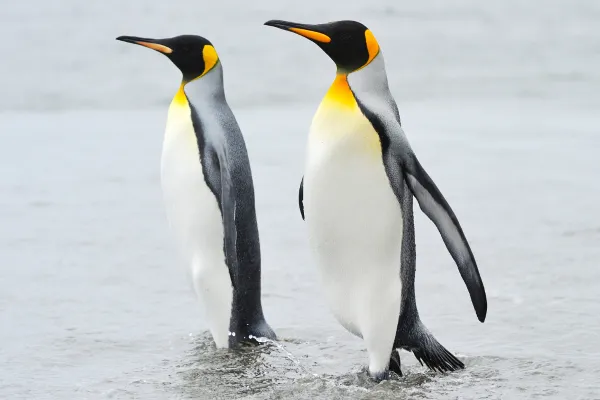
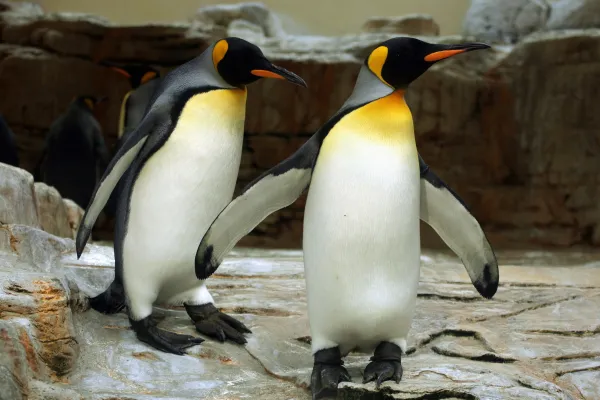
King penguins have a very distinctive appearance. The head is mostly black, with vivid orange ear patches on each side that continue as a narrow band toward the throat and upper chest. The back is bluish-gray, the belly is white, and the beak is long and slender, with orange coloration on the lower mandible. This combination makes the king penguin one of the most colorful penguin species. Adults usually stand about 85 to 95 cm tall and weigh roughly 9 to 17 kg, although body mass changes through the breeding season. Males are usually a little larger than females.
Their body shape is built for efficient swimming rather than flight. Strong flippers, dense bones, and a smooth hydrodynamic outline allow them to travel long distances at sea and dive deeply in search of food. They also have thick feathering and a layer of body fat that help them stay warm in cold subantarctic waters.
Where Does the King Penguin Live?
King penguins have a circumpolar subantarctic distribution. They spend most of their lives at sea and come onto land mainly for breeding and molting. Their breeding colonies are found on subantarctic islands, especially places such as South Georgia, the Crozet Islands, the Kerguelen Islands, Prince Edward Islands, Macquarie Island, and other nearby islands in the southern Atlantic, Indian, and southwestern Pacific oceans. Two subspecies are often recognized: one associated mainly with the South Atlantic and another with the Indian and southwestern Pacific sectors.
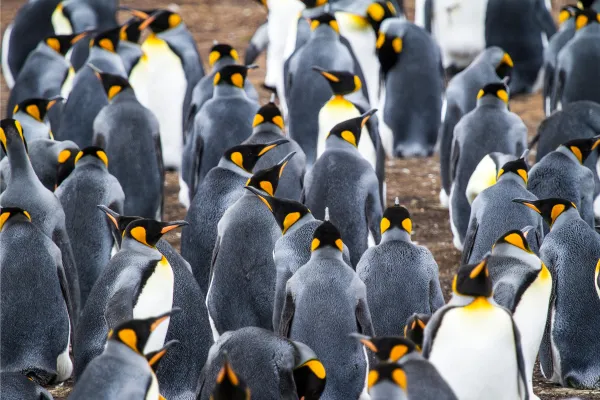
King penguins breed in very large colonies, and some colonies contain tens of thousands of breeding pairs. Because their breeding cycle is unusually long, colonies can remain occupied throughout the year by adults, eggs, chicks, and molting birds at different stages.
Diet of the King Penguin
King penguins are mainly fish-eating seabirds. Their diet is dominated by lanternfish, along with other small fish and some squid. They hunt by pursuit underwater, using their speed and agility to chase prey through the water column. Adults often travel far from their colonies while foraging, sometimes covering hundreds of kilometers before returning to feed their chick.
They are excellent divers. King penguins commonly dive to well over 100 meters, and deeper dives beyond 300 meters have been recorded. These dives allow them to reach prey living far below the surface in cold offshore waters.
Reproduction of the King Penguin
The king penguin has one of the most unusual breeding cycles of any bird. Instead of completing reproduction in a single summer season, it takes about 14 to 16 months from egg-laying to the time the chick becomes independent. Because of this long cycle, king penguins are usually successful at breeding only once every two years, or roughly two times in three years in some colonies.
Courtship begins after the adults return to the colony and complete a pre-breeding molt. Pairs recognize each other through calls and visual displays. They do not build nests. The female lays one egg, and the parents incubate it by balancing it on their feet and covering it with a fold of abdominal skin called a brood pouch. Incubation lasts around 54 days, and both parents take turns caring for the egg and later the chick.
After hatching, the chick is fed with partially digested food regurgitated by the parents. Young king penguins later gather in groups called crèches, where chicks stay together while adults go out to forage. The chick remains dependent for many months and usually fledges in late spring or early summer of the following year, when food is more abundant. Young birds usually reach breeding age at around 3 to 5 years, though many do not breed successfully until later.
Threats and Conservation
The king penguin is currently classified as Least Concern, and the global population has been estimated at around 1.1 million annual breeding pairs. In many areas the overall population has increased over the long term, although some colonies appear to be stabilizing or showing local declines.
Even so, the species faces important long-term threats. The biggest concern is climate change, because warming oceans can shift prey farther away from breeding colonies, forcing adults to travel longer distances to find food. Other risks include fisheries interactions, pollution, and changes to marine ecosystems. Since king penguins depend heavily on cold, productive feeding grounds, changes in ocean conditions may have a major impact on future colony success.
Interesting Facts About the King Penguin
The king penguin is the second-largest penguin in the world. It is often confused with the emperor penguin, but it is slightly smaller and breeds on subantarctic islands rather than on Antarctic sea ice. Its bright orange markings are among the boldest of any penguin species. King penguins are also extremely social birds, and their colonies can be noisy, crowded, and active throughout the year because different birds are at different breeding stages.
They are also powerful swimmers and deep divers, spending most of their lives in the open ocean. Their long breeding cycle, large colonies, and dependence on distant feeding grounds make them one of the most fascinating penguins to study.
FAQ
What is a king penguin?
A king penguin is a large subantarctic penguin and the second-largest penguin species in the world.
Where do king penguins live?
They live in the southern oceans and breed mainly on subantarctic islands such as South Georgia, Crozet, Kerguelen, and Macquarie.
What do king penguins eat?
They mainly eat lanternfish and other small fish, along with some squid.
How big is a king penguin?
Adults usually stand about 85 to 95 cm tall and weigh around 9 to 17 kg.
How many eggs does a king penguin lay?
A king penguin lays one egg at a time.
Is the king penguin endangered?
No. It is generally listed as Least Concern, although climate change is a growing long-term threat.
Bibliography
Araya, B., Millie Holman, G. (2005). Field Guide to the Birds of Chile. Chile: Editorial Universitaria.
De Roy, T., Jones, M., Cornthwaite, J. (2014). Penguins: The Ultimate Guide. United Kingdom: Princeton University Press.
BirdLife International (2020) Aptenodytes patagonicus. The IUCN Red List of Threatened Species 2020: e.T22697748A184637776. https://dx.doi.org/10.2305/IUCN.UK.2020-3.RLTS.T22697748A184637776.en. Accessed on 11 March 2024.