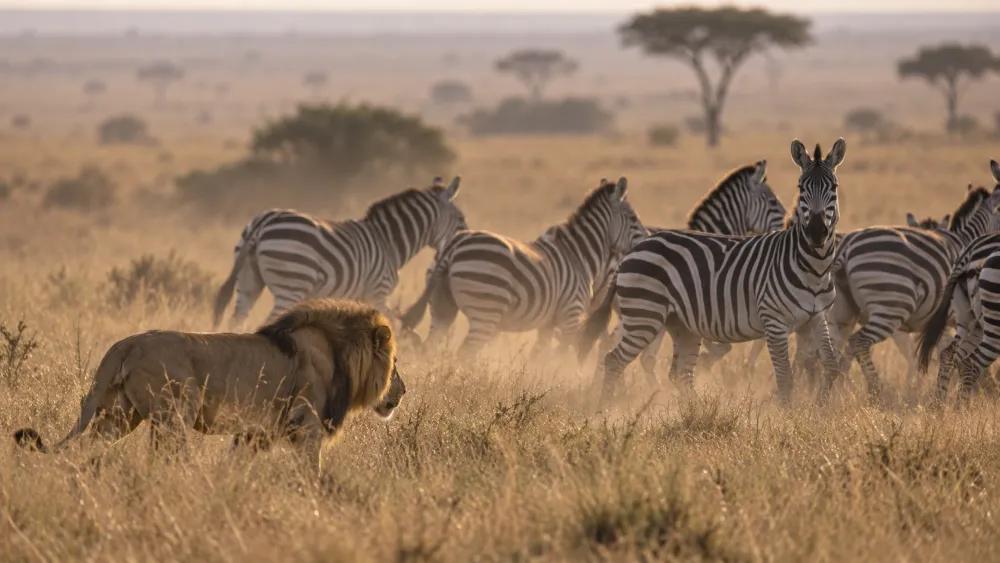
Calling any animal the “king” is a human story, not a biological rank. In nature, there isn’t one universal champion—there are specialists shaped by different habitats, hunting styles, and social systems. Lions (Panthera leo) and tigers (Panthera tigris) are both apex predators, but they “rule” in very different ways: the lion as a social strategist of open savannas, the tiger as a solitary ambush expert of forests and grasslands.
1) The simplest difference: society vs. solitude
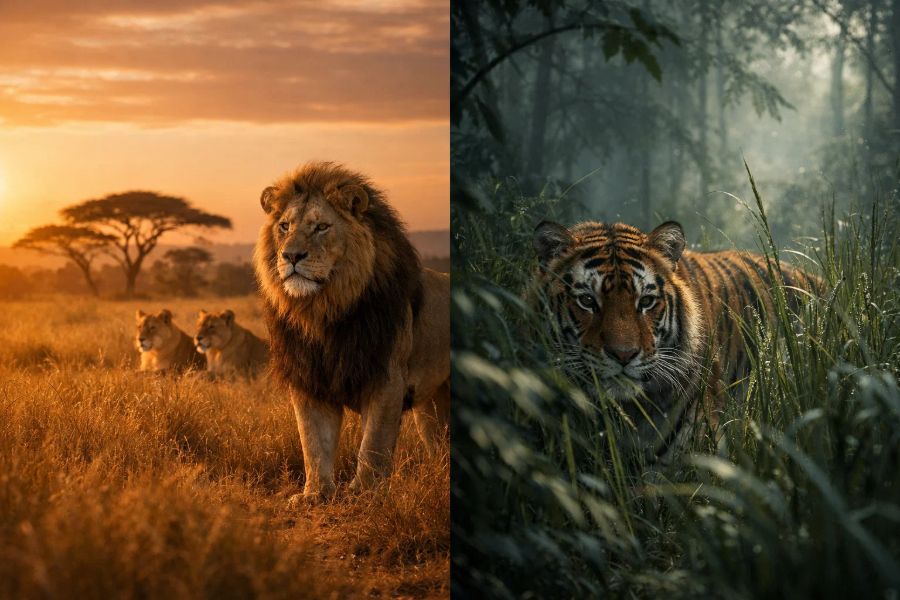
Lions are the most social felines. They live in prides—groups of related females and their offspring, plus one or more males—sometimes reaching up to ~40 individuals depending on prey availability.
This social life isn’t just “friendship”—it’s an ecological strategy that can help them defend territory, raise cubs, and hunt cooperatively.
Tigers are generally solitary. Adult tigers typically live alone, except for mothers with cubs and brief mating associations.
Solitude fits their environment: dense vegetation rewards stealth, camouflage, and single-predator ambush.
If “king” means social dominance and coordinated territory defense, lions have the strongest claim. If it means solitary mastery and stealth efficiency, tigers do.
2) Size and strength: the uncomfortable truth is “it depends”
People often ask “Which is bigger?” The evidence shows overlap, with variation by sex, region, and subspecies.
Lion (male): about 150–250 kg is a commonly cited range.
Tiger: a broad range is reported across subspecies and sexes (San Diego Zoo lists ~75–325 kg overall), and conservation sources note some males of larger subspecies can reach very high weights.
So, the largest tigers can exceed many lions, but a large male lion can be comparable to many adult male tigers depending on population. The key point is: neither species has a monopoly on being “the biggest cat.”
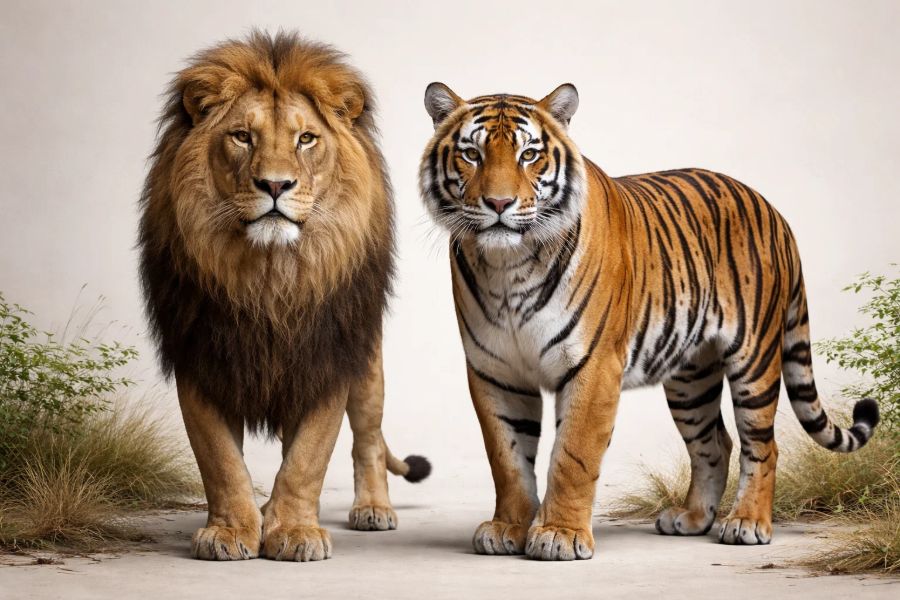
3) Weapons and “armor”: mane vs. stripes
Lion mane (male): The mane is not just decoration. Research shows mane traits (especially darkness) can signal male condition and influence both female choice and male–male competition.
That makes the mane part of a lion’s “social biology”—a display structure linked to reproduction and rivalry.
Tiger stripes: Tigers are classic stalk-and-ambush hunters, and reputable zoo references describe stripes as effective camouflage that breaks up the animal’s outline in grass and forest cover.
In other words, stripes support the tiger’s signature strategy: get close unseen, then explode into a short, powerful attack.
4) How they hunt: teamwork vs. stealth
Lions often hunt large ungulates and can coordinate as a group; on the Smithsonian profile, lionesses are described as the primary hunters, with males sometimes joining.
Tigers are described as patient ambush predators that can stalk quietly for extended periods before a neck-grab suffocation kill.
Neither method is “better” universally:
In open savanna, teamwork can increase success and allow defense of kills.
In dense habitat, solo ambush reduces detection and conflict.
That’s two different solutions to the same evolutionary problem: turning muscle, teeth, and timing into calories.
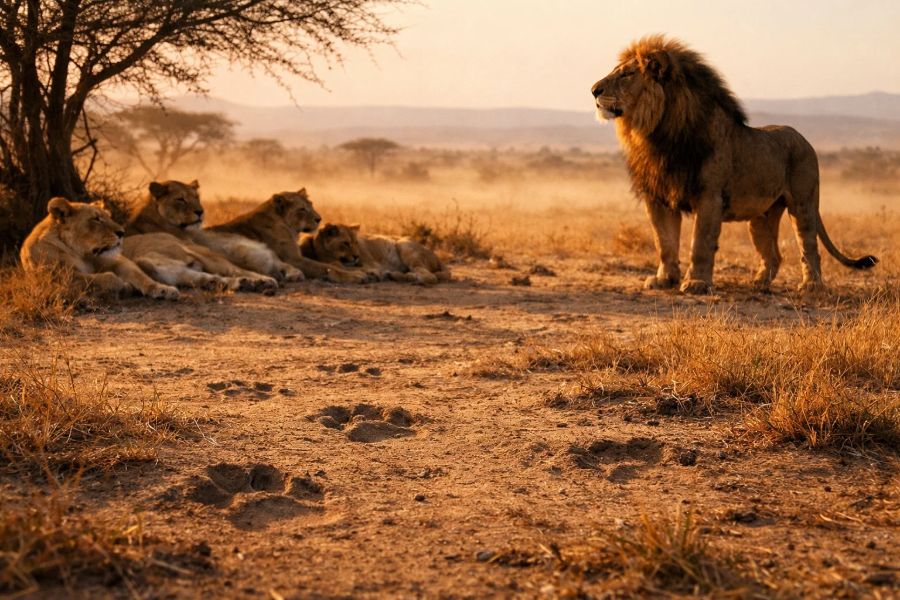
5) Territory and communication: loud coalitions vs. quiet borders
Lions use sound heavily in social life: the Smithsonian notes roaring can be heard up to about five miles and functions in territorial marking and group communication.
Tigers also vocalize and mark territory (scrapes, scent, calls), but their lifestyle is typically built around spacing and avoidance rather than group cohesion.
Quick comparison table: lion vs. tiger (what biology actually says)
| Category | Lion (Panthera leo) | Tiger (Panthera tigris) | “King” advantage? |
|---|---|---|---|
| Social system | Prides; highly social; can be ~up to 40 individuals | Generally solitary; mother with cubs is main exception | Lion (social dominance) |
| Typical hunting style | Cooperative hunting common; lionesses primary hunters | Stalk-and-ambush; stripes aid camouflage | Tiger (stealth mastery) |
| Male “signal trait” | Mane signals condition; influences mating and rivalry | Unique stripe patterns; used for individual ID by researchers | Tie (different purposes) |
| Size (broad view) | Male ~150–250 kg | Wide range across subspecies; up to ~325 kg noted in zoo references; large males can be very heavy | Tiger (upper extreme) |
| Habitat style (today) | Mostly Africa + small Gir Forest population in India | Asia across multiple habitat types; fragmented range | Not comparable |
| Conservation status | Vulnerable (IUCN) | Endangered (IUCN) | “King” = the one we save |
6) The question everyone asks: “Who would win in a fight?”
From a zoologist’s perspective, this is the least meaningful “king test,” because:
Lions and tigers rarely (essentially never) meet naturally in the wild today, so there’s no stable evolutionary “matchup” context.
Outcomes would depend on age, sex, body condition, motivation, injuries, and environment—variables that swamp any single-species answer.
Biology does support a better conclusion: both are elite predators optimized for different worlds—lion for social dominance in open landscapes; tiger for solitary ambush in complex cover.
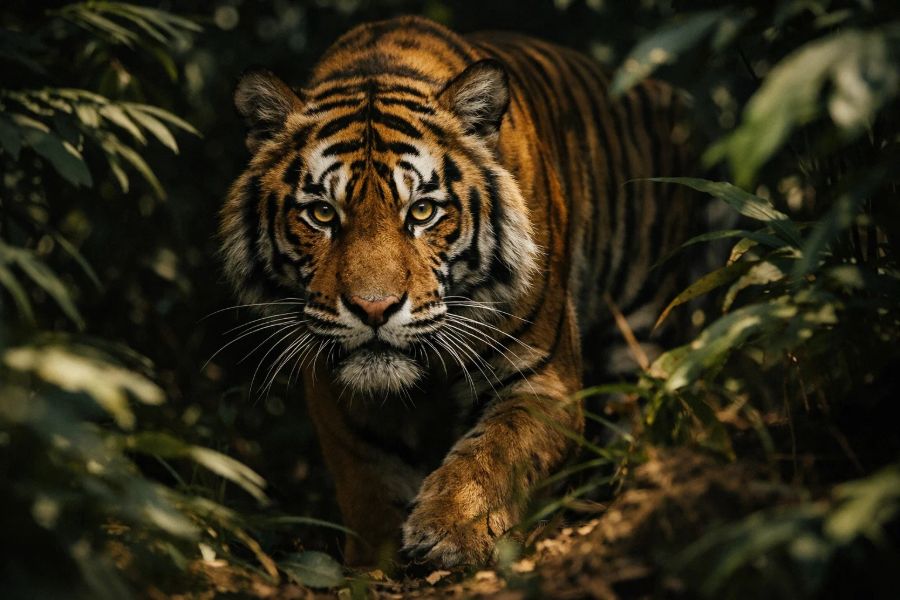
Final verdict: who’s the “true king”?
If you define “king” as social power, coalition defense, and a visible crown-like signal (mane) → lion.
If you define “king” as solitary supremacy, stealth design, and ambush efficiency → tiger.
If you define “king” as the cat we must protect most urgently → both, but the tiger’s Endangered status is a blunt warning signal.
In real science terms: there is no single “cat king”—only two different apex blueprints that humans are responsible for keeping alive.
References (bibliography)
Smithsonian’s National Zoo & Conservation Biology Institute. “Lion (Panthera leo)” (size, pride structure, roaring distance, hunting notes).
San Diego Zoo Wildlife Alliance. “Tiger (Panthera tigris)” (camouflage function of stripes, ambush hunting, solitary behavior, size range).
World Wildlife Fund (WWF). “Tiger” (solitary behavior; weight notes by subspecies).
IUCN Red List. Panthera leo assessment PDF (Vulnerable).
IUCN Red List. Panthera tigris assessment PDFs (Endangered; Red List documentation).
West, P. M., & Packer, C. (2002). “Sexual selection, temperature, and the lion’s mane.” (mane as a condition signal affecting female choice and male competition).