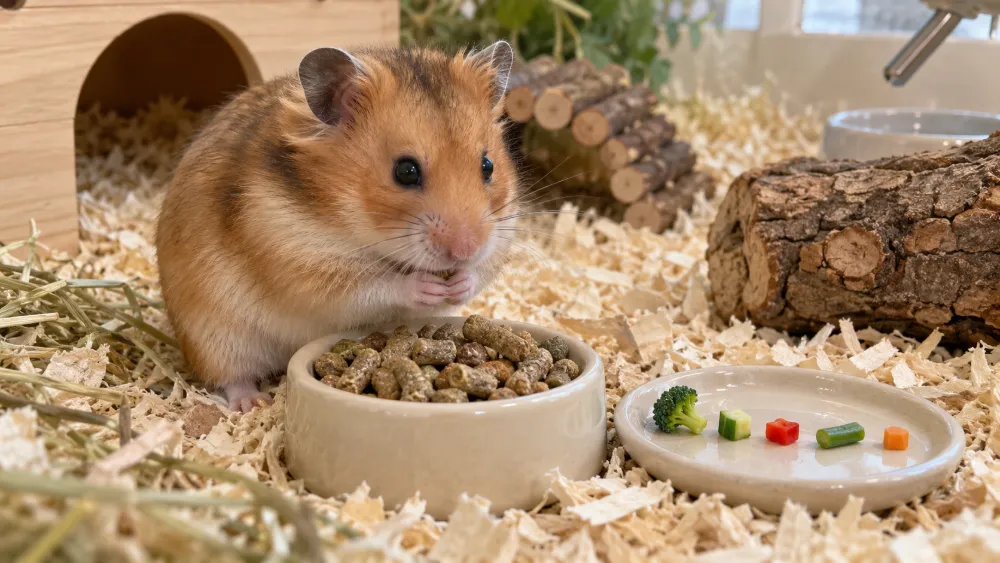
Hamsters should eat a nutritionally complete hamster food as the foundation of their diet, with small amounts of suitable vegetables, occasional fruit, and limited protein treats such as mealworms or plain boiled egg. Safe choices include broccoli, cucumber, bell pepper, pumpkin, green beans, apple without seeds, pear, oats and millet. Avoid grapes, rhubarb, fruit pits, garlic, onions, chocolate, caffeine, alcohol and heavily processed human foods. Fresh water should always be available.
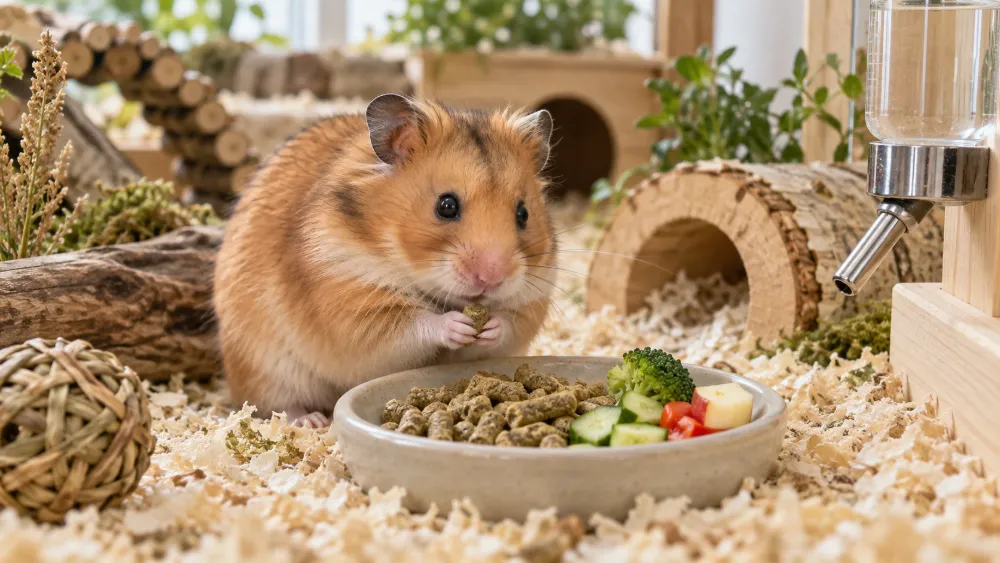
A complete hamster food should make up most of the diet. Fresh vegetables, fruit and protein treats are supplements rather than the main meal.
What Can Hamsters Eat? Quick Food Chart
| Food Type | Examples | How Often? | Main Rule |
|---|---|---|---|
| Complete hamster food | Pellets, lab blocks or a nutritionally complete hamster formulation | Daily | This should form the foundation of the diet |
| Vegetables | Broccoli, cucumber, bell pepper, pumpkin, squash, green beans | Small portions | Wash well and introduce gradually |
| Fruit | Apple without seeds, pear, banana, melon, peach flesh | Occasional | Keep portions tiny because fruit is sugary |
| Protein treats | Mealworms, crickets, plain boiled egg | Occasional | Small unseasoned portions only |
| Grains | Oats, barley, wheat, millet | Small amounts | Plain and unsweetened |
| Nuts and seeds | Small pieces of suitable plain nuts and seeds | Occasional | High in calories and fat |
| Water | Fresh clean water | Always available | Check the bottle or bowl every day |
What Should a Hamster Eat Every Day?
The most important part of a hamster's diet is not fruit, vegetables or treats. It is a complete food formulated specifically for hamsters.
Veterinary and animal-welfare organizations differ slightly in whether they prefer pellets, lab blocks or a properly formulated hamster mixture, but they agree on the main principle: the staple food needs to provide balanced nutrition rather than being a collection of treats.
A practical feeding hierarchy looks like this:
| Priority | Food | Role |
|---|---|---|
| 1 | Complete hamster food | Main source of daily nutrition |
| 2 | Suitable fresh vegetables and herbs | Small supplementary portions |
| 3 | Occasional protein or grain treats | Variety and enrichment |
| 4 | Fruit | Tiny occasional treat |
A hamster should never need sugary human snacks, heavily processed food or a large bowl of fruit to have an interesting diet.
Are Hamsters Omnivores?
Yes. Hamsters are omnivorous rodents.
Wild hamsters eat a mixture that can include:
seeds;
grains and cereals;
plant material;
insect larvae;
adult insects.
This helps explain why a balanced pet hamster diet is different from the diet of a strict herbivore such as a rabbit.
However, a pet hamster does not need owners to recreate a wild diet ingredient by ingredient. A complete commercial hamster food is the simplest way to provide reliable nutrition.
Pellets vs Seed Mix: Which Is Better?
Pelleted foods have one major advantage: every piece has a similar nutritional composition.
With some muesli-style seed mixtures, a hamster may selectively eat the tastiest high-fat or high-sugar ingredients and leave other components behind.
This is sometimes called selective feeding.
VCA Animal Hospitals advises against feeding a strict seed-only diet because seeds can be high in fat and incomplete as a sole source of nutrition.
If you use a mixed hamster food, make sure it is specifically formulated as a complete hamster diet rather than assembling a homemade mix of sunflower seeds and grains.
Safe Vegetables for Hamsters
Suitable vegetables are generally a better fresh-food choice than relying heavily on sweet fruit.
Examples commonly included in veterinary and animal-welfare feeding guidance include:
broccoli;
bell pepper;
cucumber;
courgette or zucchini;
green beans;
pumpkin;
squash;
peas;
parsnip;
kale;
small amounts of carrot;
small amounts of beetroot;
dark leafy greens.
Fresh food should be washed thoroughly and offered in small pieces.
Can Hamsters Eat Broccoli?
Yes. Hamsters can eat a small amount of broccoli.
Do not give a large serving. Broccoli and similar cruciferous vegetables may cause digestive gas when overfed.
Can Hamsters Eat Cucumber?
Yes. A small piece of fresh cucumber can be offered.
Cucumber contains a lot of water, so there is no reason to provide a large portion. Too much watery food may contribute to soft stools or digestive upset.
Can Hamsters Eat Carrots?
Yes, but carrot is naturally sweeter than many leafy vegetables.
A small piece is sufficient, particularly for dwarf hamsters or animals that are overweight.
Can Hamsters Eat Bell Peppers?
Yes. Plain fresh bell pepper can be included as one of several vegetable options.
Remove spoiled areas and serve only a small clean piece.
What Fruits Can Hamsters Eat?
Fruit should be treated as an occasional extra rather than a major part of a hamster's diet.
Suitable options can include:
apple flesh with the seeds removed;
pear with the seeds removed;
banana;
melon without seeds;
peach flesh with the pit completely removed;
small pieces of berries.
For a complete fruit-by-fruit guide, see What Fruits Can Hamsters Eat? Safe & Unsafe Fruit List.
Fruit contains natural sugars, so even safe fruit should not become a daily bowl of food.
Can Hamsters Eat Apples?
Yes.
Serve only fresh apple flesh and remove all seeds and the core.
A hamster needs only a very small piece.
Can Hamsters Eat Bananas?
Yes, but banana is sweet and calorie-dense.
A thin fragment is enough for an occasional treat.
Can Hamsters Eat Pineapple?
A healthy Syrian hamster can have a very small piece of fresh pineapple occasionally, but it is not an essential food and is relatively sugary and acidic.
Dwarf hamsters should be treated more cautiously with sugary fruit.
See our detailed guide: Can Hamsters Eat Pineapple? Safe Amounts, Risks & Better Treats.
Can Dwarf Hamsters Eat Fruit?
Dwarf hamsters can eat some of the same fresh foods as Syrian hamsters, but portion size matters even more because dwarf hamsters are much smaller.
Russian dwarf types also have a recognized predisposition to diabetes.
That means sugary fruit should be:
very small;
infrequent;
optional rather than necessary.
Vegetables with less sugar are generally a more practical fresh-food choice.
If you are unsure which hamster you have, see our guide to common pet hamster types.
Safe Protein Foods for Hamsters
Because hamsters are omnivores, limited animal-protein treats can fit into the diet.
Common examples include:
mealworms;
crickets;
a tiny piece of plain hard-boiled egg.
These are treats, not a substitute for complete hamster food.
Avoid salt, oil, butter, sauces, seasoning and processed meats.
Can Hamsters Eat Eggs?
Yes. A very small piece of plain fully cooked egg can be used as an occasional protein treat.
Do not add salt, oil or seasoning.
Can Hamsters Eat Mealworms?
Yes. Mealworms reflect the insect component of a hamster's natural omnivorous diet and are commonly recommended as an occasional treat.
They are energy-dense, so more is not better.
Can Hamsters Eat Grains?
Yes. Hamsters naturally eat seeds and cereal grains.
Suitable plain grains can include small amounts of:
oats;
barley;
wheat;
millet.
These foods may already be included in a complete commercial hamster diet.
Do not turn additional grains into a large second meal on top of the hamster's normal daily ration.
Can Hamsters Eat Nuts?
Some plain nuts can be used as occasional treats, but nuts are high in fat and calories.
Keep the portion extremely small and avoid:
salted nuts;
honey-roasted nuts;
chocolate-coated nuts;
nuts with spices or flavor coatings.
A nut should be viewed as a calorie-dense treat rather than a basic hamster food.
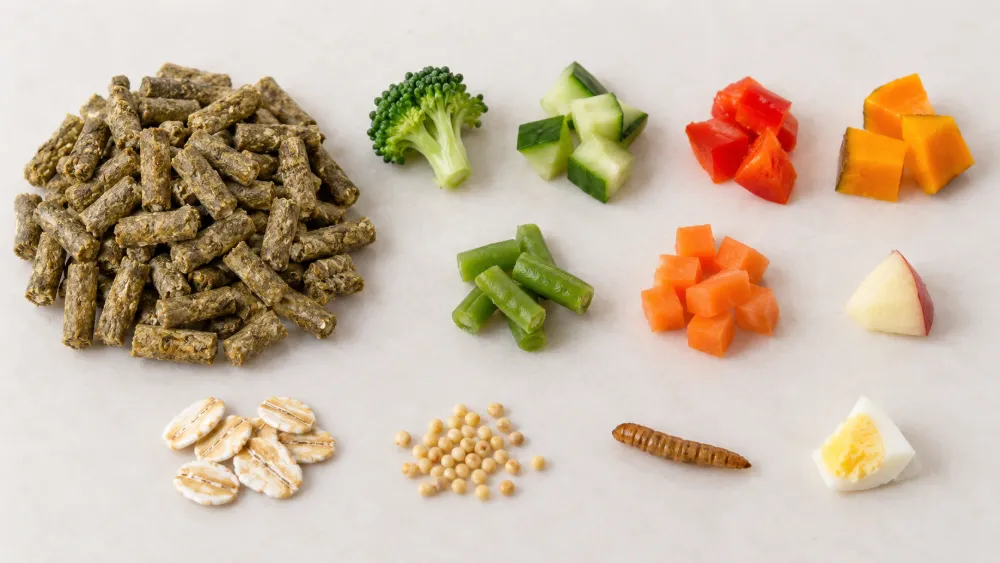
Complete hamster food should make up the largest share. Vegetables, grains, fruit and protein treats are offered in much smaller amounts.
Foods Hamsters Should Not Eat
Not every human food is suitable for a hamster.
| Food | Recommendation | Reason |
|---|---|---|
| Grapes and raisins | Avoid | RSPCA specifically advises against grapes for hamsters |
| Rhubarb | Avoid | Listed by RSPCA as potentially poisonous to rodents |
| Fruit seeds and stone-fruit pits | Avoid | Unnecessary and some contain harmful cyanogenic compounds |
| Citrus fruit | Better avoided | Guidance remains inconsistent and safer alternatives exist |
| Garlic and onions | Avoid | Veterinary hamster guidance advises against Allium foods |
| Raw beans | Avoid | Veterinary hamster guidance lists them among unsuitable vegetables |
| Raw potato | Avoid | Not recommended in veterinary hamster feeding guidance |
| Unripe tomato | Avoid | Not recommended for hamsters |
| Chocolate | Never feed | Contains methylxanthines such as theobromine and caffeine |
| Coffee, tea and energy drinks | Never feed | Caffeine can be toxic to pets |
| Alcohol | Never feed | Alcohol is toxic to animals |
| Sweet, salty or heavily processed food | Avoid | High sugar, fat or salt with little nutritional value |
Can Hamsters Eat Chocolate?
No.
Chocolate contains methylxanthines including theobromine and caffeine. These substances can cause serious toxicity in animals.
Chocolate provides no nutritional benefit to a hamster and should be kept completely out of reach.
Can Hamsters Eat Onions or Garlic?
Veterinary hamster-care guidance recommends avoiding onions and garlic.
There is no nutritional need to experiment with these foods when many established safe vegetables are available.
Also avoid seasoned human dishes that contain onion powder or garlic powder.
Can Hamsters Eat Citrus Fruit?
Guidance about citrus has become less absolute than it once was.
Some sources note that the evidence for universal citrus toxicity in hamsters is uncertain, while veterinary care sheets still recommend avoiding oranges, lemons and grapefruit.
Because citrus is not necessary and there are many better-established options, the simplest recommendation is:
Skip citrus and choose a small piece of a better-established fruit instead.
Can Hamsters Eat Grapes?
The RSPCA specifically advises owners not to give grapes to hamsters and states that grapes and rhubarb may be poisonous to rodents.
Some other pet-care sources are less restrictive, creating conflicting advice.
Since grapes provide no essential nutrient that cannot be obtained elsewhere, avoiding them is the cautious choice.
How Much Fresh Food Should a Hamster Eat?
Fresh food should remain a small supplement to the main diet.
There is no one perfect serving size for every Syrian, Chinese, Campbell's, winter white and Roborovski hamster.
Body size, age, health and the nutritional composition of the hamster's main food all matter.
Useful general rules are:
keep fresh-food servings small;
introduce one unfamiliar food at a time;
give dwarf hamsters smaller portions than Syrian hamsters;
keep fruit smaller and less frequent than vegetables;
do not allow treats to replace complete food.
Veterinary guidance commonly recommends keeping supplementary foods to only a small fraction of the total diet.
Why Portion Size Matters So Much
A piece of food that looks tiny to a person may be enormous relative to a 30-gram dwarf hamster.
Overfeeding treats can contribute to:
weight gain;
nutritional imbalance;
selective eating;
soft stools or digestive upset;
excess sugar intake.
Small portions also reduce the amount of fresh food that a hamster can carry away and hide until it spoils.
Hamsters Hoard Food—Why That Matters
Hamsters naturally carry food in their cheek pouches and store it in a nest or food cache.
This is normal behavior.
Dry hamster food can remain in a hoard relatively safely for a period, but fresh fruit, vegetables, egg and other moist foods can spoil.
Check hiding places regularly and remove old fresh food before it becomes mouldy.
Do not destroy the hamster's entire food store unnecessarily every day, because hoarding is an important natural behavior. Focus on removing food that can rot.
How to Introduce New Foods
Sudden dietary changes can upset a hamster's digestive system.
Introduce unfamiliar foods gradually.
A simple process is:
Offer one very small amount of the new food.
Do not introduce several new foods at the same time.
Watch eating behavior and droppings.
Remove uneaten fresh food after a few hours.
Stop the new food if loose stools or digestive problems develop.
If you are changing the hamster's main commercial diet, transition gradually rather than replacing the old food overnight.
How Often Should Hamsters Be Fed?
Hamsters are most active during the evening and night, so feeding around the beginning of their active period is practical.
Follow the daily ration instructions for the complete hamster food you use rather than continually refilling a large bowl whenever it looks empty.
Remember that an “empty” dish does not always mean the hamster has eaten everything. It may have carried much of the food into a hidden store.
Do Hamsters Need Hay?
Hamsters are not grazing herbivores like rabbits or guinea pigs, so hay should not replace complete hamster food.
Some care organizations recommend Timothy hay as an additional source of fiber and enrichment.
Hamsters may also use suitable hay as part of nesting and foraging behavior.
The important point is that hay is an optional supplement, not the nutritional foundation of the diet.
What Should Hamsters Drink?
Fresh, clean water.
Water should be continuously available and checked every day.
Do not substitute:
fruit juice;
milk;
sweetened drinks;
sports drinks;
tea;
coffee.
Check bottles for blockages and leaks. If using a water bowl, it should be shallow, stable and kept clean.
What If My Hamster Stops Eating?
A noticeable reduction in appetite can be a sign that something is wrong.
Other concerning signs include:
diarrhea or unusually soft droppings;
a wet or dirty rear end;
weight loss;
lethargy;
difficulty chewing;
drooling;
sudden changes in drinking.
Small mammals can deteriorate quickly when ill.
If your hamster stops eating, develops diarrhea, appears weak or shows another significant health change, contact a veterinarian experienced with small mammals.
Syrian vs Dwarf Hamster Diet
| Diet Issue | Syrian Hamster | Dwarf Hamster |
|---|---|---|
| Complete hamster food | Essential | Essential |
| Vegetable portion | Small | Smaller |
| Fruit | Tiny occasional treat | Extra caution with sugary fruit |
| Protein treats | Small occasional amount | Very small occasional amount |
| Main concern | Overfeeding and obesity | Very small body size; some Russian dwarf lines are diabetes-prone |
The basic nutritional principle is the same for both: complete food first, fresh extras second.
Frequently Asked Questions
What can hamsters eat every day?
A nutritionally complete hamster food should be the main daily diet. Small amounts of suitable fresh vegetables can supplement it, while fruit and high-calorie treats should be less frequent.
What vegetables can hamsters eat?
Suitable examples include broccoli, cucumber, bell pepper, green beans, pumpkin, squash, peas, courgette and small amounts of carrot. Wash fresh vegetables and serve small portions.
What fruit can hamsters eat?
Hamsters can eat tiny portions of fruits such as apple without seeds, pear, banana, melon and peach flesh with the pit removed. Fruit is an occasional treat because of its sugar content.
Can hamsters eat cheese?
Cheese is not necessary for a healthy hamster diet and is often high in fat and salt. If protein variety is desired, better-established options such as a tiny amount of plain boiled egg or mealworms are easier choices.
Can hamsters eat eggs?
Yes. A tiny piece of plain hard-boiled egg can be used as an occasional protein treat. Do not add seasoning, salt, butter or oil.
Can hamsters eat mealworms?
Yes. Mealworms can be used as an occasional protein-rich treat. Hamsters are omnivores and naturally eat insects as part of their wild diet.
Can hamsters eat chocolate?
No. Chocolate contains theobromine and caffeine and should never be given to a hamster.
Can hamsters eat grapes?
The RSPCA advises against grapes for hamsters. Because reputable guidance is inconsistent and grapes are unnecessary, avoiding them is the cautious choice.
Can hamsters eat onions?
Veterinary hamster-care guidance advises avoiding onions and garlic. There are many safer vegetables available, so there is no benefit to including them.
Can hamsters eat human food?
Some plain human foods are also safe hamster foods, such as small portions of suitable vegetables, plain oats or boiled egg. Processed, salty, sugary, spicy or heavily seasoned human food should not be used as hamster food.
How much should a hamster eat?
Follow the feeding instructions for the hamster's complete food and adjust for body condition and veterinary advice. Fresh foods and treats should remain a small part of the total diet, with dwarf hamsters receiving especially small portions.
What is the best food for a hamster?
The best foundation is a nutritionally complete food specifically formulated for hamsters. Fresh vegetables and occasional treats add variety but should not replace the balanced staple diet.