Spotted a bird with red eyes and wondering what it was? A red iris is a memorable clue, but it does not identify a bird by itself. Some of the 12 North American species below have striking crimson eyes throughout adulthood; others show reddish eyes only in certain sexes, ages or regional populations.
Use the real species photos and identification chart to compare bill shape, body markings, habitat, range and season. The red part should be the iris (the colored circle around the pupil), not a red bill, forehead shield, skin ring or camera-flash reflection.
12 Red-eyed Birds at a Glance
Quick answer: A black waterbird with a white bill may be an American Coot; a glossy black crested songbird in the Southwest may be a Phainopepla; a tall black-and-white wader with pink legs may be a Black-necked Stilt. However, the same red eye can appear in ducks, divers, hawks and doves. Check the details below before choosing a match.
| Bird | Red-eye clue | Fast field mark | Typical setting |
|---|---|---|---|
| American Coot | Adult: deep red | Dark, nearly black body; white bill and forehead shield; lobed toes | Lakes and marshes across much of North America |
| Red-eyed Vireo | Adults reddish; immature birds browner | Olive back, pale underside, gray cap and black-and-white eyebrow | Eastern and central North American forests in breeding season |
| Male Wood Duck | Adult male: striking red; females are darker eyed | Green-and-purple crested head; white stripes; chestnut breast | Wooded ponds, swamps and streams in North America |
| Common Loon | Adults: red, especially clear in breeding-season close-ups | Black head, white neck bands and checkerboard back in summer | Northern breeding lakes; coasts and larger waters in winter |
| Black-crowned Night Heron | Adult: red; juveniles have a different appearance | Short thick neck; black crown and back; gray wings; heavy bill | Marshes, lakes, estuaries and roost trees across North America |
| Western Grebe | Adults: bright red | Long white neck, dark crown extending around eye and long yellow-green bill | Western North American lakes and Pacific coastal waters |
| Black-necked Stilt | Adults: reddish iris | Very long pink legs, slim straight black bill, black-and-white body | Shallow wetlands, salt ponds and mudflats in the Americas |
| White-winged Dove | Adults: reddish to orange-red; juveniles darker | Broad white wing stripe; blue bare skin surrounding the eye | Southwestern and southern U.S., Mexico and Central America |
| Purple Gallinule | Adults: red | Violet-blue body, green back, yellow legs, red-and-yellow bill | Freshwater marshes of the southeastern U.S. and tropical Americas |
| Cooper's Hawk | Adults usually red; juveniles yellow | Rounded long tail, gray back, dark cap, reddish-barred breast | Woodlands and suburbs across much of North America |
| Eastern Towhee | Often red in northern and central populations; pale in parts of the Southeast | Black or brown upperparts, rusty flanks, white belly and long tail | Eastern U.S. woodland edges, scrub and thickets |
| Phainopepla | Adult male and female: red; juveniles browner | Long tail and pointed crest; male glossy black; female gray | Desert washes and dry woodlands in the southwestern U.S. and Mexico |
Note: These are 12 well-documented examples, not an exhaustive list or a ranking of which bird has the reddest eyes. Photo appearance varies with angle and light.
1. American Coot (Fulica americana)
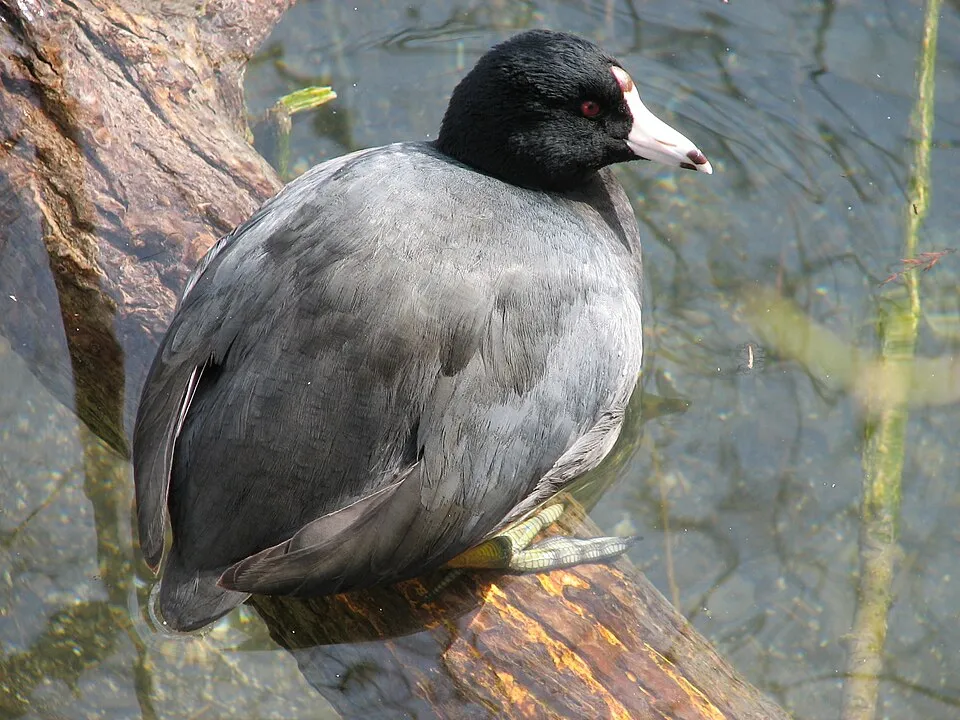
Photo: Trisha M. Shears · Public Domain · original image and attribution. Image may not show every feature discussed.
Eye: Adult: deep red. Where: Lakes and marshes across much of North America. Best identification clue: Dark, nearly black body; white bill and forehead shield; lobed toes.
From a distance an American Coot looks like a small black duck, but it belongs to the rail family. The adult has a compact dark body, a distinctive chalk-white bill and a red eye that can be surprisingly vivid in good light.
Watch one walking: instead of a duck’s webbed feet, its toes carry separate broad lobes. Those toes help it swim while still moving over muddy edges and floating plants. Coots are especially easy to encounter on open ponds and reservoirs in winter.
Do not confuse the eye with the reddish patch some individuals show near the top of their white frontal shield. The latter is skin above the bill, not the iris.
2. Red-eyed Vireo (Vireo olivaceus)
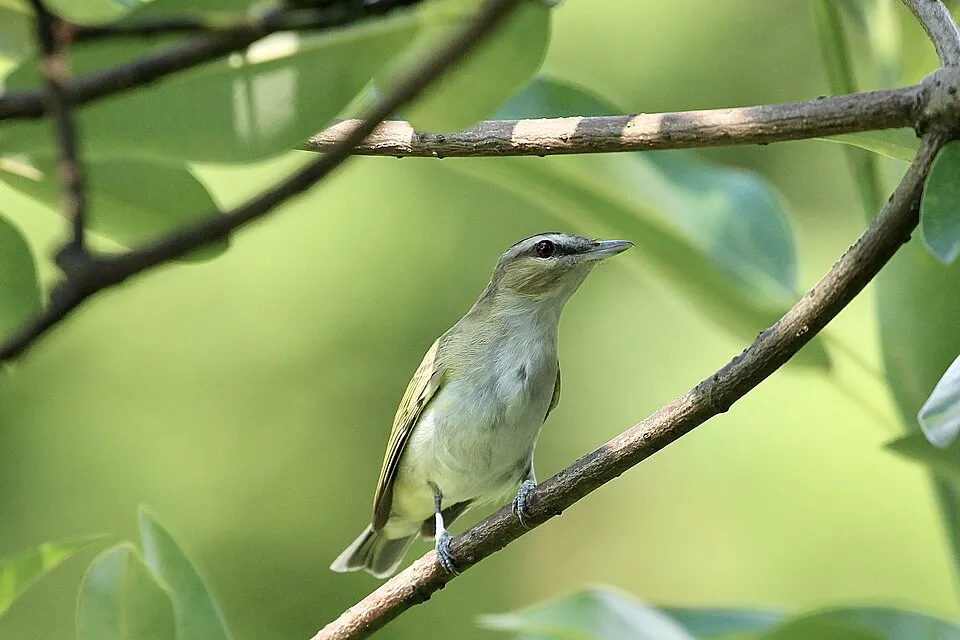
Photo: Rjw5241 · CC BY-SA 4.0 · original image and attribution. Image may not show every feature discussed.
Eye: Adults reddish; immature birds browner. Where: Eastern and central North American forests in breeding season. Best identification clue: Olive back, pale underside, gray cap and black-and-white eyebrow.
This small forest songbird practically announces its eye color in its name, yet the eye can look dark unless you have a close photograph or binocular view. Its stronger field marks are a crisp white eyebrow bordered by dark lines, a gray crown and an olive back.
It spends much of the summer searching the upper canopy for insects and singing short, repeated phrases. An individual calling persistently from a leafy tree is more likely to be located by sound than by its red iris.
Young birds have less reddish eyes, so a brown-eyed vireo is not necessarily a different species. In fall these birds migrate south; do not expect them at northern feeders in the middle of winter.
3. Male Wood Duck (Aix sponsa)
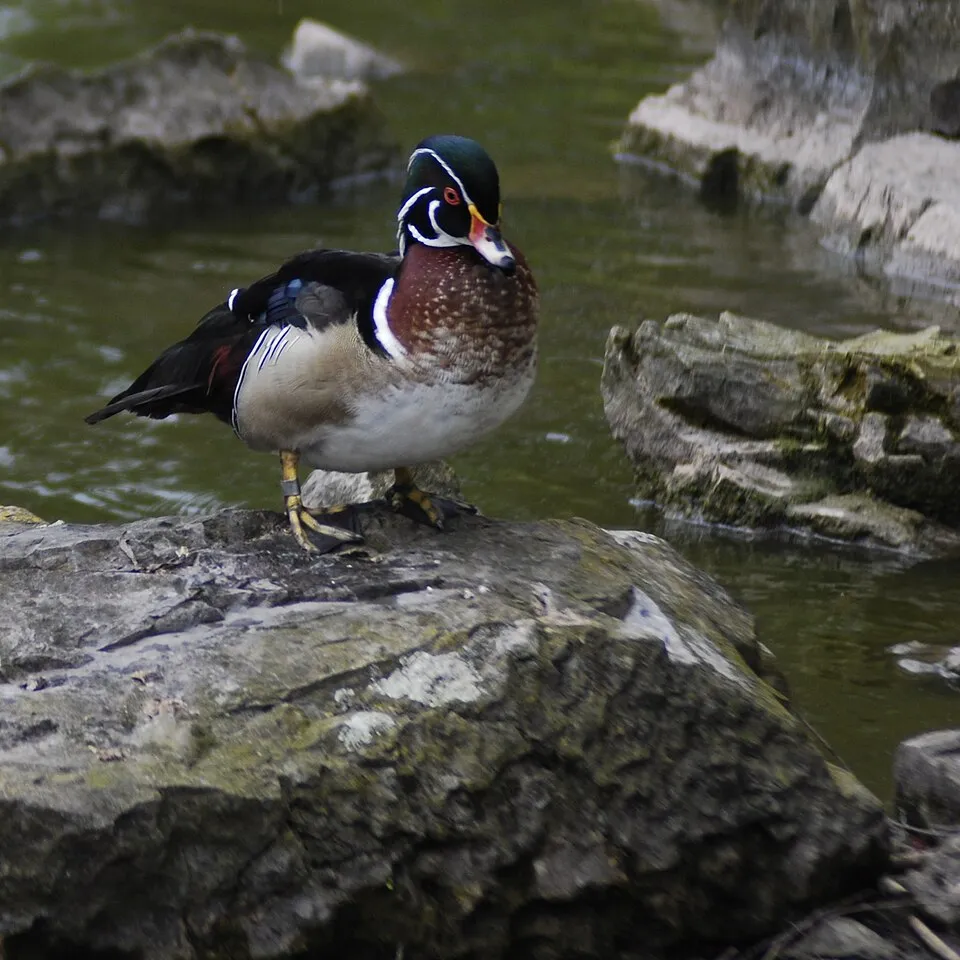
Photo: Mehmet Karatay · CC BY-SA 3.0 · original image and attribution. Image may not show every feature discussed.
Eye: Adult male: striking red; females are darker eyed. Where: Wooded ponds, swamps and streams in North America. Best identification clue: Green-and-purple crested head; white stripes; chestnut breast.
A male Wood Duck is among the most ornate waterbirds on the continent. His green crested head, sweeping white facial lines and chestnut breast are usually noticeable before the ruby-red eye. The female is much browner and is best recognized by a large white teardrop around the eye.
The species nests in tree cavities, often using nest boxes, and prefers quiet water bordered by woodland. Its red eye remains noticeable even when males replace their showier breeding plumage with plainer eclipse feathers.
Eye color can help confirm a male, but sex, age and plumage should all be checked rather than using the eye alone. For a species overview, see our Wood Duck profile.
4. Common Loon (Gavia immer)
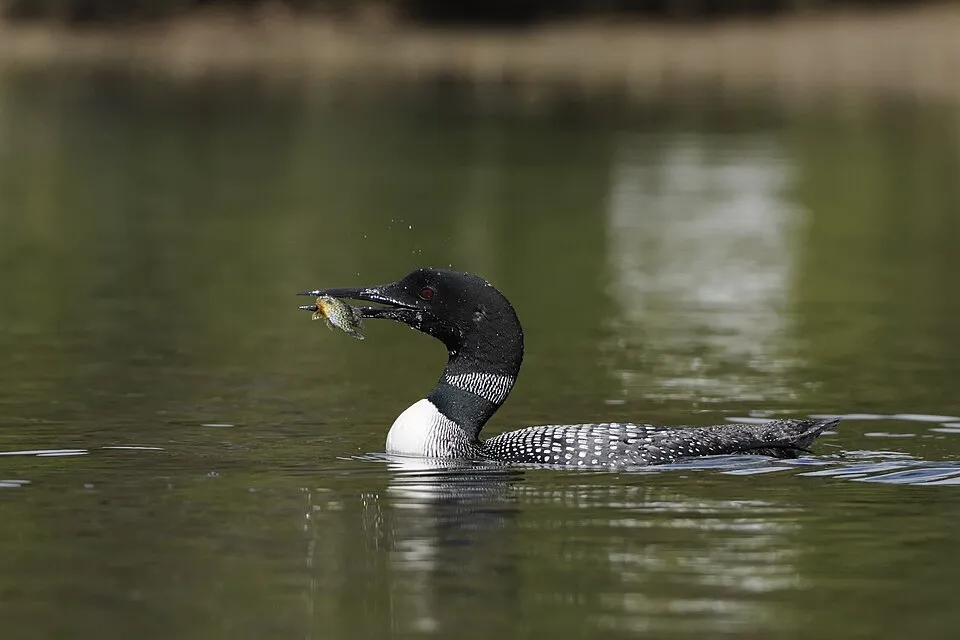
Photo: Bert de Tilly · CC BY-SA 4.0 · original image and attribution. Image may not show every feature discussed.
Eye: Adults: red, especially clear in breeding-season close-ups. Where: Northern breeding lakes; coasts and larger waters in winter. Best identification clue: Black head, white neck bands and checkerboard back in summer.
The Common Loon is a powerful diving bird with a daggerlike bill and an unforgettable breeding-season pattern: black head, white neck markings and a checkered back. In a close view, the adults’ red irises stand out against the dark head.
On breeding lakes, listen for the species’ far-carrying calls and watch for long underwater dives. Outside the breeding season, loons wear much plainer gray-and-white plumage and are often found on coastal waters.
A dark diving bird is not automatically a loon: compare bill shape, body proportions, season and region. Its red eye is supporting evidence rather than an all-purpose field mark.
5. Black-crowned Night Heron (Nycticorax nycticorax)
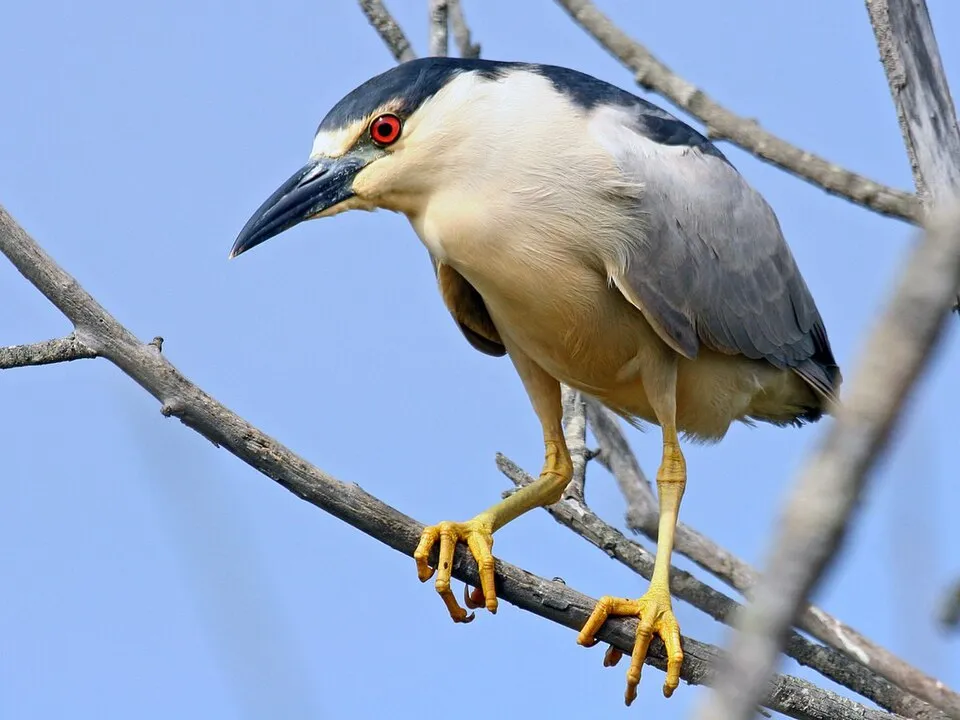
Photo: Michael L. Baird · CC BY 2.0 · original image and attribution. Image may not show every feature discussed.
Eye: Adult: red; juveniles have a different appearance. Where: Marshes, lakes, estuaries and roost trees across North America. Best identification clue: Short thick neck; black crown and back; gray wings; heavy bill.
The adult Black-crowned Night Heron has a compact, slightly hunched silhouette, thick dark bill, gray wings, black cap and deep red eyes. Unlike long-necked herons that hold an extended S-shaped neck, a resting night heron can appear quite squat.
This bird frequently stays concealed by day and becomes active around dusk, taking fish and other small prey in wetlands. A close photograph of the face makes its eye color obvious, but a distant view is more reliably identified by its shape and pattern.
Juveniles are streaky brown rather than clean gray-and-black. Do not apply the adult plumage or eye description to every age class.
6. Western Grebe (Aechmophorus occidentalis)
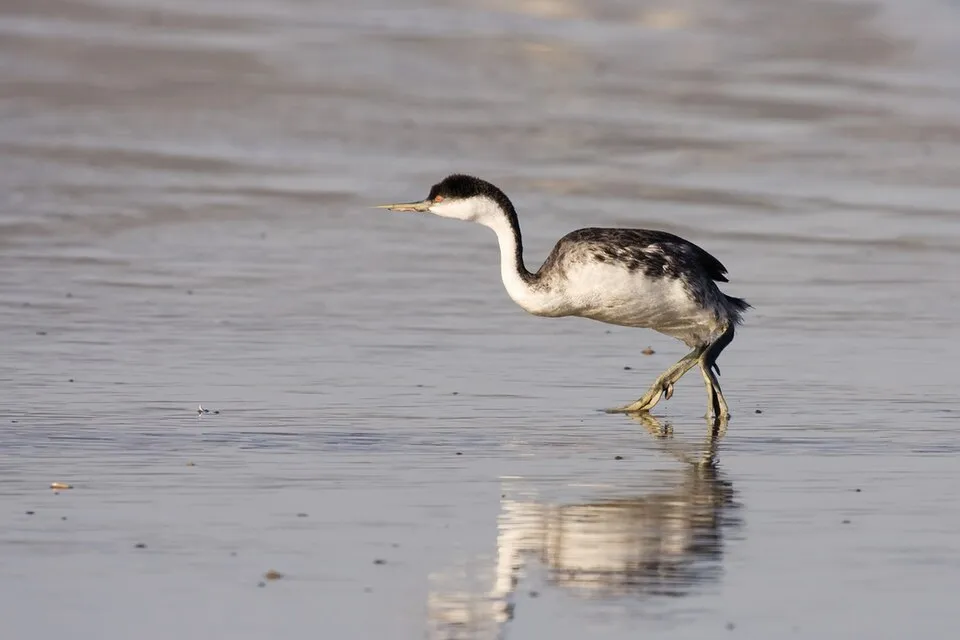
Photo: Kevin Cole · CC BY 2.0 · original image and attribution. Image may not show every feature discussed.
Eye: Adults: bright red. Where: Western North American lakes and Pacific coastal waters. Best identification clue: Long white neck, dark crown extending around eye and long yellow-green bill.
A Western Grebe is slender, elegant and almost impossibly long-necked. It has red eyes, a mostly white neck, a dark cap and a sharp yellow-green bill. Its relative the Clark’s Grebe looks similar, so the placement of the dark facial plumage matters.
On Western Grebes, black on the face usually surrounds the eye; Clark’s Grebes typically show more white above the eye. Lighting, individual variation and distance can complicate that comparison, so listen for calls and inspect more than one feature.
Western Grebes are renowned for courtship displays in which pairs rush across the water together. The source photo in this article is a real Western Grebe, but it is not an image of that courtship behavior.
7. Black-necked Stilt (Himantopus mexicanus)
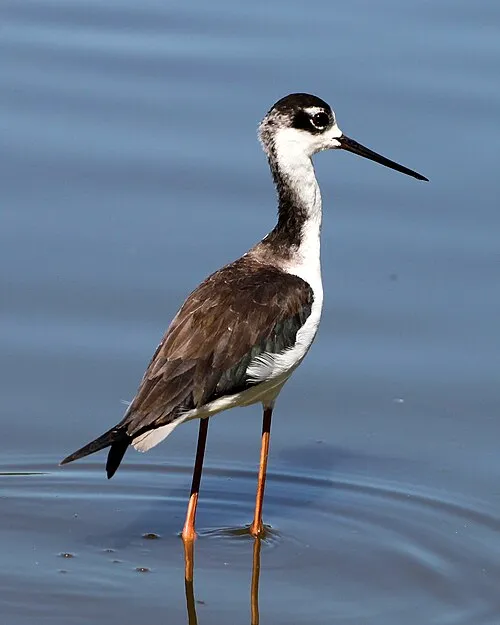
Photo: Wintertanager / J. T. Storey · CC BY-SA 3.0 · original image and attribution. Image may not show every feature discussed.
Eye: Adults: reddish iris. Where: Shallow wetlands, salt ponds and mudflats in the Americas. Best identification clue: Very long pink legs, slim straight black bill, black-and-white body.
Black-necked Stilts look as though they are balancing on stilts: long pink legs support a slim black-and-white body. Their eyes are red, but the tiny iris is seldom the first thing a viewer notices.
Look for these shorebirds probing shallow water for small invertebrates. The upright posture, straight dark bill and distinctive leg length separate them from many sandpipers and other waders.
Do not mistake the bright red or pink legs for the “red eye” trait; the iris itself is also reddish. Young birds may have browner upperparts and less crisp contrast.
8. White-winged Dove (Zenaida asiatica)
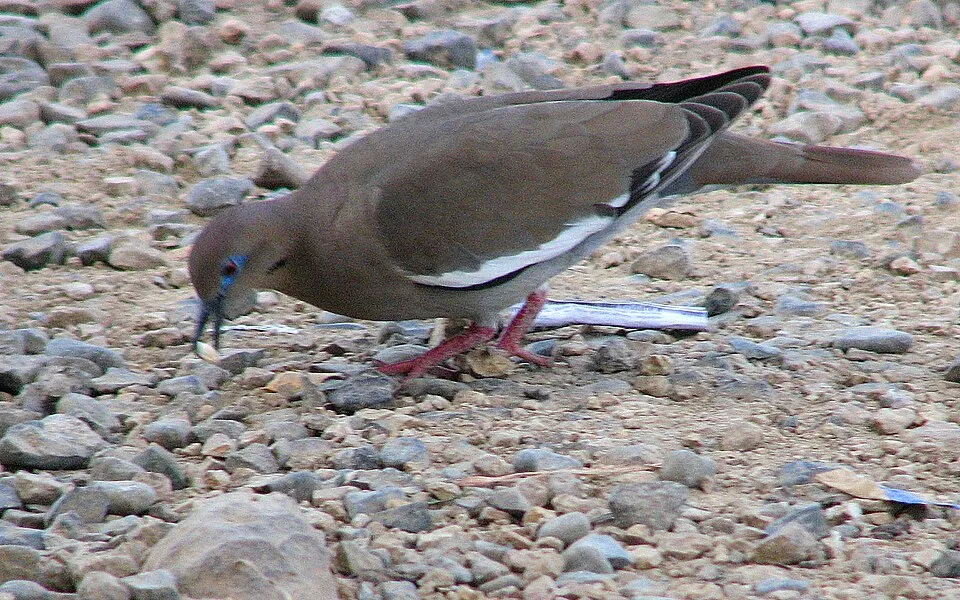
Photo: D. Gordon E. Robertson · CC BY-SA 3.0 · original image and attribution. Image may not show every feature discussed.
Eye: Adults: reddish to orange-red; juveniles darker. Where: Southwestern and southern U.S., Mexico and Central America. Best identification clue: Broad white wing stripe; blue bare skin surrounding the eye.
This sturdy dove has a plain brownish body, a conspicuous white wing stripe and a particularly colorful face. Close up, its iris looks reddish-orange, while the bare skin around it can appear bright blue.
That combination makes it an excellent test case for separating the colored iris from the colored ring around the eye. In flight, the white wing patch often gives away a White-winged Dove even when the eye cannot be seen.
It has expanded into urban and suburban environments in parts of the southern United States and may visit backyard seed sources and water. Young birds can have darker irises and lack the strong adult facial colors.
9. Purple Gallinule (Porphyrio martinicus)
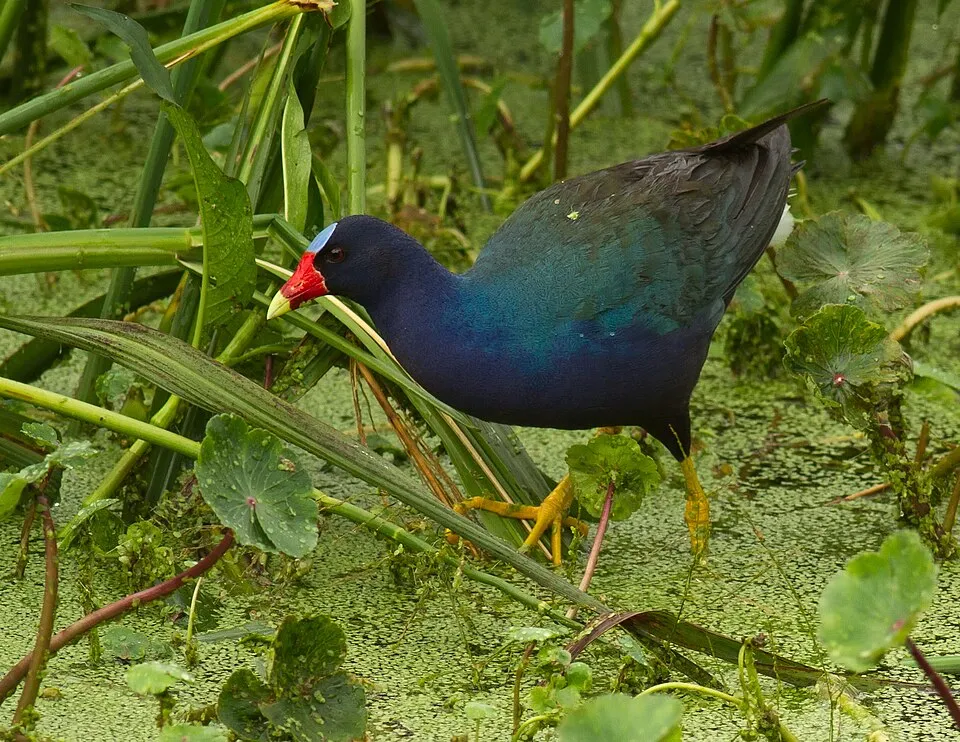
Photo: Frank Schulenburg · CC BY-SA 4.0 · original image and attribution. Image may not show every feature discussed.
Eye: Adults: red. Where: Freshwater marshes of the southeastern U.S. and tropical Americas. Best identification clue: Violet-blue body, green back, yellow legs, red-and-yellow bill.
A Purple Gallinule appears almost unreal in sunshine: its head and underside flash purple-blue, its back shines green, and the legs and toes are long and bright yellow. The adult also has red eyes, a red-and-yellow bill and a blue forehead shield.
These birds often walk over floating wetland plants using exceptionally long toes. Their resemblance to a rainbow-colored chicken is more helpful in the field than eye color by itself.
Juveniles look brownish and acquire the spectacular adult colors gradually. Confusing the red bill or blue shield with eye color is an easy mistake when comparing online photos.
10. Cooper's Hawk (Astur cooperii)
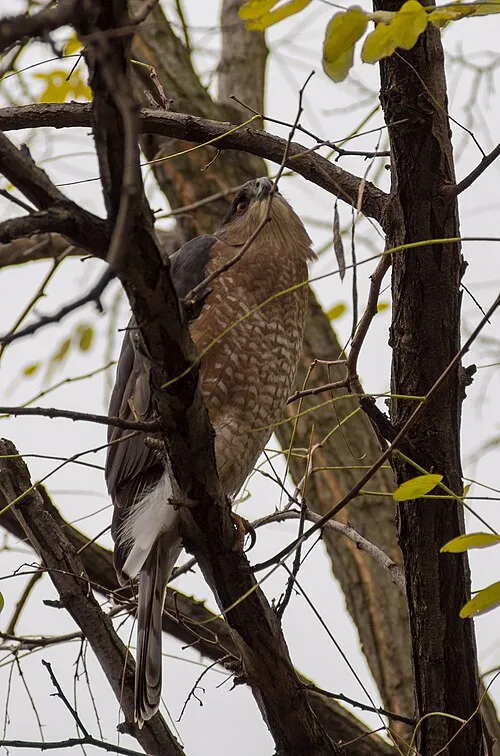
Photo: Rhododendrites · CC BY-SA 4.0 · original image and attribution. Image may not show every feature discussed.
Eye: Adults usually red; juveniles yellow. Where: Woodlands and suburbs across much of North America. Best identification clue: Rounded long tail, gray back, dark cap, reddish-barred breast.
Eye color gives a genuinely useful age clue in Cooper’s Hawks. Adults typically have red irises, dark slate-gray upperparts and finely reddish-barred underparts, while young birds often have yellow eyes, brown backs and vertical streaking.
These agile hawks regularly pursue smaller birds through trees and around backyard feeders. If one sits quietly in a branch, check the shape of the head, long rounded tail, pale nape and overall proportions.
A red eye does not identify every hawk as a Cooper’s Hawk: adult Sharp-shinned Hawks may also have red eyes. Species-level identification requires more than the iris alone.
11. Eastern Towhee (Pipilo erythrophthalmus)

Photo: Perryprog · CC BY 4.0 · original image and attribution. Image may not show every feature discussed.
Eye: Often red in northern and central populations; pale in parts of the Southeast. Where: Eastern U.S. woodland edges, scrub and thickets. Best identification clue: Black or brown upperparts, rusty flanks, white belly and long tail.
An Eastern Towhee is a large, ground-foraging sparrow that scratches through dead leaves under dense brush. Males show black upperparts and throat above warm rusty flanks and a clean white belly; females replace much of the black with brown.
The iris is often reddish across much of its range, but a pale-eyed form occurs in Florida and adjoining parts of the Southeast. This is an important reminder that “bird with red eyes” is not an invariant species trait.
For a sighting, look for the rust-colored sides, white tail flashes and distinctive backward leaf-scratching behavior rather than assuming that a pale eye rules out this bird.
12. Phainopepla (Phainopepla nitens)
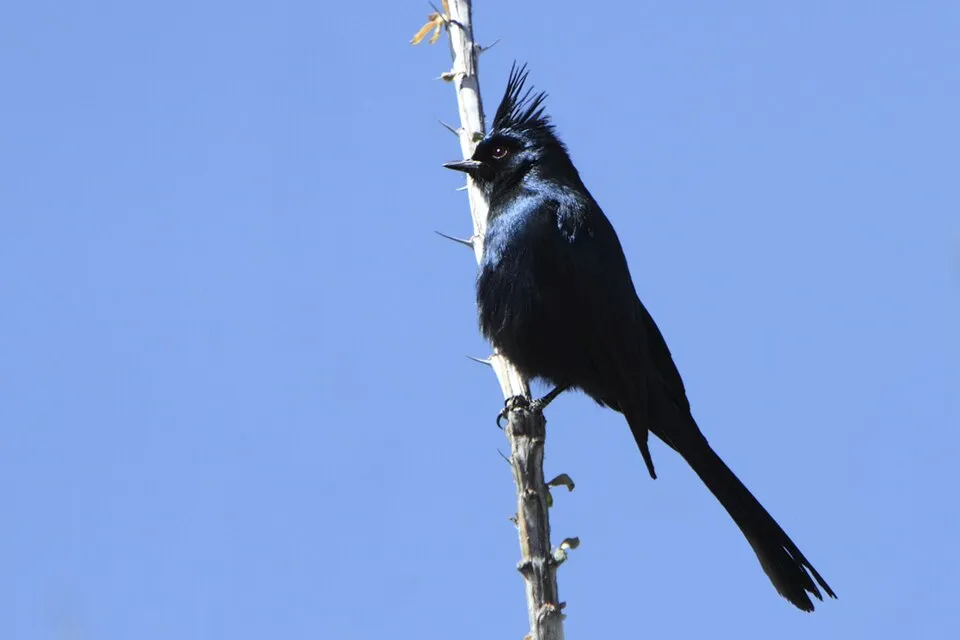
Photo: Alan Vernon · CC BY 2.0 · original image and attribution. Image may not show every feature discussed.
Eye: Adult male and female: red; juveniles browner. Where: Desert washes and dry woodlands in the southwestern U.S. and Mexico. Best identification clue: Long tail and pointed crest; male glossy black; female gray.
A male Phainopepla looks like a tiny glossy-black bird wearing an untidy pointed crown. The blood-red iris and long tail complete its striking appearance. Females are gray rather than black, but adult females also have reddish eyes.
Despite the superficial resemblance, this is not a black cardinal. It belongs to the silky-flycatcher family and is especially associated with mistletoe berries in southwestern desert habitats.
Immatures can have brownish eyes. The crest, long tail, desert setting and behavior around berry-bearing trees are often more dependable first impressions than the small red iris.
How to Identify a Red-eyed Bird in 30 Seconds
Start with the bird’s shape and environment. The iris is usually one of the smallest features visible in a field sighting, while leg length, bill shape and large patches of color are much easier to judge.
| What you noticed | First species to check | Then verify |
|---|---|---|
| Black-gray bird swimming, white bill | American Coot | Lobed toes and rounded head |
| Colorful crested duck on woodland pond | Male Wood Duck | White face stripes and chestnut chest |
| Black-and-white diver with long sharp bill | Common Loon or Western Grebe | Neck length, bill color and seasonal pattern |
| Long pink legs on a small black-white wader | Black-necked Stilt | Fine straight black bill and shallow water |
| Brown dove with blue eye ring | White-winged Dove | Bold white stripe across folded wing |
| Glossy black crested bird in desert | Male Phainopepla | Long tail, white wing patches in flight |
| Rufous-sided bird scratching leaf litter | Eastern Towhee | White belly and possible geographic eye variation |
Field checklist: Record where you saw it, habitat, estimated size, bill shape, leg color, sex/age if recognizable, the season and at least one clear photo. Compare several independent features before naming a species.
Why Do Some Birds Have Red Eyes?
A red iris is a normal characteristic of many birds. Iris color is influenced by the structure and pigmentation of eye tissues, and the visible shade may differ by species, age and occasionally population or sex. There is no single proven reason why all red-eyed birds have red eyes.
Some particularly useful examples of variation are Cooper’s Hawks, whose young birds have yellow eyes while adults have red eyes, and Eastern Towhees, whose populations include red-eyed and pale-eyed forms. The Red-eyed Vireo and Phainopepla can also look different at younger ages.
Do not confuse a red iris with the red facial skin of other birds. American Oystercatchers, for example, can have a conspicuous colored eye ring; that is a different structure from the iris. A camera flash can also create artificial red-eye in photos.
Red Iris vs Red Eye Ring vs Red Bill: An Easy Comparison
| Feature | Where it is | Example |
|---|---|---|
| Red iris | Colored part surrounding the pupil | Adult American Coot; adult Phainopepla |
| Colored orbital skin | Bare skin outside the eye itself | Blue eye skin of White-winged Dove |
| Red frontal shield | Plate-like skin above the bill | Some coots and gallinules |
| Red bill | Beak, not eye | Adult Purple Gallinule |
Frequently Asked Questions
What is the most common black bird with red eyes?
There is no universal answer because bird communities differ by region. On North American ponds, the American Coot is a familiar dark waterbird with red eyes. In southwestern desert habitats, the adult male Phainopepla is another good candidate.
What kind of duck has red eyes?
Male Wood Ducks have brilliant red eyes. Their head crest, white facial stripes and colorful body are much more reliable identification clues than their eyes alone.
Which white-and-black birds have red eyes?
Black-necked Stilts, Western Grebes and breeding-plumaged Common Loons all offer examples. They differ dramatically in size, bill shape and habitat: a stilt wades on long pink legs, whereas grebes and loons dive.
Do all Eastern Towhees have red eyes?
No. Many Eastern Towhees have reddish eyes, but birds from Florida and some nearby southern areas may have pale or whitish eyes. Geography matters as much as iris color.
Can young birds have different eye colors?
Yes. Juvenile Cooper’s Hawks commonly have yellow irises that redden with age. Young vireos and Phainopeplas can also appear browner-eyed than adults. Age is one reason not to identify a bird using the eye alone.
Are red eyes caused by camera flash?
Sometimes a photograph shows an artificial red-eye reflection, but many species genuinely have naturally reddish irises. Compare multiple photographs taken in daylight and check the bird’s other field marks.
What is a small brown bird with red eyes?
Depending on location, a White-winged Dove or a female Eastern Towhee could fit. Look for the dove’s white wing patch and blue orbital skin, or the towhee’s rusty flanks and white belly. Neither the color nor size description is sufficient by itself.
Can bird eye color help tell males from females?
Sometimes, but not reliably across birds. Male Wood Ducks stand out for their bright red irises, while both adult sexes of Phainopepla and many other species can show red eyes. Use a species-specific guide to evaluate sex and age.
Explore Related Bird Guides
For more bird identification context, browse 25 Animals With Feathers and 13 Birds That Sing. Our Wood Duck species profile gives more background on one of the waterbirds above. These are selected contextual links; the site’s existing internal-link plugin can handle additional matches.
Sources and Image Credits
The field marks and age differences in this guide were checked against bird identification references. The photographs are independently credited directly beneath each image. To use a photograph on another website, follow its specific Wikimedia Commons license and attribution requirements.