12 Animals With Striped Tails at a Glance
Animals with striped tails include ring-tailed lemurs, raccoons, red pandas, ringtails, coatis, common genets, marmosets, rock-wallabies, African civets, Geoffroy’s cats, ring-tailed mongooses and cheetahs. Some have bold rings along most of the tail; others show bands mainly near the tip. They are not all closely related.
Use the real-animal photos, scientific names and visual clues below to compare 12 species. If you are identifying an animal you saw outside, start with its location and body shape before relying on tail stripes alone.
| Animal | Scientific name | Tail pattern | Where to look |
|---|---|---|---|
| Ring-tailed lemur | Lemur catta | Bold, alternating black and white rings | Southern Madagascar |
| Raccoon | Procyon lotor | Brownish-gray tail with several dark bands | North and Central America |
| Red panda | Ailurus fulgens | Broad red and pale buff rings on a fluffy tail | Eastern Himalayas and southwestern China |
| Ringtail (ringtail cat) | Bassariscus astutus | Long black-and-white banded tail | Southwestern United States and Mexico |
| White-nosed coati | Nasua narica | Long tail with variable dark and light rings | Southern US, Mexico and Central America |
| Common genet | Genetta genetta | A long tail with alternating dark and pale rings | Africa; also parts of southwestern Europe |
| Common marmoset | Callithrix jacchus | Dark and pale bands along a long tail | Eastern and northeastern Brazil |
| Yellow-footed rock-wallaby | Petrogale xanthopus | Dark tail bands, sometimes more obvious toward the tip | Rocky ranges of southern and central Australia |
| African civet | Civettictis civetta | Variable dark bands toward the tail | Sub-Saharan Africa |
| Geoffroy’s cat | Leopardus geoffroyi | Spotted body with dark rings on the tail | Southern South America |
| Ring-tailed mongoose | Galidia elegans | Rich brown tail with dark rings | Madagascar |
| Cheetah | Acinonyx jubatus | Dark rings concentrated near the end of the tail | Mostly sub-Saharan Africa |
How to Identify an Animal by Its Striped Tail
Three details are especially helpful: (1) whether stripes form complete rings around the tail, (2) whether bands cover the whole tail or only the tip, and (3) the animal’s face, paws and habitat. No photo-based guide can identify every animal from a tail alone. Angles, shadows and individual variation can hide or exaggerate patterns.
1. Ring-tailed lemur (Lemur catta)
Quick ID: The most recognizable tail on the list. Range: Southern Madagascar.
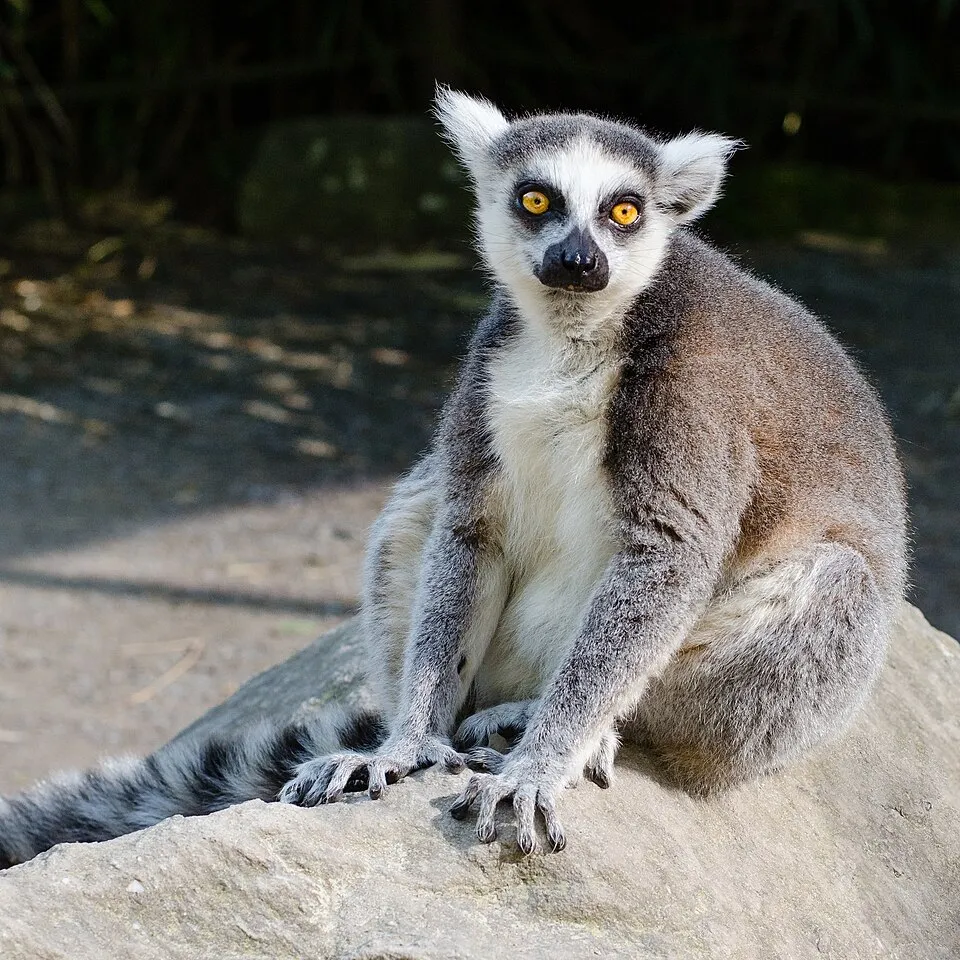
Photo: Mathias Appel · CC BY-SA 4.0 · Original image and license. Tail markings may not be fully visible in every photo.
The ring-tailed lemur is an easy starting point for identifying animals with striped tails. Its long tail carries sharply contrasting black and white rings, ending in a dark tip. Unlike monkeys, lemurs belong to a separate primate lineage. Ring-tailed lemurs spend a surprising amount of time on the ground, although they can climb well.
Look for a narrow gray body, white face, dark eye patches and a tail often held upright when the group moves. Smithsonian researchers describe tail raising as a way troop members can keep track of one another. Males also use scent from specialized glands in social encounters. Those facts are established; the claim that every stripe evolved specifically for communication is not.
2. Raccoon (Procyon lotor)
Quick ID: A dark facial mask and a compact ringed tail. Range: North and Central America.
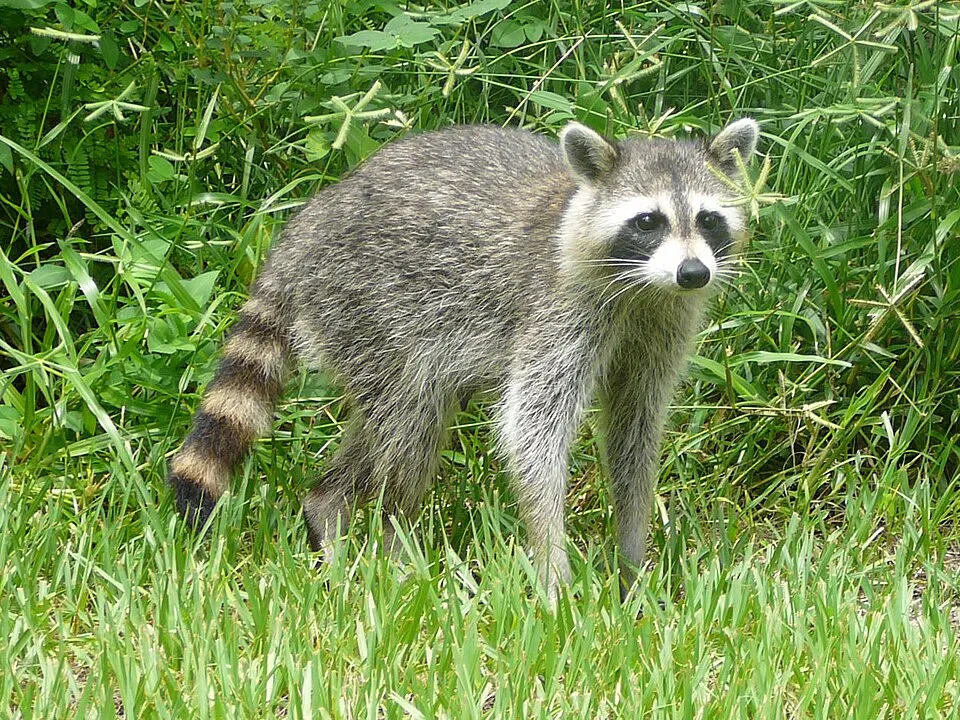
Photo: Cary Bass-Deschênes · CC BY 3.0 · Original image and license. Tail markings may not be fully visible in every photo.
The familiar raccoon has a stocky body, a dark mask around its eyes and a bushy tail with darker rings. The bands are usually less striking than the black-and-white pattern on a ring-tailed lemur. In a blurry nighttime photo, the face and body proportions may identify it more reliably than a rough ring count.
Raccoons are not close relatives of lemurs, despite both having ringed tails. They are carnivorans in the family Procyonidae and are very capable climbers and opportunistic feeders. If an animal has a long pointed nose and holds its ringed tail high, compare it with a coati instead of immediately calling it a raccoon.
For more background, see our raccoon species profile.
3. Red panda (Ailurus fulgens)
Quick ID: Rust-colored fur and a thick, banded balancing tail. Range: Eastern Himalayas and southwestern China.
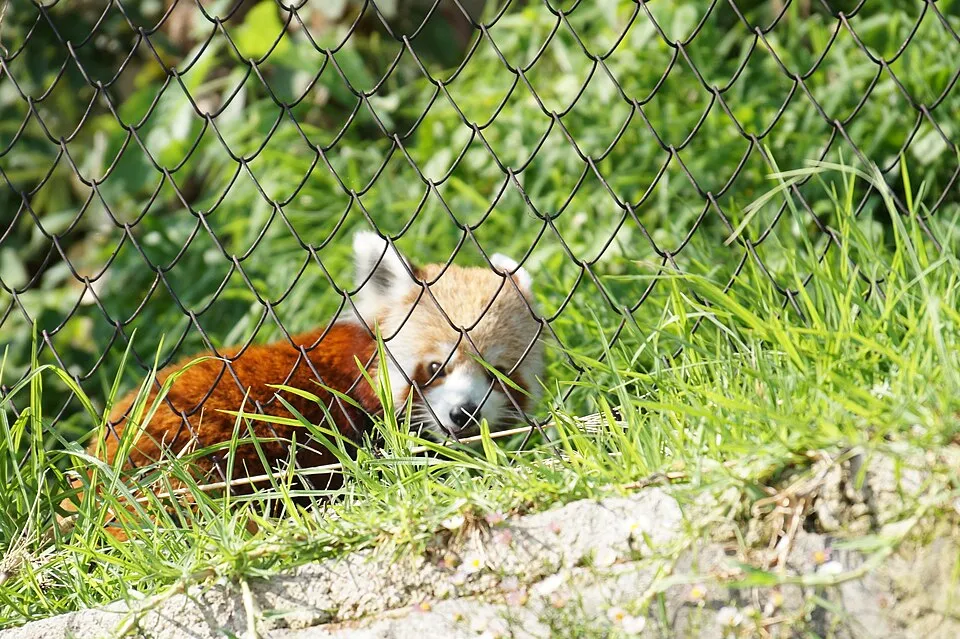
Photo: Shreyansh Paliwal · CC BY-SA 4.0 · Original image and license. Tail markings may not be fully visible in every photo.
A red panda can be identified by its reddish coat, white facial markings and thick tail marked with alternating reddish and pale buff bands. The pattern is softer than the black-and-white rings seen on a lemur. Its tail is important for balancing while moving through trees and can be wrapped around the body in cold weather.
Although red pandas may resemble raccoons, modern classification places them in their own family, Ailuridae. Their diet is dominated by bamboo. A reliable photo identification depends on combining tail color, face pattern and overall shape; a furry ringed tail alone is not enough to tell these animals apart.
Explore the red panda species page for its habitat and basic facts.
4. Ringtail (ringtail cat) (Bassariscus astutus)
Quick ID: Big eyes, slender body and a remarkably long tail. Range: Southwestern United States and Mexico.
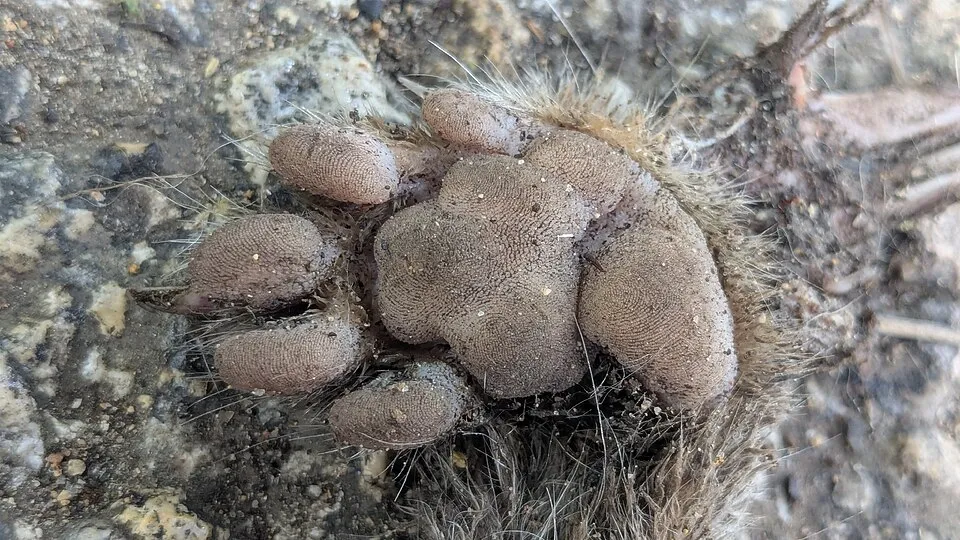
Photo: Joseph Aubert · CC BY 4.0 · Original image and license. Tail markings may not be fully visible in every photo.
The ringtail is sometimes called a ringtail cat or miner’s cat, but it is not a cat. It is a small member of the raccoon family. Its delicate build, pointed face, large eyes and dramatically ringed tail set it apart from a true raccoon. The tail can approach the length of its body.
Ringtails are largely nocturnal and are superb climbers in rocky places. San Diego Zoo notes that their long tails help with balance as they negotiate steep surfaces and narrow ledges. The animal in this photograph was recorded in the United States; seeing a striped tail after dark in canyon country could point to a ringtail, but location and silhouette also matter.
5. White-nosed coati (Nasua narica)
Quick ID: A flexible long snout and an upright banded tail. Range: Southern US, Mexico and Central America.
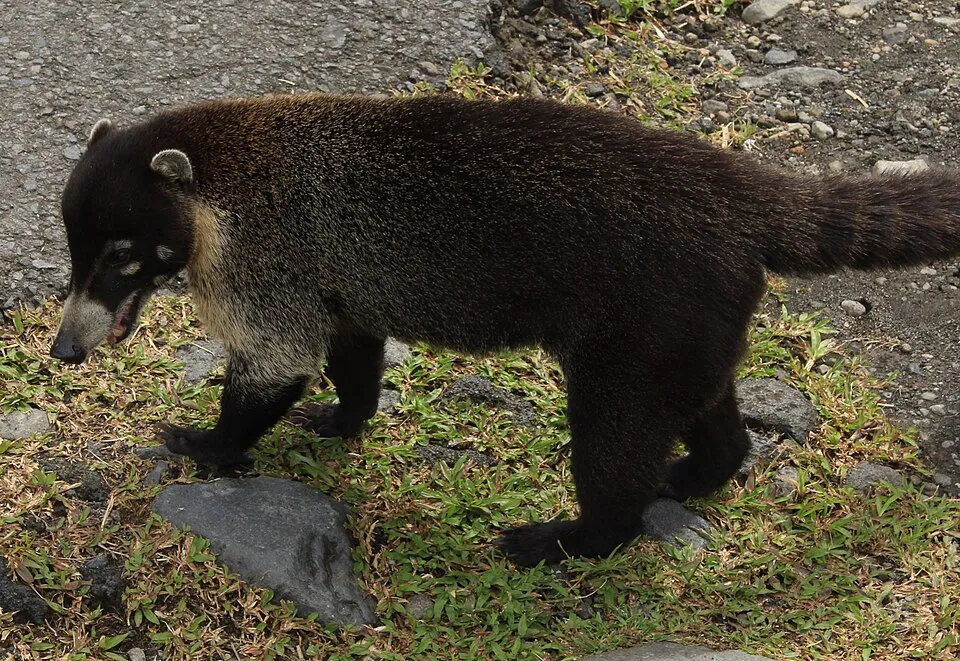
Photo: BNP-CR506 · CC BY-SA 4.0 · Original image and license. Tail markings may not be fully visible in every photo.
The white-nosed coati is related to raccoons and ringtails. It has a longer, mobile snout and a slim body, and it often holds its long tail nearly vertical as it searches for food. Tail rings can be obvious in one photograph and relatively faint in another, so not every coati has the same high-contrast look.
Coatis use their noses and claws to search leaf litter and logs for invertebrates and other food. The raised tail can help group members maintain visual contact in vegetation. If you are choosing between a coati and a raccoon, inspect the long muzzle, posture and geographic location instead of relying on the rings alone.
Our coati guide explains why coatis differ from raccoons.
6. Common genet (Genetta genetta)
Quick ID: Small spotted body, pointed face and ringed tail. Range: Africa; also parts of southwestern Europe.
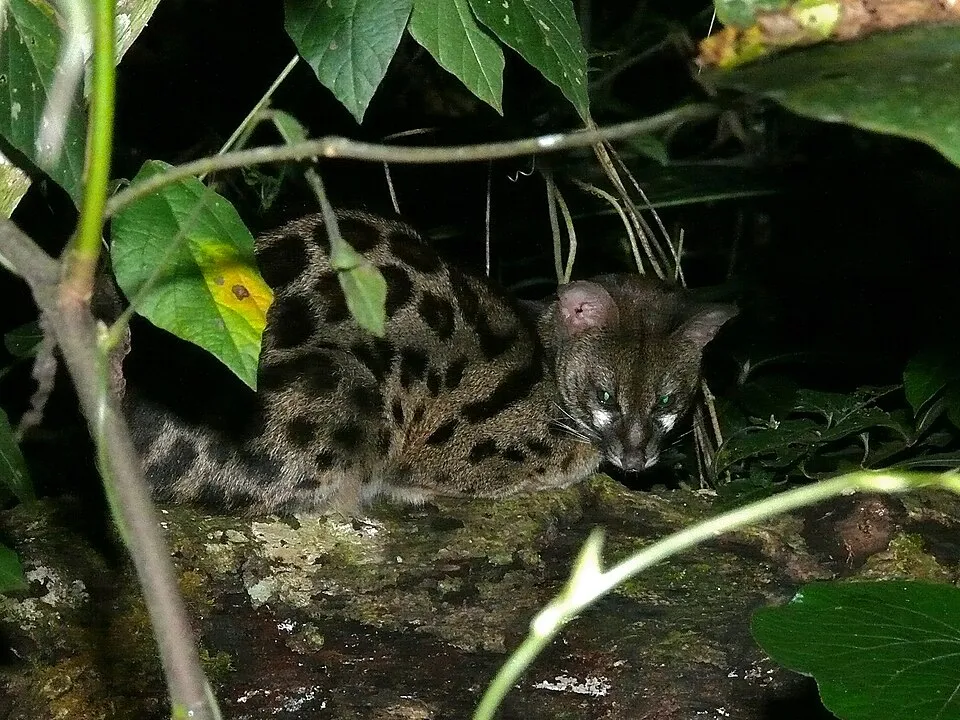
Photo: Bernard DUPONT · CC BY-SA 2.0 · Original image and license. Tail markings may not be fully visible in every photo.
Common genets look vaguely cat-like but belong to the civet family rather than the cat family. Their coat is dotted with dark spots, and the tail is long and ringed. These markings make the genet quite different from the solid-bodied ringtail, even though the two animals may look similar at a glance.
Genets are agile climbers and often active at night. In photos, a spotted back plus a slender face and black-and-pale tail bands is a stronger set of clues than any one feature by itself. A photograph from Africa or the Iberian Peninsula might show a common genet, but several other genet species share a similar appearance.
7. Common marmoset (Callithrix jacchus)
Quick ID: A small monkey with conspicuous white ear tufts. Range: Eastern and northeastern Brazil.
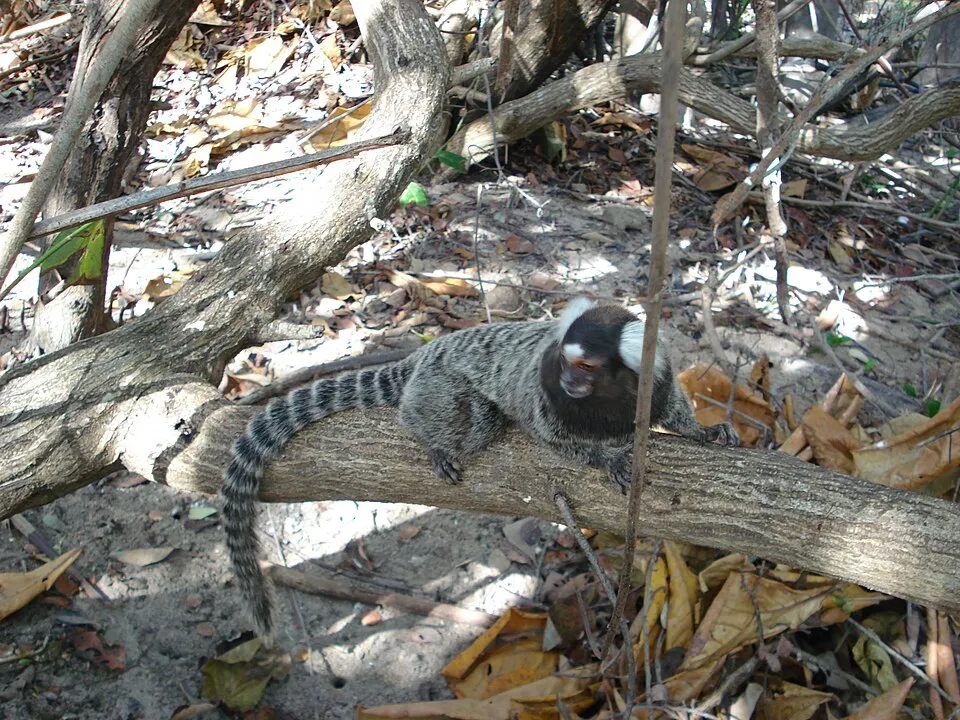
Photo: Dario Sanches · CC BY-SA 2.0 · Original image and license. Tail markings may not be fully visible in every photo.
The common marmoset is a tiny New World monkey with a surprisingly long, banded tail. Its white ear tufts make an excellent second identification clue. Unlike the tail of a spider monkey, a marmoset tail is not adapted to grip branches like an extra hand.
Marmosets move quickly through branches and use claw-like nails on most digits to cling to bark. Their food includes plant exudates as well as insects and fruit. Many marmoset species have patterned tails, so a striped tail alone is not sufficient for species-level identification; check the ear tufts and native range.
To compare different primate families, see our monkey identification guide; lemurs are primates, but not monkeys.
8. Yellow-footed rock-wallaby (Petrogale xanthopus)
Quick ID: Striped hindquarters and a banded tail on a rock-climbing wallaby. Range: Rocky ranges of southern and central Australia.
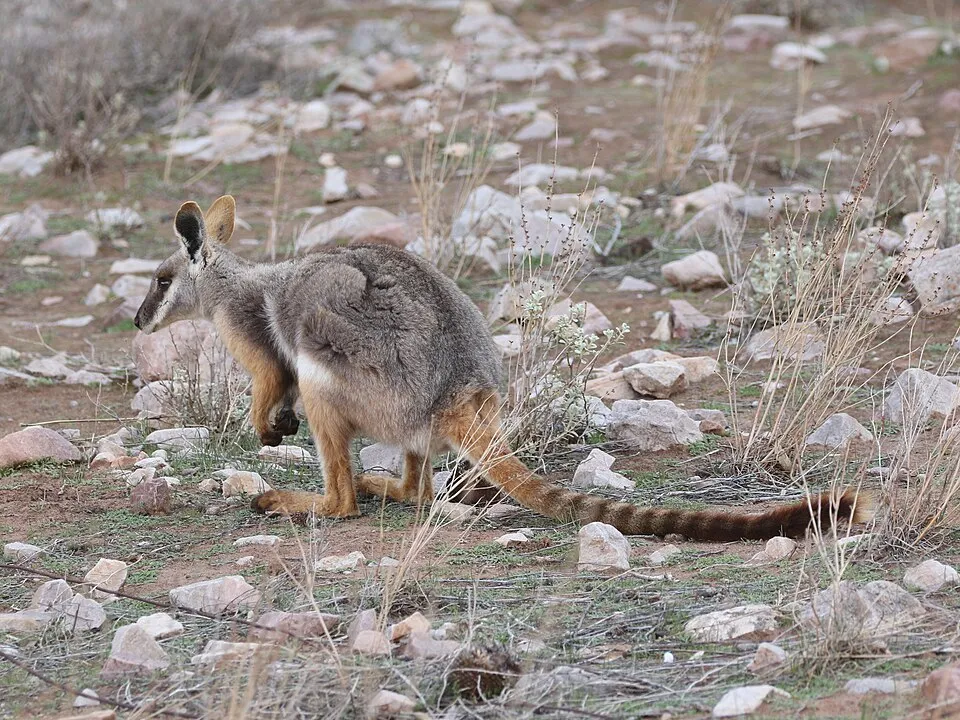
Photo: Donald Hobern · CC BY 2.0 · Original image and license. Tail markings may not be fully visible in every photo.
The yellow-footed rock-wallaby is an Australian marsupial with striking body stripes, yellowish feet and a long tail that commonly shows dark banding. Tail pattern can vary between individuals, so the dark rings may not look equally clear in every image.
Its long tail helps it keep balance as it bounds among rocks. The body pattern, facial stripes and distinctive habitat make this animal easy to separate from a raccoon or lemur. This species is a reminder that ringed tails occur in marsupials as well as placental mammals.
9. African civet (Civettictis civetta)
Quick ID: Heavy spotted body and a patterned tail. Range: Sub-Saharan Africa.
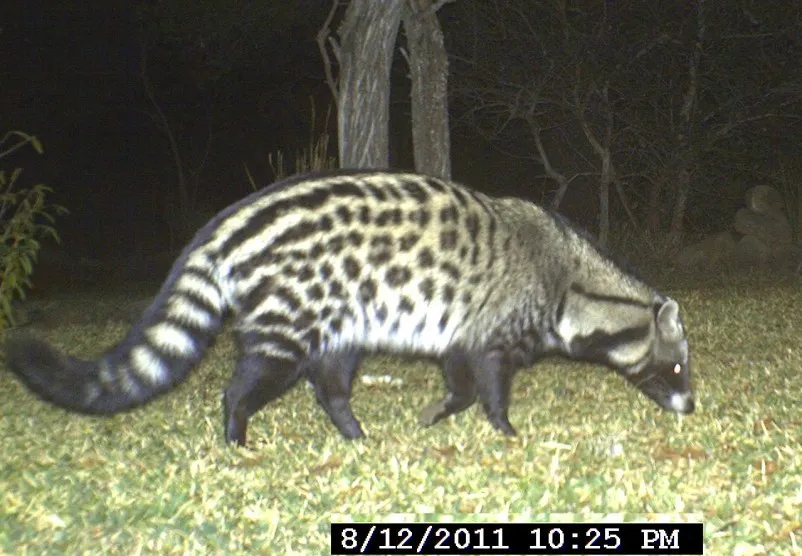
Photo: Wynand Uys · CC BY 4.0 · Original image and license. Tail markings may not be fully visible in every photo.
An African civet has a distinctive mixture of stripes, spots and a bushy tail with dark bands. The pattern across its body is often a more obvious identification mark than the tail. This is a robust, mostly nocturnal mammal rather than a small domestic cat.
African civets spend much of their time searching for a wide variety of foods on the ground. Their face markings can resemble a mask, which may tempt casual viewers to identify the animal as a raccoon. Look instead for the larger body, darker patches on the flanks, and the African location.
10. Geoffroy’s cat (Leopardus geoffroyi)
Quick ID: A compact spotted cat with a banded tail. Range: Southern South America.
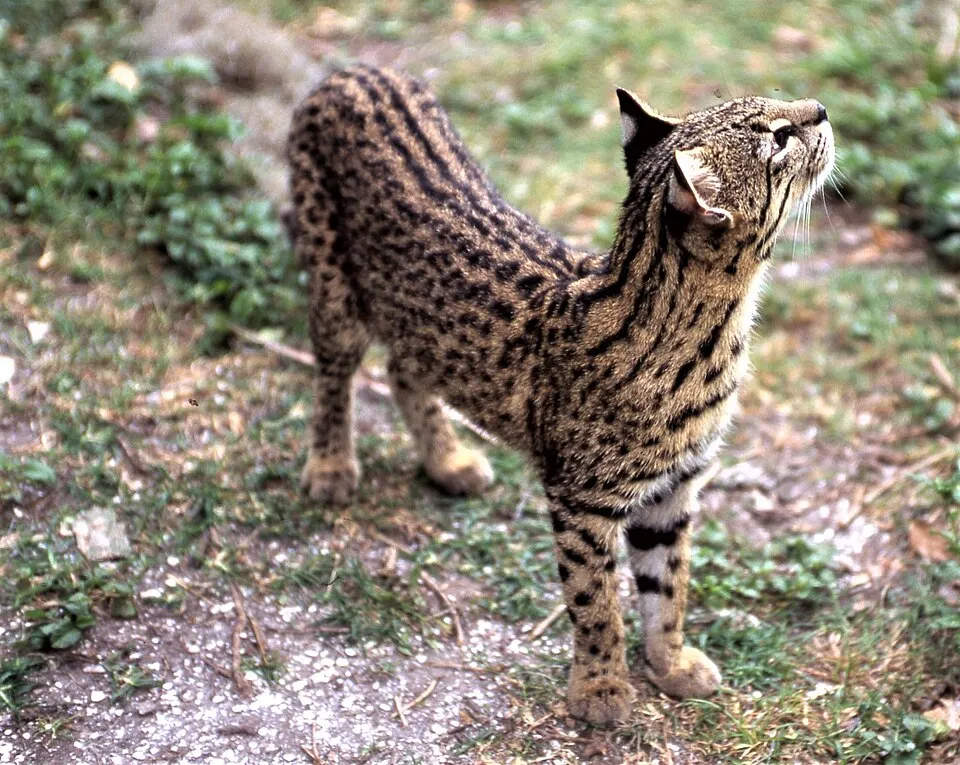
Photo: Peter L Achuff · CC BY 4.0 · Original image and license. Tail markings may not be fully visible in every photo.
Geoffroy’s cat is a small South American wild cat with dark spots across the body and bands on the tail. Depending on the photograph, the tail rings may be less noticeable than the spots on its back or legs. It should not be confused with domestic tabby cats, which can also have ringed tails.
If you are checking a wild-cat image, combine the small rounded ears, dark coat spots, tail rings and geographic context. Animal markings differ among individuals, and photo lighting may alter their appearance. A ringed tail is a useful clue but not a standalone species diagnosis.
11. Ring-tailed mongoose (Galidia elegans)
Quick ID: Reddish body, pointed muzzle and clearly ringed tail. Range: Madagascar.
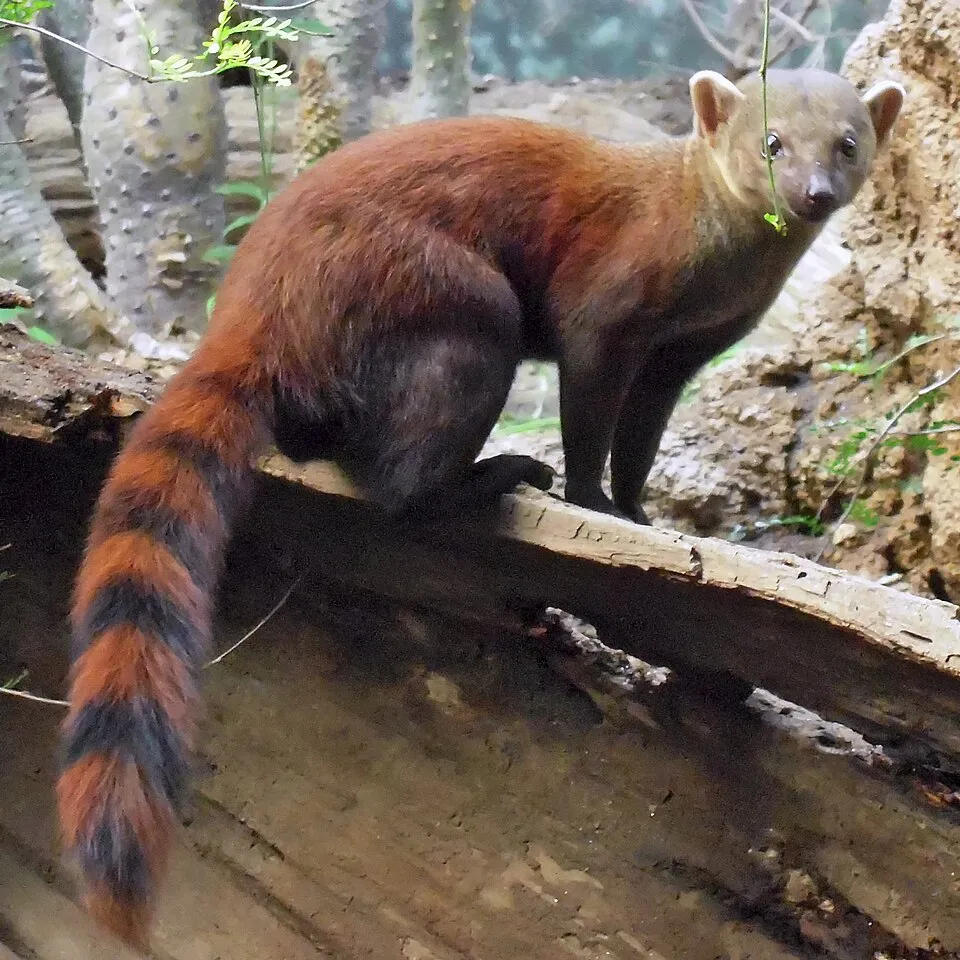
Photo: orchidgalore · CC BY 2.0 · Original image and license. Tail markings may not be fully visible in every photo.
The ring-tailed mongoose is a native Malagasy carnivore with reddish-brown fur and a long tail patterned with dark rings. Despite the English name, it is not a close relative of the common genets, raccoons or true mongooses. It belongs to Madagascar’s endemic carnivore family, Eupleridae.
This is one of the most useful animals for teaching why common names can mislead. Its ringed tail may resemble a lemur’s, but its body, head and family are entirely different. A red-brown animal on the forest floor of Madagascar, with dark tail rings and a pointed face, may be this species.
12. Cheetah (Acinonyx jubatus)
Quick ID: A spotted sprinter with a long black-and-white-banded tail tip. Range: Mostly sub-Saharan Africa.
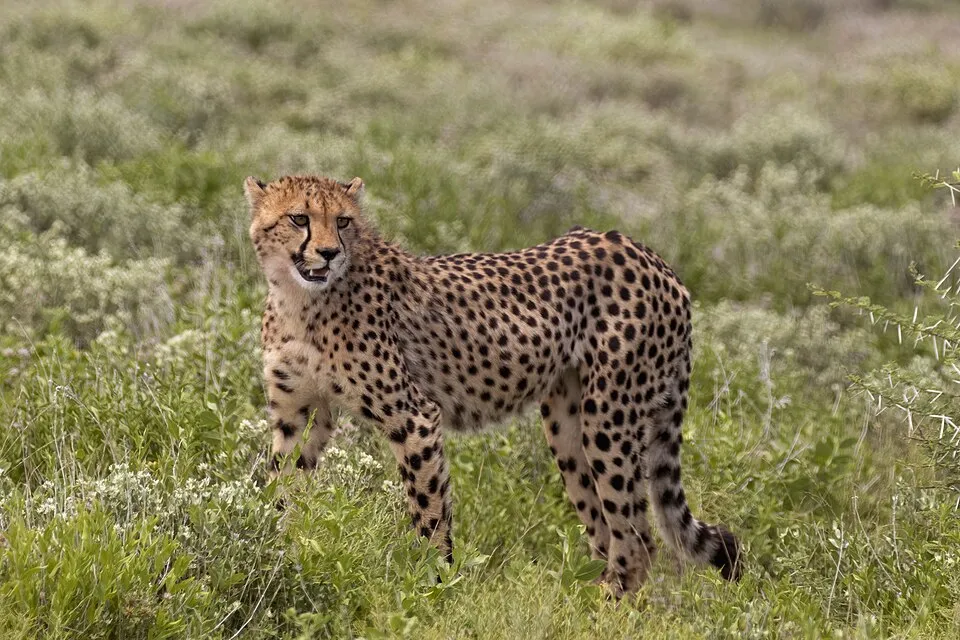
Photo: Charles J. Sharp · CC BY-SA 4.0 · Original image and license. Tail markings may not be fully visible in every photo.
The cheetah is not usually the first animal that comes to mind when someone mentions striped tails. Its body is covered with solid black spots, while the outer portion of the tail carries dark rings and generally ends in a conspicuous light or dark section. That makes the cheetah a useful contrast with animals whose entire tails are ringed.
Look for a slim body, long legs, small head and the well-known dark facial tear lines. The tail contributes to balance during high-speed maneuvers, although it would be an oversimplification to claim that its rings specifically evolved to make the animal turn faster. Pattern and tail function are separate questions.
Compare spotted cats with our leopard vs cheetah vs jaguar guide and cheetah species profile.
What Are the Differences Between Ringed, Striped and Banded Tails?
Ringed tail usually describes alternating bands encircling the tail, like a lemur’s. Striped tail is broader everyday language and can include lengthwise stripes as well as transverse bands. Banded tail often describes rings concentrated near the end, as on a cheetah. These are visual descriptions, not formal biological categories. A species may be called “striped-tailed” in common language even though its pattern is a set of rings.
Why Do So Many Unrelated Animals Have Striped Tails?
Bright tail patterns occur in animals from different evolutionary lineages: primates, marsupials, carnivorans and wild cats. Researchers have explored possible roles in social communication, visual recognition and predator interactions. A classic comparative study of contrasting mammal coloration discusses ringed tails in lemurs, marmosets, raccoons, genets, cats and other species. It also notes that several competing explanations remain plausible.
What we can say more confidently is how tails themselves are used in particular species. A ringtail uses a long tail to maintain balance; red pandas also rely on theirs when moving in trees; ring-tailed lemurs hold their tails up while troops travel. These documented behaviors do not prove that every individual stripe evolved for the same reason.
Which Striped-Tail Animal Did You See?
| What you noticed | Possible animal | Important second clue |
|---|---|---|
| Black mask and gray-brown rings near a house in North America | Raccoon | Stocky body, grasping front paws |
| Huge eyes, slender tan body, very long black/white tail in rocky SW US | Ringtail | Nighttime activity, delicate face |
| Long upright ringed tail and very pointed snout in Central America | Coati | Curved, flexible nose |
| Striking black/white rings on a social primate in Madagascar | Ring-tailed lemur | Dark eye patches, white face |
| Reddish fur and thick reddish-buff tail rings in Asia | Red panda | White face pattern and short muzzle |
| Small spotted cat, tail with dark bands in South America | Geoffroy’s cat | Cat face, spotted flanks |
| Spotted African fast runner, bands near tail tip | Cheetah | Dark tear lines on face |
Frequently Asked Questions
What animal has a black-and-white striped tail?
A ring-tailed lemur is a classic example, but North American ringtails and several other mammals also have strongly contrasting tail bands. Habitat and face shape are useful identification clues.
Are ringtail cats really cats?
No. The ringtail (Bassariscus astutus) belongs to the raccoon family, Procyonidae, rather than the cat family, Felidae.
What animal looks like a raccoon but has a very long tail?
A coati or ringtail may fit that description. Coatis have long movable snouts and often carry their tails upright. Ringtails are smaller, slimmer and more nocturnal.
Why do red pandas have striped tails?
Red pandas have broad reddish and pale rings, but the specific evolutionary purpose of the colors is not established. Their long, bushy tails help with balance and warmth.
Does a cheetah have stripes on its tail?
Yes. A cheetah has distinct dark bands toward the tip of its long tail, even though most of its body is spotted rather than striped.
What is the difference between a ring-tailed lemur and a ring-tailed mongoose?
The lemur is a primate with a white face and bold black-and-white tail bands. The ring-tailed mongoose is a reddish Malagasy carnivore with darker reddish-brown rings. Their similar names do not indicate close relationship.
Can striped tails help animals communicate?
Sometimes a conspicuous tail can be useful as a visual signal, as with the raised tails of traveling ring-tailed lemurs. However, one should not assume every stripe in every species evolved for signaling.
Can I identify an animal from its tail alone?
Not reliably. Try to compare the animal’s size, face, body markings and location. A single photo may not show enough details for a confident identification.
The Bottom Line
Striped tails are found in far more animals than raccoons and lemurs. The pattern spans many different mammal families and can be bold, subtle, or limited to the end of the tail. The most useful approach is to compare the entire animal—tail, face, size and location—using the photos and table above. That turns an attractive visual feature into a practical identification guide.