Eagles include some of the largest and most powerful flying predators on Earth—but deciding which eagle is the “largest” is not as simple as it sounds.
One species may be heavier, another may have a wider wingspan, and a third may have a longer body.
For example, the Steller's Sea Eagle is famous for extraordinary body mass, the Harpy Eagle is an exceptionally heavy and powerful forest eagle, while White-tailed and Bald Eagles can spread wings well over 2 meters across.
For that reason, this guide does not pretend there is one perfect size ranking. Instead, these are 10 of the world's largest living eagle species, compared using weight, wingspan and body length.
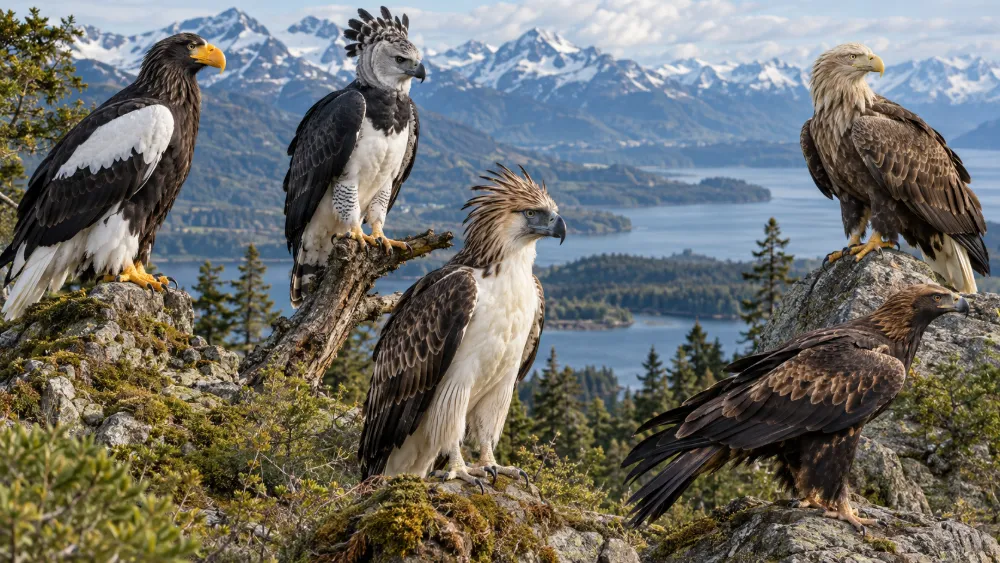
Largest Eagles at a Glance
| Species | Approx. Maximum Weight | Approx. Wingspan | What Makes It Huge |
|---|---|---|---|
| Steller's Sea Eagle | Females can exceed 7 kg | Around 2–2.5 m | Exceptional body mass |
| Harpy Eagle | Females up to about 9 kg | Up to about 2 m | Massive forest-eagle build |
| White-tailed Eagle | Females up to about 7 kg | About 2–2.4 m | Enormous broad wings |
| Bald Eagle | Females roughly 6.5–6.8 kg | Up to about 2.4–2.6 m | Huge northern females |
| Philippine Eagle | Large females around 6 kg or more | Varies by individual | Exceptional body length and forest power |
| Wedge-tailed Eagle | Females about 4.2–5.3 kg | Around 2.3 m | Very long wings and body |
| Golden Eagle | Females up to about 6.6 kg | About 1.9–2.3 m | Large open-country eagle |
| Martial Eagle | About 4.7 kg | Large broad wings | Africa's massive open-country eagle |
| Verreaux's Eagle | About 4.5–5 kg | Up to roughly 2.3 m | Large mountain eagle |
| Crowned Eagle | Females about 4.7 kg | Up to about 1.8 m | Heavy, compact forest predator |
Measurements vary among individuals, sexes, populations and reference sources. Female eagles are generally larger than males.
1. Steller's Sea Eagle
Scientific name: Haliaeetus pelagicus
The Steller's Sea Eagle is one of the strongest candidates for the title of the world's heaviest eagle.
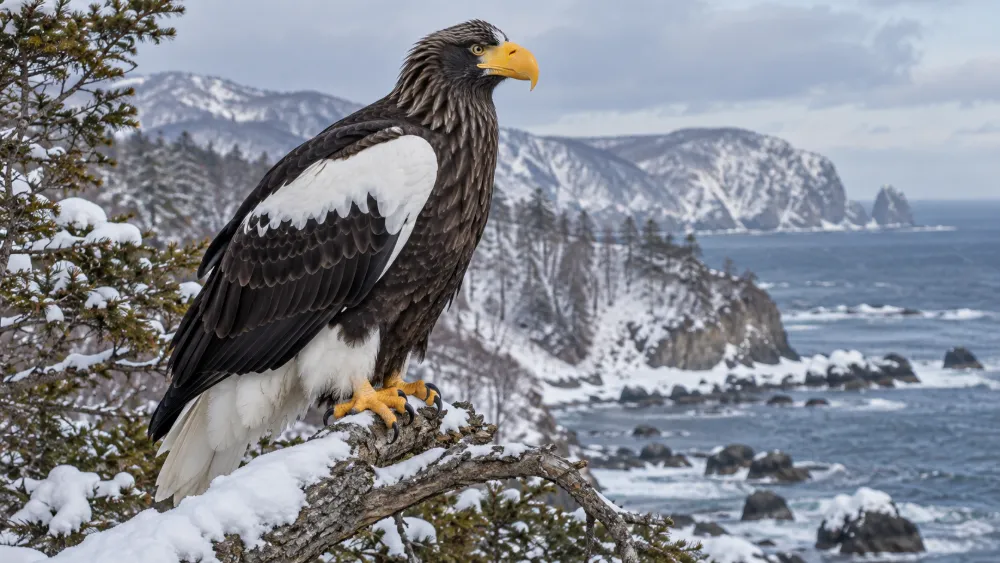
San Diego Zoo describes it as the heaviest known eagle and the largest of the sea eagles.
Adults measure approximately 86.5 to 105 centimeters from head to tail.
Other published measurements place large females well above 6 kilograms, with exceptional individuals reported considerably heavier.
Its appearance makes its size even more dramatic:
a massive yellow bill;
huge yellow feet;
broad wings;
a heavy body;
and contrasting dark and white plumage.
Steller's Sea Eagles breed in northeastern Asia and feed heavily on fish, supplemented with birds and carrion.
2. Harpy Eagle
Scientific name: Harpia harpyja
The Harpy Eagle is one of the heaviest and most powerfully built forest eagles.
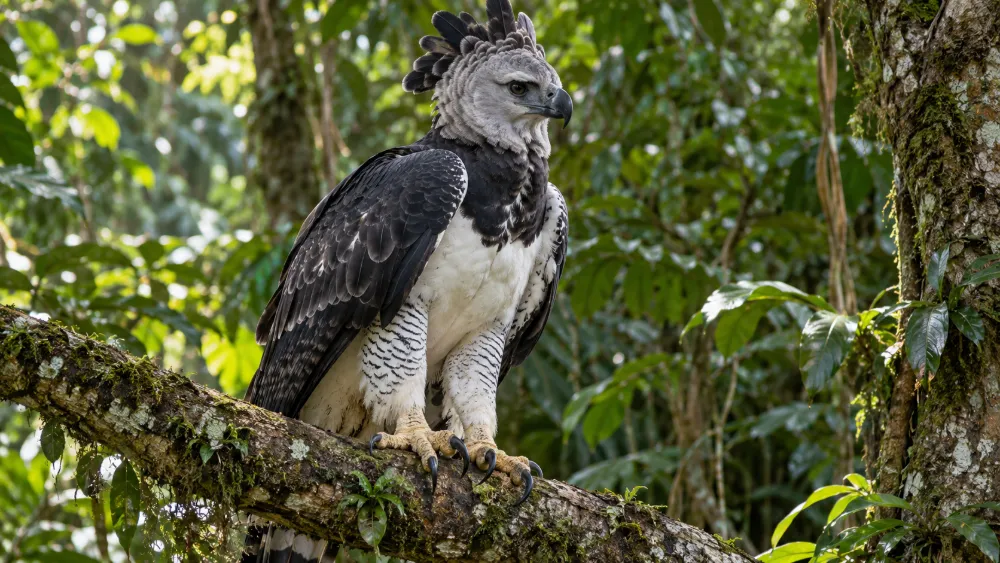
San Diego Zoo lists females at approximately 6.3 to 9 kilograms and 89 to 105 centimeters tall.
The wingspan reaches roughly 2 meters.
That is actually shorter than the wingspan of several large open-country eagles.
The reason is habitat.
Harpy Eagles hunt below the rainforest canopy, where extremely long wings would make rapid turns between tree trunks difficult.
Instead, they have relatively short, broad wings combined with:
an enormous body;
extremely thick legs;
huge feet;
and extraordinarily large talons.
This allows them to take large arboreal prey such as sloths and monkeys.
3. White-Tailed Eagle
Scientific name: Haliaeetus albicilla
If wingspan is your preferred measure of size, the White-tailed Eagle belongs near the top.
The Royal Society for the Protection of Birds lists:
length: about 70–90 cm;
wingspan: about 200–240 cm;
female weight: about 4–7 kg.
Its wings are so broad and rectangular that the species has earned the nickname “flying barn door.”
White-tailed Eagles occur across northern Europe and Asia and feed on fish, birds, mammals and carrion.
4. Bald Eagle
Scientific name: Haliaeetus leucocephalus
The Bald Eagle is North America's famous sea eagle and another contender when measuring maximum wingspan.
Smithsonian's National Zoo reports adults weighing approximately 3 to 6.5 kilograms, with wingspans reaching up to about 2.6 meters.
Females are larger than males, and northern Bald Eagles tend to be larger than birds from farther south.
This geographical size variation is one reason simple internet size rankings can be misleading.
A large female from Alaska can be substantially bigger than a male from a southern population.
5. Philippine Eagle
Scientific name: Pithecophaga jefferyi
The Philippine Eagle is one of the world's largest forest raptors and one of the longest-bodied eagles.
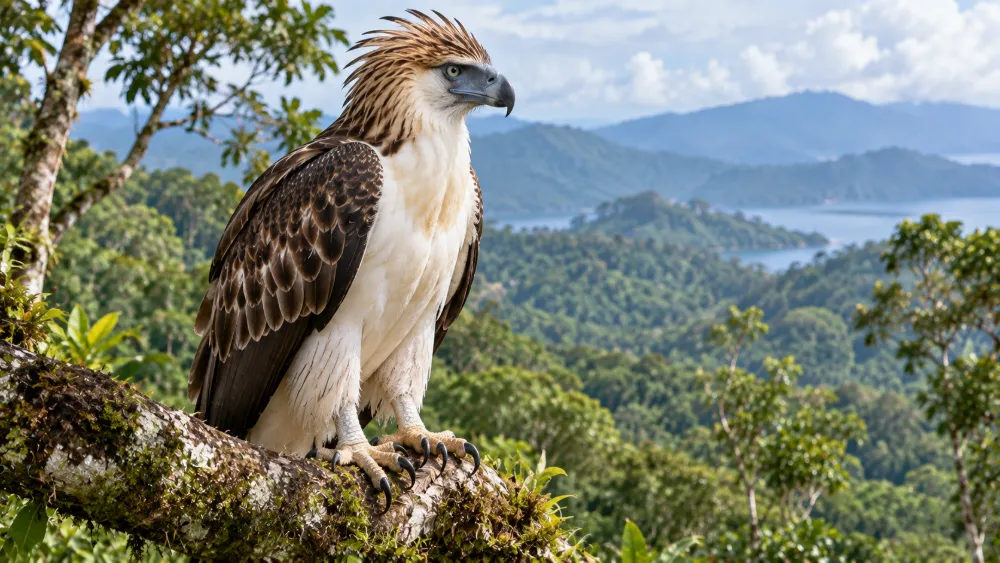
The Philippine Eagle Foundation describes it as one of the largest and most powerful forest raptors.
Recent measurements of wild individuals illustrate the scale of the species.
A young male measured by the Foundation in 2026 was about 90 centimeters long, weighed approximately 4.5 kilograms and had a wingspan of about 1.6 meters.
Adult females can be substantially heavier. Philippine Eagle Foundation veterinary reports have documented females around 5.6 to 6 kilograms, while individual variation occurs.
The species is found only in the Philippines and is Critically Endangered.
6. Wedge-Tailed Eagle
Scientific name: Aquila audax
Australia's largest living bird of prey is the Wedge-tailed Eagle.
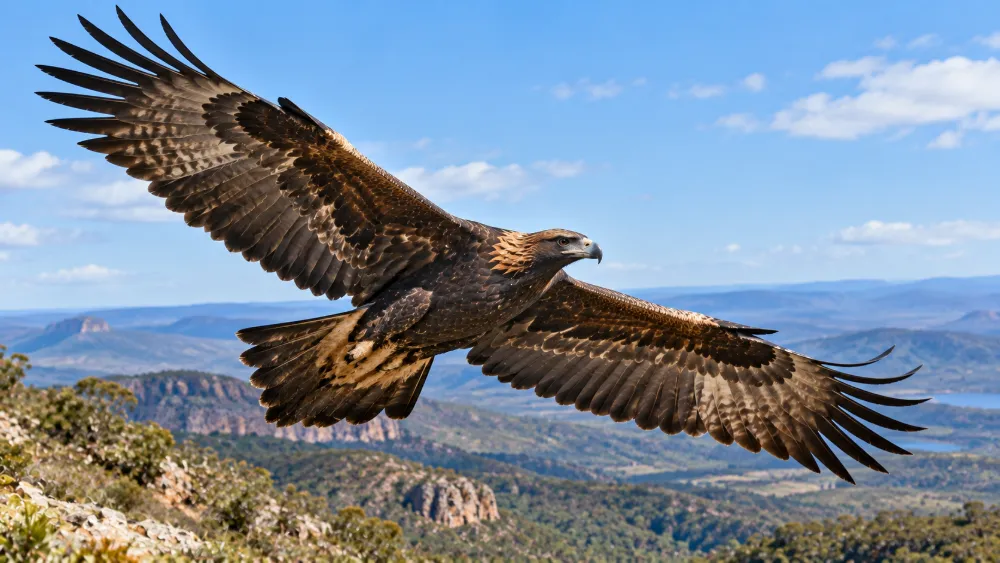
The Australian Museum lists adults at approximately 87 to 105 centimeters long.
The wingspan reaches about 2.3 meters.
Females weigh approximately 4.2 to 5.3 kilograms, while males are smaller at roughly 3.2 to 4 kilograms.
Its name comes from the unmistakable long, wedge-shaped tail visible in flight.
The combination of long wings, long body and long tail gives this eagle an especially imposing silhouette.
7. Golden Eagle
Scientific name: Aquila chrysaetos
The Golden Eagle is one of the largest widely distributed eagles in the Northern Hemisphere.
San Diego Zoo lists females at approximately 3.6 to 6.6 kilograms, with males about 2.8 to 4.5 kilograms.
Its wingspan is approximately 1.9 to 2.3 meters.
Cornell Lab of Ornithology gives a similar wingspan range of roughly 185 to 220 centimeters.
Golden Eagles inhabit open landscapes ranging from mountains and grasslands to deserts and tundra.
Their long wings are adapted to soaring over large open territories while searching for mammals and birds.
8. Martial Eagle
Scientific name: Polemaetus bellicosus
The Martial Eagle is one of Africa's largest eagles.
SANBI describes it as one of the continent's most powerfully built eagles.
Adults measure around 78 to 83 centimeters long, with females considerably larger than males.
Recorded body mass reaches roughly 4.7 kilograms.
Martial Eagles have:
very broad wings;
long powerful legs;
large feet;
and long sharp talons.
They soar at great height over African savannas and open woodland before diving onto prey.
9. Verreaux's Eagle
Scientific name: Aquila verreauxii
Verreaux's Eagle is another very large African eagle, strongly associated with cliffs and rocky mountain country.
SANBI gives a body length of approximately 80 to 90 centimeters and a body mass of about 3.7 to 4.5 kilograms.
Other SANBI material reports birds around 5 kilograms and wingspans reaching approximately 2.3 meters.
Adults are almost entirely black except for a distinctive white V-shaped pattern on the back.
The species is especially adapted to hunting rock hyraxes in mountainous terrain.
10. Crowned Eagle
Scientific name: Stephanoaetus coronatus
The Crowned Eagle does not have the longest wingspan in this list, but it is one of the largest and most powerfully constructed forest eagles in Africa.
San Diego Zoo lists:
length: approximately 80–99 cm;
female weight: approximately 3.2–4.7 kg;
wingspan: approximately 1.52–1.8 m.
Like the Harpy Eagle, it lives in forest habitat.
Its relatively broad, shorter wings allow greater maneuverability between trees, while strong legs and talons provide the power needed to catch substantial mammalian prey.
What Is the Largest Eagle in the World?
There is no perfect single answer because “largest” can mean several things.
| Measurement | Notable Candidate | Why |
|---|---|---|
| Body mass | Steller's Sea Eagle / Harpy Eagle | Both produce exceptionally heavy females |
| Very broad wingspan | White-tailed Eagle / Bald Eagle | Large sea eagles can exceed 2.4 m |
| Body length | Harpy / Philippine / Wedge-tailed Eagle | Large individuals approach or exceed 1 m |
| Forest power | Harpy Eagle | Extremely heavy body and oversized talons |
Published maximum measurements also differ among sources, so any website claiming one eagle is exactly “the largest” without explaining the measurement being used is oversimplifying the question.
What Is the Heaviest Eagle?
The Steller's Sea Eagle is frequently described as the world's heaviest living eagle.
However, very large female Harpy Eagles can also approach approximately 9 kilograms according to San Diego Zoo measurements.
Differences in published averages and exceptional maximum individuals make it more accurate to say that both species belong to the extreme upper end of living eagle body mass.
Which Eagle Has the Largest Wingspan?
Several large sea and open-country eagles can exceed 2 meters.
White-tailed Eagles routinely reach approximately 2 to 2.4 meters, while Smithsonian gives exceptionally large Bald Eagles wingspans up to about 2.6 meters.
Wedge-tailed Eagles reach around 2.3 meters, and Golden Eagles can also exceed 2 meters.
This is why wingspan alone produces a different answer from body weight.
Why Don't Harpy Eagles Have the Widest Wings?
A huge wingspan is not always an advantage.
Harpy Eagles hunt inside dense tropical rainforest.
Long, narrow soaring wings would make navigating between trees difficult.
Instead, Harpy Eagles have relatively short, broad wings that provide:
strong acceleration;
tight turning ability;
and greater maneuverability beneath the canopy.
The same principle helps explain the more compact wings of other large forest eagles.
Are Female Eagles Bigger Than Males?
Usually, yes.
Most eagles show reverse sexual size dimorphism, meaning females are larger than males.
The difference can be dramatic.
San Diego Zoo lists female Harpy Eagles at approximately 6.3 to 9 kilograms, compared with only about 3.8 to 5.4 kilograms for males.
Bald Eagles, Golden Eagles, Wedge-tailed Eagles and many other species show the same general pattern.
Therefore, any eagle size comparison should specify whether measurements come from males, females or a combined range.
Is the Philippine Eagle the Largest Eagle?
The Philippine Eagle is unquestionably one of the world's largest forest eagles, particularly when body length is considered.
However, it is not automatically the heaviest or widest-winged eagle.
Steller's Sea Eagles and Harpy Eagles can be heavier, while several sea eagles have wider wings.
The Philippine Eagle's remarkable size comes from its combination of:
a long body;
large feet;
powerful legs;
a large bill;
and an impressive feathered crest.
Is a Condor Bigger Than an Eagle?
Yes, if all birds of prey and scavenging raptors are being compared.
The Andean Condor can have a wingspan exceeding that of living eagles.
However, condors are New World vultures, not eagles.
That is why a list specifically about the largest eagles should not include condors simply to create a larger number.
FAQ
What is the largest eagle in the world?
There is no single answer unless you define “largest.” Steller's Sea Eagles are among the heaviest, Harpy Eagles are exceptionally heavy and powerful, while White-tailed and Bald Eagles can have enormous wingspans.
What is the heaviest eagle?
The Steller's Sea Eagle is frequently described as the heaviest living eagle, although very large female Harpy Eagles can also reach exceptional weights.
Which eagle has the biggest wingspan?
White-tailed Eagles, Bald Eagles and other large sea eagles can reach wingspans around or above 2.4 meters. Maximum figures vary between sources and populations.
How big is a Harpy Eagle?
Female Harpy Eagles can weigh approximately 6.3 to 9 kilograms, stand around 89 to 105 centimeters tall and reach roughly 2 meters in wingspan.
How big is a Steller's Sea Eagle?
Adults are approximately 86.5 to 105 centimeters long and are among the heaviest eagles alive.
How big is a Bald Eagle?
Large females can weigh around 6.5 kilograms or more, and Smithsonian reports maximum wingspans of approximately 2.6 meters.
What is Australia's largest eagle?
The Wedge-tailed Eagle is Australia's largest living bird of prey. It can reach approximately 105 centimeters long with a wingspan of about 2.3 meters.
What is Africa's largest eagle?
The Martial Eagle is generally regarded as one of Africa's largest and most powerfully built eagles. Verreaux's and Crowned Eagles are also very large African species.
Is the Golden Eagle one of the largest eagles?
Yes. Females can exceed 6 kilograms and the wingspan can reach approximately 2.2 to 2.3 meters.
Are female eagles larger than males?
Yes. In most eagle species, females are noticeably larger and heavier than males.
Final Thoughts
The question “What is the largest eagle?” sounds simple, but biology gives us several answers.
The Steller's Sea Eagle stands out for extraordinary mass. The Harpy Eagle combines huge body weight with some of the most impressive feet and talons among forest raptors. The White-tailed and Bald Eagles have enormous wings, while the Philippine and Wedge-tailed Eagles stand out for body length.
The differences are largely explained by ecology.
Sea eagles and open-country hunters can benefit from long wings built for soaring, while rainforest hunters such as Harpy and Crowned Eagles need shorter, broader wings for maneuvering around trees.
So rather than one universal “biggest eagle,” the world contains several giant eagle designs—each enormous in a slightly different way.
Sources Used for Fact Checking
San Diego Zoo Wildlife Alliance — Steller's Sea Eagle
San Diego Zoo Wildlife Alliance — Harpy Eagle
Royal Society for the Protection of Birds — White-tailed Eagle
Smithsonian's National Zoo — Bald Eagle
Philippine Eagle Foundation — Philippine Eagle
Australian Museum — Wedge-tailed Eagle
Cornell Lab of Ornithology — Golden Eagle
SANBI — Martial Eagle
SANBI — Verreaux's Eagle
San Diego Zoo Wildlife Alliance — Crowned Eagle
BirdLife International — Eagles