Animals with big ears include fennec foxes, elephants, servals, bilbies, jackrabbits and long-eared bats. Their ears may look similar at first, but the reasons behind their size are different: some help release heat, some detect faint prey sounds, and others help an animal notice danger in open habitats.
Below are 12 real species with their scientific names, clear visual clues and photo sources. This is an illustrated selection, not a scientific ranking of ear size: a huge elephant ear and a tiny bat ear cannot be compared fairly without specifying whether we mean absolute area or size relative to the body.
12 Big-Eared Animals at a Glance
Use this table to compare what to look for and what each animal gains from its ears. The functions are simplified; a single species may use its ears in several ways.
| # | Animal | Scientific name | Ear adaptation |
|---|---|---|---|
| 1 | Fennec fox | Vulpes zerda | Cooling + detecting prey |
| 2 | Bat-eared fox | Otocyon megalotis | Finding termites and other insects |
| 3 | African savanna elephant | Loxodonta africana | Dissipating body heat + communication |
| 4 | Serval | Leptailurus serval | Pinpointing rodents in vegetation |
| 5 | Caracal | Caracal caracal | Hearing + conspicuous ear tufts |
| 6 | Black-tailed jackrabbit | Lepus californicus | Heat release + predator detection |
| 7 | Greater bilby | Macrotis lagotis | Listening while foraging at night |
| 8 | Long-eared hedgehog | Hemiechinus auritus | Sensitive hearing + possible heat loss |
| 9 | Aardvark | Orycteropus afer | Listening for predators and movements |
| 10 | African wild dog | Lycaon pictus | Awareness and social interactions |
| 11 | Mule deer | Odocoileus hemionus | Detecting danger |
| 12 | Brown long-eared bat | Plecotus auritus | Detecting faint insect sounds |
12 Animals With Big Ears: Photos and Facts
1. Fennec fox (Vulpes zerda)
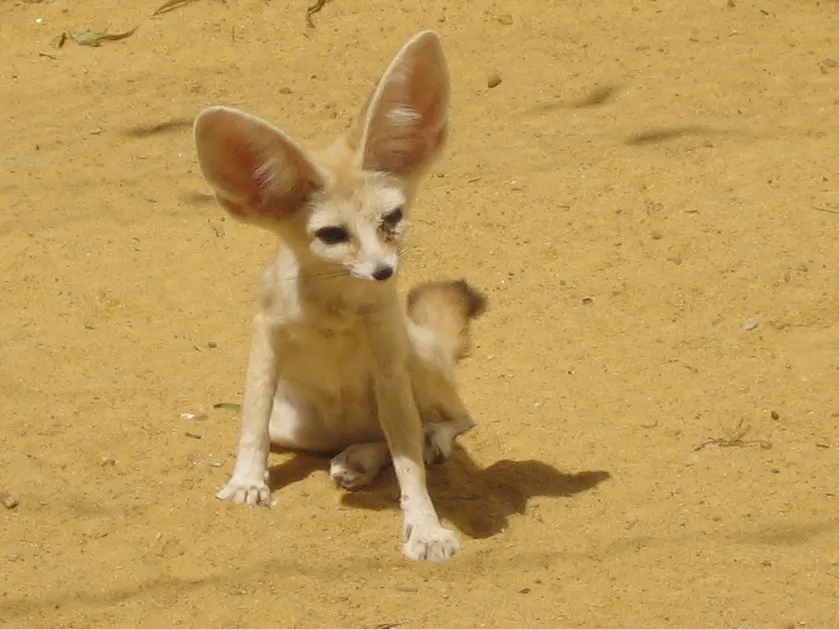
Photo: Fennec fox. Credit: Kkonstan; original photo and permissions · CC BY 3.0. For CC images, check attribution and changes if you resize or edit.
Where it lives: Sahara and nearby arid regions. Key ear clue: Extra-large triangular ears on a very small fox.
The fennec fox makes the value of large ears easy to see. It is a tiny, pale-colored desert fox, yet its upright ears can reach about 10–15 cm (4–6 in) long. Those ears are useful in two different ways: blood vessels close to the surface help release excess heat, and sensitive hearing helps the fox locate prey that may be moving beneath sand.
Look for a compact muzzle, cream-colored fur, a black-tipped bushy tail and ears that seem almost too large for the head. Ear size is an adaptation, not a dependable way to determine the animal’s age. Unlike many animals on this list, the fennec needs both quiet nighttime hunting and effective heat management in a very dry environment.
For more fox identification examples, see our 10 beautiful fox species guide.
2. Bat-eared fox (Otocyon megalotis)

Photo: Bat-eared fox. Credit: Zammerman; original photo and permissions · CC BY-SA 4.0. For CC images, check attribution and changes if you resize or edit.
Where it lives: Eastern and southern Africa. Key ear clue: Very wide upright ears and a dark facial mask.
The bat-eared fox is named for its very noticeable ears. Although it resembles other foxes in general shape, it has a specialized diet that includes large numbers of termites and other insects. Its hearing helps it detect small animals in grass and soil, making those oversized ears an important hunting tool.
The face offers a useful identification clue: large ears, dark markings around the eyes and muzzle, and a grizzled gray-brown coat. Its social behavior also differs from the usually solitary fennec fox. The accompanying photograph shows young bat-eared foxes near their den, so their body proportions will change as they grow.
3. African savanna elephant (Loxodonta africana)

Photo: African savanna elephant. Credit: Hobbyfotowiki; original photo and permissions · CC0 1.0. For CC images, check attribution and changes if you resize or edit.
Where it lives: Sub-Saharan African savannas. Key ear clue: The largest external ears among living animals.
If the question is which living animal has the biggest ears in absolute size, the African savanna elephant is an outstanding example. Its ears are broad, thin and full of blood vessels. On warm days the elephant can move them to help lose heat, an especially useful adaptation for such a large body.
Those ears also participate in displays. An elephant may spread them when attentive or trying to look imposing, but ear movement alone does not prove anger: context, posture and other behavior all matter. African savanna elephants generally have larger ears than Asian elephants, so a large, fan-shaped ear can help with identification when the whole animal is visible.
Read more about the species in our elephant facts article.
4. Serval (Leptailurus serval)
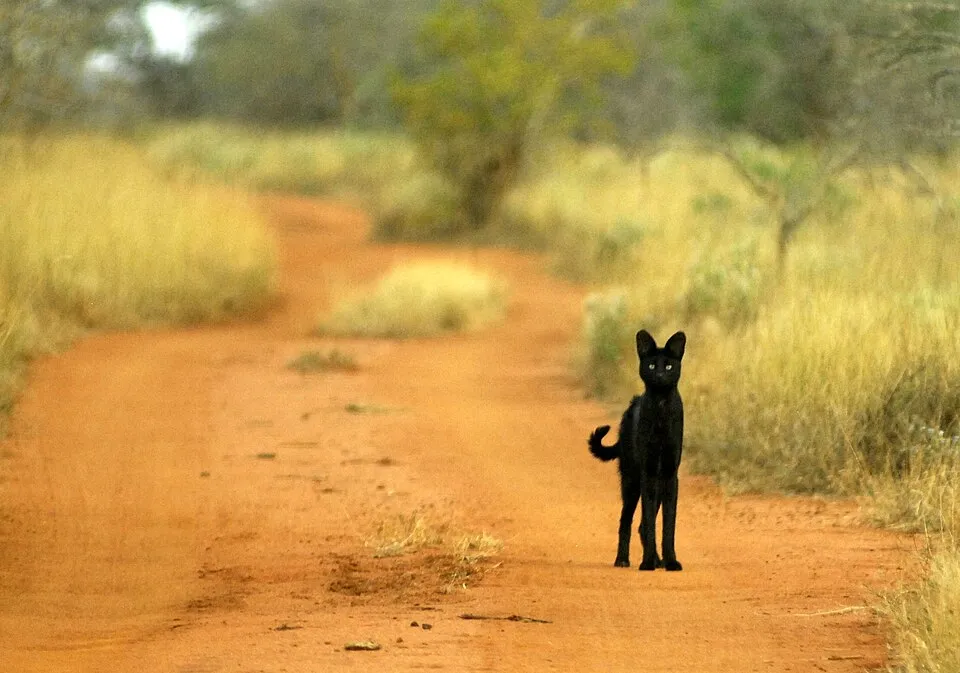
Photo: Serval. Credit: Stan Rullman; original photo and permissions · CC BY 4.0. For CC images, check attribution and changes if you resize or edit.
Where it lives: African grasslands and wetlands. Key ear clue: Tall rounded ears on a long-legged spotted cat.
A serval has some of the most striking ears among wild cats. The ears are tall, rounded and independently mobile, supporting the fine hearing needed to locate small animals in tall grass. The rest of its body is specialized too: long legs allow the cat to stand high over vegetation and jump sharply at prey.
When identifying a serval, combine ear shape with the spotted golden coat, slim build and unusually long legs. It should not be confused with a caracal, whose ear tips carry distinctive black tufts. Big ears can indicate acoustic specialization, but that does not mean the serval hunts only by sound: vision and movement remain important.
You can also browse our serval species profile for more identification details.
5. Caracal (Caracal caracal)

Photo: Caracal. Credit: Silvio Tanaka; original photo and permissions · CC BY 2.0. For CC images, check attribution and changes if you resize or edit.
Where it lives: Africa and parts of Asia. Key ear clue: Pointed ears with long black tufts.
The caracal’s ears are memorable because each tip carries a cluster of long black hairs. It has excellent hearing and can detect small prey by sound. Yet scientists have not conclusively established the exact function of those long tufts, so it would be misleading to claim they definitely work as sound funnels or a secret signaling system.
Its reddish coat is generally less spotted than a serval’s, and the ear tufts are a fast visual clue. The difference illustrates a broader point: large ears and visible ear decorations are not the same adaptation. When looking at wildlife photographs, pay attention to the ear outline and not just the apparent size.
6. Black-tailed jackrabbit (Lepus californicus)
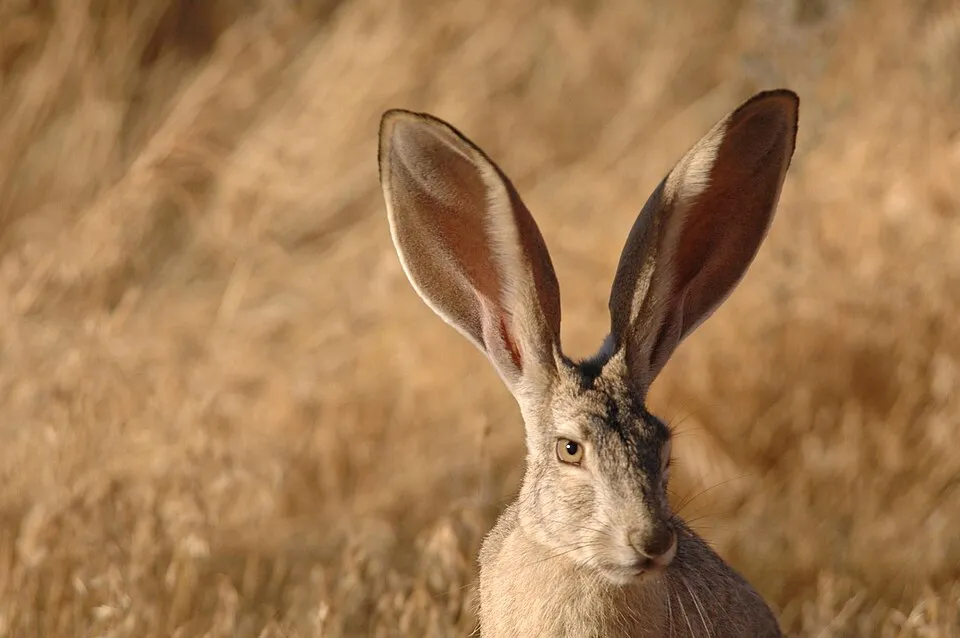
Photo: Black-tailed jackrabbit. Credit: Scott Rheam / USFWS; original photo and permissions · Public domain. For CC images, check attribution and changes if you resize or edit.
Where it lives: Western North America. Key ear clue: Very long upright ears and a lean hare body.
Despite its name, a jackrabbit is a hare, not a true rabbit. The black-tailed jackrabbit lives in open country, where tall ears help it detect approaching danger. Large ear surfaces also support heat exchange, which is valuable in exposed, dry habitats. The ears are often held up or rotated when the animal is alert.
This species has long hind legs, a slim body and a black stripe along the top of its tail. A photograph may show only the head, so the size of the ears should be judged against the head rather than against an unseen body. It is a practical example of why large ears can benefit an animal that spends much of its time avoiding predators.
7. Greater bilby (Macrotis lagotis)

Photo: Greater bilby. Credit: Andrew Gould; original photo and permissions · CC BY 2.0. For CC images, check attribution and changes if you resize or edit.
Where it lives: Arid and semi-arid Australia. Key ear clue: Rabbit-like ears, pointed snout and two-toned tail.
The greater bilby can look like a rabbit at first glance, but it is a marsupial in an entirely different family. It has long pinkish ears, a pointed nose, powerful digging claws and a black-and-white tail. Australian Museum notes that bilbies use acute hearing and smell to locate food as they forage after dark.
The photograph shows a bilby in human care rather than a wild desert scene. That distinction matters when captions are meant to build trust. Unlike a hare, a bilby digs burrows and uses its snout and claws to uncover insects, seeds, fungi and plant material. Its ears are one part of a whole set of nocturnal desert adaptations.
8. Long-eared hedgehog (Hemiechinus auritus)

Photo: Long-eared hedgehog. Credit: Мария Павлуша; original photo and permissions · CC BY 4.0. For CC images, check attribution and changes if you resize or edit.
Where it lives: Dry areas of North Africa and Asia. Key ear clue: Large exposed ears rising above a spiny head.
Most people picture hedgehogs as round, spiny mammals with small ears. The long-eared hedgehog is different: its ears stand conspicuously above the spines and are large relative to its head. Such ears are associated with acute hearing, helping the animal locate small prey and notice danger when it is active at night.
Scientists also consider the ear surfaces helpful for heat radiation in its dry environments, although the importance of cooling depends on the conditions. This hedgehog should not be confused with a porcupine; hedgehogs have short defensive spines and a different body plan. In a close-up photograph, the exposed ear margins make the species easy to distinguish from common European hedgehogs.
Curious how hedgehogs differ? Our hedgehog species overview adds context.
9. Aardvark (Orycteropus afer)
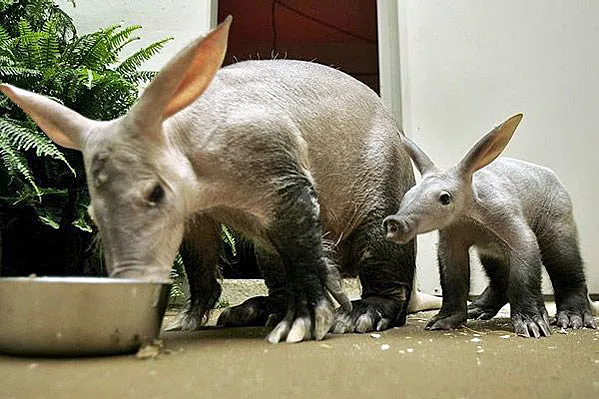
Photo: Aardvark. Credit: Scotto Bear; original photo and permissions · CC BY-SA 2.0. For CC images, check attribution and changes if you resize or edit.
Where it lives: Sub-Saharan Africa. Key ear clue: Long rabbit-like ears paired with a tubular snout.
The aardvark is hard to mistake for anything else: it has a long tubular snout, strong digging claws, thick tail and upright ears that resemble those of a rabbit. It hunts mainly for ants and termites, opening nests with its claws and collecting insects with a long sticky tongue.
Large ears support awareness while it travels and digs at night, but smell is also crucial in finding food. Aardvarks are not pigs and are not close relatives of the American anteaters, even though their feeding habits can seem similar. On this list, they show how ear shape can stand out in an animal whose strongest feeding tool is actually its nose.
10. African wild dog (Lycaon pictus)

Photo: African wild dog. Credit: Mathias Appel; original photo and permissions · CC0 1.0. For CC images, check attribution and changes if you resize or edit.
Where it lives: Sub-Saharan Africa. Key ear clue: Large round ears with a mottled coat.
African wild dogs have broad, rounded ears that are easy to pick out even in a crowded pack. The ears can swivel to collect sound, helping animals stay alert while they travel and hunt. In a group-living species, attention to nearby pack members is also vital, although no single ear position can be translated into a universal emotion.
Look for a patchwork coat of black, tan and white, long legs and a dark muzzle. These animals are distinct from domestic dogs and are highly specialized cooperative hunters. Large ears are only one part of their sensory equipment: scent, sight and calls also contribute to communication and coordination.
11. Mule deer (Odocoileus hemionus)

Photo: Mule deer. Credit: Tupper Ansel Blake / USFWS; original photo and permissions · Public domain. For CC images, check attribution and changes if you resize or edit.
Where it lives: Western North America. Key ear clue: Wide mule-like ears and a black-tipped tail.
The mule deer gets its common name from its large ears, which resemble those of a mule. Its ear movements help it listen for approaching animals and orient toward unusual sounds. National Park Service educational material describes these large ears as an adaptation that improves hearing.
To distinguish mule deer from white-tailed deer, look for the broad ears, black-tipped tail and characteristic bounding motion. Antler shape may help when adult males are present, but the ears remain a useful clue for females and young deer as well. In a photo, posture and camera angle can exaggerate ear size, so combine several features before naming the species.
Compare deer features with our elk vs deer guide or explore the mule deer species profile.
12. Brown long-eared bat (Plecotus auritus)
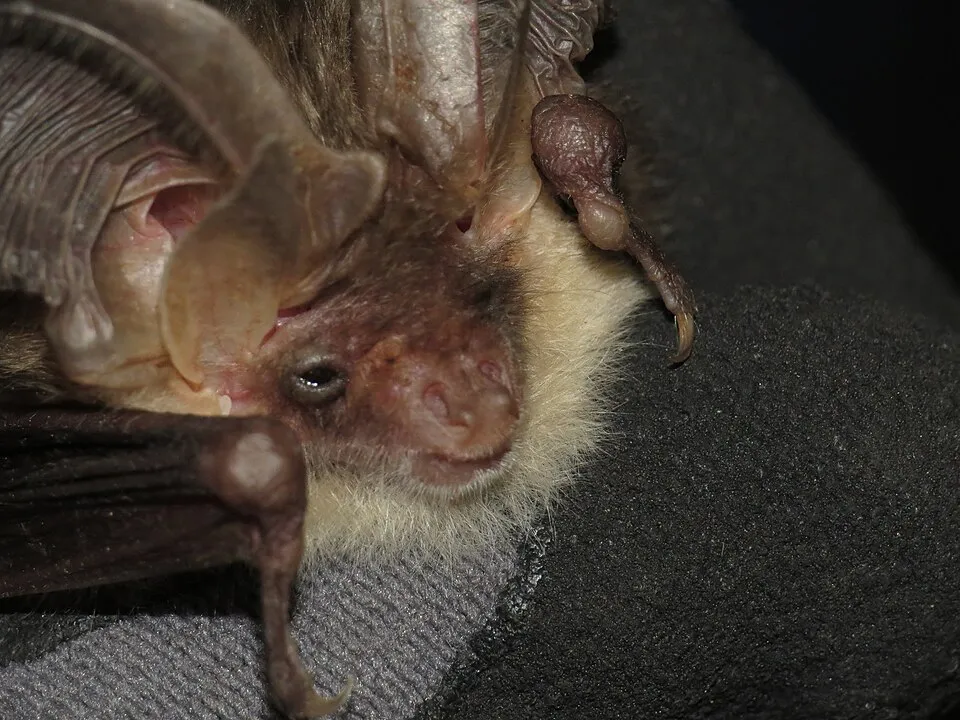
Photo: Brown long-eared bat. Credit: Yves Bas; original photo and permissions · CC BY 4.0. For CC images, check attribution and changes if you resize or edit.
Where it lives: Europe including the British Isles. Key ear clue: Ears nearly as long as the body.
The brown long-eared bat is a strong example of extraordinary ear size relative to body length. Its ears can be almost as long as its small body, giving it very sensitive hearing. Bat Conservation Trust explains that it often locates prey by the faint sounds insects make on leaves and bark.
It also produces very quiet echolocation calls, which is why it is sometimes called a whispering bat. When resting, it may fold or curl its ears, making them look unexpectedly short. That behavior is a useful reminder that a single photograph does not always reveal an animal’s full ear proportions. The selected image documents the species; it is not presented as a hunting-action photograph.
Which Animal Has the Biggest Ears?
For absolute ear size, the African savanna elephant is the standout among living land animals. Its enormous ear surfaces help shed heat from a massive body. But if you compare ears with body size, animals such as the fennec fox and brown long-eared bat become especially striking. Do not confuse these two measurements: a bat does not have larger ears than an elephant in centimeters.
Why Do Some Animals Have Such Large Ears?
1. Hearing quiet prey or predators
The serval, bilby and brown long-eared bat are examples of animals that rely on sensitive hearing. Ears can turn and help an animal orient toward subtle sounds, though hearing always works alongside other senses.
2. Letting body heat escape
Thin external ears can act as heat-exchange surfaces because blood flows close to the skin. This is particularly well documented in elephants and fennec foxes. Climate and behavior matter: large ears do not guarantee an animal always stays cool.
3. Orientation and social signals
Deer and wild canids turn their ears in response to what they hear and to activities around them. Some ear postures are visible to other animals, but a single still photograph rarely proves a specific emotional state.
How to Identify a Big-Eared Animal From a Photo
Check the ear outline: fennec fox ears are large and triangular; African wild dog ears are rounded; caracal ears have black tufts.
Compare the ears with the head: long-eared bats and hedgehogs are proportionally distinctive.
Look for the rest of the body: a serval has long legs and spots; a bilby has a pointed snout and a contrasting tail; a mule deer has a black-tipped tail.
Consider image context: perspective can exaggerate ears, and photos in zoos should not be described as wild photographs.
Big Ears FAQ
What animal has the largest ears in the world?
The African savanna elephant has exceptionally large external ears in absolute size. The answer changes when you ask for the biggest ears relative to body size.
Which fox has the biggest ears?
The fennec fox is especially famous for exceptionally large ears relative to its small body. Bat-eared foxes also have prominent ears used in insect hunting.
Why do desert animals often have large ears?
Ear surfaces can help release excess body heat, and sensitive hearing can make it easier to detect prey or danger in sparse habitats. Not all desert animals rely on both functions equally.
Do large ears always mean better hearing?
No. Ear shape is only one part of hearing. The inner ear, neural processing, head shape and the sounds an animal needs to detect are also important.
Are jackrabbits actually rabbits?
No. Jackrabbits are hares in the genus Lepus, although both hares and rabbits belong to the same order, Lagomorpha.
What is the difference between a serval and a caracal?
Servals are spotted, long-legged cats with tall rounded ears. Caracals tend to be more evenly reddish in coat color and have distinctive black ear tufts.
What animal has ears almost as long as its body?
The brown long-eared bat is a classic example. Its ears may be nearly as long as the body, and it can curl them back when resting.
Can big ears help animals stay cool?
Yes, in some species. Heat can move from warm blood in the ear to the surrounding air. Elephant and fennec fox ears are well-known examples, but cooling is not the only reason animals have big ears.
Final Takeaway
The most interesting thing about animals with big ears is not the size alone. The same eye-catching feature helps very different species solve different problems. An elephant can use huge ears to exchange heat; a serval listens for rodents; a bilby searches for food after dark; and a long-eared bat hears the faint movements of insects. Use the photographs and scientific names above to compare these adaptations rather than assuming every big-eared animal uses its ears in the same way.