12 Yellow-Bellied Birds at a Glance
Spotted a bird with a yellow belly and want to know its name? Look at the head, wings, size and location before relying on color alone. A yellow underside can belong to a goldfinch, a warbler or even a meadowlark, and the same species may look quite different in winter or at a younger age.
This photo identification guide covers 12 real North American species, with one reference photo for each, scientific names, field marks and the habitats where you are most likely to see them. The list is a practical field guide, not a scientific ranking of yellowness or rarity.
| Bird | Best clue | Where to look |
|---|---|---|
| 1. American Goldfinch | Breeding male: bright yellow body, black forehead and black-and-white wings | Weedy fields, parks and backyard feeders |
| 2. Lesser Goldfinch | Yellow underside with black cap; back greenish or black depending on region | Dry scrub, weedy edges, gardens and feeders |
| 3. Yellow Warbler | Mostly yellow plumage; adult males often show fine chestnut streaks on breast | Willows, streamside thickets and wet shrubland |
| 4. Common Yellowthroat | Adult male: bold black face mask, pale border and yellow throat and underparts | Marsh edges, dense low thickets and grassy wetlands |
| 5. Magnolia Warbler | Bright yellow underparts with strong black chest/flank streaks and white wing accents | Young conifers and mixed forest; leafy migration stopovers |
| 6. Prothonotary Warbler | Rich golden-yellow head and body with blue-gray wings | Wooded swamps and flooded bottomland forests |
| 7. Pine Warbler | Yellowish throat and breast, olive upperparts and pale wingbars | Pine woods, mature evergreen trees and nearby yards |
| 8. Wilson's Warbler | Mostly bright yellow; adult male has a neat black cap | Moist scrub, forest edges and low leafy growth |
| 9. Nashville Warbler | Gray head, pale eye ring, yellow chest and much of the underside | Brushy forest edges, young trees and migratory flocks |
| 10. Canada Warbler | Yellow underparts with a broken black necklace and gray upperparts | Moist mixed woods with dense understory |
| 11. Prairie Warbler | Yellow belly with black flank streaks and a curved dark facial mark | Overgrown fields, shrubby woodland and some coastal mangroves |
| 12. Eastern Meadowlark | Much larger than a warbler; bright yellow breast and bold black V | Pastures, grasslands, farm fields and fence lines |
How to Identify a Bird With a Yellow Belly
First, check the bill. A short, thick, triangular bill suggests a seed-eating finch. A thin, pointed bill often belongs to an insect-eating warbler. Meadowlarks have longer, spear-shaped bills and are noticeably larger than either group.
Next, study the face. A black mask across the eyes suggests a male Common Yellowthroat; a small black crown suggests a male Wilson's Warbler; a pale eye ring and gray head suggest a Nashville or Canada Warbler. Then compare the chest for streaks, an incomplete necklace or a bold V.
Finally, consider habitat and season. A bird on a backyard seed feeder is more likely to be a goldfinch than a marsh-dwelling Common Yellowthroat. Spring and fall bring migratory warblers through unfamiliar neighborhoods. Winter American Goldfinches may be brownish rather than bright yellow.
1. American Goldfinch (Spinus tristis)
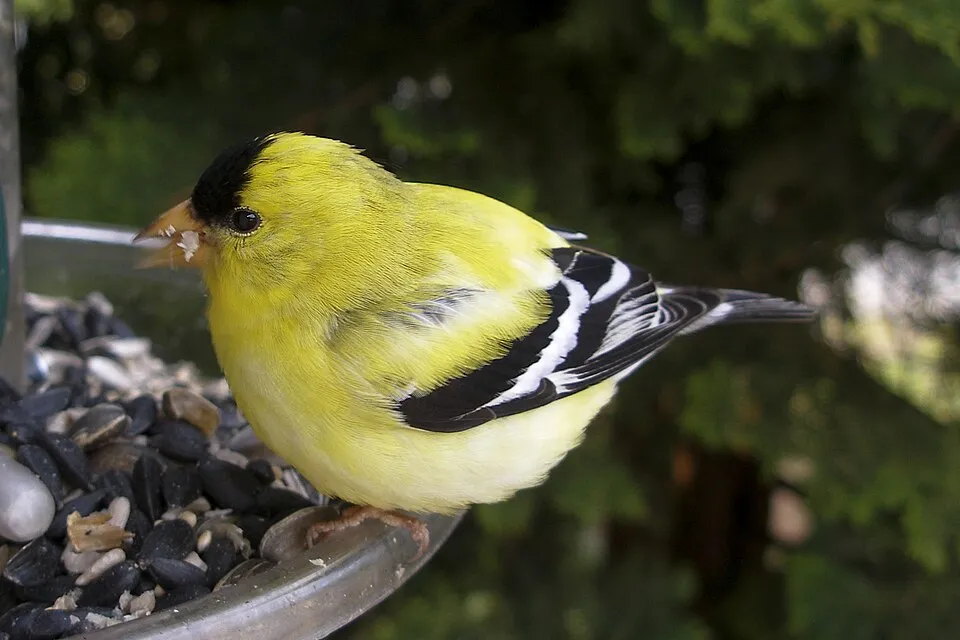
Real species photograph: quinet · Wikimedia Commons source · CC BY 2.0. The reference photo does not necessarily show every plumage described.
Key marks: Breeding male: bright yellow body, black forehead and black-and-white wings. Typical habitat: Weedy fields, parks and backyard feeders.
The American Goldfinch is often the first bird people think of when they picture a tiny yellow bird. A male in breeding plumage has a brilliant yellow underside, black forehead, contrasting dark wings and pale wingbars. The short, conical bill tells you this bird mainly handles seeds rather than catching insects in flight.
Watch how it feeds: goldfinches cling to seedheads and visit feeders stocked with sunflower or nyjer. Do not rule out this species if a bird looks brownish in November. Winter males lose most of their brilliant yellow, while females and younger birds can be surprisingly subdued.
Season and sex note: Males turn much duller in winter; females are olive above and paler below.
2. Lesser Goldfinch (Spinus psaltria)
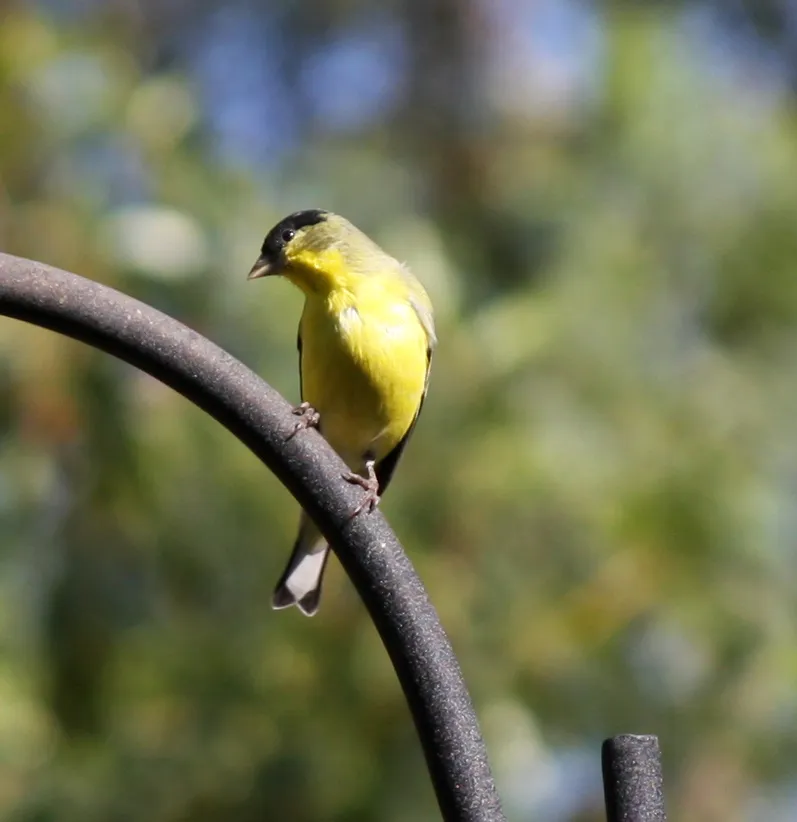
Real species photograph: tinyfroglet · Wikimedia Commons source · CC BY 2.0. The reference photo does not necessarily show every plumage described.
Key marks: Yellow underside with black cap; back greenish or black depending on region. Typical habitat: Dry scrub, weedy edges, gardens and feeders.
Lesser Goldfinches are small, quick-moving seed eaters with lemon-yellow underparts. Males often show a glossy black cap, dark wings and white wing patches. In much of the western United States, males can have greenish backs; some southern and eastern populations have black backs.
Check size, range and the wing pattern before calling one an American Goldfinch. The Lesser Goldfinch is usually a little smaller, and its white wing patch can be especially noticeable. Females are duller but may still show a clearly yellow belly.
Season and sex note: Females are dull olive above and yellowish below.
3. Yellow Warbler (Setophaga petechia)
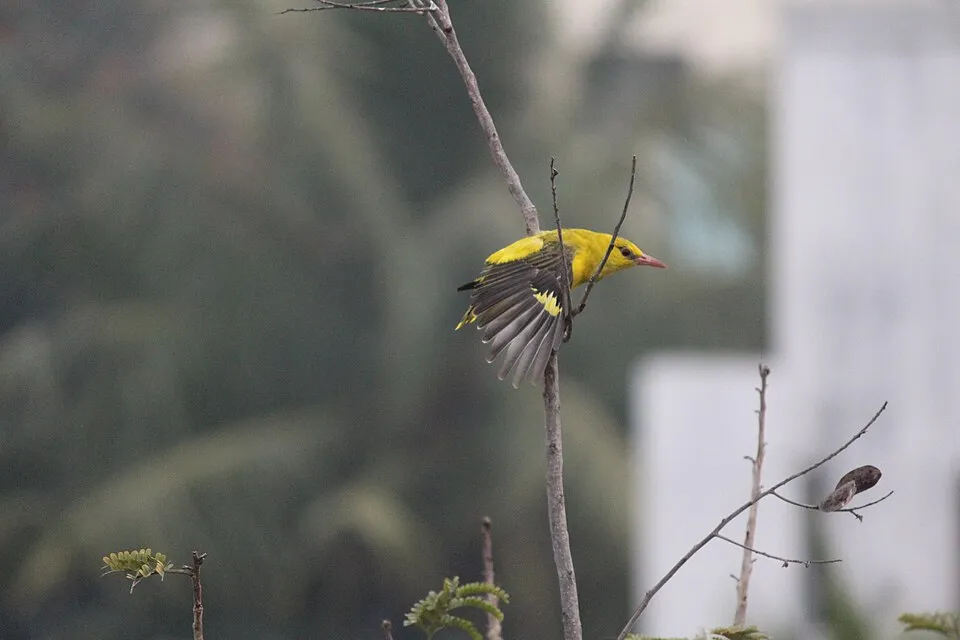
Real species photograph: Pchaithanyasai · Wikimedia Commons source · CC BY-SA 4.0. The reference photo does not necessarily show every plumage described.
Key marks: Mostly yellow plumage; adult males often show fine chestnut streaks on breast. Typical habitat: Willows, streamside thickets and wet shrubland.
A Yellow Warbler may look almost uniformly yellow from a distance. Look more closely at an adult male and you may see delicate reddish-brown streaks down the chest. The bird has a relatively plain face with a dark, beadlike eye and no bold black mask.
This is a classic late-spring and summer bird around wet shrubs, willows and stream margins. Its thin, pointed bill is unlike a goldfinch’s seed-cracking bill. In autumn, female and immature plumages can be much less vivid, so a plain yellowish warbler is not automatically a bright breeding male.
Season and sex note: Females and young birds are generally paler and less streaked.
4. Common Yellowthroat (Geothlypis trichas)
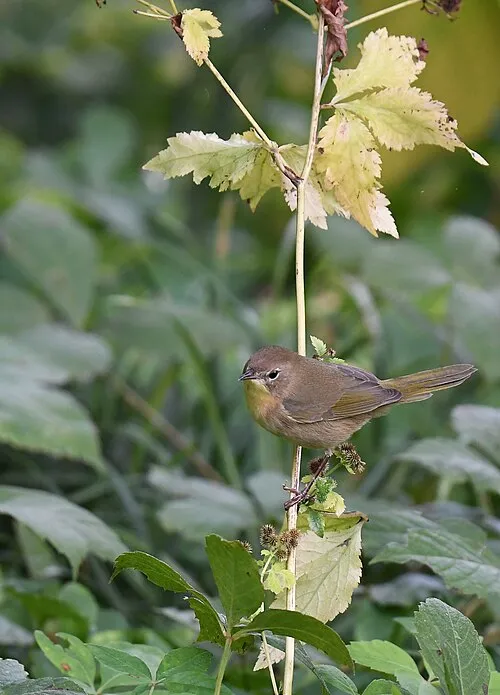
Real species photograph: Wildreturn · Wikimedia Commons source · CC BY 2.0. The reference photo does not necessarily show every plumage described.
Key marks: Adult male: bold black face mask, pale border and yellow throat and underparts. Typical habitat: Marsh edges, dense low thickets and grassy wetlands.
A male Common Yellowthroat is one of the easiest yellow-bellied songbirds to recognize because of its sharply contrasting black bandit mask. The yellow throat and breast stand out below an olive-brown back. It is a small, round-bodied warbler that often moves close to the ground.
If you are searching in thick marsh vegetation and hear a rolling “witchety” song, look for this species. An unmasked, brownish female can look very different from a male: location, tail shape and the yellow wash around the throat help narrow the identification.
Season and sex note: Females lack the black mask and can be mostly brownish with yellow concentrated near the throat.
5. Magnolia Warbler (Setophaga magnolia)
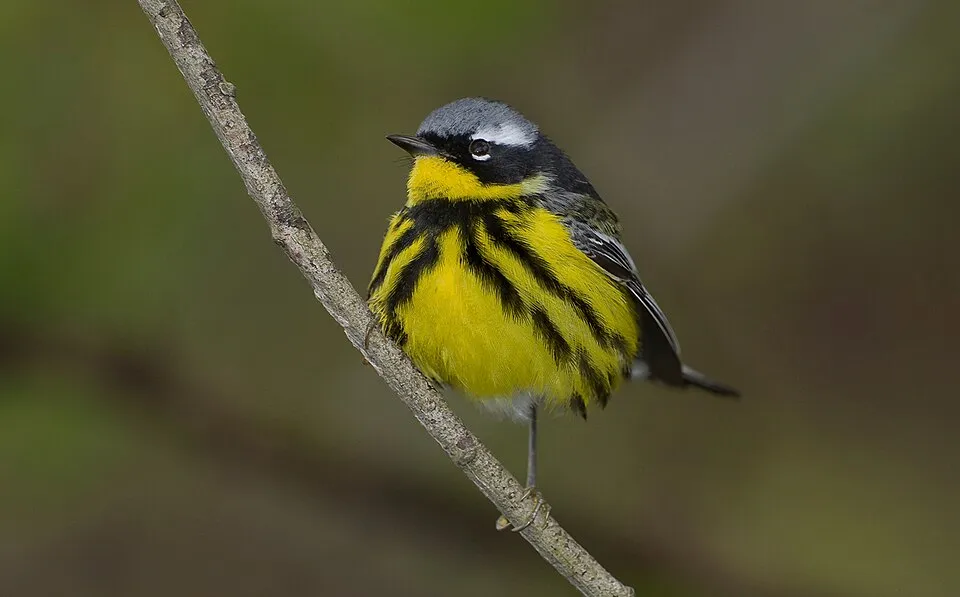
Real species photograph: William H. Majoros · Wikimedia Commons source · CC BY-SA 3.0. The reference photo does not necessarily show every plumage described.
Key marks: Bright yellow underparts with strong black chest/flank streaks and white wing accents. Typical habitat: Young conifers and mixed forest; leafy migration stopovers.
The Magnolia Warbler is a striking choice when the bird has a vivid yellow belly marked by dark vertical lines. Adult males also show a dark mask and conspicuous white patches or wingbars. A quick look from below may reveal white areas at the base of the undertail with a contrasting black tail tip.
Magnolia Warblers are often seen during spring and fall migration, hopping through foliage and searching for insects. Not every individual will show the dramatic markings of an adult male. Compare weaker-patterned birds with Canada Warblers and Prairie Warblers before deciding.
Season and sex note: Females and immatures have weaker stripes but retain useful tail pattern.
6. Prothonotary Warbler (Protonotaria citrea)
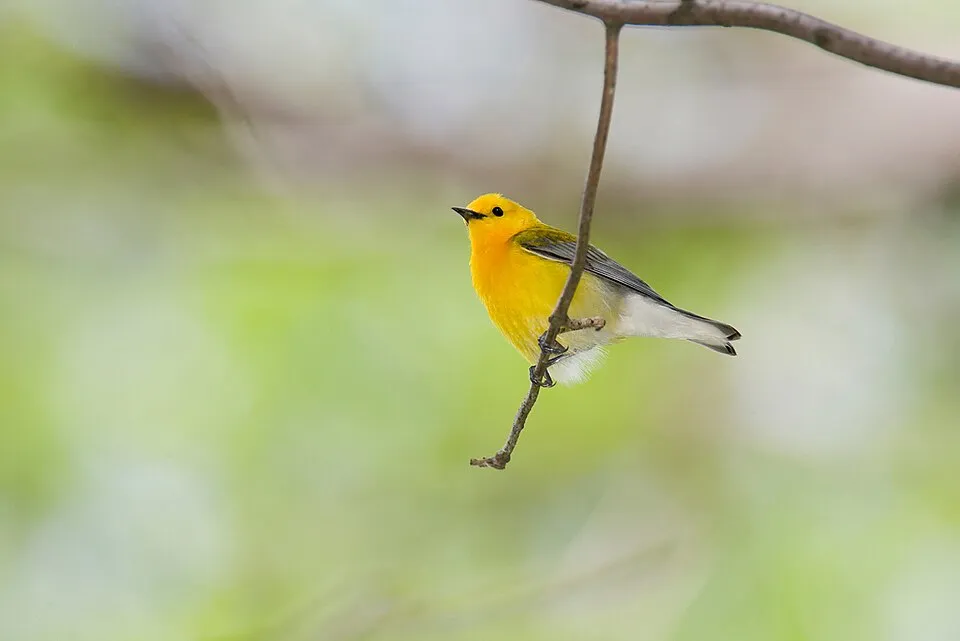
Real species photograph: William H. Majoros · Wikimedia Commons source · CC BY-SA 3.0. The reference photo does not necessarily show every plumage described.
Key marks: Rich golden-yellow head and body with blue-gray wings. Typical habitat: Wooded swamps and flooded bottomland forests.
A Prothonotary Warbler is almost glowing yellow around the head, throat and breast. Its wings and tail are distinctly blue-gray, creating a different color balance from an all-yellow Yellow Warbler. The relatively sturdy bill and rounder head can also help with identification.
The setting is an important clue: this species is associated with wet forests, often over standing water, and it nests in tree cavities or artificial nest boxes. If the bird is deep in swampy woods, with gold below and cool gray wings, it becomes a strong candidate.
Season and sex note: Females are typically paler but retain the golden look.
7. Pine Warbler (Setophaga pinus)
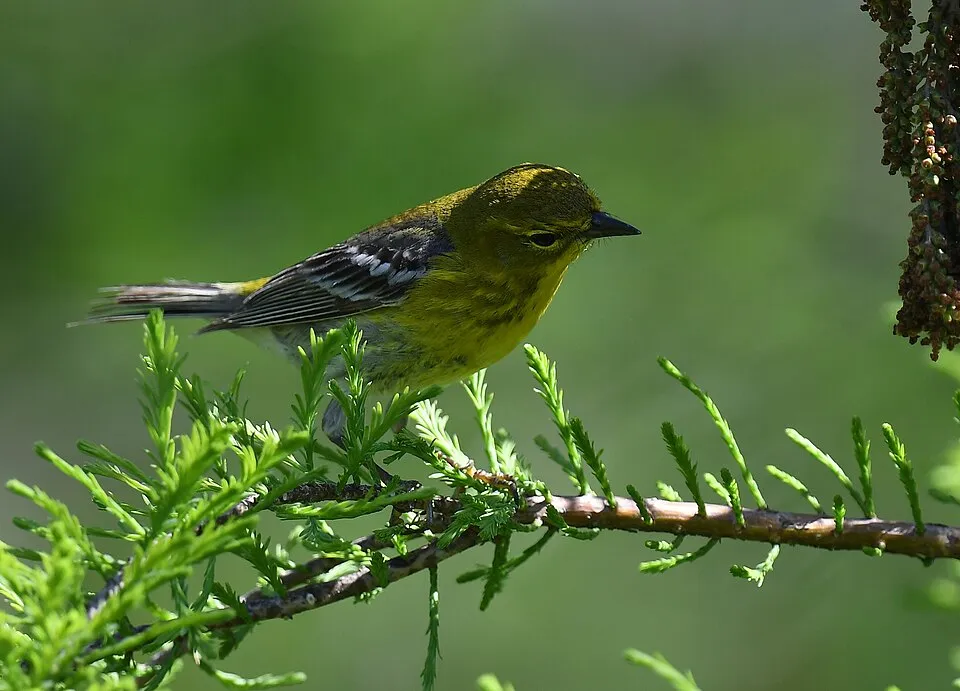
Real species photograph: Wildreturn · Wikimedia Commons source · CC BY 2.0. The reference photo does not necessarily show every plumage described.
Key marks: Yellowish throat and breast, olive upperparts and pale wingbars. Typical habitat: Pine woods, mature evergreen trees and nearby yards.
Pine Warblers usually look less flashy than a Prothonotary or Yellow Warbler. The chest and belly can be washed with yellow, while the back is olive and the wings show pale bars. A fairly sturdy bill helps separate it from some more delicately built warblers.
Habitat often does much of the identification work: listen for a steady musical trill high in the pine branches. Depending on time of year, Pine Warblers may also visit suet or other backyard feeders, making them an especially relevant yellowish bird for winter observers in parts of the southeastern United States.
Season and sex note: Females and immature birds can be noticeably duller.
8. Wilson's Warbler (Cardellina pusilla)
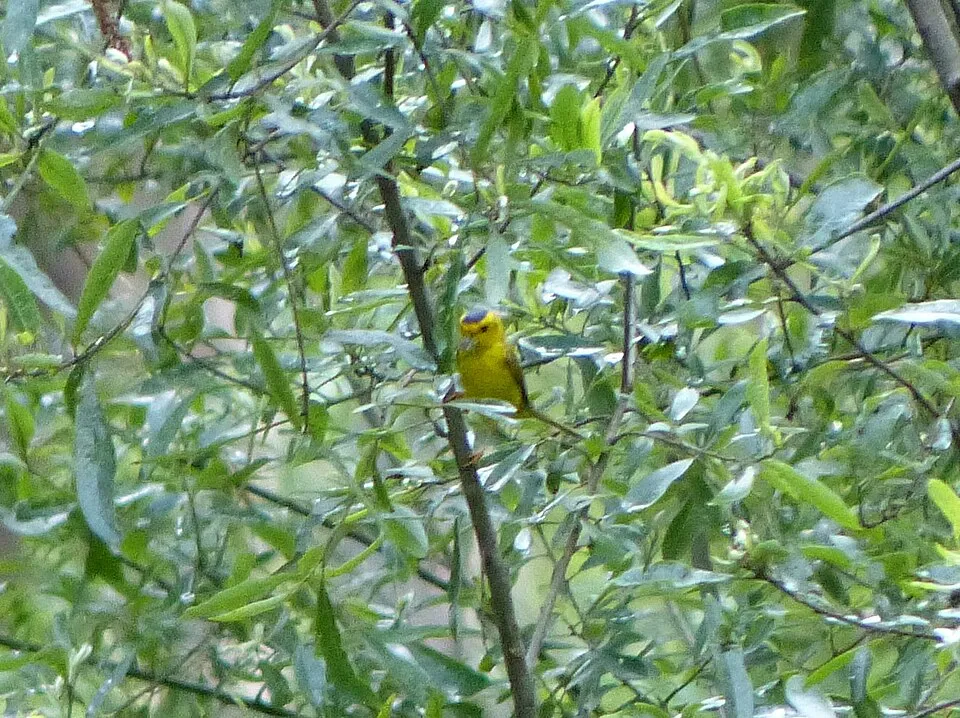
Real species photograph: bgwashburn · Wikimedia Commons source · CC BY 2.0. The reference photo does not necessarily show every plumage described.
Key marks: Mostly bright yellow; adult male has a neat black cap. Typical habitat: Moist scrub, forest edges and low leafy growth.
Wilson's Warbler is a compact bird with bright yellow below and an olive-toned back. A neat, rounded black patch on top of the head is the best clue on an adult male. Unlike the Common Yellowthroat, its dark mark is on the crown, not stretched across the face as a mask.
These active little warblers often forage low in vegetation. Look at the head from more than one angle: if the bird is yellow underneath and seems to wear a tiny black beret, Wilson’s Warbler is a strong possibility. However, the cap is not obvious in every sex or age class.
Season and sex note: Females and immature males may have a faint cap or none.
9. Nashville Warbler (Leiothlypis ruficapilla)
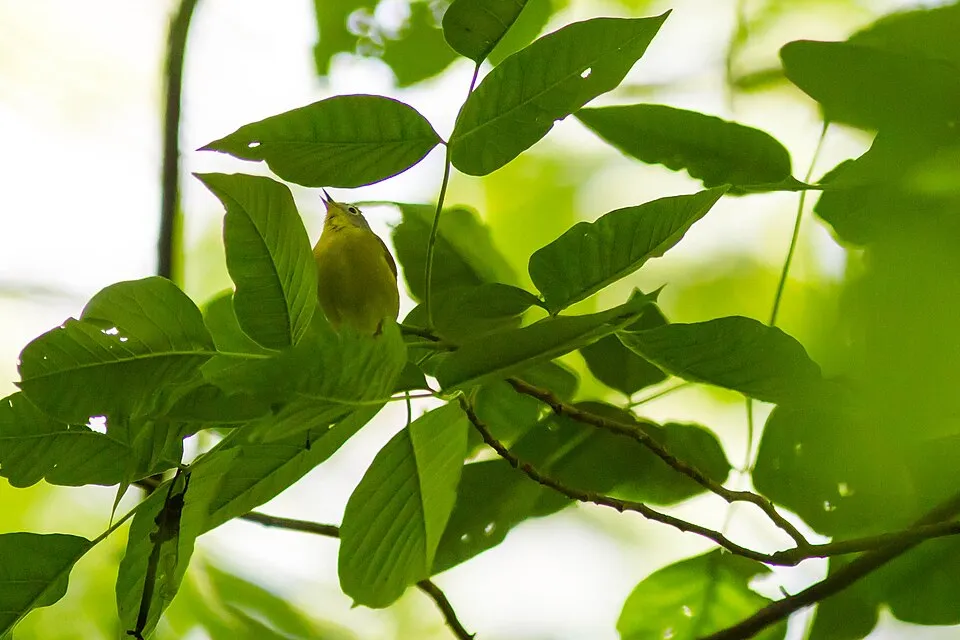
Real species photograph: Melissa McMasters · Wikimedia Commons source · CC BY 2.0. The reference photo does not necessarily show every plumage described.
Key marks: Gray head, pale eye ring, yellow chest and much of the underside. Typical habitat: Brushy forest edges, young trees and migratory flocks.
Nashville Warblers combine a grayish head and pale eye ring with a bright yellow throat and underparts. The transition from yellow chest to paler or white lower belly is a useful detail that can help distinguish the species from birds that are uniformly yellow below.
During migration they move actively through low and middle vegetation. The scientific name has changed in some references, but Leiothlypis ruficapilla is widely used. If you saw a small yellow-bellied warbler with a subdued gray head and no strong black mask, keep Nashville Warbler on your list.
Season and sex note: Many show a pale or whitish lower-belly patch; do not assume solid yellow throughout.
10. Canada Warbler (Cardellina canadensis)
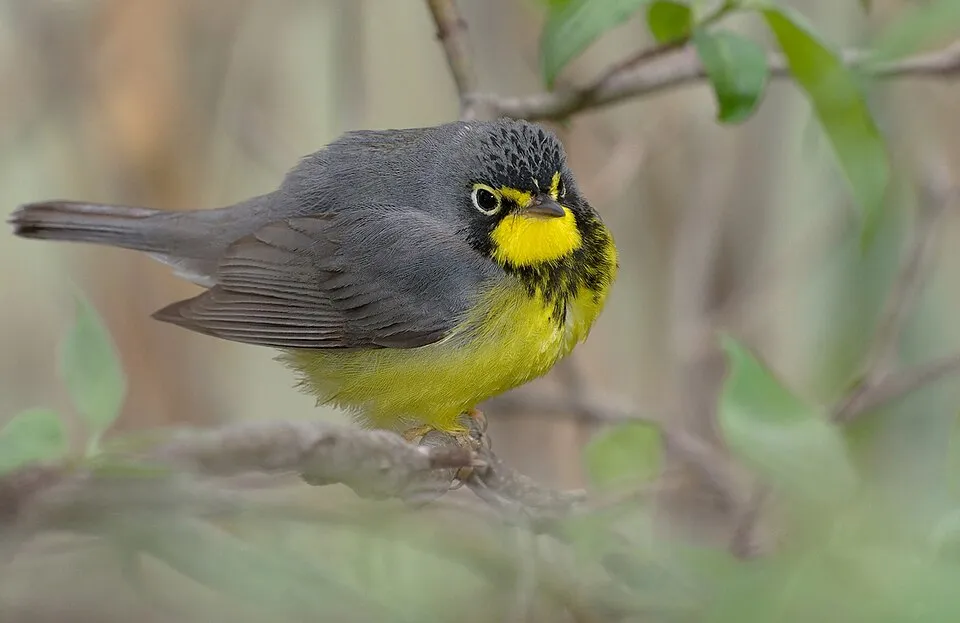
Real species photograph: William H. Majoros · Wikimedia Commons source · CC BY-SA 3.0. The reference photo does not necessarily show every plumage described.
Key marks: Yellow underparts with a broken black necklace and gray upperparts. Typical habitat: Moist mixed woods with dense understory.
The Canada Warbler has a blue-gray back, yellow throat and belly, and a distinctive row of dark marks across its upper chest. Adult males can look as though they are wearing a broken black necklace. A bold pale eye ring adds another excellent clue.
Do not confuse that necklace with the long vertical streaks on a Magnolia Warbler. The Canada Warbler’s marks cluster near the collar, while a Magnolia shows more extensive streaking down the sides. Both may pass through leafy eastern woods during migration, so the pattern matters.
Season and sex note: Female and immature necklaces tend to be fainter.
11. Prairie Warbler (Setophaga discolor)
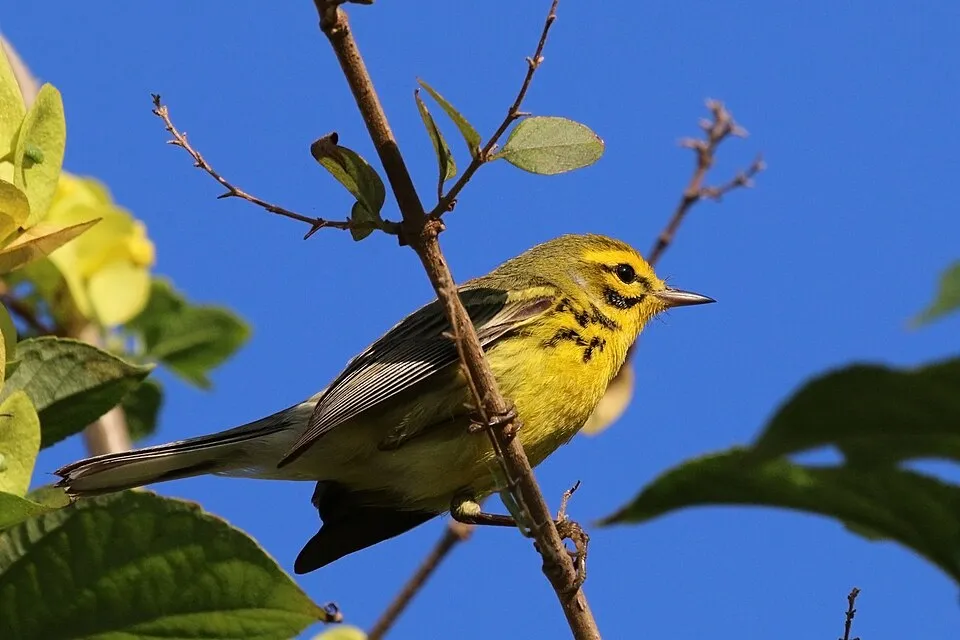
Real species photograph: Charles J. Sharp · Wikimedia Commons source · CC BY-SA 4.0. The reference photo does not necessarily show every plumage described.
Key marks: Yellow belly with black flank streaks and a curved dark facial mark. Typical habitat: Overgrown fields, shrubby woodland and some coastal mangroves.
Prairie Warblers are slender birds that can show vivid yellow underparts, dark flank streaks and an unmistakable dark line curving beneath the eye. On breeding males, the face pattern may look like an eye line plus a small black hook. The bird often bobs its tail as it searches for insects.
Despite the name, this species is not simply a bird of open prairie. Many occur in brushy, regenerating woodland. The reference photo here represents the Florida mangrove-associated subspecies; the identification features discussed apply broadly, though details vary between populations and plumages.
Season and sex note: Females and young birds are paler and less sharply patterned.
12. Eastern Meadowlark (Sturnella magna)
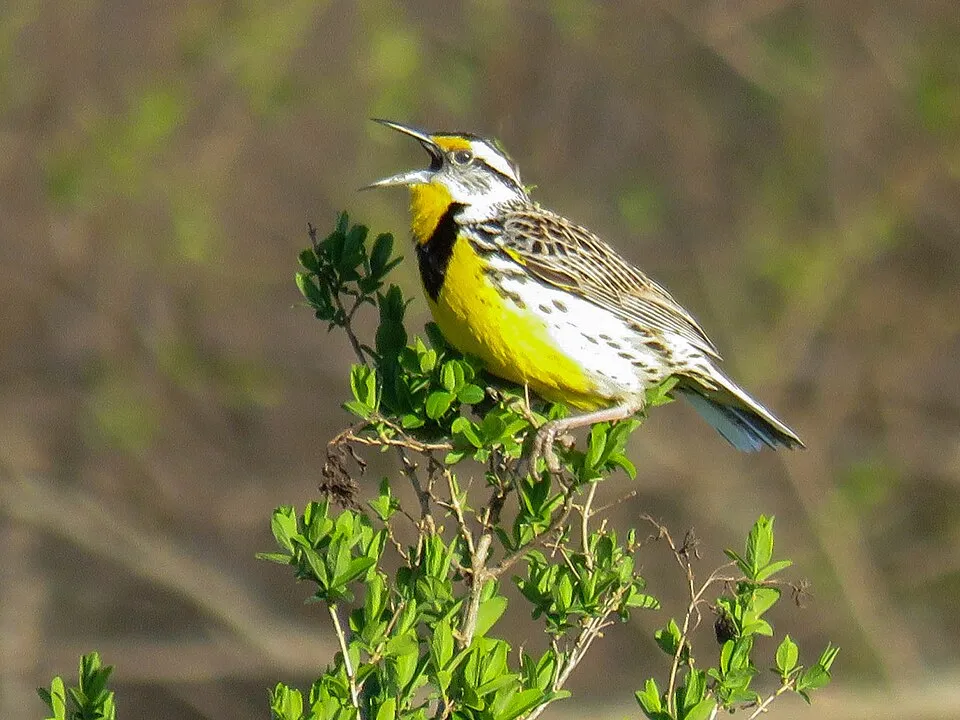
Real species photograph: synspectrum · Wikimedia Commons source · CC BY 2.0. The reference photo does not necessarily show every plumage described.
Key marks: Much larger than a warbler; bright yellow breast and bold black V. Typical habitat: Pastures, grasslands, farm fields and fence lines.
Not all yellow-bellied birds are tiny warblers. An Eastern Meadowlark is a chunky, medium-sized songbird with a long, pointed bill, patterned brown upperparts and a brilliant yellow breast and belly. The large black V across the chest makes it immediately different from a goldfinch.
You are more likely to spot it walking in grass or singing from a fence post than moving through tree foliage. Eastern and Western Meadowlarks can look very similar, and they overlap in some regions; range, voice and finer facial marks may be needed for a confident identification.
Season and sex note: The black V remains a useful clue, though nonbreeding birds can be duller.
Quick Comparison: Which Yellow-Bellied Bird Did You See?
| If you noticed... | Check these birds first | One more clue |
|---|---|---|
| Bright yellow with black wings at a feeder | American Goldfinch; Lesser Goldfinch | Look for wing patches, bill shape and western vs eastern range. |
| Black face mask and yellow throat in reeds | Common Yellowthroat | Often low in marsh or grassy cover. |
| Small yellow bird with black cap | Wilson's Warbler | Dark mark sits on top of head, not across eyes. |
| Yellow breast with dark necklace | Canada Warbler; Magnolia Warbler | Canada: broken chest necklace; Magnolia: more vertical streaks. |
| Golden bird with grayish wings in wet woods | Prothonotary Warbler | Strong link to wooded swamps. |
| Yellow chest with gray head and pale eye ring | Nashville Warbler | Look for paler white on lower belly. |
| Yellow below with dark hooked eye pattern | Prairie Warbler | Often in scrubby, regenerating habitat. |
| Large yellow bird with bold black V | Eastern Meadowlark | Grassland bird with spear-shaped bill. |
Yellow Warbler vs Goldfinch: What Is the Difference?
These birds can appear similarly bright, but their bills and feeding behavior separate them. The American Goldfinch has a stout, conical seed-cracking bill and often visits seed feeders. The Yellow Warbler has a thinner bill suited to insects and usually searches foliage in shrubby, often waterside habitat. In breeding plumage, male Yellow Warblers may have reddish breast streaks; male goldfinches have a sharp black forehead and prominent dark wings.
Do Birds With Yellow Bellies Stay Yellow in Winter?
Not always. Some goldfinches have dramatic seasonal molts that replace their bright breeding plumage with much duller brown and buff colors. Other species in this article migrate away from the northern United States and Canada for much of winter. Age and sex also matter: females and immature warblers may show a lighter yellow wash and weaker head or chest markings. For a November backyard sighting, check which species are actually present in your region before using a summer photograph as your only match.
Where Are Yellow-Bellied Birds Most Likely to Be Found?
Backyards and seed feeders: American and Lesser Goldfinches are strong candidates where their ranges overlap. Marshes and wet thickets: consider Common Yellowthroats. Wooded swamps: look for Prothonotary Warblers in the breeding season. Pine forests: Pine Warblers are a natural possibility. Open grassland: a larger bird with a black chest V could be an Eastern Meadowlark. During migration, many warblers may appear in a city park or leafy residential garden far from their breeding habitat.
Frequently Asked Questions
What small bird has a bright yellow belly?
Several species do. American and Lesser Goldfinches, Yellow Warblers, Wilson's Warblers and Common Yellowthroats are possibilities. The head pattern, bill and location are essential for a reliable ID.
What yellow-bellied bird has a black mask?
An adult male Common Yellowthroat is a classic example. It typically has a wide black mask, a pale border above the mask and yellow underneath.
What yellow bird has black streaks on its chest?
Magnolia and Prairie Warblers can both show black streaking. Magnolia Warblers often have a more extensive neck and flank pattern, while Prairie Warblers have a distinctive dark curved marking below the eye.
What bird has a yellow chest and a black V?
An Eastern Meadowlark is a strong possibility if the bird is medium-sized and seen in a field. Western Meadowlarks also have black chest Vs, so range and voice may be needed.
Are female yellow birds less colorful?
Often, yes, but not universally. Female American Goldfinches and many female warblers are generally duller than breeding males. Field guides should be checked for age and sex differences.
What yellow-bellied birds come to bird feeders?
Goldfinches are among the more likely candidates, especially at sunflower and nyjer feeders. Pine Warblers occasionally visit certain feeders in parts of their range.
Why does my goldfinch look brown in winter?
American Goldfinches change body plumage seasonally. The brilliant yellow breeding male becomes much duller and can look mostly brownish in winter.
Can a photograph alone identify a yellow bird?
Sometimes, but a single angle may hide important field marks. Note the region, date, size, bill, wingbars and habitat, and compare several images or a regional field guide.
Related Reading
If you enjoy comparing bird colors and field marks, explore our 15 colorful birds from around the world, see 25 examples of animals with feathers, or compare vocal identification cues in 13 birds that sing.
Scientific References and Photo Credits
Species descriptions and seasonal identification details were checked against the Cornell Lab of Ornithology’s All About Birds species profiles. Geographic ranges can vary by season and from year to year; use a local field guide or current eBird observations for region-specific confirmation.
Photographic sources, author credits and Creative Commons licenses appear below each photograph and in the accompanying image-sources file. If photographs are resized or converted to WebP, keep those attribution and license links and note the format change if required.