From neon-blue reef fish to giant spotted sharks, the underwater world is packed with species that look almost unreal. Among the most beautiful fish in the world are the mandarin fish, clownfish, betta fish and lionfish, along with other equally stunning marine and freshwater species.
Below you’ll find 10 of the most beautiful fish in the world, with their common and scientific names, colors, habitat and interesting facts to help you recognize them and learn a bit more about each one.

1. Mandarin Fish (Synchiropus splendidus)
The mandarin fish, also called the mandarin dragonet, is often considered one of the most colorful fish on the planet.
Family: Callionymidae
Habitat: Coral reefs of the Pacific Ocean, from the southern islands of Japan down to Australia, and from Java to the Ryukyu Islands
Depth: Usually up to about 100 m (330 ft)
What it looks like
Small, elongated body
Slightly protruding mouth and large, bulging eyes
Extremely vivid colors: swirling green, orange and yellow lines over a bright blue or blue-green background
Lifestyle & diet
Carnivorous: feeds on tiny crustaceans and other small invertebrates
Often lives in small groups in coral habitats, typically one male with several females
Its combination of psychedelic colors and shy, secretive behavior makes the mandarin fish a favorite among underwater photographers and aquarium enthusiasts.

2. Blue Tang (Paracanthurus hepatus)
Known worldwide as “Dory” from Finding Nemo, the blue tang (also called the regal tang) is a real reef star.
Family: Acanthuridae
Habitat: Coral reefs of the Indian Ocean and western Pacific, from East Africa to Japan and the Great Barrier Reef
Depth: Around 2–40 m (6–130 ft)
What it looks like
Laterally compressed body (thin when seen head-on)
Bright electric blue color with a black palette-shaped pattern along the flanks
Tail fin and the edge of the pectoral fins are a vivid yellow, which makes the fish stand out even more
Lifestyle & diet
Adults are omnivores, feeding on plankton and macroalgae
Often seen swimming in small groups among the corals
Its intense contrast of blue, black and yellow, plus its movie fame, have turned the blue tang into one of the best-known beautiful reef fish.

3. Betta Fish (Betta splendens)
The betta fish, or Siamese fighting fish, is one of the most popular and photogenic freshwater aquarium fish in the world.
Family: Osphronemidae
Habitat: Shallow freshwater environments in Southeast Asia – rice paddies, canals and slow streams in Thailand, Cambodia, Vietnam, etc.
What it looks like
Slender body, flattened from side to side
Males have long, flowing fins and tails that look almost like silk in the water
Incredible range of colors: deep reds, blues, emerald greens, purples, and even metallic and bicolor varieties
Lifestyle & diet
Carnivorous: eats small insects, larvae and tiny crustaceans
Adapted to low-oxygen waters and can breathe air from the surface thanks to a special organ (labyrinth organ)
Because of their spectacular fins and colors, bettas are a classic choice for decorative home aquariums.

4. Clownfish (Amphiprion ocellaris)
The clownfish became globally famous after Finding Nemo, but it was already one of the most iconic coral reef fish.
Family: Pomacentridae
Habitat: Warm waters of the Indian Ocean and western Pacific
Depth: Typically 1–15 m (3–50 ft)
What it looks like
Small, oval body
Bright orange background with three white bands bordered in black
The striking pattern gives it its “clown” look
Lifestyle & diet
Omnivorous: eats algae, plankton and tiny invertebrates
Lives in a close symbiotic relationship with sea anemones:
The anemone protects the clownfish with its stinging tentacles
The clownfish helps keep parasites away and brings food particles
Their vivid pattern and fascinating anemone partnership make clownfish some of the most beloved reef inhabitants.

5. Emperor Angelfish (Pomacanthus imperator)
The emperor angelfish is one of the most elegant and striking marine fish, widely admired in the wild and in large saltwater aquariums.
Family: Pomacanthidae
Habitat: Coral reefs of the Indian and Pacific Oceans
Size: Up to about 40 cm (16 in)
What it looks like
Adults: deep blue body with yellow horizontal stripes and a dark “mask” across the eyes
Juveniles: completely different pattern – circular blue and white rings, like a target
Laterally compressed (oval and flat) body, typical of many reef fish
Lifestyle & diet
Feeds mainly on sponges, algae and small invertebrates
Lives on coral reefs between about 5 and 60 m (16–200 ft)
The dramatic change in coloration from juvenile to adult and its strong contrasting stripes make the emperor angelfish a true underwater showpiece.

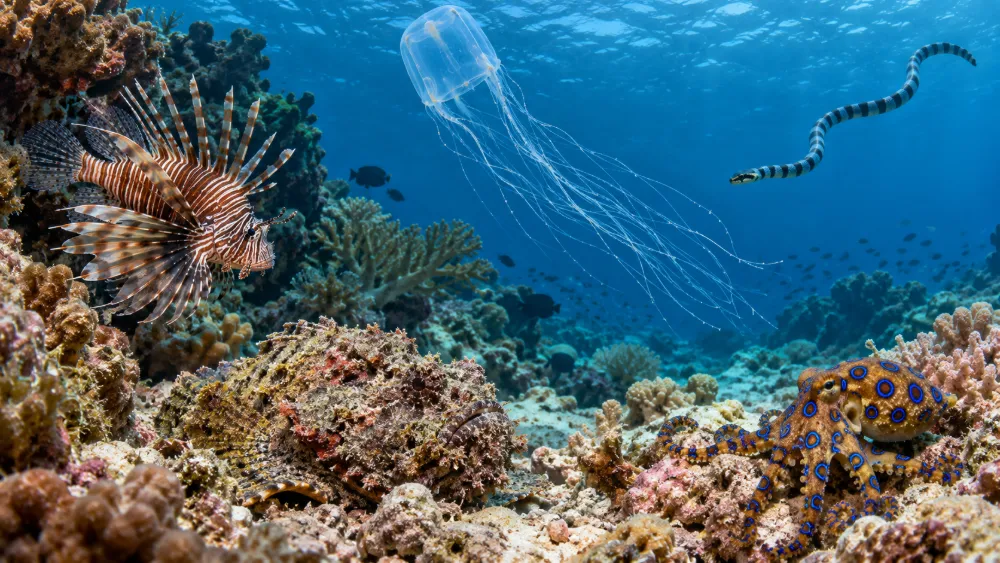
6. Lionfish (Pterois volitans)
The lionfish is both mesmerizing and dangerous – a beautiful reef fish with venomous spines.
Family: Scorpaenidae
Original habitat: Indian Ocean and western Pacific
Current situation: Introduced to other areas (like the Atlantic and Caribbean), where it is considered an invasive species
What it looks like
Long, fan-like pectoral fins and impressive dorsal spines that resemble a lion’s mane
Body covered in red, white and brown vertical stripes
Moves slowly, in a very graceful, floating way
Lifestyle & diet
Carnivorous: feeds mainly on small fish and crustaceans
Uses its fins to corner prey and then swallow it whole
Dorsal spines contain venom, used for defense
Although spectacular to look at, lionfish must be handled with extreme care and managed properly in areas where they are invasive.

7. Parrotfish (Scarus guacamaia)
The rainbow parrotfish is a large, colorful species that literally helps create white tropical sand.
Family: Scaridae
Habitat: Tropical reefs of the western Atlantic, from Florida to Brazil
What it looks like
Thick, robust body
Mouth shaped like a parrot’s beak, formed by fused teeth
Coloration mixes greens, blues and pinks, often changing with age and sex
Lifestyle & ecological role
Feeds mostly on algae that grow on coral and dead reef surfaces
While scraping food from the coral, it grinds pieces of coral skeleton, which pass through its digestive system and leave as fine white sand
Plays a key role in keeping reefs clean and healthy
Thanks to their bright colors and ecological importance, parrotfish are among the most fascinating reef species to watch while snorkeling or diving.

8. Discus Fish (Symphysodon aequifasciatus)
The discus is one of the most beautiful freshwater fish in the world and a classic in advanced aquariums.
Family: Cichlidae
Habitat: Warm, slow-moving waters of the lower Amazon River and its floodplains
What it looks like
Almost round, disc-shaped body (hence the name)
Laterally compressed, with long, flowing dorsal and anal fins
Huge variety of colors and patterns: blue, green, red, brown, often with stripes, spots or intricate markings
Lifestyle & care
Peaceful, social fish that prefers to live in groups
Feeds on small invertebrates, algae and plant material
Likes calm waters with dense aquatic vegetation and stable, warm conditions
Because of their intense colors and graceful shape, discus are considered “the kings” of many freshwater aquariums.

9. Butterflyfish (Chaetodon auriga)
The threadfin butterflyfish is a classic tropical reef fish that looks as delicate and colorful as its name suggests.
Family: Chaetodontidae
Habitat: Coral reefs of the Indian and Pacific Oceans
What it looks like
Tall, thin, laterally compressed body
Bright white and yellow base colors
Black band running through the eye, plus a black spot on the rear part of the body
Fine diagonal gray or light brown lines across the sides
A distinctive “filament” or thread extending from the dorsal fin (the “threadfin”)
Lifestyle & diet
Omnivorous: eats coral polyps, algae and small invertebrates
Often seen in pairs or small groups on shallow reefs
Together with angelfish, butterflyfish are some of the most recognizable and photogenic reef fish for divers and snorkelers.

10. Whale Shark (Rhincodon typus)
The whale shark is the largest fish in the world, and also one of the most impressive and beautiful to see in the wild.
Group: Cartilaginous fish (class Chondrichthyes, like other sharks and rays)
Family: Rhincodontidae
Size: Can reach around 12 m (40 ft) or more
What it looks like
Massive, elongated body with a wide, flat head
Dark bluish-gray back covered in a unique pattern of white spots and stripes
This spot pattern is so distinctive that it can be used to identify individuals, like a fingerprint
Lifestyle & diet
Despite its size, it is a gentle filter-feeder
Feeds on plankton, small fish and crustaceans, which it filters through its large mouth
Lives in warm and tropical seas around the world, often swimming slowly near the surface
Being able to swim alongside a whale shark is one of the most unforgettable wildlife experiences many divers and snorkelers dream of.

If you enjoyed this selection of the most beautiful fish in the world, you can keep exploring other amazing species like colorful reef fish, freshwater aquarium fish or the most beautiful animals on land and sea. Each species has its own colors, shapes and behaviors that make the underwater world one of the most spectacular places on Earth.
Bibliografía
FishBase. (2025). Disponible en: https://www.fishbase.se
Parr, F. (25 de mayo del 2025). Most beautiful fish: Are these 8 species are the ocean's most stunning fish? Discover Wildlife. Disponible en: https://www.discoverwildlife.com/animal-facts/fish/most-beautiful-fish