To identify animal tracks in snow, start with the pattern of several steps—not a single footprint. Deer leave split hoof marks; foxes and coyotes leave four-toed canine tracks; bobcats typically show rounder four-toed prints with no obvious claw marks; hares and squirrels travel in groups of four impressions; raccoons leave five long toes; and wild turkeys make three-forward-toed bird tracks. Snow depth, melting and the animal's speed can change all of these clues.
This illustrated North American field guide compares eight genuine photographs of tracks in snow, with simple ways to tell look-alikes apart. You do not need to be an expert tracker, but you should expect some prints to remain uncertain.
8 Animal Tracks in Snow at a Glance
| Animal | First clue | Typical trail clue | Common confusion |
|---|---|---|---|
| White-tailed deer | Two halves of a hoof | Walking line with paired hoof marks | Other hoofed mammals |
| Red fox | Small oval four-toed paw | Often a narrow, efficient line | Small dog or coyote |
| Coyote | Oval canine paw; claws may show | Fairly purposeful, direct trail | Domestic dog |
| Bobcat | Round paw, four toe impressions | Quiet walking trail; claws often absent | House cat, canine |
| Snowshoe hare | Two large rear impressions | Sets of four in bounding pattern | Rabbit, squirrel |
| Red squirrel | Smaller grouped prints | Four-print bounds often near trees | Hare or another squirrel |
| Raccoon | Five fingerlike toes | Alternating side-by-side pairs | Opossum |
| Wild turkey | Three long forward toes | Alternating walking steps | Other large ground birds |
These are screening clues, not guaranteed identifications. A trail, its habitat, and several clear prints matter more than any single feature.
How to Read Tracks Before Naming the Animal
Start by taking a photo that includes several steps. Put a ruler or another known-size object beside—not inside—the best print. Photograph the whole trail too, because whether the animal walked, bounded or hopped may be more revealing than toe shapes.
Find the cleanest impression. Look in sheltered, firm snow rather than deep powder or slush.
Count toes only when clear. Snow often hides toes and claws or creates extra edges.
Check for hooves, pads or webbing. These broad categories narrow the possibilities.
Follow several steps. Is the path nearly straight, made of four-print groups, or a left-right walk?
Use location. A print beside a suburban trash bin suggests a different shortlist than one above the tree line.
The U.S. National Park Service emphasizes that the overall trackway can reveal how an animal moves; tracking specialists also warn that real prints are rarely textbook-perfect. See the National Park Service walking-pattern guide.
1. White-tailed Deer Tracks: Two-Part Hoof Prints
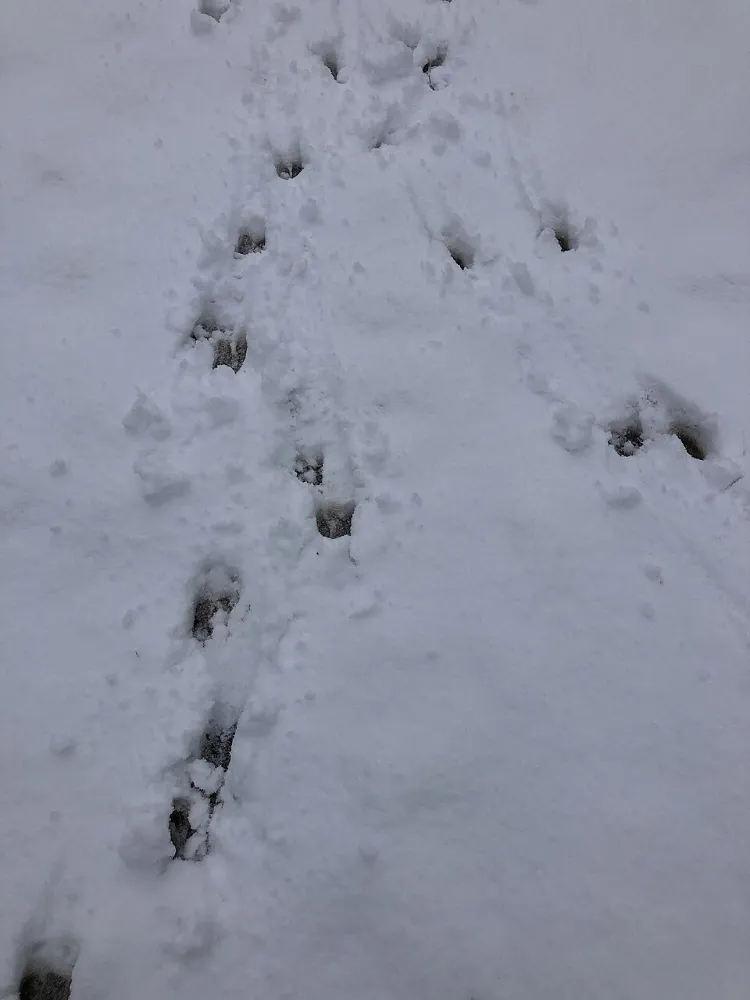
Deer tracks in snow in New Jersey; look for the split, paired hoof impressions. Photo: Famartin · CC BY-SA 4.0 · Original file.
Deer do not leave a paw pad and separate toes. They walk on cloven hooves, so a clear print looks like two narrow halves forming a heartlike or pointed shape. The tips usually indicate the direction of movement, though sliding can distort them.
A normal walking trail may appear as a sequence of paired hoof marks. In deeper snow, the animal can drag a hoof or step partially into an earlier impression. Dewclaws sometimes register behind the main hoof during faster movement or in soft ground, but they are not always visible.
Look-alike warning: Elk, moose, domestic goats and other hoofed animals can leave superficially similar tracks. Size, habitat and the full trail matter. A hoof print alone cannot tell you the animal's sex or age.
For more context on deer behavior, see our guide to deer groups and family structure.
2. Red Fox Tracks: A Narrow Canine Trail
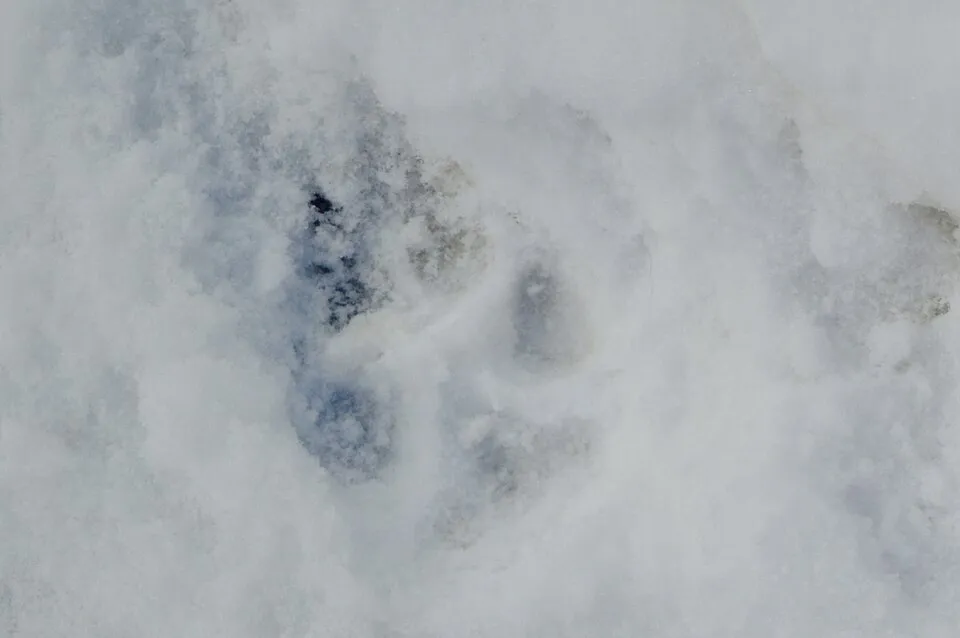
A real red fox paw impression; soft snow reduces visible pad detail. Photo: BorealFox · CC0 1.0 · Original file.
Red fox tracks usually show four toes and a main paw pad, broadly resembling a small dog print. On a crisp surface, claw tips may appear ahead of the toes. On powdery snow, the fox's furry feet can make the outline softer than expected.
Foxes often travel efficiently and may place rear paws into or close to their front paw prints, creating a fairly narrow trackway. But not every fox travels in a perfectly straight line, and not every straight canine trail belongs to a fox.
How to distinguish fox from a pet dog: compare several consecutive steps, track width and local habitat. Do not identify fox solely from a supposed X-shaped gap between the toes and pad—melted or distorted tracks can imitate this.
Our fox species photo guide shows the diversity of foxes, but the tracks shown here are attributed to red fox.
3. Coyote Tracks: Oval Four-Toed Prints
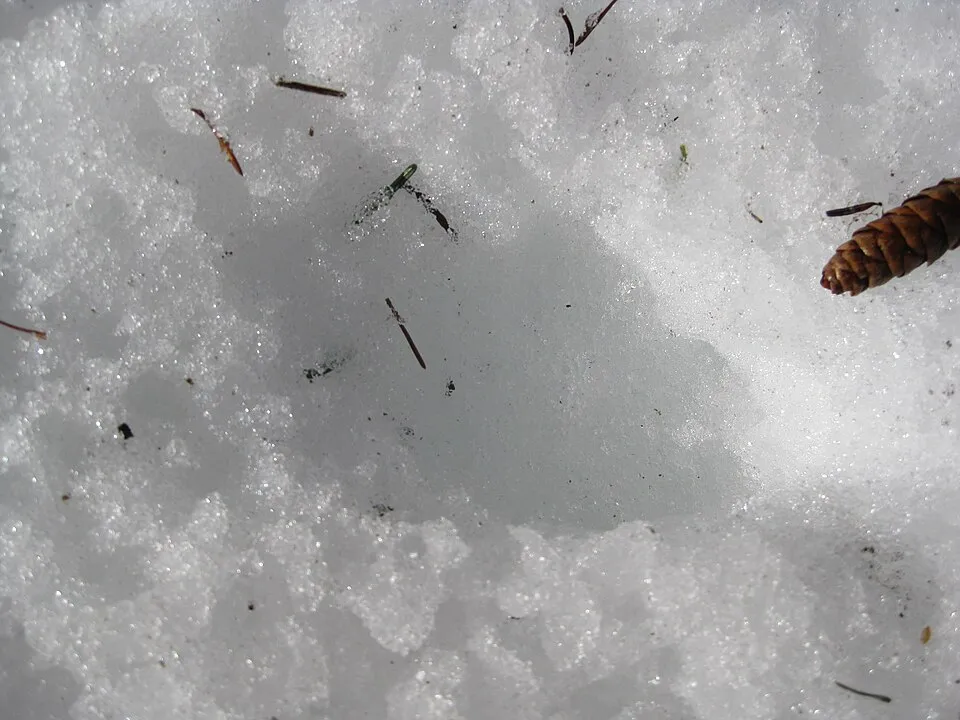
Coyote paw impressions in snow; individual tracks alone may resemble dog prints. Photo: Kieran Hunt · CC BY-SA 4.0 · Original file.
Coyote tracks are canine: four toes, a central pad and frequently visible nail marks. Individual prints are often relatively oval, although their exact dimensions vary with age, sex, footing and snow conditions.
Unlike a loose-running domestic dog, a traveling coyote may follow a more direct line, with less side-to-side wandering. This is a useful tendency, not a rule: dogs can travel straight, and coyotes often wander while hunting.
Coyote versus dog: look for a combination of a compact track, nail marks, a purposeful trail and signs of nearby habitat. Photograph the trackway before attempting to infer species from one paw impression. The Salt Lake City Public Lands Department provides examples of typical coyote trails in winter.
4. Bobcat Tracks: Rounder Paws, Usually No Claw Imprints
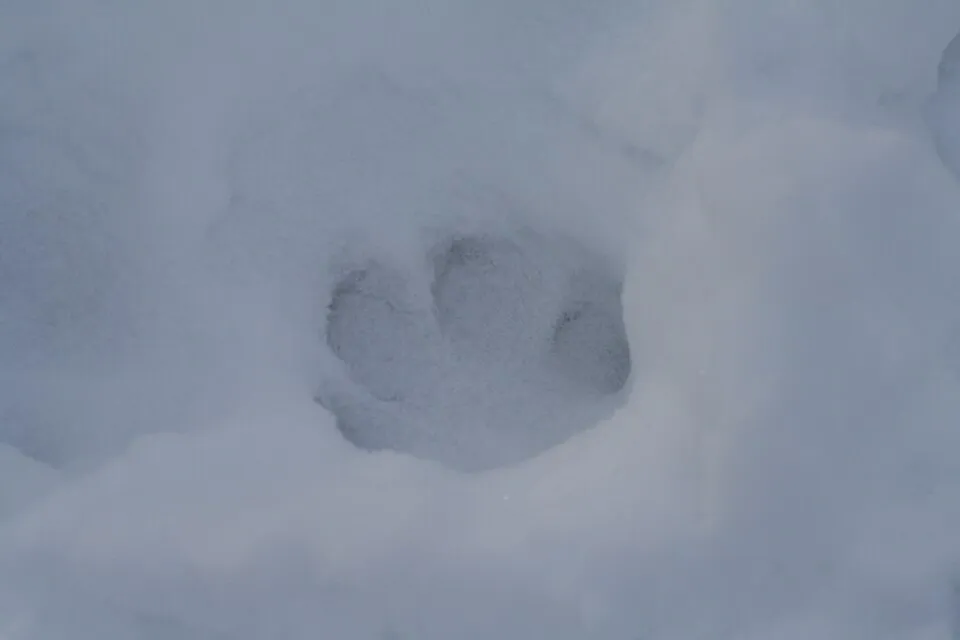
Bobcat track photographed at Lee Metcalf National Wildlife Refuge. Photo: Kimi Smith / USFWS Mountain-Prairie · CC BY 2.0 · Original file.
Bobcats usually leave four toe impressions in a rounded feline paw print. Because feline claws are usually retracted while walking, clear prints often lack obvious claw punctures. The overall paw shape can look broad and compact compared with many canine prints.
However, no claws does not automatically mean bobcat. Claws can fail to register in canine prints, and a cat may extend its claws on slippery terrain. The size, pad shape, trail and surroundings are more reliable together than any single sign.
The real photograph above was identified as a bobcat track at a U.S. Fish and Wildlife Service refuge. For another useful field clue, the USFWS explains the rounded shape and usual absence of claw marks in its snow tracks guide.
5. Snowshoe Hare Tracks: Large Rear Feet Ahead of Small Front Prints
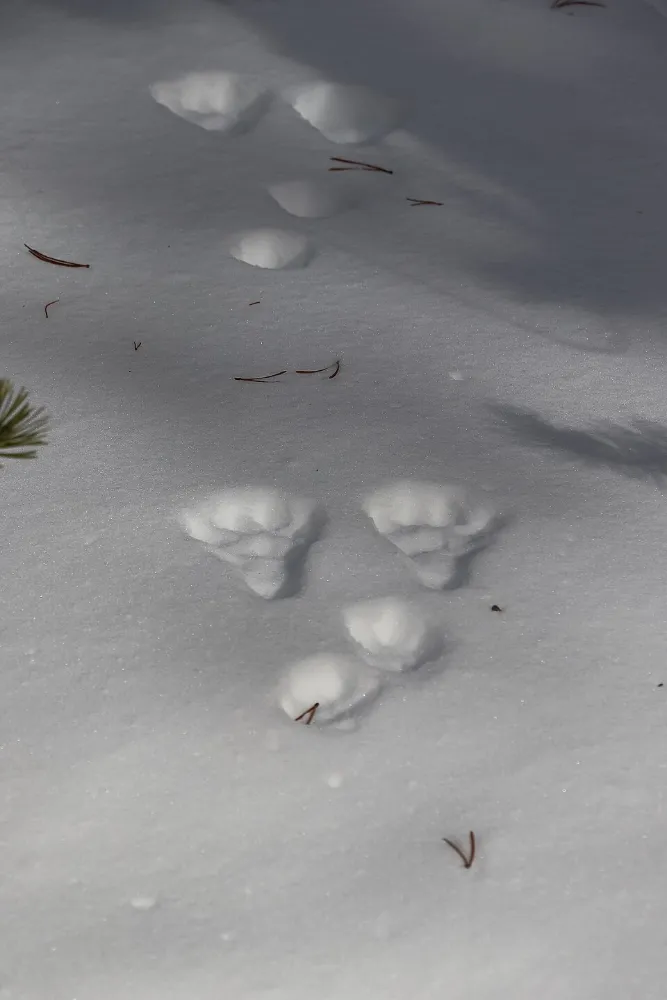
Snowshoe hare bounds in Yellowstone; notice the broad rear impressions. Photo: A. Falgoust / Yellowstone National Park (NPS) · Public domain (US federal government work) · Original file.
Snowshoe hares bound rather than leave a simple alternating trail. In a typical group, the large hind feet land in front of the smaller front feet. The rear prints can look like elongated ovals, especially in soft snow where fine toe details disappear.
This can seem backward: the hare's rear feet start behind the front feet, but during a hop they swing forward and touch down ahead. The resulting groups of four are often easier to recognize than an isolated foot impression.
Hare versus squirrel: hare rear prints are commonly larger and more elongated, and the smaller front prints can be staggered. But there is overlap. Measure several groups and consider the scale of the whole trail. Snowshoe hares have broad, furred hind feet that spread their weight on snow.
For related adaptations, see our winter wildlife survival guide.
6. American Red Squirrel Tracks: Four-Print Bounds Near Trees
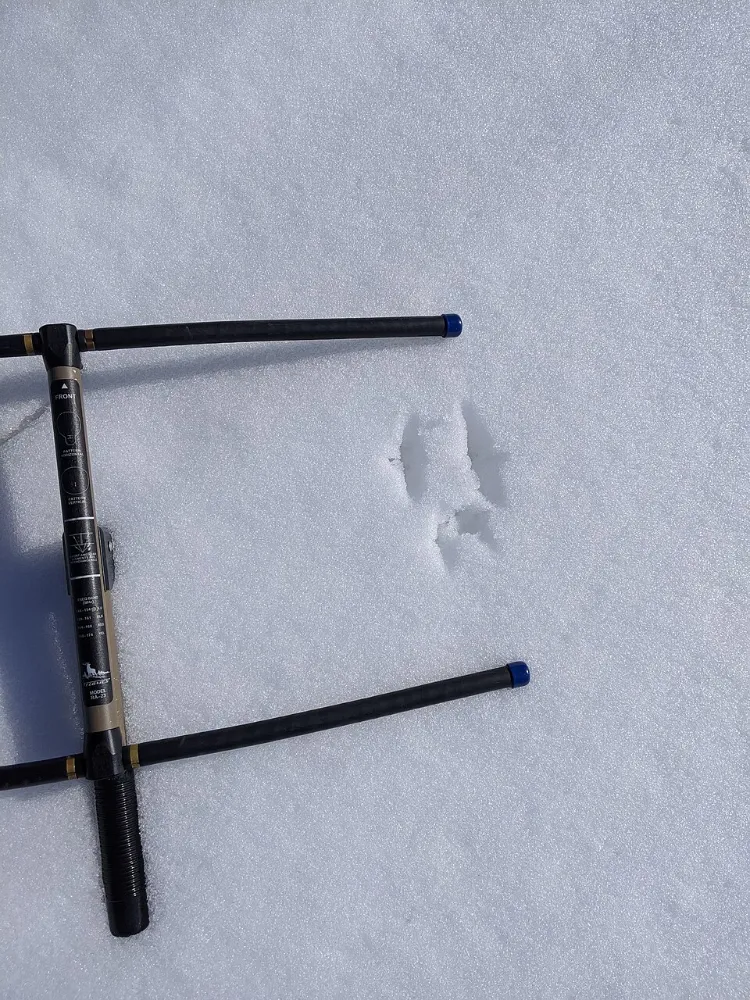
Fresh red squirrel tracks beside equipment used as an informal scale reference. Photo: Born of Iron · CC BY-SA 4.0 · Original file.
A squirrel bounding through snow often creates repeated groups of four: two smaller forefeet behind and two larger hind feet ahead, sometimes arranged roughly side by side. Tracks often begin or end near a tree trunk, where the squirrel climbs.
These groupings can resemble rabbit or hare tracks. One helpful difference is the arrangement of the small front feet: squirrels frequently place them beside one another, while hares more often place them one ahead of the other. This pattern is not perfect in every leap.
Species caution: the photograph above documents an American red squirrel. It would be inaccurate to label every squirrel track in North America as red squirrel; gray squirrels, fox squirrels and other species also leave similar bounding patterns.
Learn more about winter foraging in Do Squirrels Remember Where They Bury Nuts?
7. Raccoon Tracks: Five Toes That Look Like Little Hands
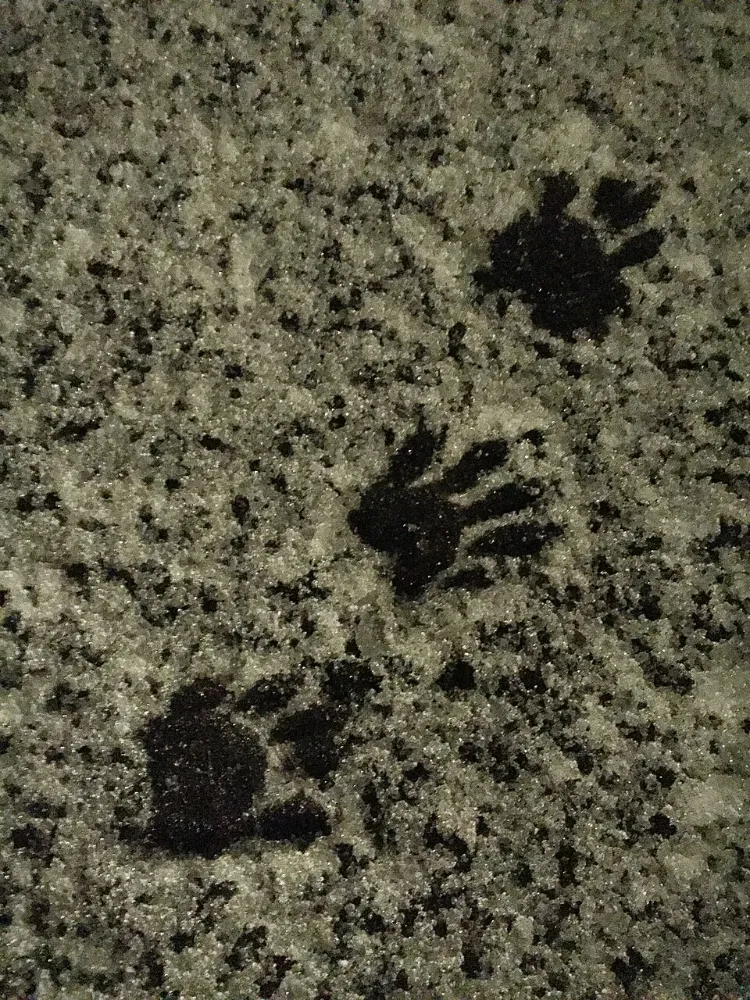
Raccoon tracks showing the long, fingerlike toes on the paws. Photo: Steven Pavlov · CC BY-SA 4.0 · Original file.
Raccoons have five toes on each foot, and their long front toes can look surprisingly handlike in a clear impression. The hind feet are often longer and may register more of the sole, creating a track that differs noticeably from a cat or dog paw.
At a walk, raccoons can produce alternating pairs of tracks from the front foot on one side and the rear foot on the other. That paired trail is an important clue if individual toes are blurred.
Raccoon versus opossum: both have five toes, but an opossum's hind foot has an unusually splayed, thumb-like inner digit. In sloppy snow, this can be hard to see. Do not identify a raccoon from a handlike silhouette alone.
8. Wild Turkey Tracks: Three Long Toes Point Forward
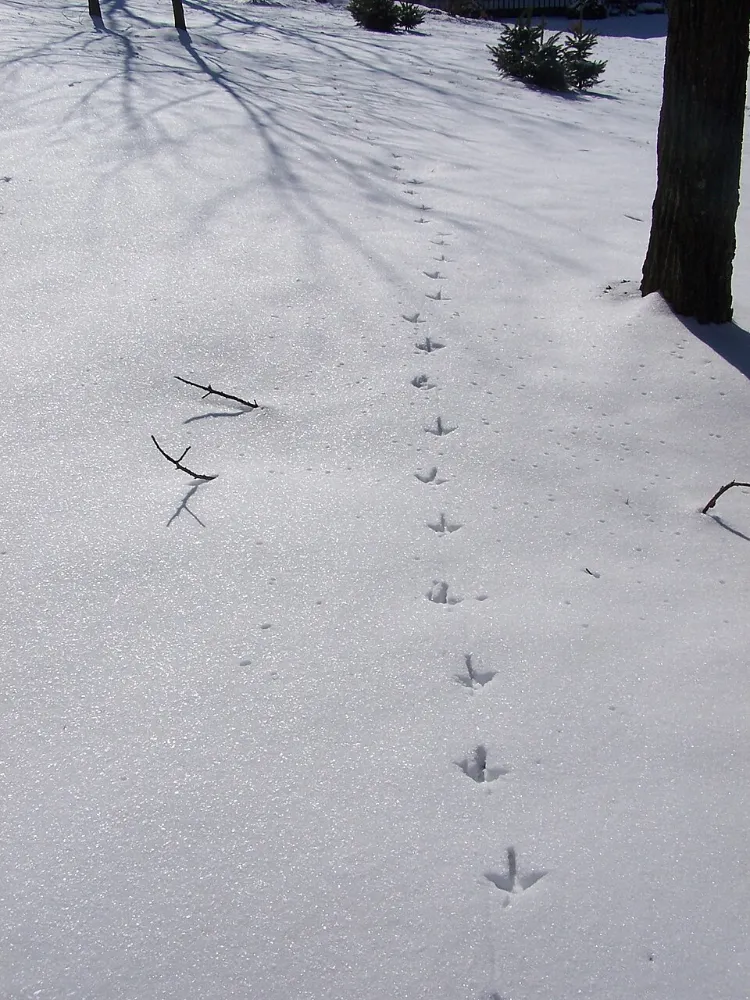
Wild turkey tracks forming a three-toed walking trail across snow. Photo: Tim Engleman · CC BY-SA 2.0 · Original file.
Wild turkeys leave a walking trail of relatively large bird prints with three prominent forward-pointing toes. A shorter rear toe may leave a faint impression or not show at all in firm snow.
The narrow toes sometimes look like a three-pronged fork. Unlike web-footed ducks and geese, turkeys typically show separate toes with no membrane connecting them. A line of alternating tracks across an open patch can suggest an animal walking rather than hopping.
Do not identify every three-toed bird track as a turkey. Other ground birds also have forward-pointing toes. Compare size, nearby habitat and the length of the stride before settling on a species.
Fox vs. Coyote vs. Bobcat Tracks: What Matters Most?
| Feature | Fox | Coyote | Bobcat |
|---|---|---|---|
| Visible toes in a clear print | Usually 4 | Usually 4 | Usually 4 |
| Claw marks | May show | May show | Often absent |
| General outline | Small canine oval | Often oval | Often rounder |
| Typical trail | Can be narrow/direct | Often purposeful/direct | Walking feline trail |
| Most important caution | Small dogs overlap | Dogs overlap | Domestic cats and poor snow conditions overlap |
Snow depth can make a small print appear much larger. A track without claws might still belong to a canine. Use this table as a starting point rather than proof of identification.
Rabbit vs. Squirrel Tracks: How to Tell Bounding Patterns Apart
Both can leave four impressions grouped together, with the larger hind feet landing ahead of the front feet. Rabbit and hare front feet frequently appear staggered, while squirrel front feet often look more side by side. These are common tendencies, not universal signatures.
Look for the whole sequence: print groups separated by longer gaps may indicate a series of bounds, and a trail leading directly to a tree strongly favors a tree-dwelling animal. Measure the marks without stepping on them; compare several groups instead of picking the clearest single one.
Why Animal Tracks in Snow Can Be Misleading
Fresh, thin snow on a firm surface often preserves the clearest tracks. Deep powder collapses around each foot. Wind fills impressions; sun melts edges; thawing and refreezing can enlarge a print until a small animal seems much larger. Prints pressed through snow into the ground below can also merge.
These changes explain why a supposed giant paw print may be ordinary, why claws disappear and why two close steps can look like one large print. Wildlife trackers sometimes describe such conditions as distortion or overprinting.
For a more reliable record, take a photo at ground level and another from directly above. Capture the stride pattern, terrain, nearby trees and at least five or six consecutive steps when possible. Do not pursue or disturb an animal to confirm a guess.
FAQ: Identifying Animal Prints in Snow
What animal leaves tracks in a straight line in snow?
Traveling foxes and coyotes often leave relatively direct trails, but other animals can do the same. Straightness alone is not enough to identify species.
What animal makes two big prints and two small prints in snow?
Hares, rabbits and squirrels commonly leave groups of four while bounding. Compare the shapes, the arrangement of front feet and where the trail leads.
How can I tell dog tracks from coyote tracks?
Both are four-toed canine tracks with possible claw impressions. A compact print and a consistent, direct trail can favor coyote, but overlap is substantial; use multiple clues.
Do cat tracks always lack claw marks?
No. Feline claws often do not register during ordinary walking, but cats may extend them for traction. Conversely, a dog's claws may not register in hard or shallow snow.
What animal leaves hand-shaped tracks in snow?
Raccoons and opossums are common candidates because of their five long toes. An opossum's hind foot has an outward-facing, thumb-like toe.
Why do tracks get bigger when snow melts?
Edges soften and collapse, expanding the visible outline. A melted track may greatly exaggerate the size of the original foot.
Can you tell how old animal tracks are from snow?
Usually not precisely. Wind, sunshine, shade, fresh snow and temperature changes can alter a print at different rates. Compare nearby weather and snow layers, but avoid exact age claims.
Where is the best place to photograph winter tracks?
Look on a fresh, thin snow layer along paths, near trees and at sheltered woodland edges. Stay on permitted trails, keep your distance from wildlife and avoid damaging the track.
Final Takeaway
The best winter track identification starts with three questions: Is it a hoof, a paw or a bird foot? Does the animal walk or bound? What does the surrounding habitat suggest? Use real photographs for comparison, but remember that snow changes shapes. If the evidence is weak, a careful identification such as “small canine” or “bounding mammal” is better than a confident species guess.