Not every large black bird is a crow. In North America, ravens, grackles, blackbirds, starlings, and cowbirds can look crow-like from a distance. The fastest way to narrow down your identification is to check body size, bill shape, tail length, eye color, call, and location—not just feather color.
This photo guide compares eight commonly confused birds against the familiar American Crow. It includes real photos, scientific names, quick field marks, and a table you can use while watching a bird in your yard, at a park, or near water.
What Does an American Crow Look Like?
The American Crow (Corvus brachyrhynchos) is our reference bird. It is relatively large, with a heavy straight bill, broad wings, a squared-to-rounded fan of tail feathers, and entirely black legs and plumage. Its usual call is a strong caw. A crow may look blue or purple in bright light, but it lacks the slim, extreme tail of a male grackle and the pointed bill of a starling.
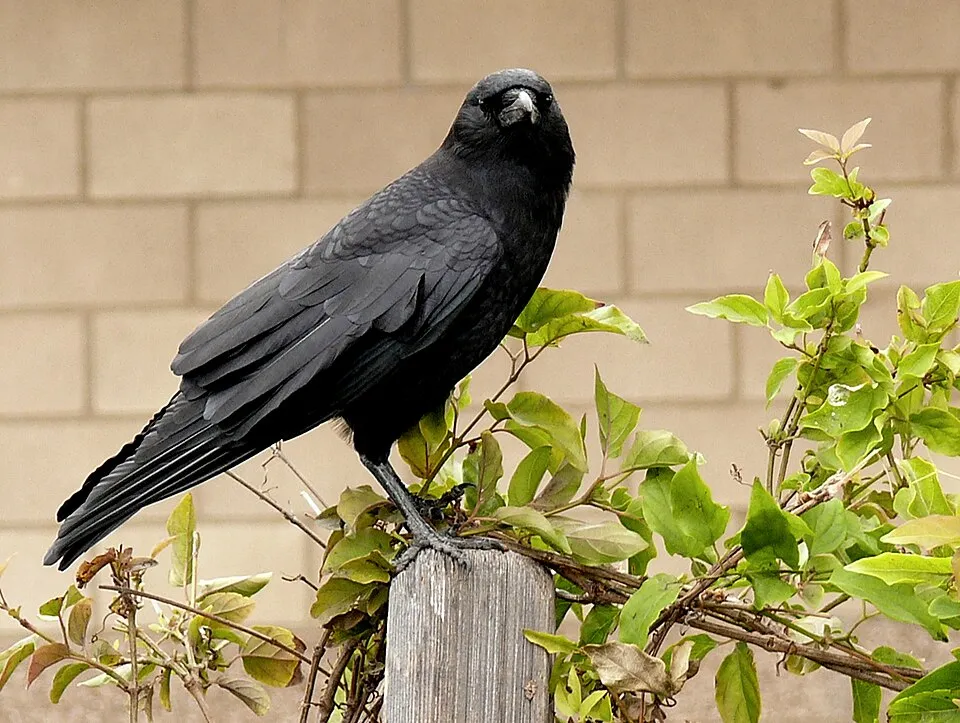
American Crow, the reference species for the eight lookalikes. Photo: Linda Tanner · CC BY 2.0 · original file / attribution
If the bird has a thicker bill, a shaggy throat, and a wedge-shaped tail in flight, compare it with a raven. For a detailed two-species breakdown, see Raven vs. Crow: How to Tell the Difference.
8 Crow Lookalikes at a Glance
| Bird | Fastest clue | Where it fits |
|---|---|---|
| Common Raven | Very large; heavy bill; shaggy throat; wedge-shaped tail in flight | Widespread in western and northern North America |
| Chihuahuan Raven | Crow-sized raven; heavy bill; slight wedge tail; dry grassland habitat | Southwestern United States and northern Mexico |
| Common Grackle | Smaller and slimmer; yellow adult eye; iridescent head; long tail | Much of eastern and central North America |
| Great-tailed Grackle | Extremely long keel-like tail in males; slender bill; noisy calls | Southwestern and south-central United States, Mexico, and beyond |
| Boat-tailed Grackle | Glossy coastal male; very long folded tail; eye color changes geographically | Atlantic and Gulf coastal region of the United States |
| Brewer's Blackbird | Compact blackbird; short tail; adult male pale yellow eye | Western North America; often fields, parks, and parking areas |
| European Starling | Short tail; triangular wings; slender pointed bill; seasonal speckles | Introduced and widespread across the United States and southern Canada |
| Brown-headed Cowbird | Adult male dark body and brown head; stout short conical bill | Broadly distributed across North America |
Important: These clues work best in combination. Light, age, sex, distance, and feather wear can change how a bird looks. An unfamiliar bird should not be identified from color alone.
8 Black Birds Commonly Mistaken for Crows
1. Common Raven (Corvus corax)
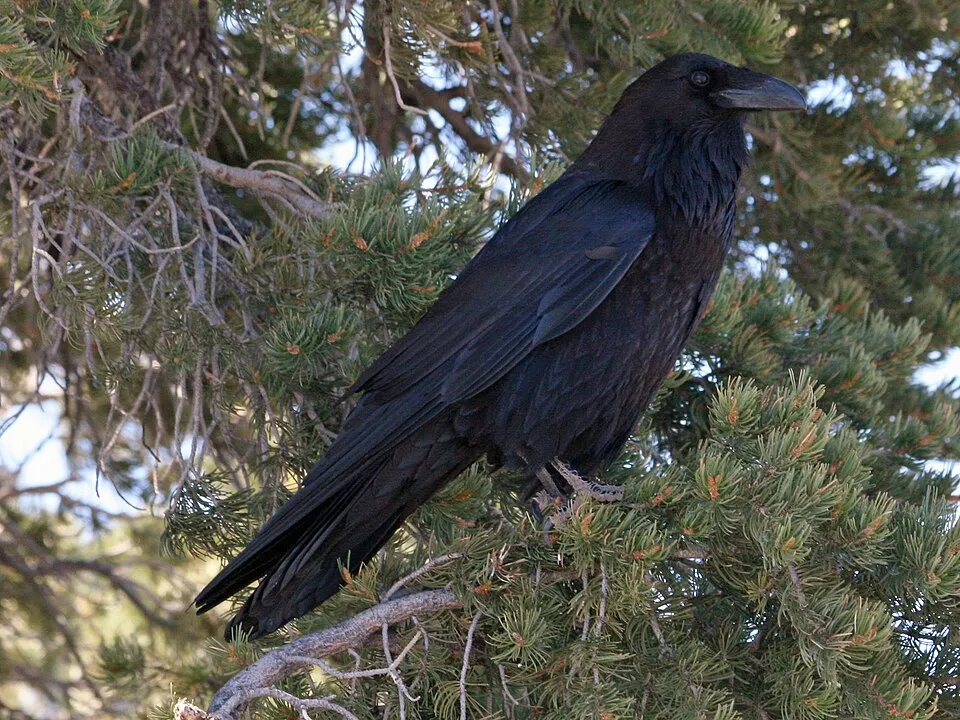
Common Raven in a real wildlife photograph; compare the bill, body outline, and tail. Photo: Dick Daniels · CC BY-SA 3.0 · original file / attribution
A Common Raven can look like an oversized American Crow when it is perched alone. Look for a notably heavy, slightly curved bill and shaggy throat feathers. In flight the tail often comes to a wedge or diamond-like point, particularly when spread. Ravens may glide and soar for extended stretches and often give a deep, resonant croak rather than the familiar crow caw. Size helps when there is a reference object, but never rely on size alone.
Best clue: heavy bill plus shaggy throat, backed by a deep croaking call.
2. Chihuahuan Raven (Corvus cryptoleucus)
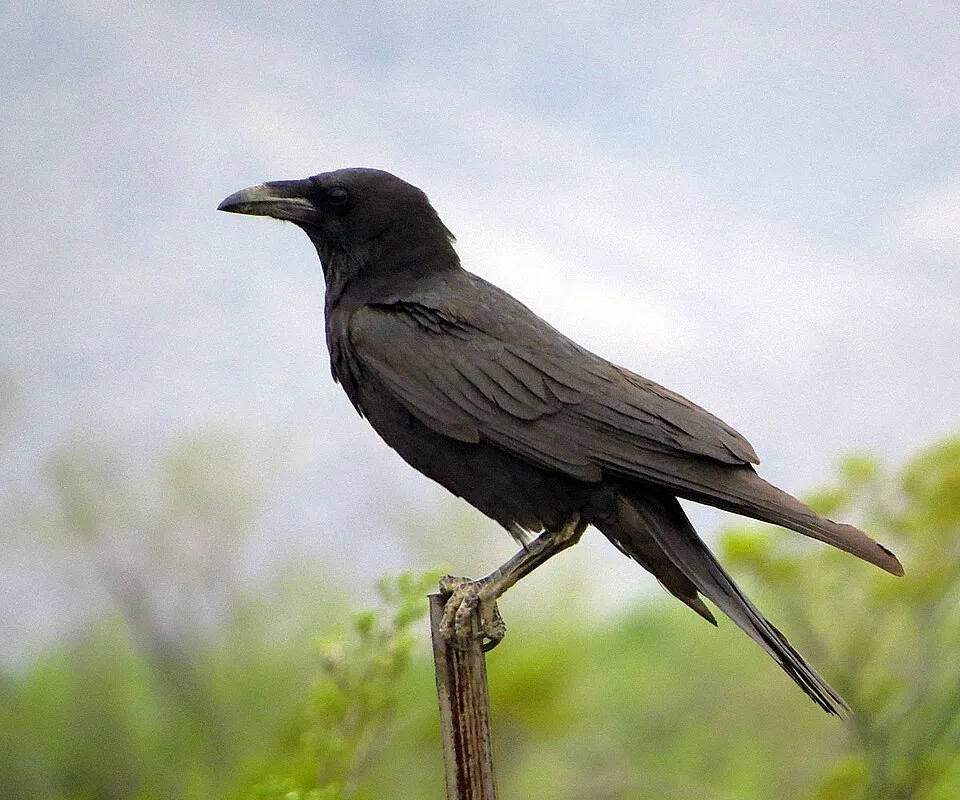
Chihuahuan Raven in a real wildlife photograph; compare the bill, body outline, and tail. Photo: Don Faulkner · CC BY-SA 2.0 · original file / attribution
The Chihuahuan Raven is a genuine raven, but it is smaller than a Common Raven and may be mistaken for an American Crow. Its bill is substantial and its tail tends toward a shallow wedge. It favors open desert scrub, grasslands, farms, and utility structures in the Southwest. The feathers on the nape have whitish bases, yet those bases are often completely hidden. Not seeing white on the neck therefore does not rule this bird out.
Best clue: location in dry Southwestern grassland, then bill, voice, and tail.
3. Common Grackle (Quiscalus quiscula)
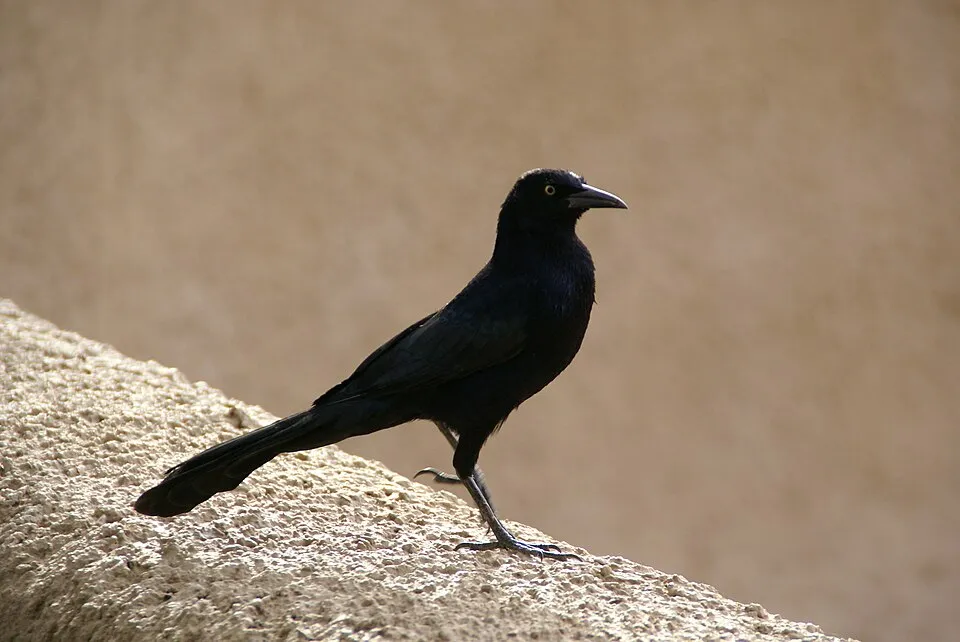
Common Grackle in a real wildlife photograph; compare the bill, body outline, and tail. Photo: lwolfartist · CC BY 2.0 · original file / attribution
A Common Grackle is often called a crow by people who notice only its dark feathers. In sunlight an adult male reveals blue-purple iridescence on the head and a bronze-toned body; adults usually show a pale yellow eye. The body is more slender than a crow, with a notably long tail and longer-looking legs. Grackles often walk through grass or parking lots searching for food. Young birds are duller and may lack the striking adult eye and sheen, so shape and behavior also matter.
Best clue: pale eye, sleek build, metallic head, and longer tail.
4. Great-tailed Grackle (Quiscalus mexicanus)
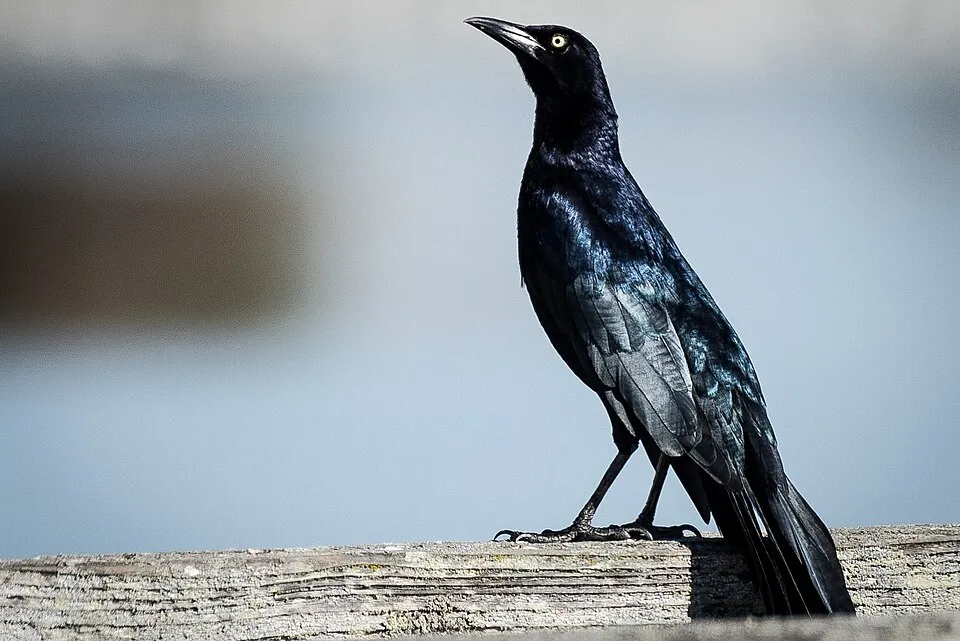
Great-tailed Grackle in a real wildlife photograph; compare the bill, body outline, and tail. Photo: Becky Matsubara · CC BY 2.0 · original file / attribution
A male Great-tailed Grackle is a glossy black bird with an exceptionally long, often folded tail. His body is leaner than a crow’s, and his pointed bill is relatively narrow. The tail may look like a long V or keel from different angles. This species is common around urban parking lots, lawns, fields, and water in many southern areas. Females are mostly brown, so a female usually will not match a search for a large all-black bird. Listen for loud whistles, squeaks, and mechanical-sounding notes rather than a straightforward crow caw.
Best clue: an adult male with a very long, folded tail and varied squeaky calls.
5. Boat-tailed Grackle (Quiscalus major)
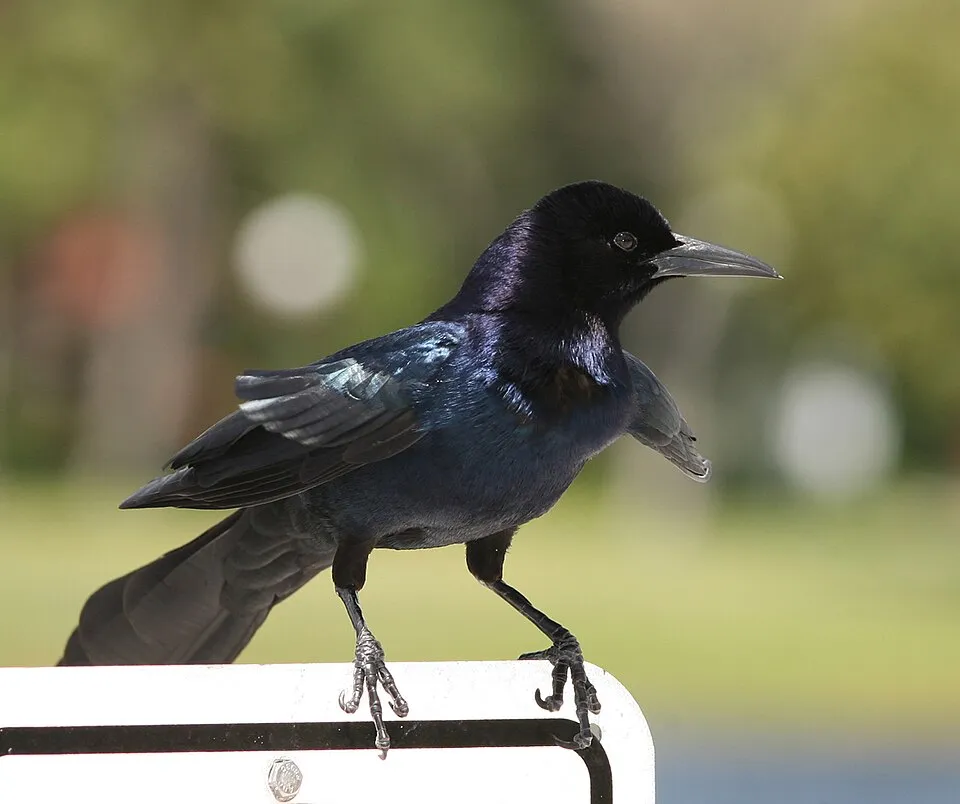
Boat-tailed Grackle in a real wildlife photograph; compare the bill, body outline, and tail. Photo: Tomfriedel · CC BY 3.0 · original file / attribution
The Boat-tailed Grackle also has a long tail that may be held in a boat-shaped V, but its strongest context clue is geography. It is associated mainly with Atlantic and Gulf coastal areas, including marshes, beaches, and developed areas nearby. Males are glossy dark birds; females are brown. Adult male eye color varies by region—some populations have pale eyes while others have dark eyes—so yellow eyes are not a universal identification rule. Where Boat-tailed and Great-tailed Grackles overlap, location, vocalizations, and several body features should be considered together.
Best clue: coastal habitat, tall slim build, and a very long V-shaped tail.
6. Brewer's Blackbird (Euphagus cyanocephalus)
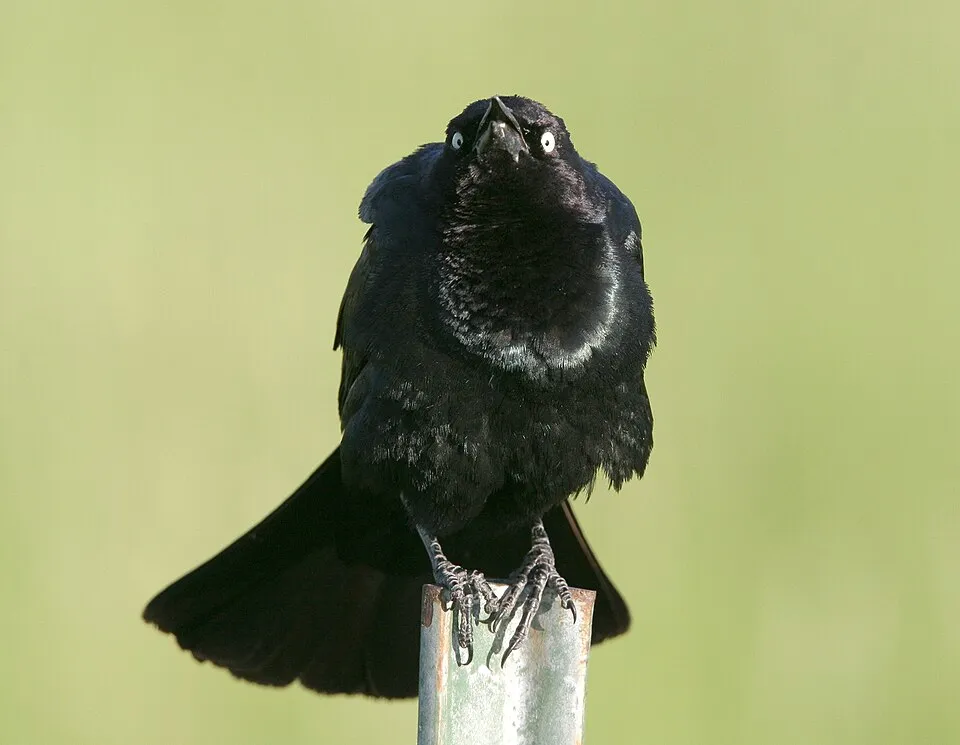
Brewer's Blackbird in a real wildlife photograph; compare the bill, body outline, and tail. Photo: Gary L. Clark · CC BY-SA 4.0 · original file / attribution
The male Brewer's Blackbird can appear solid black until light brings out greenish and purple gloss. Compared with a crow it is smaller, shorter-tailed, and more compact, and the bill is narrower. Adult males have light-colored eyes that can look striking against the dark head. Females are brownish, and juvenile birds look different again. Brewer's Blackbirds commonly gather and feed on open ground, sometimes alongside grackles or starlings, making relative size especially useful.
Best clue: a compact, short-tailed bird with a pale eye and slender bill.
7. European Starling (Sturnus vulgaris)
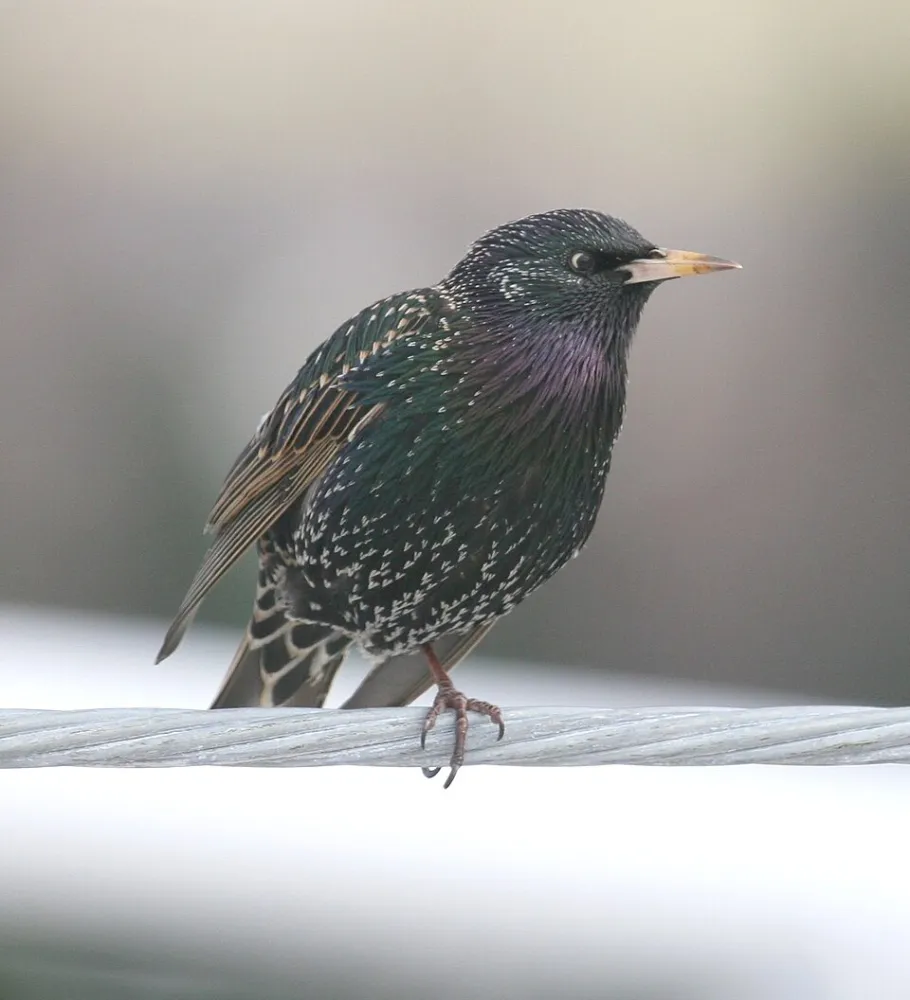
European Starling in a real wildlife photograph; compare the bill, body outline, and tail. Photo: Paul Carter · CC BY 2.0 · original file / attribution
European Starlings look nearly black at a distance, particularly in breeding plumage. Up close, their feathers show glossy green or purple and, in winter, pale speckles. The starling has a comparatively short tail, sharp triangular-looking wings, and a narrow pointed bill. The bill is generally yellow in breeding season and darker outside it. Large, coordinated flocks are another clue, although flocks alone do not prove an identification: crows and blackbirds also gather in groups.
Best clue: short tail, thin pointed bill, and spotted winter plumage.
8. Brown-headed Cowbird (Molothrus ater)
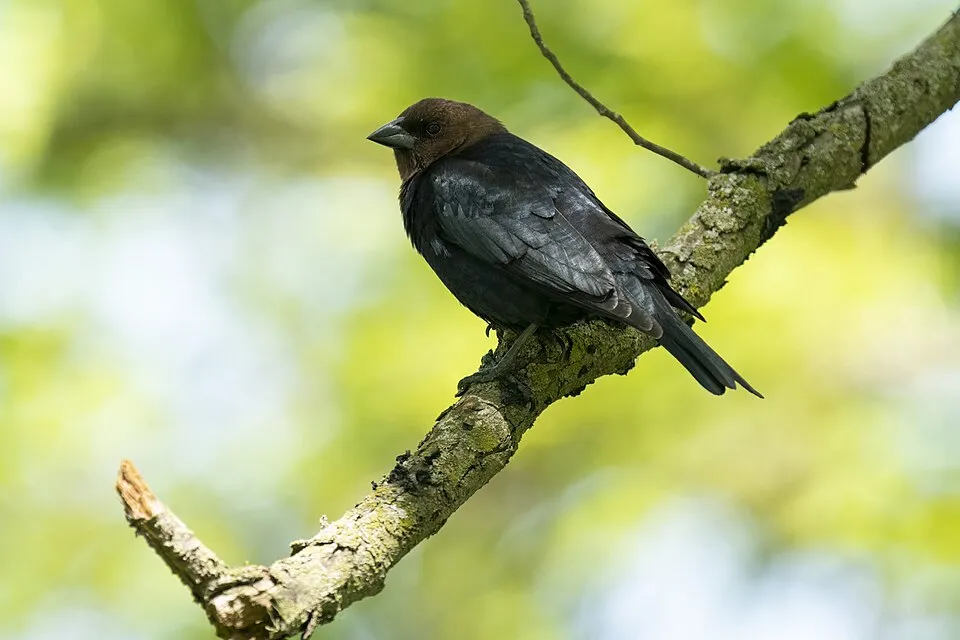
Brown-headed Cowbird in a real wildlife photograph; compare the bill, body outline, and tail. Photo: Joseph Gage · CC BY-SA 2.0 · original file / attribution
From a distance, a male Brown-headed Cowbird might register as a small black crow. In good light its head and neck are chocolate brown, contrasting with a glossy dark body. Its short, thick, cone-shaped bill is unlike a crow’s long, straight beak. Females are plain brown and therefore less likely to be mistaken for crows. Cowbirds are brood parasites, laying their eggs in the nests of other bird species, but their nesting behavior should not be used as a field identification shortcut.
Best clue: brown adult-male head and a thick, short seed-eater’s bill.
How to Tell a Crow From a Grackle in Five Seconds
First, look at the tail. An American Crow has a moderately short, broad tail; a male Great-tailed or Boat-tailed Grackle has a strikingly long tail, often folded into a V. Next, examine the bill. A grackle’s bill is narrower and more pointed than the heavy bill of a crow. Finally, check eyes and voice. Adult grackles may show pale eyes and produce whistles, squeals, or metallic notes. These traits are helpful but vary by species, sex, and region.
A Common Grackle can be confused with a Brewer’s Blackbird, too. The grackle has a noticeably longer tail and usually a lankier appearance. If you only have a blurry distant photo, record the locality and habitat before committing to an identification.
Crow vs. Raven vs. Blackbird: Which Shape Should You Look For?
Common Raven: large body, bulky bill, ragged throat, and often a wedge-shaped tail. American Crow: broad wings, moderate tail with rounded or squared spread, and a classic caw. Grackle: long tail, streamlined body, and pointed bill. Starling: short tail, small body, and narrow pointed beak. Cowbird: shorter, thick conical bill and compact body.
If you are comparing actual crow and raven species rather than lookalikes, our 10 Types of Ravens and Crows guide covers their diversity. This page focuses instead on birds that a North American observer might misidentify as an ordinary crow.
What Does the Bird’s Eye Color Tell You?
Some dark birds have pale or yellowish eyes, which are useful clues in good lighting. Adult Common Grackles and male Brewer’s Blackbirds frequently show light eyes. But eye color does not identify every species reliably. Boat-tailed Grackles, for example, have regional differences in eye color, and young birds of several species look different from adults. A photo taken against the sky may hide the eye entirely.
Is the Bird Really Black? Watch for Seasonal and Sex Differences
The word “black” can cover several appearances. A Common Grackle may look bronze or purple in sunlight. A European Starling may show pale spots in winter. Female Great-tailed and Boat-tailed Grackles are largely brown rather than glossy black, and female Brown-headed Cowbirds are also brown. This guide therefore highlights the plumages most likely to be mistaken for a crow, not every appearance of each species.
A Quick Identification Checklist
Measure relative size: sparrow-sized, robin-sized, crow-sized, or larger? Use a familiar nearby bird if possible.
Look at the bill: thick and straight, heavy and curved, thin and pointed, or short and conical?
Note the tail: short, rounded, diamond-shaped, or extremely long and folded?
Listen: a harsh caw, a deep croak, whistling squeaks, or thin starling chatter?
Check place and season: coastal marsh, Southwest grassland, neighborhood lawn, or winter urban flock?
Check multiple features: a bird should fit more than one clue before you label it.
If you can, photograph the whole bird from the side and record a few seconds of its call. A clear photo showing the bill and tail, plus your location, can be more useful than a close-up of black feathers.
Frequently Asked Questions
What black bird looks like a crow but is smaller?
Common Grackles, Brewer’s Blackbirds, European Starlings, and male Brown-headed Cowbirds may look crow-like from a distance. Check their shorter or longer tails, eye color, and bill shape.
What black bird looks like a crow with a very long tail?
An adult male Great-tailed Grackle or Boat-tailed Grackle is a strong possibility in the appropriate region. Common Grackles also have longer tails than crows, though generally not as extreme.
What bird is bigger than a crow and all black?
The Common Raven is a leading possibility in much of North America. Look for its heavy bill, shaggy throat, deep voice, and wedge-shaped tail.
Do grackles have yellow eyes?
Many adult grackles show pale eyes, but age and geography matter. Boat-tailed Grackles in some Gulf Coast populations have darker eyes.
Are grackles part of the crow family?
No. Grackles belong to the blackbird family Icteridae, whereas crows and ravens belong to the corvid family Corvidae.
How do I tell a European Starling from a crow?
A starling is much smaller, has a short tail and thin pointed bill, and can show pale winter spots. A crow has a larger body and heavier bill.
Are ravens and crows the same species?
No. American Crows and Common Ravens are distinct species in the genus Corvus; they can be separated by combinations of body shape, call, bill, tail, and locality.
Can a crow have a shiny purple or blue sheen?
Yes. A crow may show subtle iridescence in sunlight. Color sheen alone does not make a bird a grackle.
Final Identification Tips
If a black bird looks like a crow, start with its silhouette and call rather than its shade of black. The most convincing identification normally combines two or three field marks: a raven’s shaggy throat and deep croak; a grackle’s long tail and slim bill; a starling’s short tail and pointed bill; or a cowbird’s compact shape and brown-headed adult male.
The goal is not to identify every dark bird from one still photograph. It is to observe better, rule out unlikely matches, and know which additional details to check next.