Butterflies with eyespots have round, eye-like markings on their wings, but the shape, size and position of those spots differ enormously between species. Some, like the common buckeye and European peacock, show obvious colored targets when their wings are open. Others, including owl butterflies and blue morphos, reveal their most dramatic eye patterns on the underside of closed wings.
This photo guide shows 12 real butterflies with eyespots, their scientific names and the details that separate similar-looking species. The list is a visual selection, not a ranking of the biggest or most dangerous eyespots. Identifications depend on location, wing surface, sex and even seasonal form.
12 Eyespot Butterflies at a Glance
Use this table first if you are trying to identify a butterfly from a photograph. The column about wing position is often more useful than color alone.
| Butterfly | Scientific name | Eye-pattern clue | Typical region |
|---|---|---|---|
| Common Buckeye | Junonia coenia | Large round targets on open brown wings | North America |
| European Peacock | Aglais io | Four bold multicolored eyespots on spread wings | Europe and temperate Asia |
| Owl Butterfly | Caligo memnon | A very large eye-like mark below each hindwing | Central America and nearby tropical forests |
| Common Morpho (Blue Morpho) | Morpho helenor peleides | Several circular eyespots on the brown underside | Central America |
| Speckled Wood | Pararge aegeria | Small dark-centered spots on brown wings with pale patches | Europe and surrounding regions |
| Meadow Brown | Maniola jurtina | One obvious forewing eyespot; often two pale pupils | Europe and western Asia |
| Gatekeeper | Pyronia tithonus | Double white pupils inside a dark forewing eyespot | Europe |
| Common Wood-Nymph | Cercyonis pegala | One or two conspicuous forewing spots, often in a pale patch | North America |
| Grayling | Hipparchia semele | Conspicuous forewing eyespots on otherwise cryptic brown wings | Europe |
| Blue Pansy | Junonia orithya | Blue and orange wing sections with contrasting eyespots | South and Southeast Asia, with regional forms elsewhere |
| Peacock Pansy | Junonia almana | Large hindwing eyespots on warm orange wings | South and Southeast Asia |
| Large Heath / Common Ringlet | Coenonympha tullia | Subtle underside spots that can vary by region and form | Northern Europe and parts of North America |
1. Common Buckeye (Junonia coenia)
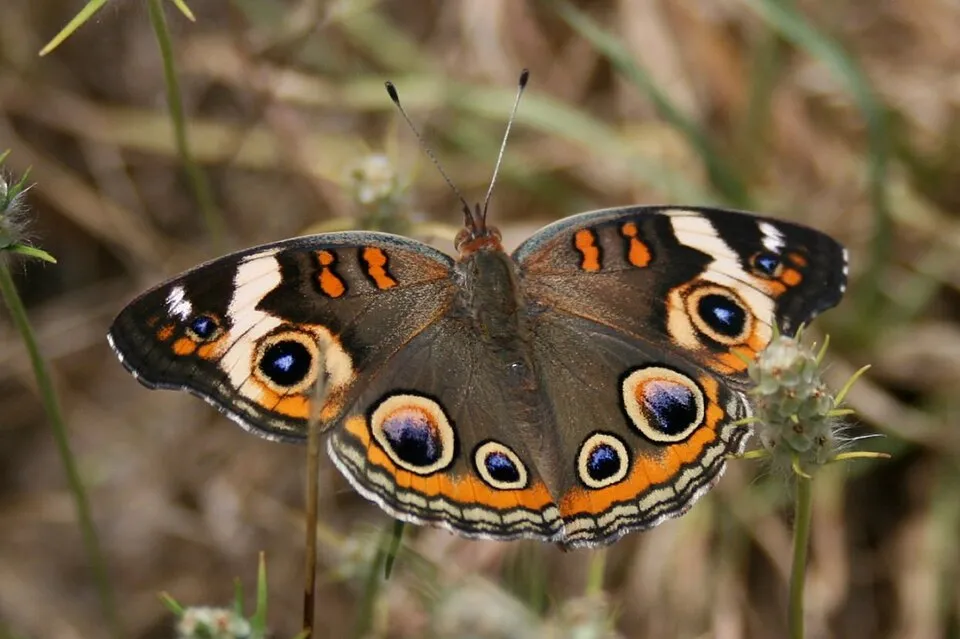
Photo: Lonnie Huffman / Wikimedia Commons · CC BY 3.0. Reproduced with attribution; check the source file for license details. Photo is illustrative of the named butterfly, not proof of a specific defensive behavior.
In sunny fields, the common buckeye often spreads its wings on low vegetation. Both forewings and hindwings carry attention-grabbing eyespots, making the upper surface unusually easy to recognize. The markings are not all identical: their colored centers and outer rings differ by wing position.
How to identify it: Look for orange bars near the forewing base, a pale band, and several prominent orange-ringed spots.
Where you may see it: North America.
2. European Peacock (Aglais io)
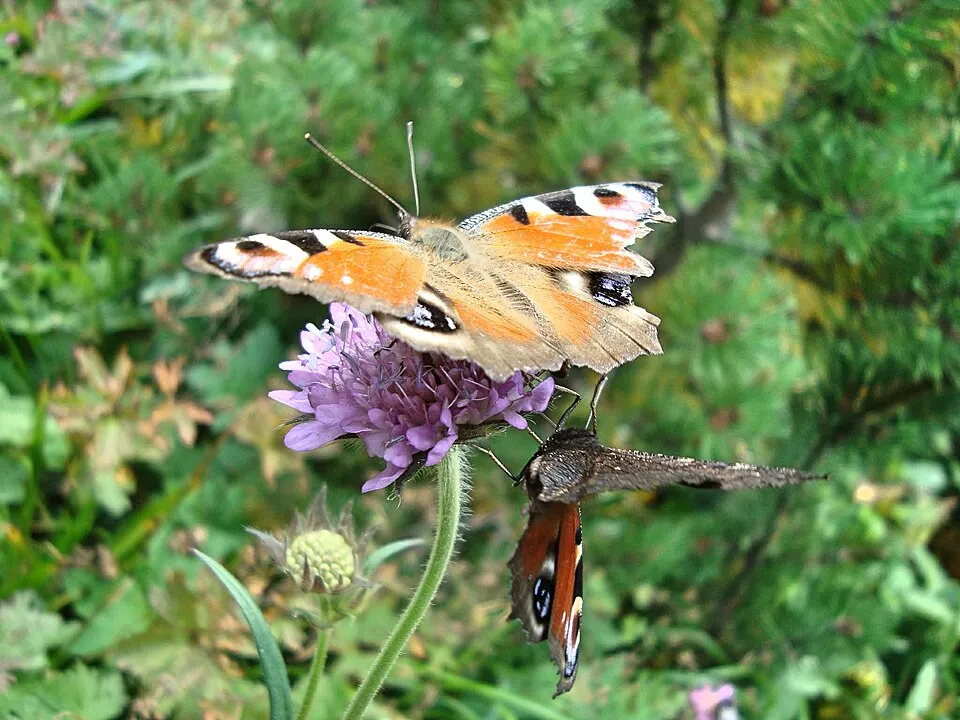
Photo: Monika Budzakova / Wikimedia Commons · CC BY-SA 4.0. Reproduced with attribution; check the source file for license details. Photo is illustrative of the named butterfly, not proof of a specific defensive behavior.
With wings open, the European peacock shows dramatic targets; when the wings shut, the much darker underside helps it disappear against dry vegetation. Experiments with birds support a defensive role for the sudden display of its eyespots, but behavior and sounds can contribute too.
How to identify it: Check for rusty red wings and a large blue, yellow and black eyespot near each wing corner.
Where you may see it: Europe and temperate Asia.
3. Owl Butterfly (Caligo memnon)
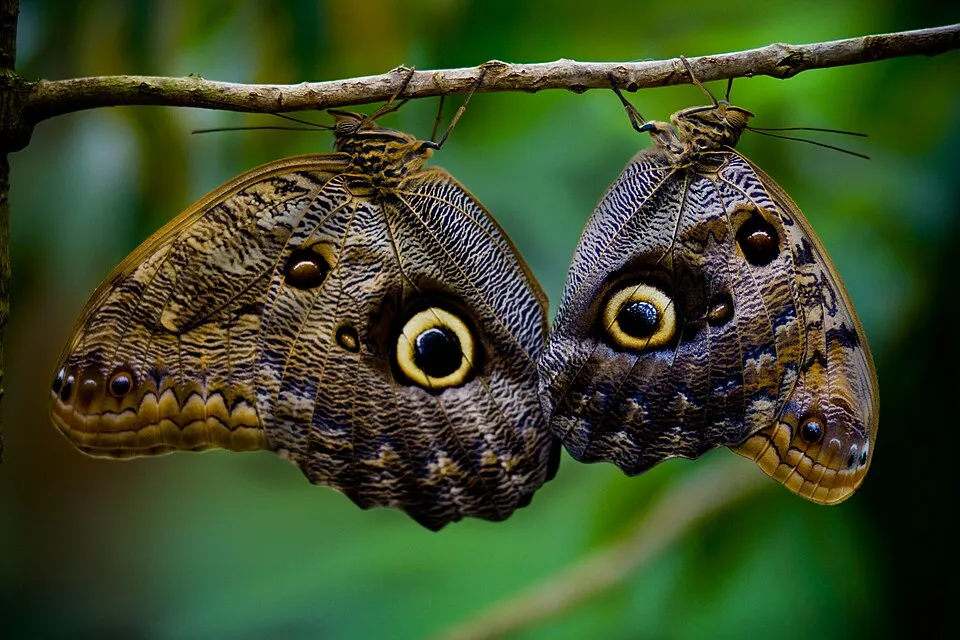
Photo: Edwin Dalorzo / Wikimedia Commons · CC BY-SA 2.0. Reproduced with attribution; check the source file for license details. Photo is illustrative of the named butterfly, not proof of a specific defensive behavior.
This large forest butterfly looks very different with wings folded. Its most famous mark is the big circular pattern on the hindwing underside. The label “owl butterfly” describes the resemblance, not proof that every bird mistakes the design for a real owl. Species in the Caligo group can be difficult to separate from a single photo.
How to identify it: Look at the closed wing: a giant ringed spot sits on a brown, leaf-like underside.
Where you may see it: Central America and nearby tropical forests.
4. Common Morpho (Blue Morpho) (Morpho helenor peleides)
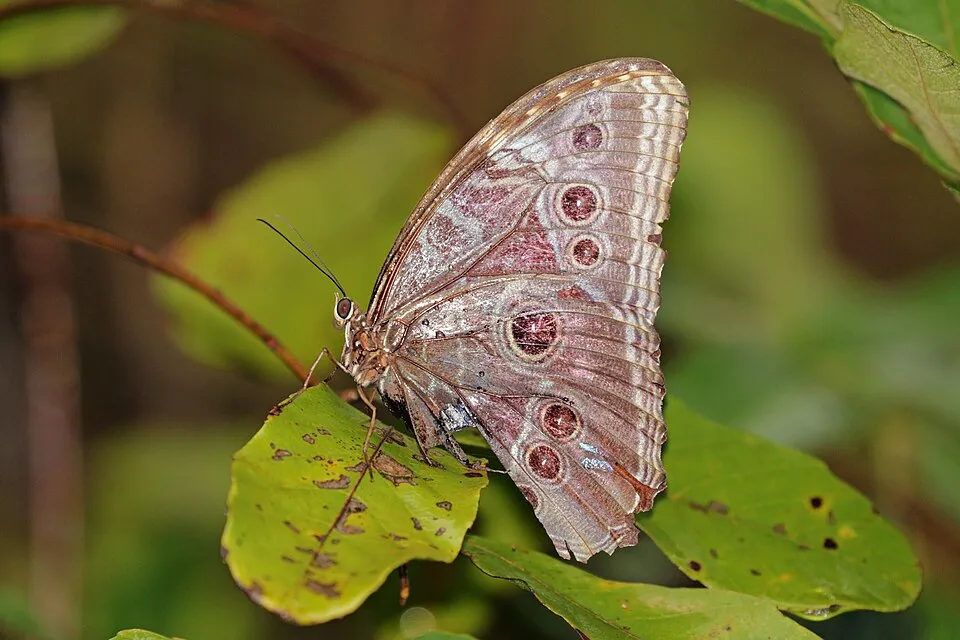
Photo: Charles J. Sharp / Wikimedia Commons · CC BY-SA 4.0. Reproduced with attribution; check the source file for license details. Photo is illustrative of the named butterfly, not proof of a specific defensive behavior.
The common morpho is an excellent reminder to examine both sides of a butterfly. Its iridescent blue upper wings contrast with a brown underside marked by multiple ringed spots. A photograph showing only a bright blue wing may conceal the most useful eyespot clues. Older sources sometimes treat peleides as a separate Morpho species; this photo is identified as Morpho helenor peleides.
How to identify it: Photograph the underside; the famous shimmering blue upper side does not reveal these same patterns.
Where you may see it: Central America.
5. Speckled Wood (Pararge aegeria)
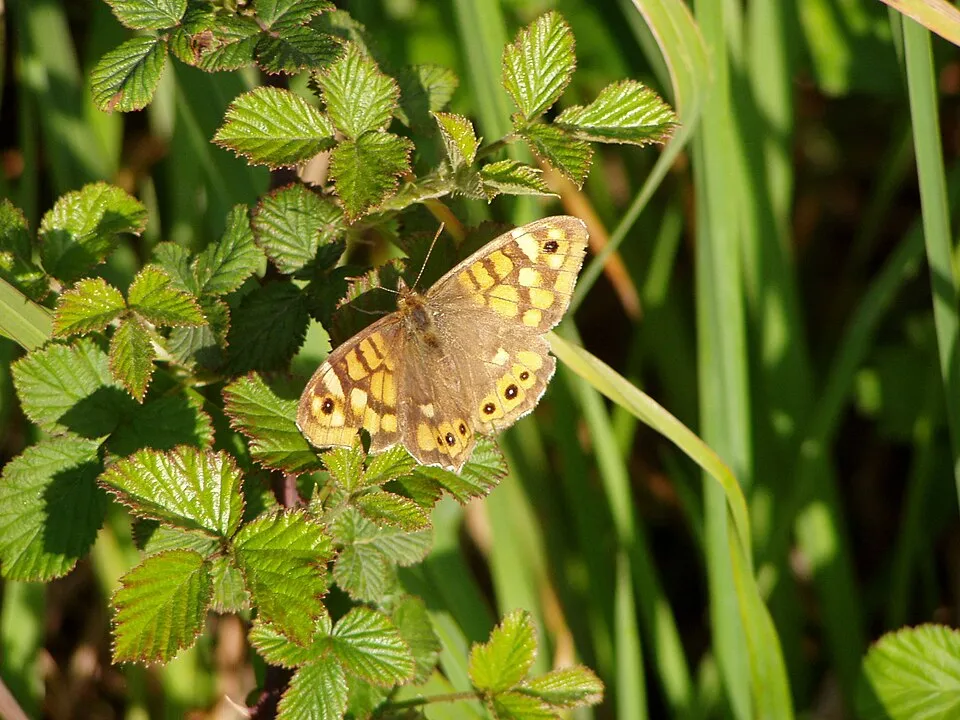
Photo: Júlio Reis / Wikimedia Commons · CC BY-SA 3.0. Reproduced with attribution; check the source file for license details. Photo is illustrative of the named butterfly, not proof of a specific defensive behavior.
Unlike the bright peacock, the speckled wood favors subtle contrast. It often settles on sunlit patches in woodland, where light and shade echo its mottled wings. Eyespot number and prominence vary; identification should also use overall wing pattern and habitat.
How to identify it: Look for a chocolate-brown wing covered in cream-colored spots, with smaller dark eyespots near the edges.
Where you may see it: Europe and surrounding regions.
6. Meadow Brown (Maniola jurtina)
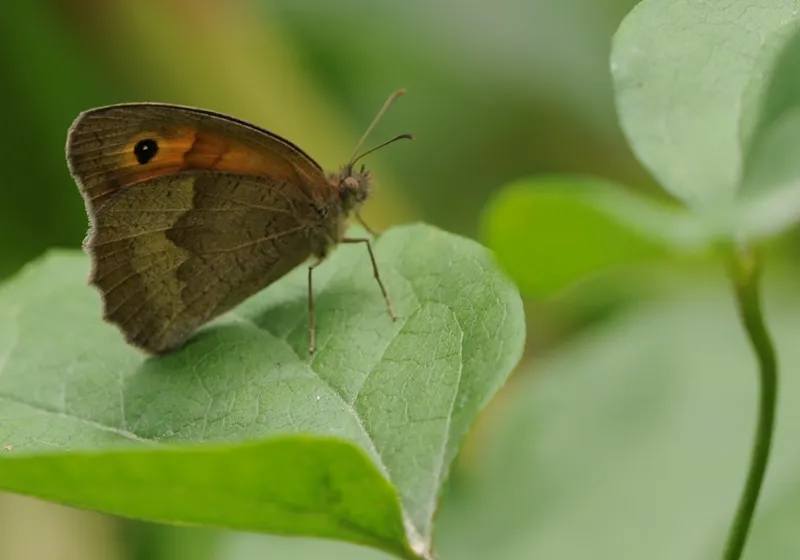
Photo: Zeynel Cebeci / Wikimedia Commons · CC BY-SA 3.0. Reproduced with attribution; check the source file for license details. Photo is illustrative of the named butterfly, not proof of a specific defensive behavior.
The meadow brown offers a simple visual contrast to multi-eyed species: a single prominent forewing spot is often the first thing you notice. Females typically show more orange around the spot than many males, but there is substantial individual variation. The linked photo shows a female from the underside.
How to identify it: A brown grassland butterfly with an orange-tan forewing panel and a dark, pale-centered spot.
Where you may see it: Europe and western Asia.
7. Gatekeeper (Pyronia tithonus)
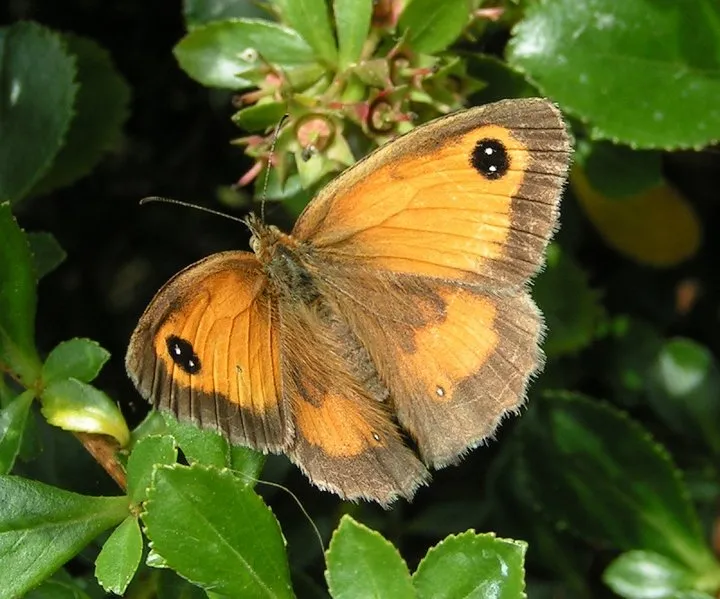
Photo: sannse / Wikimedia Commons · CC BY-SA 3.0. Reproduced with attribution; check the source file for license details. Photo is illustrative of the named butterfly, not proof of a specific defensive behavior.
In many photographs the gatekeeper resembles a meadow brown at first glance. The pair of white pupils within the main eyespot is a valuable clue. Confirm it with the broad brown margin, orange wing field and local range rather than relying on a single mark.
How to identify it: Search for an orange-brown butterfly with a brown border and a dark forewing spot containing two white dots.
Where you may see it: Europe.
8. Common Wood-Nymph (Cercyonis pegala)
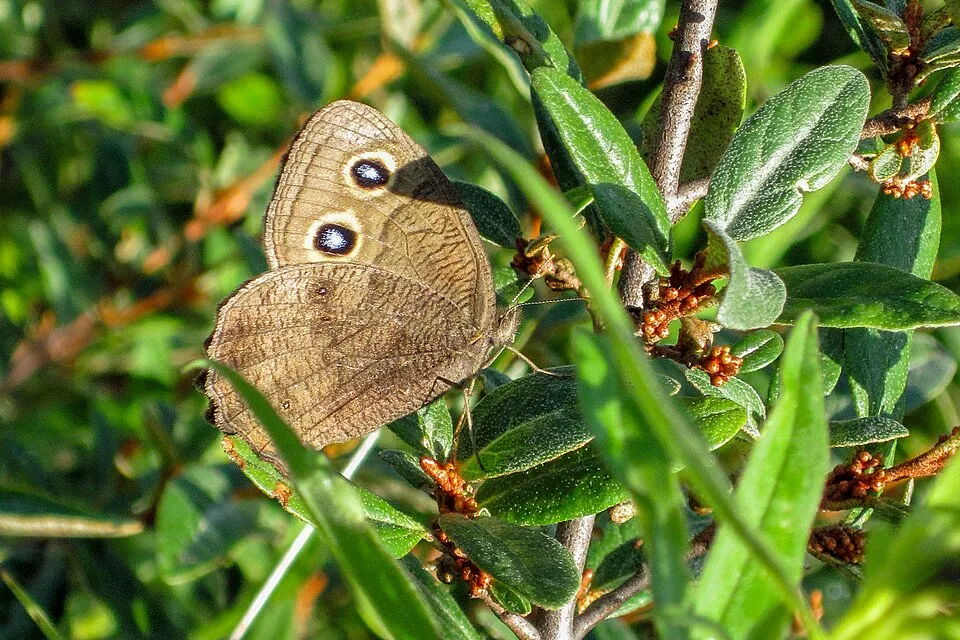
Photo: Kristof Zyskowski & Yulia Bereshpolova / Wikimedia Commons · CC BY 2.0. Reproduced with attribution; check the source file for license details. Photo is illustrative of the named butterfly, not proof of a specific defensive behavior.
Common wood-nymphs are highly variable across their North American range, so photographs may show differently sized pale patches or brighter spots. They are often encountered in grasslands and open habitats. The specimen photo is identified to the nephele form; use several clues before assigning a subspecies in the field.
How to identify it: Look for a medium-to-large brown butterfly with eye-like spots near the forewing tip, sometimes enclosed by a pale area.
Where you may see it: North America.
9. Grayling (Hipparchia semele)
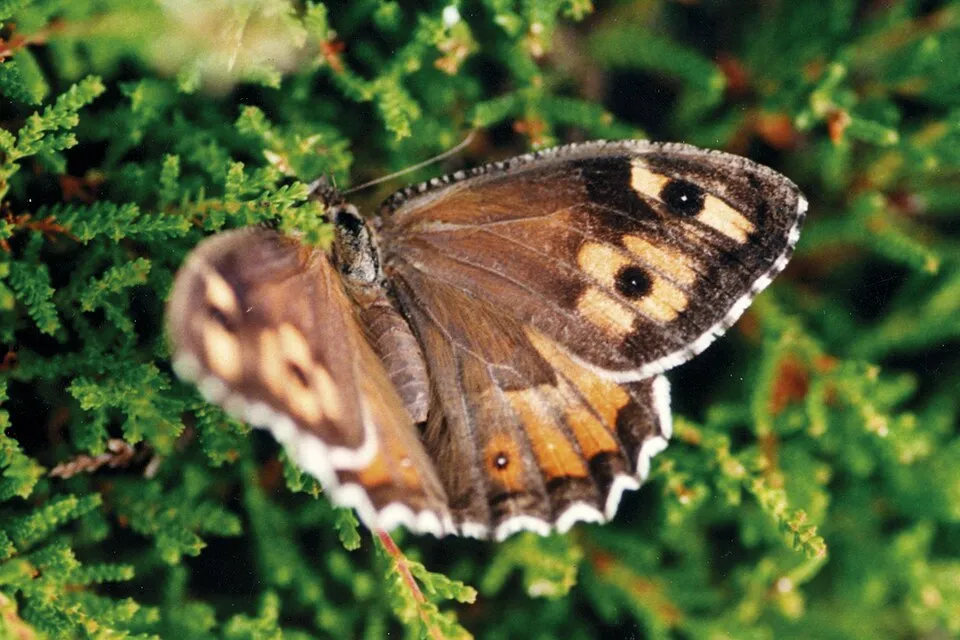
Photo: Katja Schäfer / Wikimedia Commons · CC BY-SA 3.0 Germany. Reproduced with attribution; check the source file for license details. Photo is illustrative of the named butterfly, not proof of a specific defensive behavior.
The grayling shows how an eyespot can coexist with highly cryptic coloring. At rest, it can turn and angle its closed wings so they blend with rock, soil or bark. Some of the brightest markings may be hidden, which is why habitat and wing posture matter when identifying it.
How to identify it: Notice a dull brown-gray underside and an eye-like mark near the forewing tip when it is visible.
Where you may see it: Europe.
10. Blue Pansy (Junonia orithya)
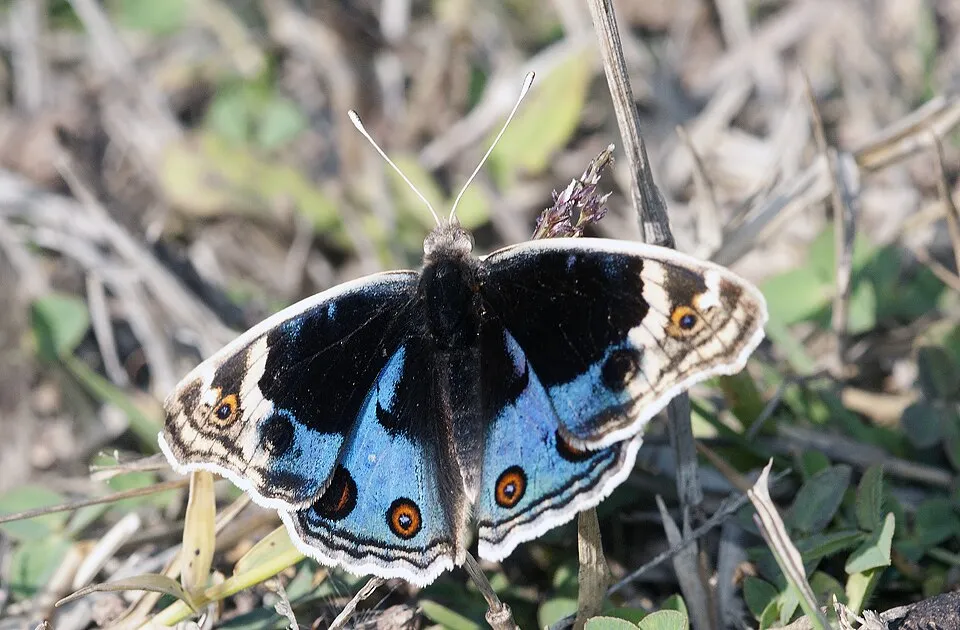
Photo: Dûrzan cîrano / Wikimedia Commons · CC BY-SA 3.0. Reproduced with attribution; check the source file for license details. Photo is illustrative of the named butterfly, not proof of a specific defensive behavior.
The blue pansy can look radically different depending on sex, subspecies and wing posture. Open-wing photos often reveal the most dramatic blue zones and eyespots. Do not confuse every blue-winged butterfly with a blue morpho: pansies are typically much smaller and have a different pattern layout.
How to identify it: Look for a bright blue area on the hindwings combined with dark eyespots and orange markings.
Where you may see it: South and Southeast Asia, with regional forms elsewhere.
11. Peacock Pansy (Junonia almana)
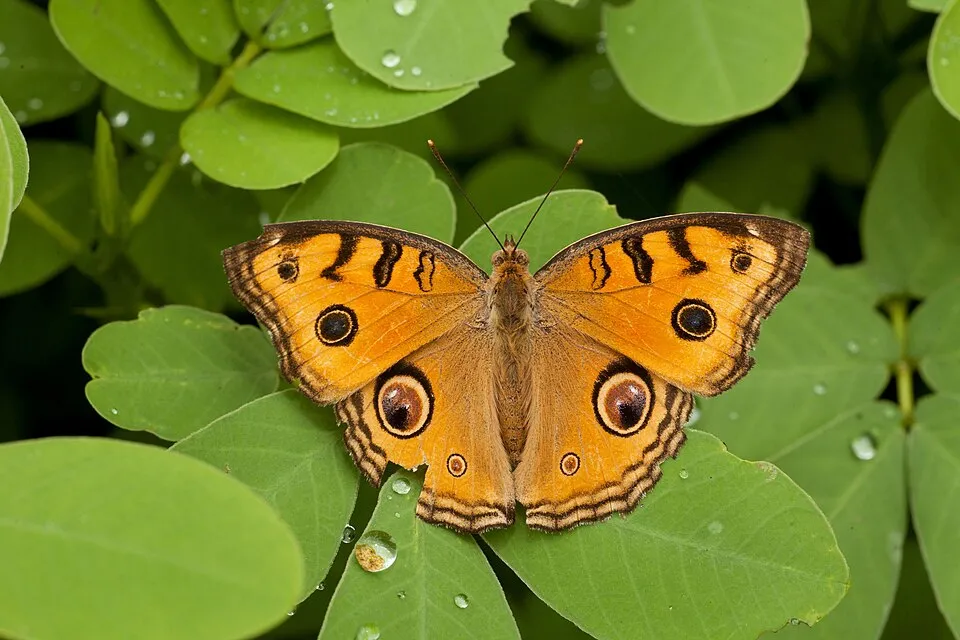
Photo: Ajeesh Kumar (Ajeeshkumar4u) / Wikimedia Commons · CC BY-SA 4.0. Reproduced with attribution; check the source file for license details. Photo is illustrative of the named butterfly, not proof of a specific defensive behavior.
The peacock pansy shares the Junonia genus with the common buckeye and blue pansy, but its orange wing surface and bold circular hindwing design are distinctive. Seasonal forms may differ considerably on the underside, so compare the same wing surface when using reference photos.
How to identify it: Find a vivid orange upper wing with rounded eye marks, especially a large one on each hindwing.
Where you may see it: South and Southeast Asia.
12. Large Heath / Common Ringlet (Coenonympha tullia)
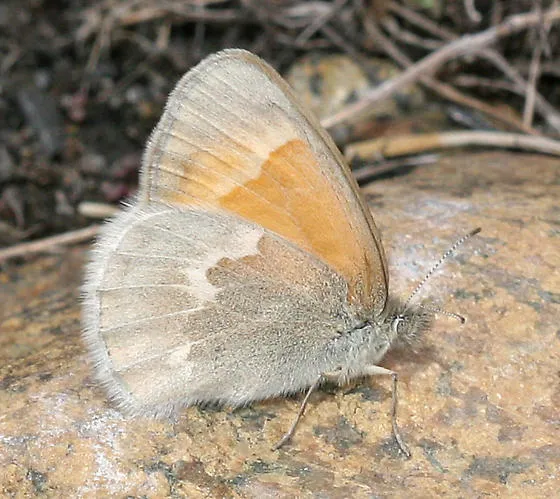
Photo: Mike Boone / Wikimedia Commons · CC BY-SA 2.5. Reproduced with attribution; check the source file for license details. Photo is illustrative of the named butterfly, not proof of a specific defensive behavior.
Not every eyespot butterfly has huge, flashy targets. This species complex includes understated ringlet or heath butterflies whose wing patterns vary geographically. The Michigan specimen is labeled Coenonympha tullia; local naming traditions can differ, and a photo alone may not be enough for precise subspecies identification.
How to identify it: Small brown-and-buff satyrine; inspect the underside for pale-centered circles and variable bands.
Where you may see it: Northern Europe and parts of North America.
Why Do Butterflies Have Eye-like Spots on Their Wings?
The marks are called eyespots, or ocelli. They are wing-scale patterns rather than actual eyes. Two leading defense explanations are intimidation—a large conspicuous mark may make a predator hesitate—and deflection—a smaller mark near the wing margin may draw a strike away from the head or body.
Researchers have tested these ideas using paper models, live butterflies and predator behavior. A 2016 field study found that, under its experimental conditions, a single sufficiently large eyespot was associated with fewer attacks, while many small spots on models did not have the same effect. A separate study of Junonia butterflies found a relationship between eyespot size, position and the two defensive hypotheses. These results do not establish that every mark on every butterfly evolved for the same purpose.
The European peacock provides a dramatic example of eyespot display: it can suddenly expose its bright upper wings when disturbed. In contrast, an owl butterfly or common morpho may show its spotted underside while at rest. The appearance of an eyespot therefore depends on both the species and how the butterfly holds its wings.
Quick ID: Where Are the Eyespots?
| What you noticed | First species to compare | Extra check |
|---|---|---|
| Four very colorful targets on reddish wings | European Peacock | Look for large spots near each wing corner |
| Several orange-ringed targets on open brown wings | Common Buckeye | Orange forewing bars and pale band |
| One giant eye on a closed brown hindwing | Owl Butterfly | Tropical American location and large size |
| Blue upper wings, brown spotted underside | Common Morpho | Do not compare upper and lower surfaces as if identical |
| Brown-orange grassland butterfly, one main spot | Meadow Brown or Gatekeeper | Gatekeeper often has two white pupils in the spot |
| Bright orange wings and large circular hindwing mark | Peacock Pansy | South/Southeast Asian range; seasonal variation |
Three Mistakes to Avoid When Identifying Eyespots
Mixing up upper and lower wings. A blue morpho can look brilliant blue in flight and patterned brown at rest. Compare the same wing surface.
Ignoring location. A European gatekeeper and a North American wood-nymph may both appear brown with small eye-like marks; geography helps narrow the answer.
Treating every round dot as an eyespot. True eyespots often include contrasting concentric rings and a pupil-like center, whereas ordinary speckles, spots and bands can have very different structures.
Frequently Asked Questions
What butterfly has big eyes on its wings?
The owl butterfly is famous for one large, eye-like mark on the underside of each hindwing. European peacock butterflies also show four prominent multicolored eyespots when their wings are open.
Are butterfly eyespots real eyes?
No. These are patterns made by pigmented and structurally colored scales on the wings. The butterfly's real compound eyes are on its head.
Do butterfly eyespots scare away birds?
In some species and contexts, large eyespots can reduce or delay attacks. In others, small marginal spots may redirect attacks, and some spot patterns may have additional functions. No single explanation covers all butterflies.
Which blue butterfly has eye spots underneath?
Many morpho butterflies have brown undersides marked with several eyespots even though their upper wing surfaces can look metallic blue. Compare the wing side and range before choosing a species.
Do all buckeye butterflies have eyespots?
Large eyespots are a defining visual feature of many buckeyes in the genus Junonia, although exact arrangement and color vary by species, sex and sometimes seasonal form.
Why do some butterflies show spots only when they open their wings?
Wing surfaces have different markings, and resting posture controls what a predator or observer sees. The European peacock's bright upper-wing eyespots are a clear example of a pattern that can be concealed when the wings close.
Can eyespots help me identify a butterfly from a photograph?
Yes, especially if the photo shows both wings and the butterfly's location is known. However, eyespot arrangement alone may not distinguish closely related species or local forms.
Are owl butterflies the same as peacock butterflies?
No. Owl butterflies are tropical American butterflies commonly assigned to the genus Caligo; the European peacock belongs to the genus Aglais. Both have eye-like wing markings, but their body size, range and patterns differ.
Related Animal Guides
For a closer look at one of these species, read our Owl Butterfly profile. To compare shiny blue upper wings with brown spotted undersides, visit the Morpho Butterfly guide. You can also use our Green Butterfly Identification guide to see how color alone can be misleading when identifying butterflies.
Scientific References and Photo Sources
Florida Museum of Natural History — Common Buckeye field marks.
Missouri Department of Conservation — Common Buckeye field guide.
Ho et al. (2016) — Attack risk for butterflies changes with eyespot number and size.
Kodandaramaiah et al. (2013) — Deflective and intimidating eyespots in Junonia butterflies.
Vallin et al. — Experimental work on European peacock defensive displays.
All 12 photographs link directly to their individual Wikimedia Commons file pages in the captions. Check the linked Creative Commons terms before any image edits or reposting.