Some insects look exactly like bees—until you notice their wings, antennae or feeding behavior. A buzzing visitor with a fuzzy yellow-and-black body might actually be a hoverfly, bee fly, clearwing moth, beetle or even a predatory robber fly. This photo guide introduces 10 look-alikes and shows the clues that help tell them apart without touching them.
These examples come from North America and Europe; they are not all species that occur in the same garden. The aim is to recognize insect groups first, then compare photographs and your location before deciding on a species.
Bee or Not a Bee? A 30-Second Identification Checklist
Count functional wings if you can: bees and moths have two pairs; true flies have one functional pair and small balancing organs called halteres.
Check the head: many bee-like flies have very large compound eyes and relatively short antennae.
Look for hard wing cases: striped, shell-like covers indicate a beetle rather than a bee.
Watch feeding behavior: a moth may hover and extend a long coiled proboscis; a robber fly may capture another insect.
Use your location: a European species photograph is not proof of the same species in an American yard.
Important: wing pairs can overlap in a still photo, and not every real bee looks fuzzy. Several clues together are better than any single mark. The safest identification method is a photo, not handling an unknown insect.
10 Insects That Look Like Bees at a Glance
| Insect | Scientific name | Actually a... | Best clue |
|---|---|---|---|
| Drone Fly | Eristalis tenax | Hoverfly | Honeybee-like amber bands, broad eyes and one pair of wings |
| Narcissus Bulb Fly | Merodon equestris | Hoverfly | Very fuzzy, bumblebee-like body with variable black, yellow or orange hairs |
| Bumblebee Hoverfly | Volucella bombylans | Hoverfly | Black-and-white or black-and-rust bumblebee-style hair pattern |
| Large Bear Hoverfly | Criorhina ranunculi | Hoverfly | Large dark bumblebee-like fly; some forms have pale or reddish tail hairs |
| Dark-edged Bee-fly | Bombylius major | Bee fly | Rounded fuzzy body, long straight feeding proboscis, dark-edged wings |
| Dotted Bee-fly | Bombylius discolor | Bee fly | Hairy rounded body, projecting proboscis and small dark spots on the wings |
| Hummingbird Clearwing Moth | Hemaris thysbe | Moth | Fast hovering, mostly transparent wings, reddish-brown abdomen and usually pale legs |
| Snowberry Clearwing Moth | Hemaris diffinis | Moth | Bumblebee-like yellow-and-black body, clear wings, dark legs and dark stripe from eye |
| Bee Beetle | Trichius fasciatus | Beetle | Yellow-and-black banded hard wing covers on a thick beetle body |
| Bee-like Robber Fly | Laphria thoracica | Robber fly | Heavy fuzzy bee-style body but predatory robber-fly face and strong legs |
Meet the 10 Bee Look-Alikes (With Real Photos)
1. Drone Fly (Eristalis tenax)
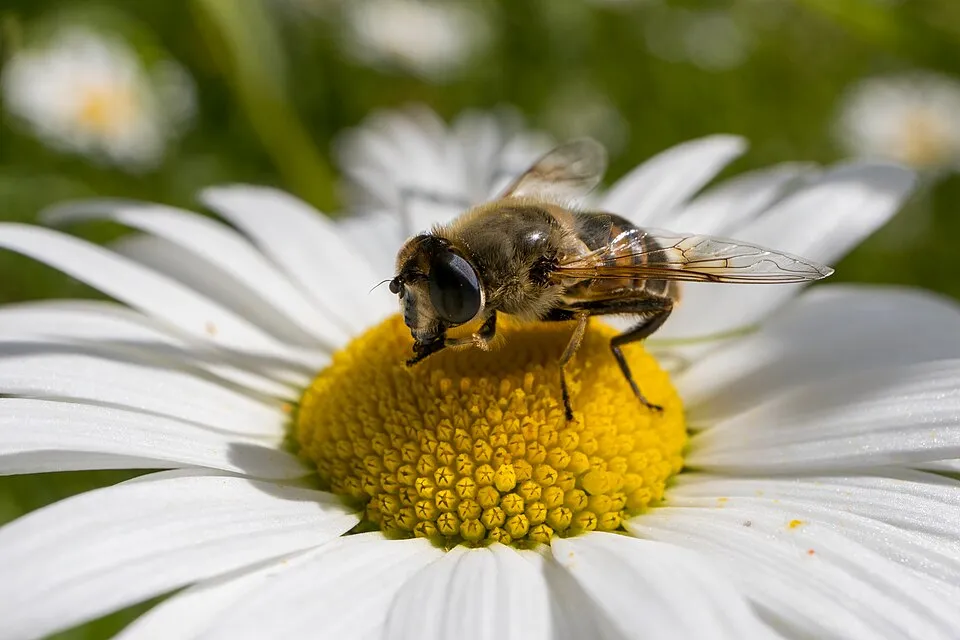
Photo: JackyM59 · Original photograph · CC BY-SA 4.0. Image may be converted to WebP for publication.
Quick ID: Honeybee-like amber bands, broad eyes and one pair of wings. Typical region: Europe, North America and many other regions.
A drone fly can be mistaken for a worker honeybee while it drinks nectar from a flower. The golden-brown body and dark abdominal bands are convincing at arm’s length, and its flight can be surprisingly steady. The important correction is that a drone fly is not a male honeybee, despite the common name: it is a hoverfly in the order Diptera.
Look for the large compound eyes, short antennae and a single functional pair of wings. A honeybee has two pairs of wings, although they can overlap and look like one pair in a photograph. Drone flies are flower visitors, and their larvae are associated with very wet, organically rich environments. An adult drone fly has no stinger.
2. Narcissus Bulb Fly (Merodon equestris)
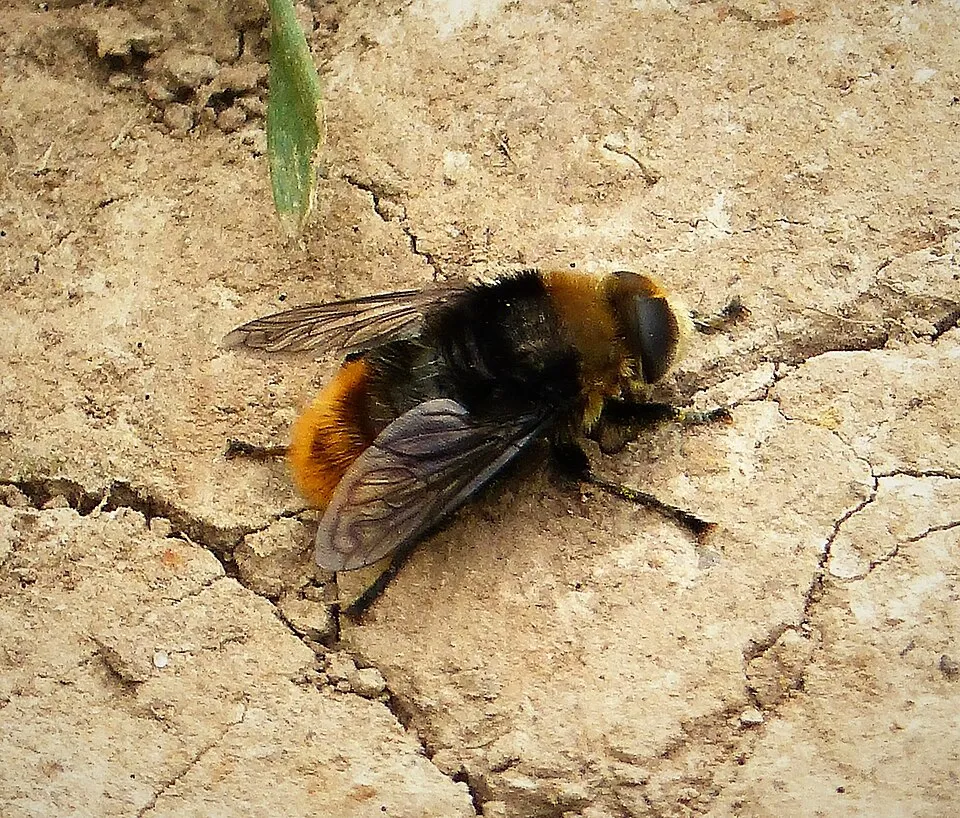
Photo: gailhampshire · Original photograph · CC BY 2.0. Image may be converted to WebP for publication.
Quick ID: Very fuzzy, bumblebee-like body with variable black, yellow or orange hairs. Typical region: Europe; also introduced elsewhere.
The narcissus bulb fly is among the most striking bumblebee look-alikes. Some individuals are pale and fluffy, while others show stronger orange or dark bands. These different color forms are one reason appearance alone can be misleading: a yellow-and-black insect in the garden need not be a bee.
It is actually a syrphid fly. Its short antennae, fly-like eyes and one pair of functional wings are useful clues. Adults visit flowers, but the larvae can develop in bulbs, including narcissus, and may damage ornamental plantings. The name and the body shape are useful starting points; a close photograph is needed for a confident species-level identification.
3. Bumblebee Hoverfly (Volucella bombylans)
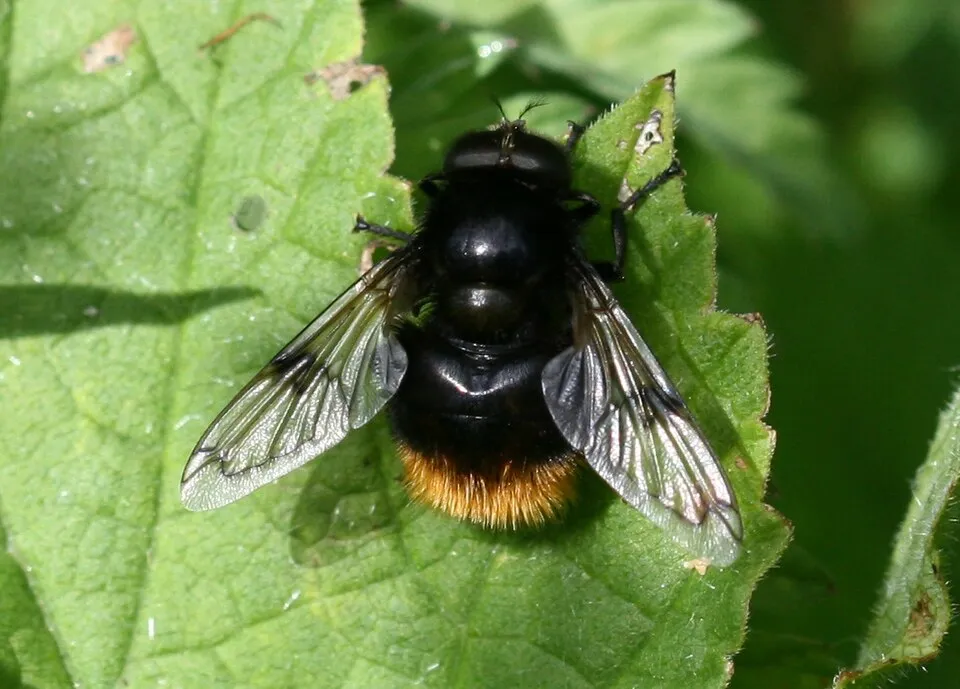
Photo: Sandy Rae · Original photograph · CC BY-SA 3.0. Image may be converted to WebP for publication.
Quick ID: Black-and-white or black-and-rust bumblebee-style hair pattern. Typical region: Mainly Europe; check local records elsewhere.
If you see a fuzzy insect that looks almost exactly like a bumblebee, take a second look before deciding what it is. The bumblebee hoverfly has variable hair patterns that resemble several bumblebee color forms. It can even visit the same flowers, making the resemblance more convincing.
This insect is a true fly, so close views reveal only one pair of working wings and short fly antennae. Unlike a bumblebee, an adult hoverfly does not possess a stinger. The larvae of some Volucella species develop in social-wasp or bumblebee nests. A furry body by itself is not enough to call an insect a bee.
4. Large Bear Hoverfly (Criorhina ranunculi)
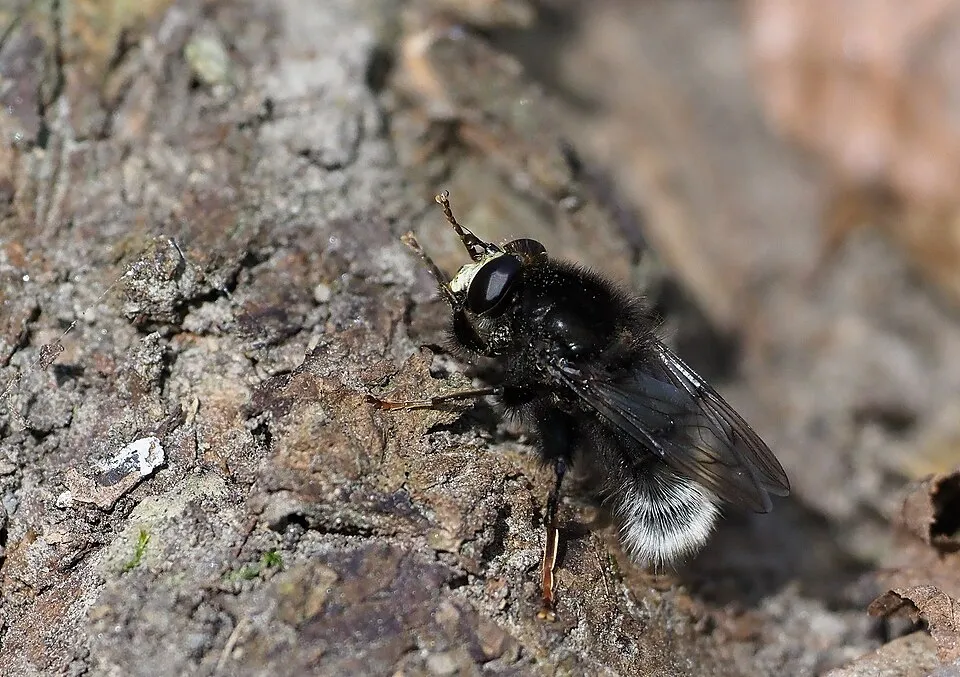
Photo: Frank Vassen · Original photograph · CC BY 2.0. Image may be converted to WebP for publication.
Quick ID: Large dark bumblebee-like fly; some forms have pale or reddish tail hairs. Typical region: Europe.
The large bear hoverfly is another example of a fly dressed in a bumblebee-like coat. It can look bulky and dark, sometimes with contrasting hairs toward the end of the abdomen. People often judge the entire insect by its color and size, but a large fuzzy insect is not necessarily a member of the bee family.
The name refers to a European hoverfly rather than a bear or bee. Look for the broad fly head, shorter antennae and characteristic hoverfly wing structure. Distinguishing this species from similar hairy hoverflies can require several photographs. It is a useful reminder that the article’s pictures are examples, not an automatic identification key for every garden visitor.
5. Dark-edged Bee-fly (Bombylius major)
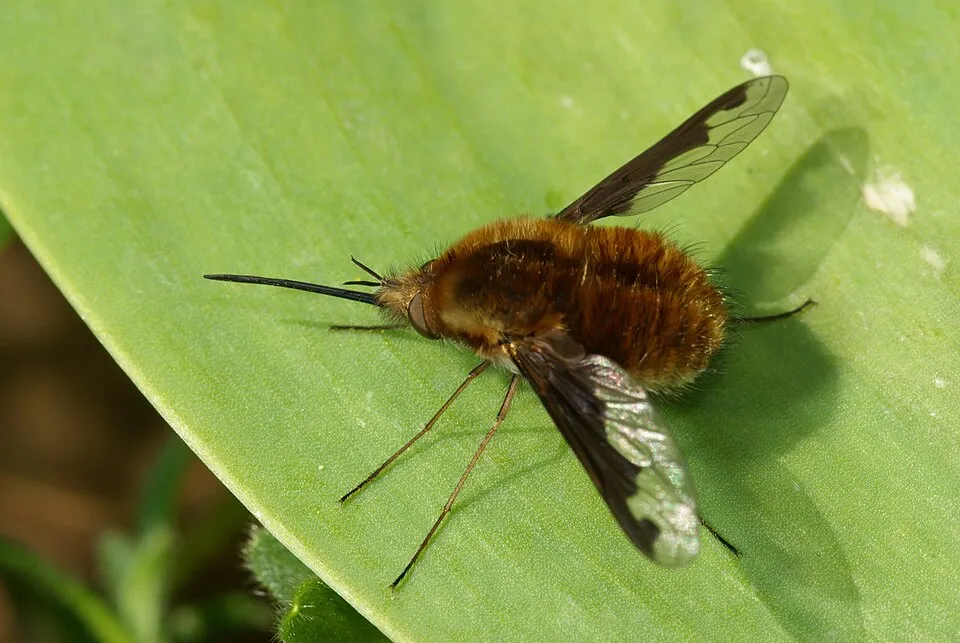
Photo: jp hamon · Original photograph · CC BY-SA 3.0. Image may be converted to WebP for publication.
Quick ID: Rounded fuzzy body, long straight feeding proboscis, dark-edged wings. Typical region: Europe and parts of temperate Asia.
This bee fly looks like a tiny fuzzy ball with wings. Its long, straight proboscis extends forward like a slender straw as it feeds at flowers. The wings often show a darker front portion, which helps separate it from the similar dotted bee-fly.
Despite looking like a miniature bee, it belongs to the fly family Bombyliidae. The adult cannot sting. Bee flies are important nectar visitors, while their developing young are often associated with the nests or immature stages of other insects. A long proboscis does not mean the fly is trying to sting you; it is a feeding structure.
6. Dotted Bee-fly (Bombylius discolor)
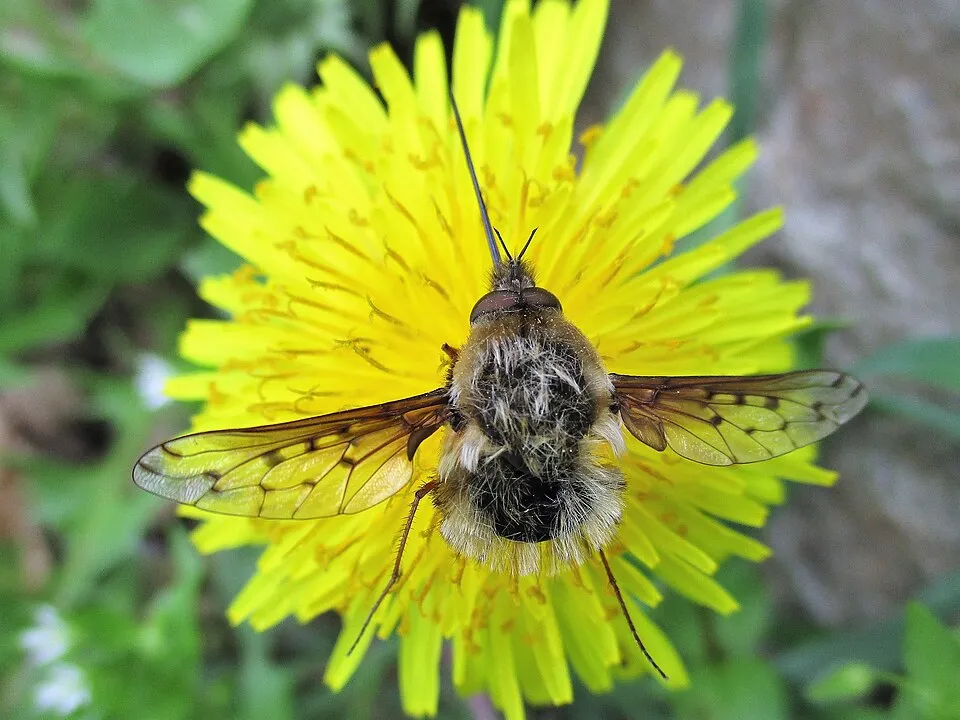
Photo: Слободан Стевчић · Original photograph · CC BY-SA 4.0. Image may be converted to WebP for publication.
Quick ID: Hairy rounded body, projecting proboscis and small dark spots on the wings. Typical region: Europe.
At first glance the dotted bee-fly can look almost identical to the dark-edged bee-fly: both are fuzzy, hover near flowers and extend a long feeding proboscis. The clue is in the wings. Dotted bee-flies have multiple small dark spots rather than the continuous dark leading-edge pattern typical of the dark-edged species.
This difference is easier to see in a sharp photograph taken from slightly above the insect. Like other bee flies, it is a fly rather than a bee, and it has no sting. For beginners, a sensible identification may stop at “bee fly” if the wing pattern cannot be seen clearly.
7. Hummingbird Clearwing Moth (Hemaris thysbe)
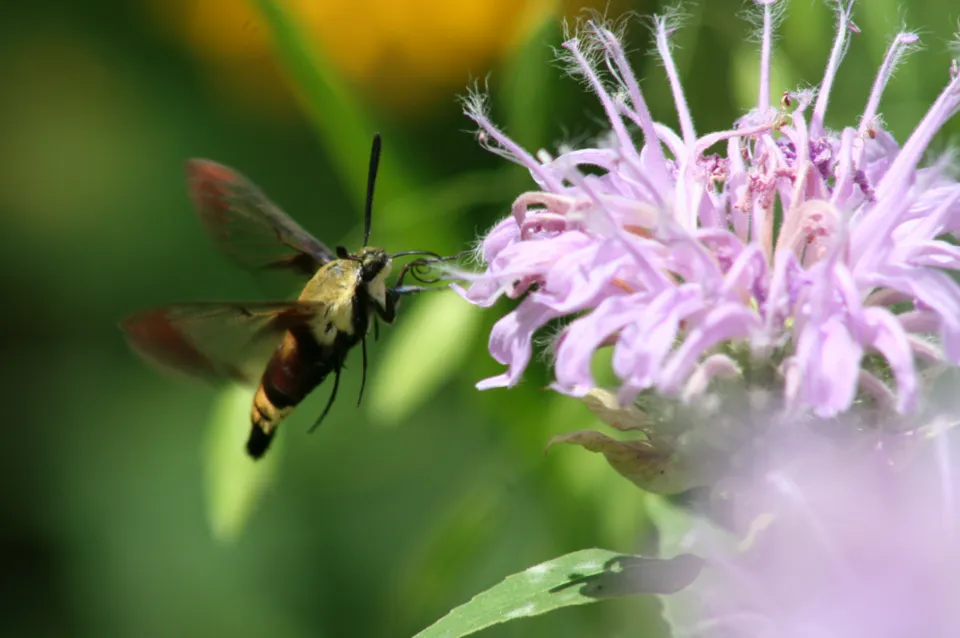
Photo: Rick Hansen / USFWS · Original photograph · Public Domain (USFWS). Image may be converted to WebP for publication.
Quick ID: Fast hovering, mostly transparent wings, reddish-brown abdomen and usually pale legs. Typical region: North America.
A hummingbird clearwing is a day-flying moth, not a bee or a hummingbird. It has a plump body, transparent patches in the wings and a long feeding tube that uncoils to reach flower nectar. When it hovers, its rapidly beating wings make it easy to mistake for a small furry bee.
Compared with the snowberry clearwing below, the hummingbird clearwing often has broader dark wing borders and paler legs. These features are more useful than body color alone, which varies. Its four moth wings are not arranged like the single functional wing pair of a fly. The photo shows nectar feeding, not aggressive behavior.
8. Snowberry Clearwing Moth (Hemaris diffinis)
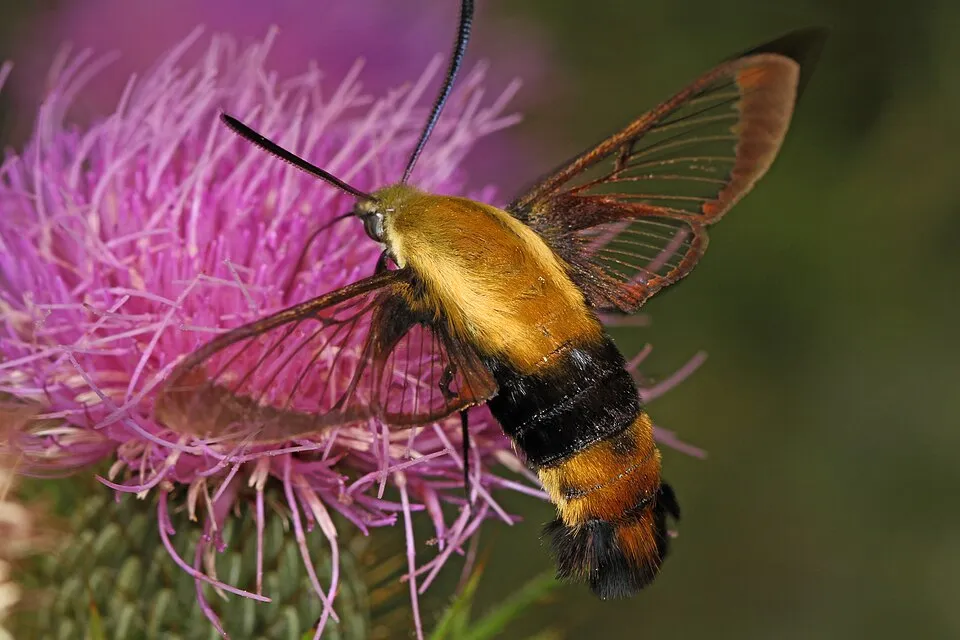
Photo: Judy Gallagher · Original photograph · CC BY 2.0. Image may be converted to WebP for publication.
Quick ID: Bumblebee-like yellow-and-black body, clear wings, dark legs and dark stripe from eye. Typical region: North America.
Among the two clearwing moths in this guide, the snowberry clearwing often looks more like a bumblebee because of its yellow-and-black body pattern. It travels rapidly from flower to flower during the day and hovers while taking nectar.
Look for the dark legs and a black band crossing near the eye and running along the side of the thorax; the comparison species Hemaris thysbe has pale legs and lacks that same side band. These marks are useful in close, well-lit photographs, but avoid forcing a species label from a distant blurry image. Neither clearwing moth has a bee-type stinger.
9. Bee Beetle (Trichius fasciatus)
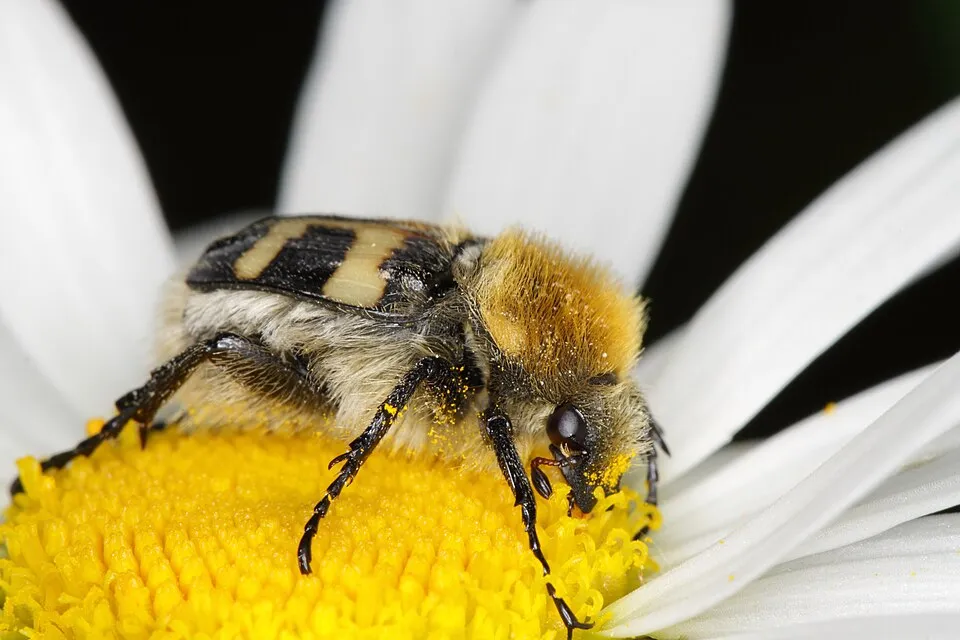
Photo: gbohne · Original photograph · CC BY-SA 2.0. Image may be converted to WebP for publication.
Quick ID: Yellow-and-black banded hard wing covers on a thick beetle body. Typical region: Europe.
The bee beetle uses black-and-yellow markings that may suggest a bee when viewed briefly on a flower. But a photograph taken from above reveals a different construction: the patterned surfaces are hardened forewings, called elytra. They meet along the middle of the back like two protective covers.
This makes it a beetle, not a fly and not a bee. The visible striped wing covers, shorter compact outline and beetle movement are useful clues. The species is European, so a similar beetle in North America should not automatically be given the same species name. Bee beetles do not possess a bee-like sting.
10. Bee-like Robber Fly (Laphria thoracica)
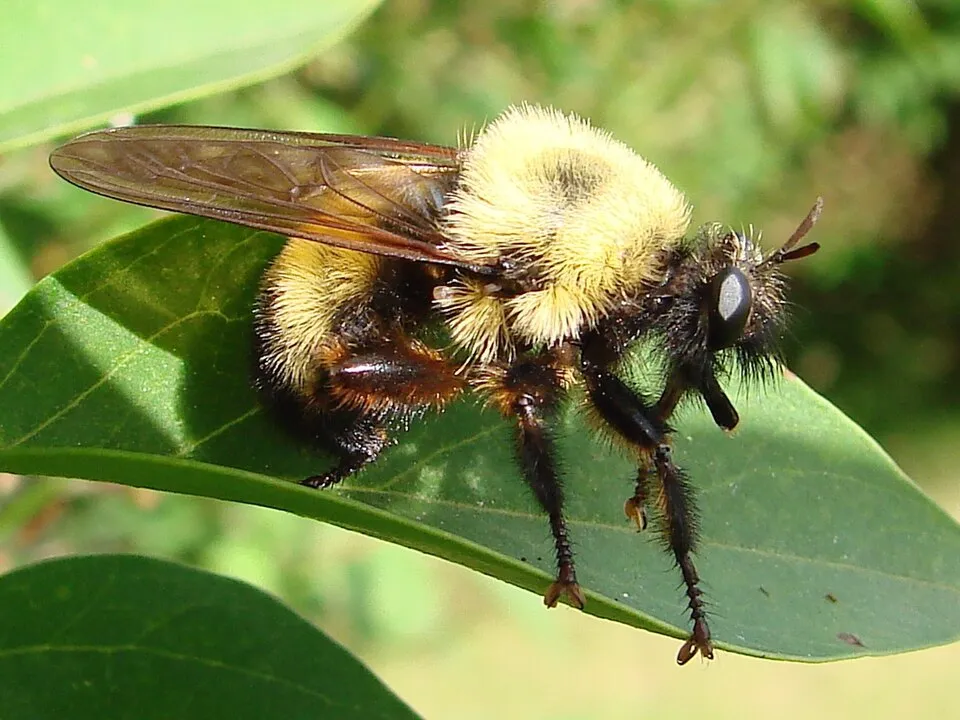
Photo: Ilona Loser · Original photograph · CC BY-SA 3.0. Image may be converted to WebP for publication.
Quick ID: Heavy fuzzy bee-style body but predatory robber-fly face and strong legs. Typical region: North America.
Not every bee look-alike is harmless when handled. The bee-like robber fly has a stout, furry appearance, but it is an insect hunter. It uses strong legs and piercing mouthparts to catch and feed on other insects rather than collecting nectar like a bee.
Robber flies do not have a bee stinger, yet a robber fly may deliver a painful bite if someone catches or squeezes it. Look for a conspicuous bristly face and hunting posture, but keep your distance and use photographs rather than trying to hold the animal. This North American example shows why “looks like a bee” is not a reliable statement about behavior.
How to Tell a Hoverfly, Bee Fly, Moth or Beetle Apart From a Bee
| Feature | Real bee | Bee-like fly | Clearwing moth | Bee beetle |
|---|---|---|---|---|
| Wing arrangement | Two pairs of membranous wings | One functional pair; hindwings modified into halteres | Two pairs; may appear clear and move rapidly | Hard forewing covers with flying wings underneath |
| Antennae | Usually noticeably segmented | Often short | Typically thicker, moth-like | Beetle-type antennae |
| Common behavior | Visits flowers; some collect pollen for young | Visits flowers or, for robber flies, hunts prey | Hovers to take nectar with a proboscis | Walks over and feeds at flowers |
| Sting / bite | Some female bees can sting | Hoverflies and bee flies do not sting; robber flies can bite if handled | No bee-type stinger | No bee-type stinger |
The number of wings is a strong anatomical clue, but do not assume you can see every wing in a photo. Adult hoverflies may be important flower visitors, and many hoverfly larvae eat aphids. The body shape and behavior of a particular species can matter more than its yellow-and-black pattern.
Why Do So Many Unrelated Insects Look Like Bees?
A conspicuous insect may be safer from some predators if its appearance resembles an animal that can defend itself. This is often discussed as Batesian mimicry when a relatively defenseless organism resembles a better-defended model. But not every similar color pattern proves a particular evolutionary story: resemblance may vary by location, species and predator.
Hoverflies can resemble honeybees or wasps; some clearwing moths resemble bumblebees; bee beetles provide a different kind of striped visual similarity. An insect’s real identity still comes from anatomy, not whether its colors look dangerous.
What Should You Do If a Bee-Looking Insect Lands Near You?
Stay calm and avoid swatting. Do not pick up or squeeze an insect simply because you suspect it is a harmless hoverfly. If it is visiting flowers, move slowly and give it space. If you need an identification, photograph the insect from above and from the side, especially its eyes, antennae, wings and abdomen.
Stinging risk depends on the actual species and situation. Many bee look-alikes cannot sting, but real bees and wasps may sting when threatened, and predatory robber flies may bite if handled. For insects gathering around ground openings, see our ground bee identification and nest guide, which explains why underground yellowjackets require a different response.
Frequently Asked Questions
What insect looks like a honeybee but is actually a fly?
The drone fly (Eristalis tenax) is a classic example. Its color and flower-visiting habits resemble a honeybee, but it has the anatomical features of a hoverfly.
Can hoverflies sting?
No. Hoverflies are true flies and do not have a bee-type stinger. They can resemble stinging insects without sharing that defense.
What looks like a bumblebee but has clear wings?
A snowberry clearwing moth is one possibility in North America. Other clearwing moths and hoverflies can look similar, so compare body markings and the number of functional wing pairs.
Do bee flies sting with their long nose?
No. The long forward-pointing structure on a bee fly is a feeding proboscis, not a stinger.
How can I tell a bee from a hoverfly in a photo?
Look for large fly-like eyes, short antennae and one functional pair of wings. Bees have two wing pairs, though they may overlap in a still photograph.
Are all insects that look like bees harmless?
No. Many hoverflies, bee flies and clearwing moths do not sting, but robber flies can bite if caught or squeezed. Other look-alikes can be real wasps or bees.
Why is a bee beetle not a bee?
It has hardened forewing covers called elytra and beetle anatomy. Its striped appearance is not enough to make it a bee.
Can a picture identify every bee mimic to species?
Not always. Similar species may differ in subtle wing, hair or body markings. Location and additional images often matter; sometimes identification to family or genus is more accurate.
More Insect Identification and Ecology Guides
If you are comparing a bee-like insect with an actual bee, start with Ground Bees: Identification, Nests, Stings & What to Do. For a closer look at real bees, browse 12 Common Types of Bumblebees. You may also be interested in Why Bees Are Endangered and our guide explaining whether insects are animals.
Sources and Further Reading
Michigan State University Extension — Know the insects that look like bees
Butterflies and Moths of North America — Hummingbird Clearwing
Butterflies and Moths of North America — Snowberry Clearwing
Identification note: photo captions identify a documented example of each species, but this guide cannot confirm the identity of a different insect from a brief sighting. Photographs and licenses are documented individually; please check the original license page when reusing each image.