Some deer grow wide, shovel-shaped antlers; others carry long branching beams or compact three-pointed racks. If you have seen an antlered animal and wondered whether it was a moose, elk, caribou or another deer species, the shape of its antlers can give you a valuable clue—but the body, season and location matter too.
This photo identification guide compares ten distinct deer species. The photographs show real animals, while the descriptions explain which antler features to notice and when those features may be misleading.
10 Animals With Antlers: Quick Photo ID Table
| Animal | Scientific name | Typical antler clue | Where to look |
|---|---|---|---|
| Moose | Alces alces | Broad, paddle-like palms with multiple points | North America, northern Europe and Asia |
| Elk (Wapiti) | Cervus canadensis | Long main beams with several upward tines | North America; related populations in Asia |
| Reindeer / Caribou | Rangifer tarandus | Complex curved branches and forward brow tines | Arctic and subarctic North America and Eurasia |
| Red Deer | Cervus elaphus | Branched antlers, often with a crown near the top | Europe and western Asia; introduced elsewhere |
| Fallow Deer | Dama dama | Flattened, fan-like antler tips | Europe and introduced populations around the world |
| White-tailed Deer | Odocoileus virginianus | Tines often rise from a forward-curving main beam | Most of North America and parts of Central and South America |
| Mule Deer | Odocoileus hemionus | Repeated, forked branching on the main antler | Western North America |
| Sika Deer | Cervus nippon | Fairly upright beams with several distinct tines | East Asia; introduced to Britain and other regions |
| Roe Deer | Capreolus capreolus | Short, typically three-pointed antlers in mature bucks | Europe and western Asia |
| Chital (Axis Deer) | Axis axis | Typically three tines per side on long slender beams | Indian subcontinent; introduced in several places |
Important: These are typical mature-male traits, not fixed species rules. Age, nutrition, genetics, injury and the growth season can change a rack, and an animal without antlers may still be a deer.
Photos and Identification Tips for Each Species
1. Moose (Alces alces)
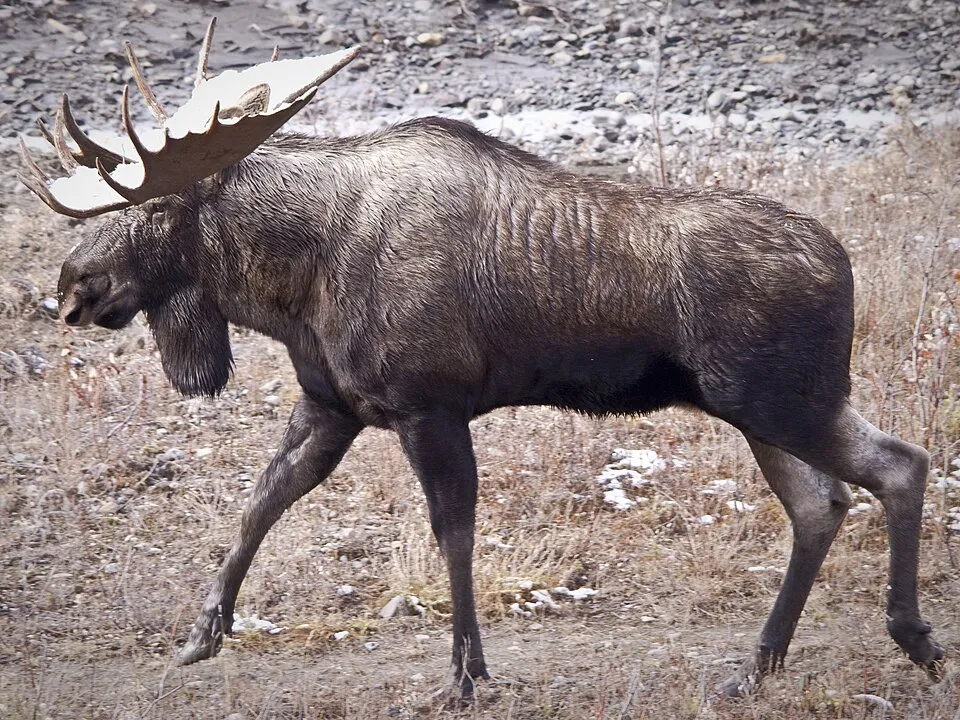
Photo: NPS / Jacob W. Frank · Wikimedia Commons source · Public domain. Image is presented as a species example.
Key field mark: Broad, paddle-like palms with multiple points.
The easiest clue is a wide, flattened antler surface rather than a narrow branching beam. A mature bull moose may carry enormous palms with projecting points. However, younger bulls can have smaller or more branchlike antlers, so a narrow rack does not rule out a moose. Check the long legs, prominent muzzle, shoulder hump and large body. The photograph shows a bull with a developed antler rack.
Identification tip: Moose antlers look like broad shovels or paddles. Fallow deer also develop palmate antlers, but their bodies are far smaller and their antler shape is different.
For the animal’s general appearance and habitat, see the moose species guide on Animals Top.
2. Elk (Wapiti) (Cervus canadensis)
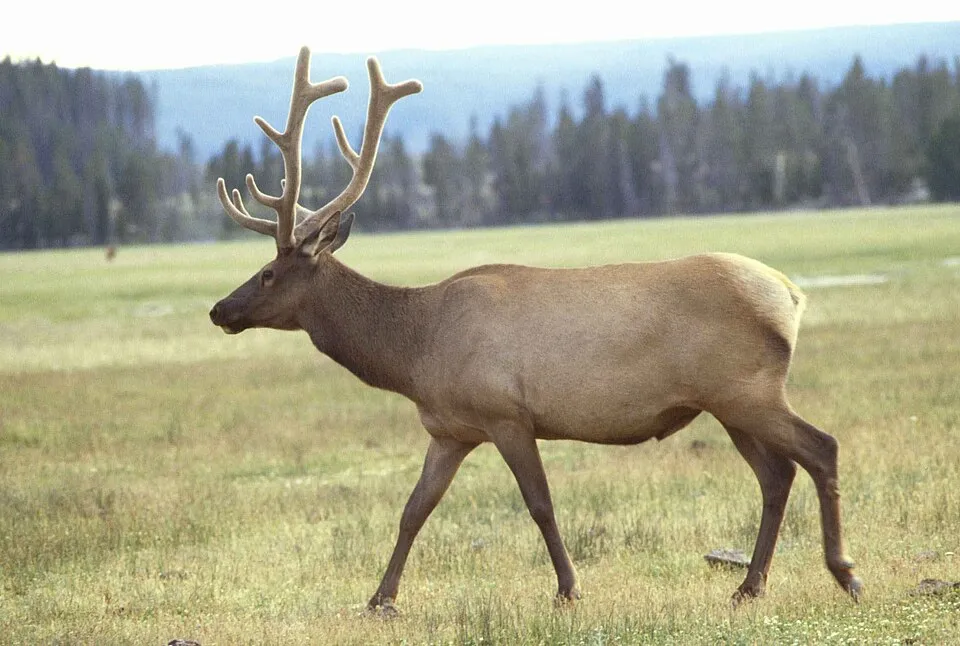
Photo: Jim Leupold / USFWS · Wikimedia Commons source · Public domain. Image is presented as a species example.
Key field mark: Long main beams with several upward tines.
Elk antlers are large and sweep backward, with clearly spaced tines rising from a strong main beam. Unlike a moose, a bull elk normally does not develop a broad solid palm. During summer, growing antlers are wrapped in living velvet. Look as well for the large tan body, darker neck and pale rump patch. In Europe the word elk may instead mean moose, so use wapiti when the naming could confuse readers.
Identification tip: The selected photograph shows a bull elk with velvet-covered antlers; a mature hard-antler rack has the same general branching plan once the velvet is gone.
If you are comparing elk with smaller deer, our Elk vs Deer comparison covers size, coat and behavior.
3. Reindeer / Caribou (Rangifer tarandus)
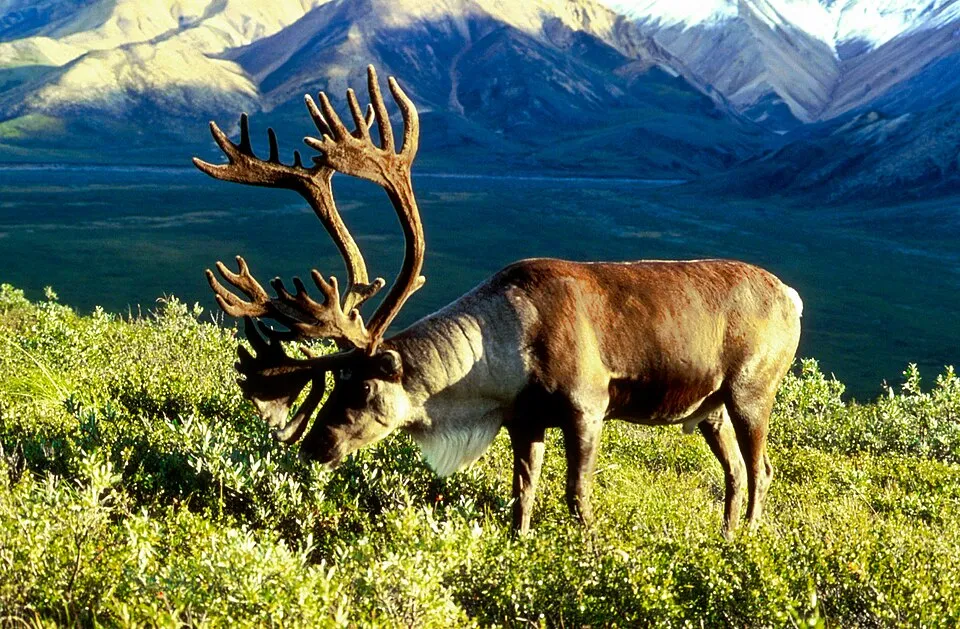
Photo: Dean Biggins / USFWS · Wikimedia Commons source · Public domain. Image is presented as a species example.
Key field mark: Complex curved branches and forward brow tines.
Caribou antlers can be irregular-looking, with curving beams, forward-pointing brow tines and several smaller points. Many females also grow antlers, an unusual pattern among deer species, though not every female is antlered. The animal also has a compact, cold-adapted body with broad hooves. Reindeer and caribou are generally names used for members of the same species, although regional populations and taxonomy are complex.
Identification tip: Do not identify a reindeer from antlers alone: age, sex, season and population can change the rack dramatically.
You can also explore the reindeer/caribou guide and the moose vs. reindeer comparison.
4. Red Deer (Cervus elaphus)
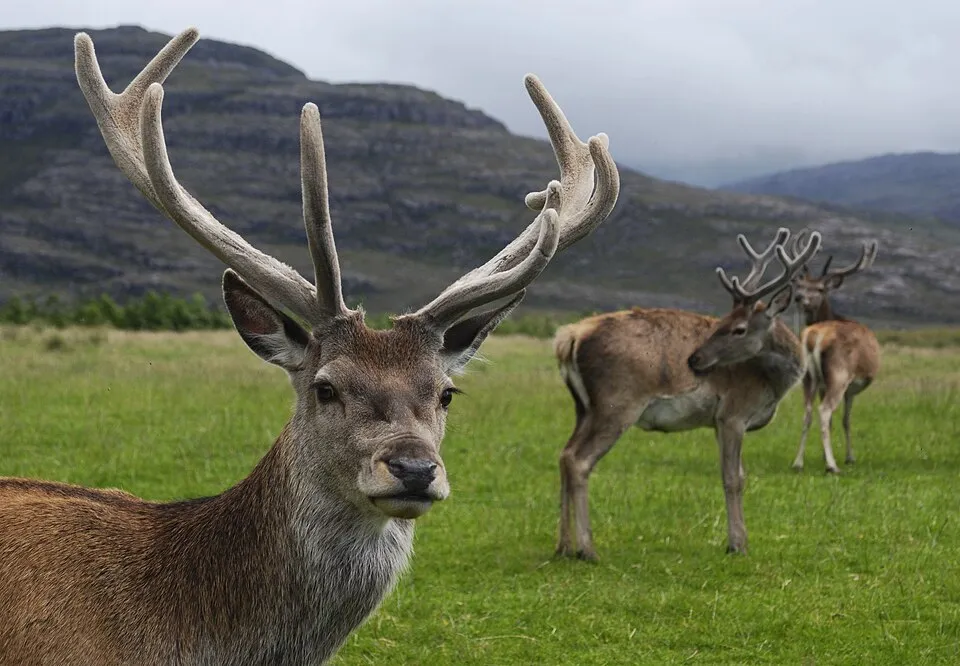
Photo: Mehmet Karatay · Wikimedia Commons source · CC BY-SA 3.0. Image is presented as a species example.
Key field mark: Branched antlers, often with a crown near the top.
A mature red deer stag typically carries antlers that branch along the main beam and may form a cluster of points near the tip, often called a crown. This shape is useful when distinguishing it from an elk or a fallow deer, but there is considerable variation between individual stags. Red deer tend to have a reddish-brown coat in summer and live in forests, moorland and open landscapes. The selected photograph shows a stag in velvet rather than a completely hardened autumn rack.
Identification tip: The crown at the top is a clue, not an absolute diagnostic rule; younger animals may lack an impressive crown.
5. Fallow Deer (Dama dama)
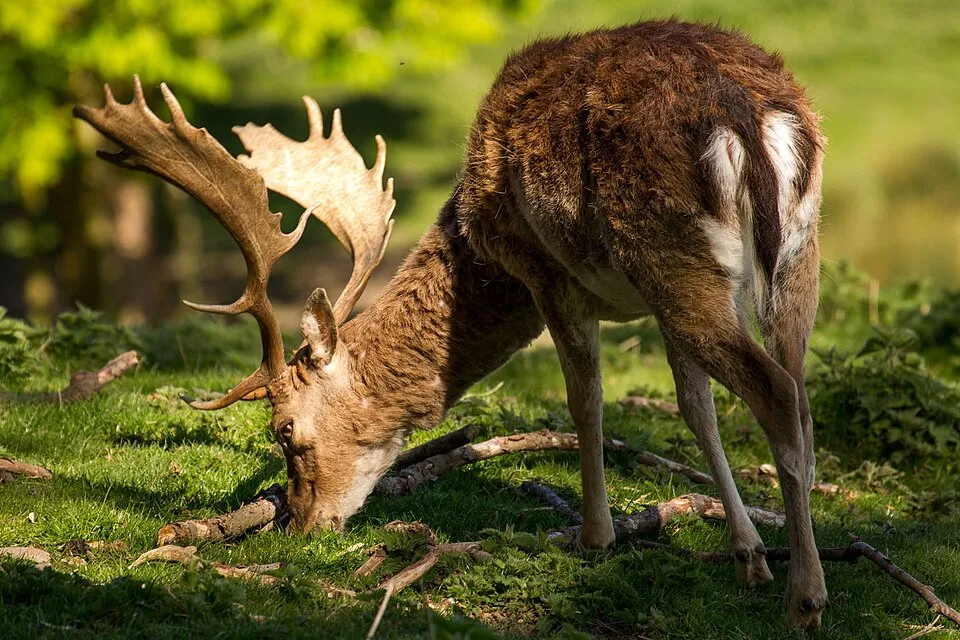
Photo: Michael Palmer · Wikimedia Commons source · CC BY-SA 4.0. Image is presented as a species example.
Key field mark: Flattened, fan-like antler tips.
Fallow deer are among the easiest deer to spot by their broad, flattened antler tips. Their palms resemble a compact fan and are quite different from the expansive paddles of an adult moose. Coat colors range from spotted brown to dark and pale forms, so do not rely on spots alone. A buck is also substantially smaller than a moose. Palmation becomes more evident as a male matures; young bucks often have simpler antlers.
Identification tip: Compare body scale as well as antler silhouette: a small deer with fan-shaped upper antlers may be a fallow deer.
6. White-tailed Deer (Odocoileus virginianus)
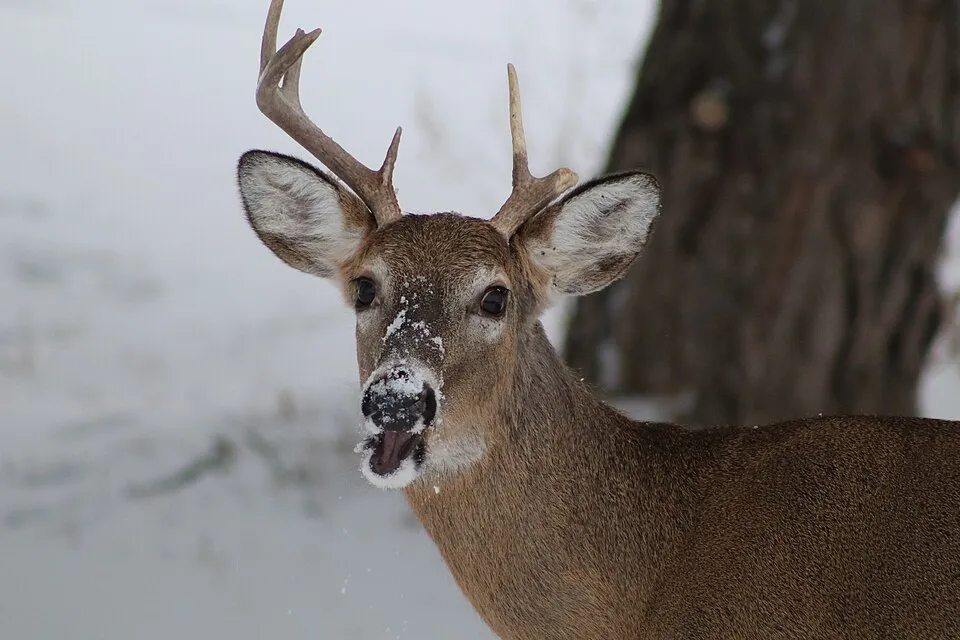
Photo: Liz Julian / USFWS · Wikimedia Commons source · Public domain. Image is presented as a species example.
Key field mark: Tines often rise from a forward-curving main beam.
White-tailed bucks often have a sweeping main beam with individual points growing upward. Hunters and wildlife watchers sometimes count points, but the number is highly variable and is not a reliable way to determine the animal’s exact age. Look for the reddish-to-gray coat, relatively compact body and, especially, the broad white underside of the tail when raised in alarm. The selected photo shows a buck carrying visible antlers.
Identification tip: Compared with mule deer, white-tailed antlers more often show tines sprouting from a single main beam rather than repeated forked divisions.
7. Mule Deer (Odocoileus hemionus)
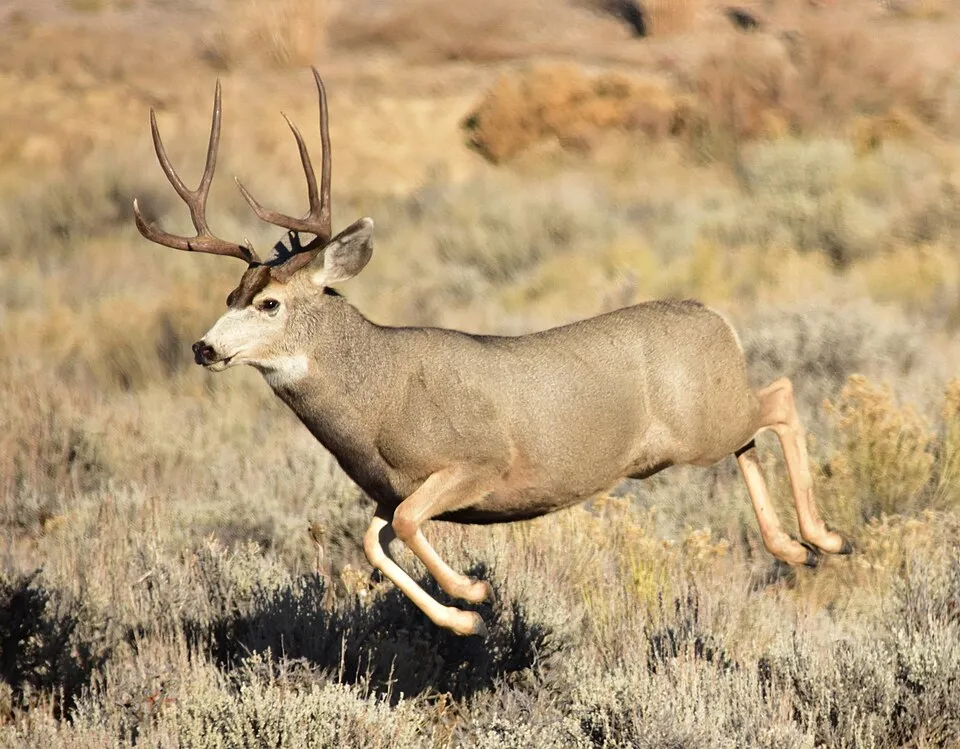
Photo: USFWS Mountain Prairie · Wikimedia Commons source · Public domain. Image is presented as a species example.
Key field mark: Repeated, forked branching on the main antler.
A typical mature mule deer buck shows antler beams that repeatedly split into paired forks, giving a branching silhouette different from many white-tailed bucks. Antler shape varies, so use more than one clue: mule deer have large ears, a black-tipped tail and a distinctive bounding gait known as stotting. Their habitat often includes western shrublands, foothills, mountains and forest edges.
Identification tip: A simple practical rule is forked branching suggests mule deer, while tines off a main beam suggest white-tailed deer—but neither rule identifies every individual.
8. Sika Deer (Cervus nippon)
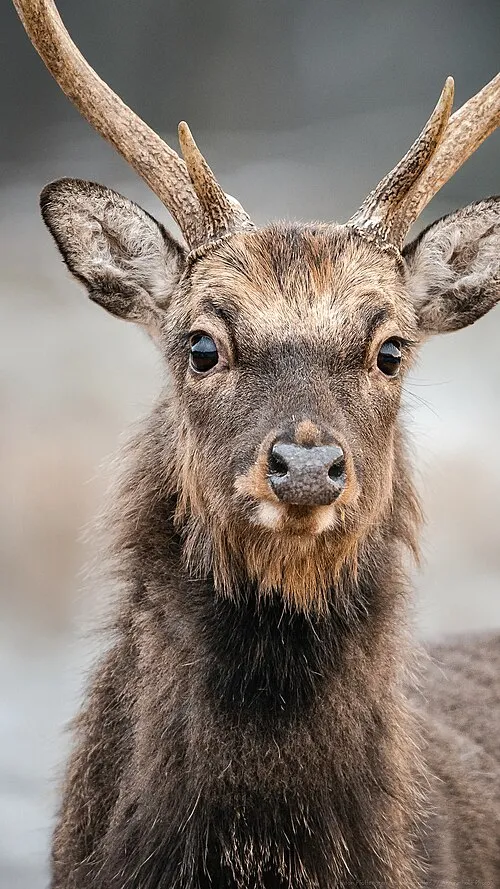
Photo: Ashtonpfaffen · Wikimedia Commons source · CC BY-SA 3.0. Image is presented as a species example.
Key field mark: Fairly upright beams with several distinct tines.
A sika deer stag generally has comparatively slender, upright antlers with distinct points and no wide palms. Many sika show spots in summer, though coat pattern varies by season and population. A white rump patch bordered by darker markings may also be helpful. Sika deer can hybridize with red deer where both occur, complicating field identification in some introduced populations. This makes body proportions and locality important as well as the antlers.
Identification tip: Do not use a single antler characteristic to separate sika from red deer where hybrids are present.
9. Roe Deer (Capreolus capreolus)
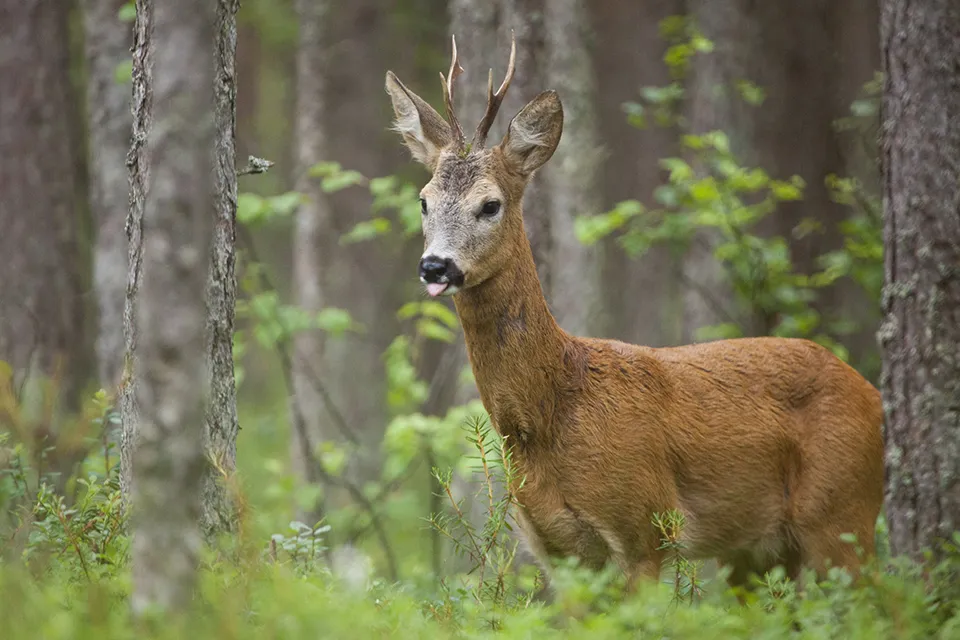
Photo: Hans Markus Antson · Wikimedia Commons source · CC BY-SA 4.0. Image is presented as a species example.
Key field mark: Short, typically three-pointed antlers in mature bucks.
Roe deer are small deer with relatively short antlers, often with up to three main points on each side in mature males. Their antlers are much less imposing than the racks of elk, moose or red deer. The face can appear compact, the tail is tiny, and the rump patch is often prominent. Roe deer have a different annual antler cycle from many larger deer, with males shedding in autumn and growing new antlers through winter.
Identification tip: A small-bodied deer with short, compact, often three-pointed antlers may be a roe deer, but location remains essential.
10. Chital (Axis Deer) (Axis axis)
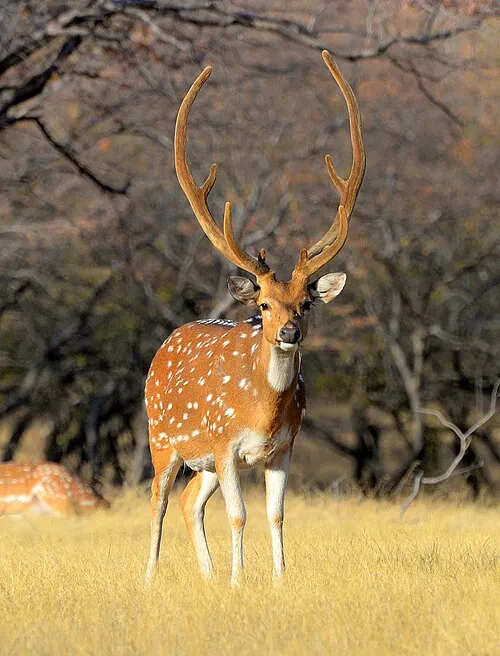
Photo: Ranjan Ghosal · Wikimedia Commons source · CC BY-SA 4.0. Image is presented as a species example.
Key field mark: Typically three tines per side on long slender beams.
The chital or axis deer is often identified by a spotted coat, white underparts and a stag’s elegant, slender antlers. Mature antlers commonly have three prominent points per side, unlike the broad palms of fallow deer or the densely branched antlers of some older red deer. Spots can remain visible in adulthood, which helps distinguish chital from many other deer species. In introduced populations, location is not sufficient by itself, so compare the head and antlers as well.
Identification tip: The strongly spotted adult coat plus graceful three-tined antlers is a useful combination for identifying a chital stag.
Antlers vs. Horns: Why the Difference Matters
Antlers are bony structures that emerge from pedicles on the skull of deer-family mammals. New antlers develop under a vascular covering called velvet. After growth is complete, the velvet dries and is shed. The hardened antlers are generally dropped after the breeding season, and the animal grows a new pair during a later cycle.
True horns, by contrast, usually consist of a bony core covered by a keratin sheath and are normally retained rather than completely shed every year. Bighorn sheep, cattle and goats are horned animals, not antlered deer. The North American pronghorn is a special case: it sheds its outer horn sheath, but that does not make it a deer with antlers.
Our related 20+ Horned Animals guide covers permanent horns and other look-alike head structures in more detail.
How to Identify Deer by Antler Shape: Five Checks
Look for broad palms: very large palms on a giant-bodied animal suggest moose; smaller fan-like palms on a medium deer suggest fallow deer.
Check how the tines branch: repeated forks commonly suggest mule deer, while many white-tailed deer have tines that rise from a main beam.
Look for a crown or curved beams: mature red deer stags often have crown-like points near the tips; caribou can have more irregular curves and forward brow tines.
Judge body size and markings: giant body and long muzzle for moose, pale elk rump, huge mule deer ears, spotted adult chital.
Consider the time of year and region: a deer might have velvet antlers, hard antlers, or no antlers at all depending on season, age and sex.
Which Deer Has the Biggest Antlers?
Among living deer, male moose generally carry the largest antlers by spread. A full-grown bull can grow broad palms far wider than those of a fallow deer. Elk antlers can be extremely long and heavy, but their shape remains more beam-like. “Biggest” can mean maximum width, mass, height, or number of points, so comparisons need to specify the measurement.
Why Do Deer Shed Their Antlers?
Most deer species grow antlers for the breeding season, when antlers help males signal condition and compete with rivals. After mating, changing hormone levels contribute to antler shedding. Later, increasing daylight and hormones support new growth. Because that annual cycle is energetically costly, a rack’s size can be affected by food availability, age and health. A missing antler is not proof that an animal is female.
Can Female Deer Grow Antlers?
Female reindeer or caribou commonly can grow antlers, though there is variation between individuals and populations. Females of most other deer species usually do not have antlers. Rare exceptions can occur because of unusual hormonal conditions. The safest approach is not to infer sex from the presence of a rack without considering the species.
Frequently Asked Questions
1. Are moose and elk actually deer?
Yes. Moose and elk belong to the deer family Cervidae. They are larger than many deer people commonly see, but they are still deer-family mammals.
2. What is the difference between elk and moose antlers?
Mature bull moose usually have large, flattened palmate antlers. Bull elk typically have long main beams with separate points and no broad continuous palm.
3. Do all male deer have antlers?
Most male deer species grow them, but age, injury, physical condition and season can affect whether an individual has visible antlers at a given time. Some deer groups differ in the usual antler pattern.
4. Which deer has antlers shaped like a shovel?
Moose are famous for their large shovel-like antler palms. Mature fallow deer have smaller fan-shaped palmate antlers too.
5. Can you identify a deer by counting antler points?
Point count can be a clue, but it is unreliable on its own. Individual deer can vary widely within one species, and point count does not give an exact age.
6. Do deer antlers hurt when they are growing?
Growing velvet-covered antlers are living, vascularized and sensitive. Once the antlers finish hardening and the velvet is lost, the exposed antler is no longer living tissue in the same way.
7. Do reindeer females really have antlers?
Yes, many female reindeer or caribou grow antlers, unlike the usual pattern in other deer species. Not every individual has the same-sized rack.
8. Is a pronghorn an antlered deer?
No. A pronghorn is not a member of the deer family and has a unique horn structure with a seasonally shed keratin sheath, not true antlers.
Bottom Line
If you need to identify an antlered animal, start with the overall silhouette: broad palms, upward tines, paired forks, or a small three-pointed rack. Then match that shape to the body, markings, region and season. These ten species show how varied deer antlers can be—without confusing them with the horns of sheep, bison or pronghorns.
Scientific Sources and Further Reading
Photo credits are supplied under each photograph. For CC BY-SA materials, retain attribution, link the license, mark any changes, and comply with applicable share-alike requirements. US federal-government public-domain photographs are identified separately. Source and licensing details: image-sources.csv.