Found a green caterpillar with a horn on its tail? You may be looking at a hornworm—the larva of a sphinx or hawk moth. Some have red horns, others have dark ones, and a few lose an obvious horn as they grow. This photo guide compares eight examples using side markings, food plants and the position of the horn.
8 Horned Caterpillars at a Glance
Start with the plant and the markings along the sides. Rear-horn color is helpful, but it should not be your only clue.
| Caterpillar | Scientific name | Best quick clue | Typical food plant |
|---|---|---|---|
| Tomato Hornworm | Manduca quinquemaculata | Eight pale V-shaped side marks and a usually dark rear horn | Tomato, peppers and other nightshade-family plants |
| Tobacco Hornworm | Manduca sexta | Seven slanting pale stripes, commonly with a reddish tail horn | Tomato, tobacco, pepper and other nightshade-family plants |
| White-lined Sphinx Caterpillar | Hyles lineata | Variable dark or green body with lengthwise stripes and a tail horn | Many herbaceous plants, including purslane and other wildflowers |
| Catalpa Sphinx Caterpillar | Ceratomia catalpae | Variable green-to-dark caterpillar with a rear horn | Catalpa trees |
| Virginia Creeper Sphinx Caterpillar | Darapsa myron | Smooth green or brown larva; horn can change with development | Virginia creeper and grape-family vines |
| Tersa Sphinx Caterpillar | Xylophanes tersa | Large false eyes near the front; short rear horn or reduced projection | Plants including buttonbush and other regional hosts |
| Pandorus Sphinx Caterpillar | Eumorpha pandorus | Early larva may show tail horn; older larva can have a button-like tip | Grapevine and Virginia creeper |
| Privet Hawk-moth Caterpillar | Sphinx ligustri | Bright green caterpillar with oblique pale stripes and a curved rear horn | Privet, lilac, ash and other suitable trees or shrubs |
How to Identify a Caterpillar With a Tail Horn
1. Check which end has the horn. In sphinx moth larvae, the horn is near the rear end, not on the head. The little true eyes near the head are different from large decorative eye spots.
2. Count and trace the side stripes. A tomato hornworm commonly shows eight V-shaped marks; a tobacco hornworm has seven slanting lines. Take a side-on photo if possible.
3. Identify the food plant. A larva eating tomato leaves suggests a different set of likely species than one feeding on catalpa, grapevines or privet.
4. Look for growth-stage clues. Some sphinx caterpillars carry a prominent horn when young and a much reduced bump later. Color can also change between molts.
5. Note your region and season. A privet hawk-moth in Britain and a tobacco hornworm in an American vegetable garden may look superficially similar, but they are not interchangeable identifications.
1. Tomato Hornworm (Manduca quinquemaculata)
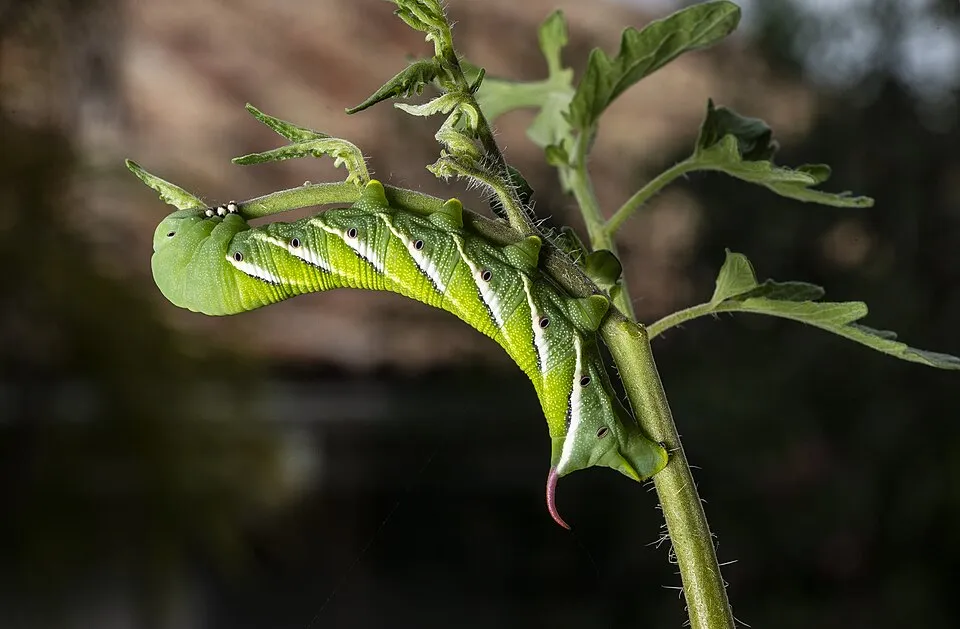
Photo: Thierry Pierrard photographies · Wikimedia Commons source · CC BY-SA 4.0. If modified, note the change.
Host clue: Tomato, peppers and other nightshade-family plants
A full-grown tomato hornworm is a thick, green caterpillar that can approach four inches (10 cm). Its most useful field mark is a sequence of about eight pale, V-shaped markings along the flanks. A dark blue-black tail horn is another common clue, although lighting, age and individual variation can make color harder to judge in a photograph.
Despite its name, you might discover this species on more than tomatoes: other members of the nightshade family can also provide food. Look for chewed foliage and coarse, dark droppings beneath the plant. Before deciding which hornworm you found, photograph the entire side of its body; counting marks is often more dependable than judging horn color alone.
2. Tobacco Hornworm (Manduca sexta)
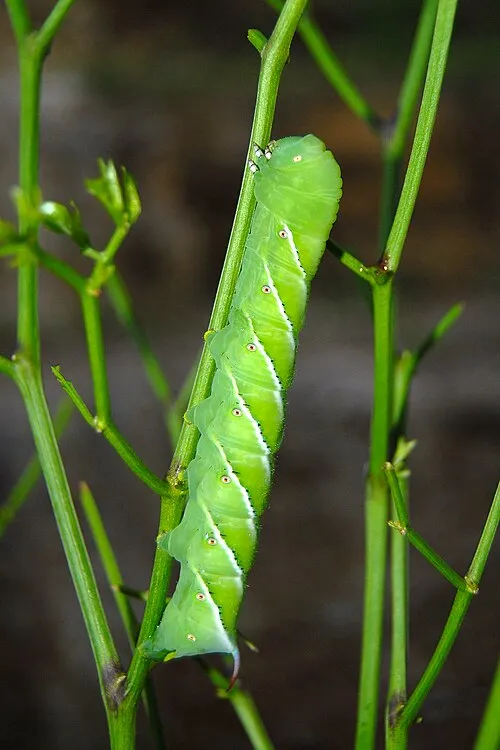
Photo: Sam Fraser-Smith · Wikimedia Commons source · CC BY 2.0. If modified, note the change.
Host clue: Tomato, tobacco, pepper and other nightshade-family plants
This familiar green caterpillar is often mistaken for the tomato hornworm. The tobacco hornworm generally carries seven separate diagonal pale stripes, each often bordered in black, rather than a row of broad V shapes. Its rear horn is typically reddish or orange-red. In some parts of the southeastern United States, tobacco hornworms are the ones gardeners most often encounter on tomato plants.
The fastest comparison is the side pattern: seven slashes versus eight V shapes. The plant alone does not settle the identification, because both species can feed on tomatoes. Although the projecting horn may look like a sting, it is not a venom-injecting stinger. Avoid squeezing or handling unidentified caterpillars unnecessarily.
3. White-lined Sphinx Caterpillar (Hyles lineata)
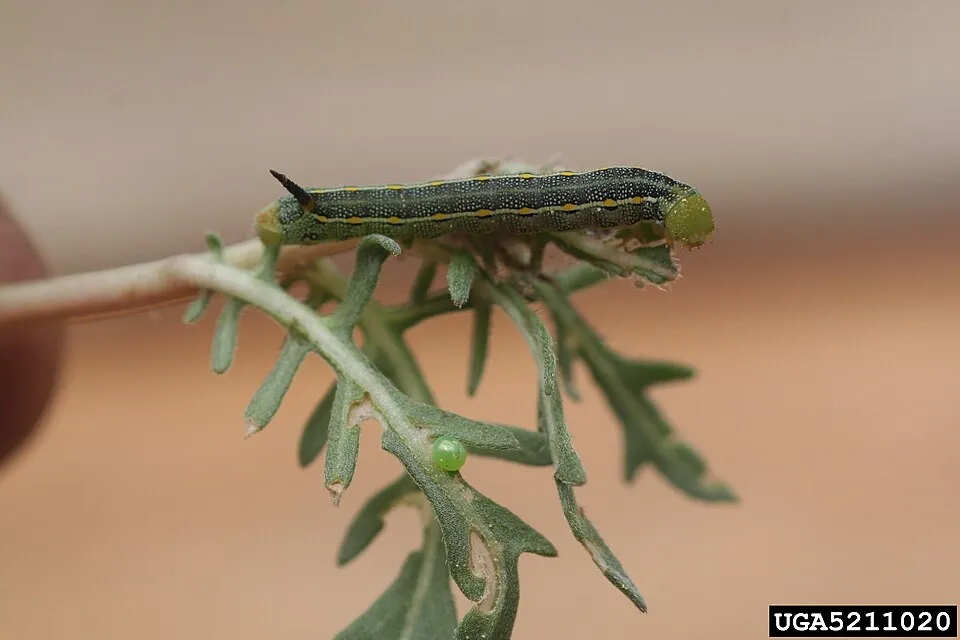
Photo: Whitney Cranshaw / Colorado State University / Bugwood.org · Wikimedia Commons source · CC BY 3.0 US. If modified, note the change.
Host clue: Many herbaceous plants, including purslane and other wildflowers
White-lined sphinx caterpillars are much more variable than the typical green garden hornworm. They can be green, dark brown or nearly black, with long pale lines and sometimes yellow or orange spots. A rear horn helps identify them as sphinx moth larvae, but color alone is especially unreliable for this species.
These caterpillars may appear in numbers in open areas or gardens after periods of favorable growth. They feed on a wide range of low-growing plants rather than concentrating on tomatoes. Check the lengthwise striping, body proportions and host plant together, and remember that two individuals of the same species can look surprisingly different.
4. Catalpa Sphinx Caterpillar (Ceratomia catalpae)
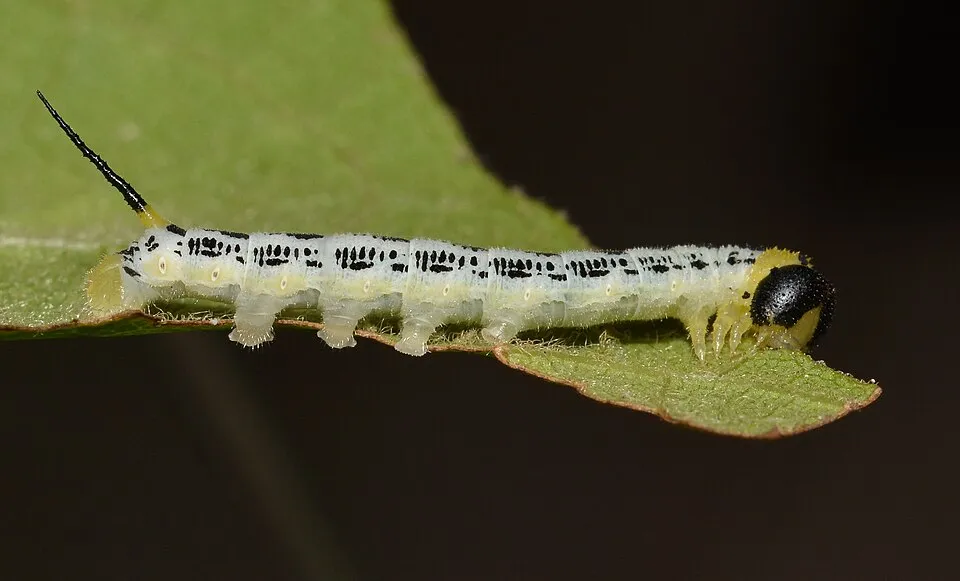
Photo: Andy Reago & Chrissy McClarren · Wikimedia Commons source · CC BY 2.0. If modified, note the change.
Host clue: Catalpa trees
Also called the catalpa worm, this species is closely associated with catalpa trees. Caterpillars can be yellowish-green, dark or patterned with contrasting bands, and they have a pointed structure toward the rear. The coloration varies sufficiently that a single photograph is a poor representation of every individual.
Host plant is the most helpful clue: when a large horned caterpillar is eating catalpa leaves, this species becomes a strong candidate. Catalpa worms are sometimes collected as fishing bait, but the most useful feature for a naturalist is the relationship between caterpillar and tree. Do not confuse its variable stripes with the characteristic V-shaped marks of tomato hornworms.
5. Virginia Creeper Sphinx Caterpillar (Darapsa myron)
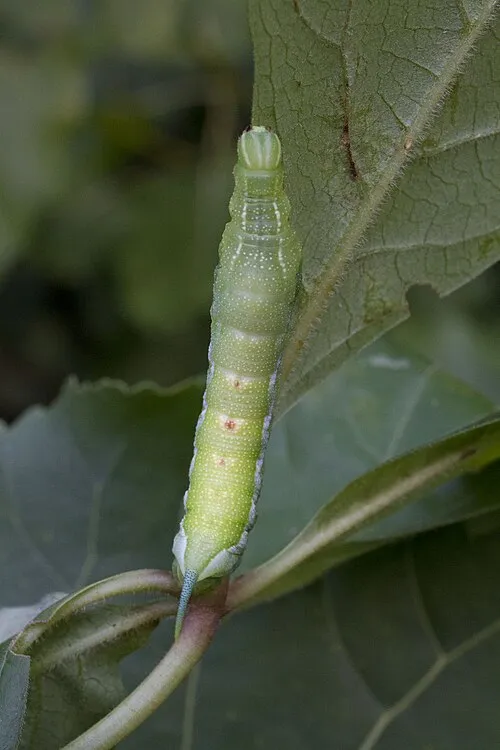
Photo: Kristof Zyskowski & Yulia Bereshpolova · Wikimedia Commons source · CC BY 2.0. If modified, note the change.
Host clue: Virginia creeper and grape-family vines
A Virginia creeper sphinx caterpillar is an excellent example of why the word “hornworm” does not guarantee that an obvious long horn will be visible at every age. Younger larvae may show a more noticeable rear projection, while it can become shorter or altered as the caterpillar develops. The body is generally smooth, and colors can shift from green to brown.
The safest starting point is the vine on which it feeds. Virginia creeper and related grape-family plants are stronger clues than a one-time snapshot of its tail. If the rear end seems blunt, do not rule out sphinx moth larvae: developmental stage matters.
6. Tersa Sphinx Caterpillar (Xylophanes tersa)
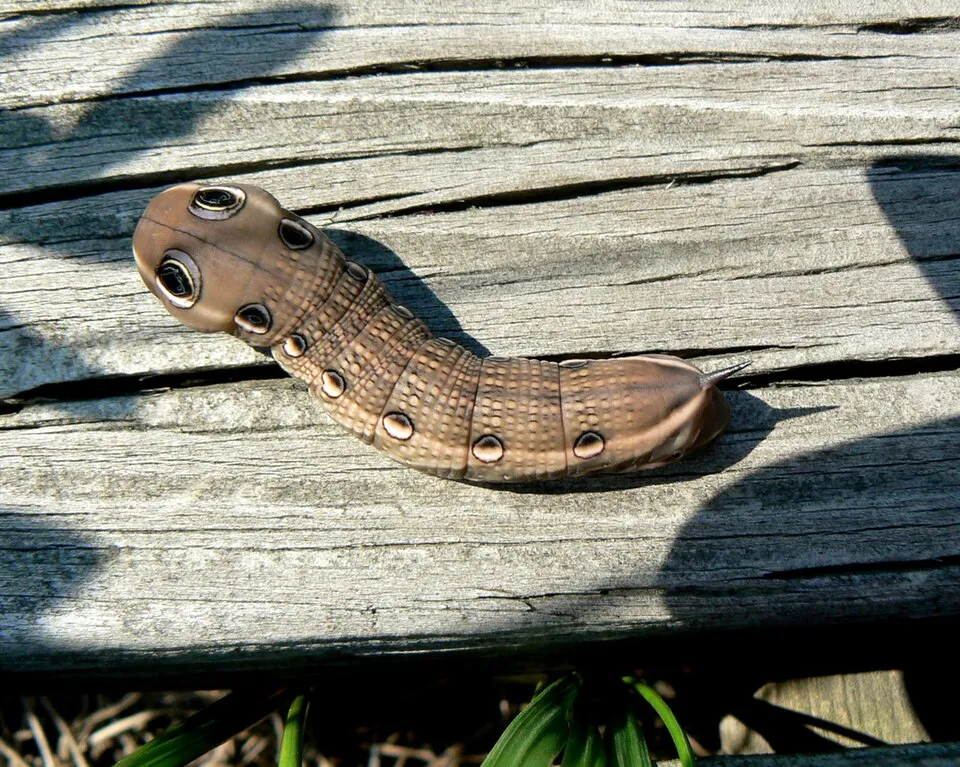
Photo: Benimoto · Wikimedia Commons source · CC BY 2.0. If modified, note the change.
Host clue: Plants including buttonbush and other regional hosts
The tersa sphinx larva may attract attention because of prominent eye-like markings toward the front of its body. Those dark spots are not its real eyes. Some larvae show a distinct slender rear horn, while later development can change how noticeable that feature is. Individuals can be green or brown.
Do not identify this species by the apparent eye spots alone, as several sphinx moth larvae use similar visual defenses. Check the host plant, body shape and tail end, and use a regionally appropriate insect identification guide before reaching a firm conclusion.
7. Pandorus Sphinx Caterpillar (Eumorpha pandorus)
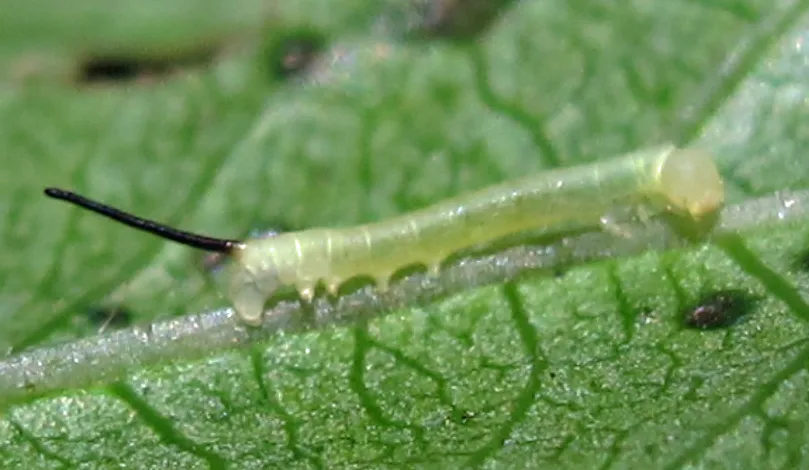
Photo: Jacy Lucier · Wikimedia Commons source · CC BY-SA 4.0. If modified, note the change.
Host clue: Grapevine and Virginia creeper
The Pandorus sphinx is a particularly useful identification lesson because its appearance changes with each growth stage. Young larvae can have a clear tail horn, while later caterpillars may replace the obvious horn with a rounded, button-like structure. Mature individuals can have dramatic side patterns and large eye-like markings.
The credited photograph shows an early larva, not every stage of this moth. When photographing a candidate, include the tail and any nearby grapevine or Virginia creeper leaves. A very large, patterned larva with no long spike can still belong to a group whose younger members were conspicuously horned.
8. Privet Hawk-moth Caterpillar (Sphinx ligustri)
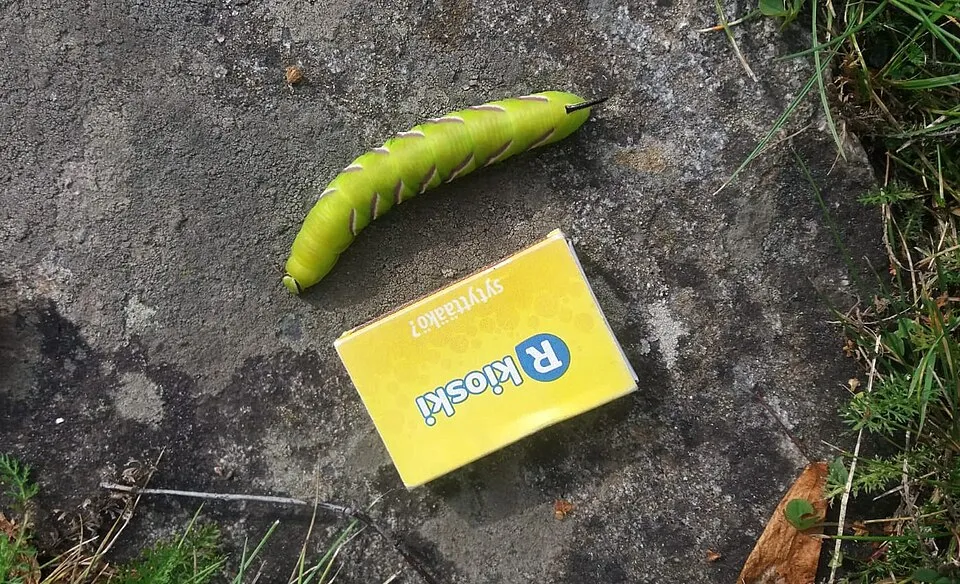
Photo: Joe K. · Wikimedia Commons source · CC BY-SA 4.0. If modified, note the change.
Host clue: Privet, lilac, ash and other suitable trees or shrubs
The privet hawk-moth is a familiar European species. Its large green larva often displays conspicuous diagonal pale stripes edged in purple or darker color, along with a curved horn at the back. It can resemble American tomato-feeding hornworms in shape, but the regional distribution and food plants are different.
This is the only predominantly European example in this list, included for English-speaking readers in the UK. Look at privet or lilac rather than tomato as the first host-plant clue. The photograph includes a matchbox as a size reference; it should not be interpreted as evidence of a dangerous sting.
Tomato Hornworm vs. Tobacco Hornworm: The Fastest Comparison
| Feature | Tomato hornworm | Tobacco hornworm |
|---|---|---|
| Scientific name | Manduca quinquemaculata | Manduca sexta |
| Side markings | Usually eight pale V shapes | Usually seven slanting pale stripes |
| Tail horn | Often dark blue-black | Often orange-red |
| Food plants | Tomato and other nightshade plants | Tomato and other nightshade plants |
| Most reliable everyday clue | V-shaped side pattern | Separate diagonal side stripes |
These are typical traits, not guarantees for every individual photograph. Both species can eat tomatoes, so a name based only on the host plant may be wrong. University extension guides recommend checking the side markings and tail horn together.
Is a Green Caterpillar With a Horn Poisonous?
For common tomato and tobacco hornworms, the tail horn is not a venomous stinger. It is a projecting part of the caterpillar's body, not a needle used to inject toxin. Their main garden impact is eating leaves and sometimes fruit. They are also food for birds and hosts for natural enemies such as tiny parasitoid wasps.
However, “caterpillar with a pointy end” is not a sufficient safety test. Some completely different caterpillar families carry venomous or irritating spines elsewhere on the body. Do not touch an unfamiliar caterpillar based only on a web photo. If you must move a hornworm off a plant, use a leaf or small branch rather than gripping it.
What to Do if You Find a Hornworm on Tomatoes
First confirm the insect instead of automatically treating every caterpillar as a pest. Look for large irregular holes in leaves, stripped stems and dark pellets of frass. Inspect leaf undersides and nearby stems, especially when a caterpillar has blended into green foliage.
On a small planting, hand removal can be enough if you choose to protect the crop. Place unwanted hornworms on suitable vegetation away from crops only where appropriate and permitted; do not move nonnative insects to new environments. Caterpillars carrying white parasitoid cocoons are already being used by natural predators, and gardeners often leave them in place so those insects can emerge. Follow local extension guidance before applying pesticides.
Frequently Asked Questions
What is the horn on the back of a caterpillar?
In many sphinx moth larvae it is a caudal horn—a tapering projection toward the rear of the body. It is not a stinging organ.
Can a tomato hornworm sting you?
No. The familiar rear horn of a tomato hornworm does not inject venom. Avoid handling unknown caterpillars, since other species can have irritating hairs or spines.
What caterpillar has a red horn?
A tobacco hornworm, Manduca sexta, commonly has a reddish tail horn. Check for seven diagonal side stripes as well.
What caterpillar has a black horn?
A tomato hornworm, Manduca quinquemaculata, often has a dark tail horn. Eight V-shaped side markings are a useful supporting clue.
Do all hornworms turn into butterflies?
No. The hornworms in this guide develop into moths, principally hawk moths or sphinx moths in the family Sphingidae.
Why does my hornworm have no visible horn?
It could be at a later growth stage, have a reduced projection, or be a look-alike species. Some larvae, such as Pandorus sphinx caterpillars, change the appearance of the tail end as they grow.
Can hornworms damage plants?
Yes. Tomato and tobacco hornworms can rapidly eat foliage on nightshade-family crops. Other species feed primarily on different host plants, such as catalpa trees or grapevines.
How can I identify a hornworm from a picture?
Photograph the full side of the body, rear projection, head markings and host plant. Then compare several features instead of making the identification from color alone.
Explore More Caterpillar and Insect Guides
For a broad introduction, see our Types of Caterpillars guide. Curious about disguise rather than rear horns? Explore snake-mimicking caterpillars. For the bigger biological picture, read Are Insects Animals?
Sources and Further Reading
This identification guide was prepared using university extension resources. Image author and license information is given beneath each photograph.