 LC
LC
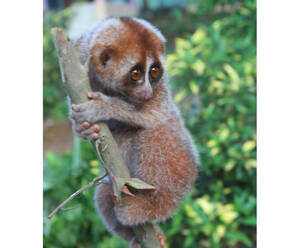
Nycticebus menagensis
Nycticebus menagensis,Philippine Slow Loris
Philippine Slow Loris (Nycticebus menagensis) is a primate of the order Prosimian, a slow loris native to the northern and eastern···
Explore mammals from tiny bats and rodents to primates, carnivores, ungulates, whales, and elephants. Each profile connects core facts with habitat, lifespan, traits, and conservation information.

Use these shortcuts to move into more specific animal groups.
Primates are an important order of mammals known for their advanced cognitive abilities, complex social structures, and flexible limbs. This group includes humans, monkeys, and apes, all of which have played a significant role in understanding evolution and biodiversity.
Scientific Name: Primates
Key Characteristics:
Highly Developed Brain: Complex cognitive functions and social behavior.
Flexible Limbs: Most species have grasping hands and opposable thumbs.
Facial Structure: Forward-facing eyes provide excellent depth perception.
Strong Social Bonds: Most primates live in groups with intricate social dynamics.
Reproduction: Typically low reproductive rates, with extended care for offspring.
Ecological Roles:
Seed Dispersers: Help maintain forest ecosystems by spreading seeds.
Food Chain Members: Act as both predators and prey.
Evolutionary History:
Originated about 55 million years ago during the Paleocene epoch.
Evolved from early arboreal mammals, adapting to a wide range of habitats.
Humans (Homo sapiens) represent the pinnacle of primate evolution.
Primates are divided into two suborders: Strepsirrhines (primitive primates) and Haplorhines (advanced primates).
These are the more primitive primates, with enhanced olfactory senses and nocturnal habits.
Examples: Lemurs, lorises, and aye-ayes.
| Taxonomic Level | Family | Genus | Representative Animals |
|---|---|---|---|
| Lemuridae | Lemuridae (Lemurs) | Lemur | Ring-tailed lemur, mouse lemur |
| Daubentoniidae | Daubentoniidae (Aye-ayes) | Daubentonia | Aye-aye |
| Lorisidae | Lorisidae (Lorises) | Loris | Slender loris |
These are more advanced primates, characterized by excellent vision and greater intelligence.
Divided into two infraorders: Platyrrhines (New World monkeys) and Catarrhines (Old World monkeys and apes).
| Taxonomic Level | Family | Genus | Representative Animals |
|---|---|---|---|
| New World Monkeys | |||
| Cebidae | Cebidae (Capuchins) | Cebus | Capuchins, squirrel monkeys |
| Atelidae | Atelidae (Howler monkeys) | Alouatta | Howler monkeys, spider monkeys |
| Old World Monkeys | |||
| Cercopithecidae | Cercopithecidae (Monkeys) | Macaca | Rhesus macaques, baboons |
| Colobinae | Colobinae (Leaf monkeys) | Nasalis | Proboscis monkeys |
| Great Apes | |||
| Hylobatidae | Hylobatidae (Gibbons) | Hylobates | White-cheeked gibbon |
| Hominidae | Hominidae (Great apes) | Pan | Chimpanzees, gorillas |
| Homo | Humans (Homo sapiens) |
Primates exhibit advanced learning, memory, and problem-solving capabilities. They can use tools, communicate, and form intricate social relationships.
Forward-facing eyes provide exceptional stereoscopic vision, which aids in climbing, hunting, and navigating complex environments.
Primates have prehensile hands and feet, enabling them to grasp branches and manipulate objects—a crucial adaptation for arboreal life.
Primates typically have fewer offspring, with extended parental care ensuring the survival and development of their young.
Early Primates:
Emerged about 55 million years ago during the Paleocene epoch.
Adapted to arboreal life, feeding on insects and fruits in tropical forests.
Diversification:
During the Oligocene and Miocene epochs, primates spread across various continents and diversified into strepsirrhines and haplorhines.
Human Evolution:
The genus Homo appeared around 2.5 million years ago, with Homo sapiens emerging as the most advanced species.
Seed Dispersers:
By consuming fruits and dispersing seeds, primates maintain the health and diversity of forest ecosystems.
Trophic Importance:
Primates act as both predators (eating insects and small animals) and prey (for large birds and carnivores).
Study Subjects:
Their complex social behavior and intelligence make them valuable for studying human evolution and social systems.
Examples: Ring-tailed lemurs, aye-ayes.
Distribution: Found primarily in Madagascar and parts of Southeast Asia.
Examples: Capuchins, howler monkeys.
Distribution: Tropical forests of Central and South America.
Examples: Baboons, colobus monkeys.
Distribution: Widespread across Africa and Asia.
Examples: Gorillas, chimpanzees, humans.
Distribution: Africa, Southeast Asia, and globally (humans).
Habitat Loss:
Deforestation and agricultural expansion threaten primate habitats.
Illegal Hunting:
Primates are hunted for bushmeat and the exotic pet trade.
Conservation Efforts:
Establishing wildlife reserves.
Implementing anti-poaching laws.
Raising public awareness about primate conservation.
Classification:
Suborder: Strepsirrhines
Family: Lemuridae
Genus: Lemur
Habitat: Madagascar.
Features: Distinctive black and white tail rings, highly social.
Classification:
Suborder: Haplorhines
Family: Cercopithecidae
Genus: Macaca
Habitat: Forests of Asia.
Features: Adaptable to various environments, often lives near humans.
Classification:
Suborder: Haplorhines
Family: Hominidae
Genus: Pan
Habitat: Tropical rainforests of Africa.
Features: Close genetic similarity to humans (98%).
Primates are among the most intelligent and socially complex animals on Earth. From arboreal lemurs to tool-using chimpanzees and humans, this order showcases the diversity and adaptability of life. This detailed classification and historical overview provide users with insights into the evolution, roles, and conservation of primates. For further customization or additions, feel free to reach out!
Search the animals shown on this page or narrow them by IUCN conservation code.
LC
Nycticebus menagensis,Philippine Slow Loris
Philippine Slow Loris (Nycticebus menagensis) is a primate of the order Prosimian, a slow loris native to the northern and eastern···
 LC
LC
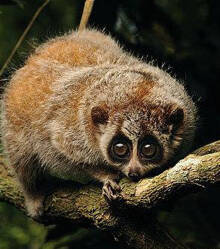
Nycticebus kayan,Kayan Slow Loris
Kayan Slow Loris (Scientific name: Nycticebus kayan) is named after the Kayan River that flows through its territory. It was disco···
 LC
LC
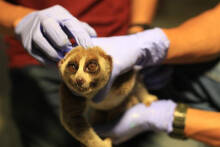
Nycticebus hilleri,Sumatran Slow Loris
Sumatran Slow Loris (scientific name: Nycticebus hilleri) foreign name Sumatran Slow Loris, no subspecies.Sumatran Slow Loris is a···
 LC
LC
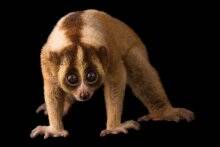
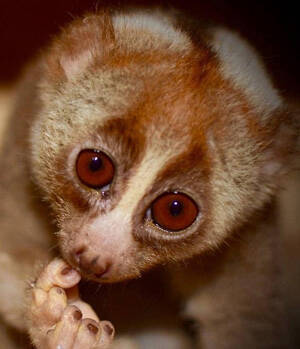
Nycticebus javanicus,Javan Slow Loris
Javan Slow Loris (scientific name: Nycticebus javanicus) is also known as Javan Slow Loris. It has two subspecies.The Javan slow l···
 LC
LC
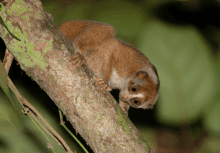
Nycticebus coucan, Greater Slow Loris、 Slow Loris、Sunda Slow Loris, Loris lent, Loris Lento,Middle Slow Loris
The slow loris (scientific name: Nycticebus coucan) is called Greater Slow Loris, Slow Loris, Sunda Slow Loris in English, Loris l···
 LC
LC
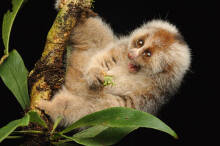
Nycticebus borneanus,Bornean Slow Loris
Kalimantan slow loris (scientific name: Nycticebus borneanus), foreign name Bornean Slow Loris, no subspecies.The Kalimantan slow ···
 LC
LC
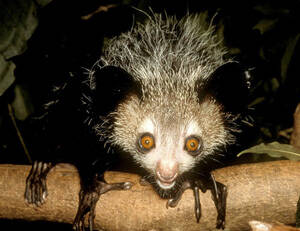
Nycticebus bancanus,Bangka Slow Loris
Bangka Island Slow Loris (scientific name: Nycticebus bancanus), also known as Bangka Slow Loris in English, is a species of Prima···
 LC
LC
Daubentonia madagascariensis,Aye-aye
Daubentonia madagascariensis (scientific name: Aye-aye) is named after the length of its fingers and toes (middle finger is partic···
 LC
LC
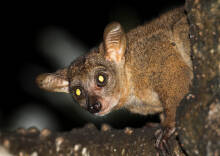
Otolemur crassicaudatus,Rough-tailed monkey
Otolemur crassicaudatus (Latin name: Otolemur crassicaudatus) is a nocturnal primate and the largest member of the family Otolemur···
 LC
LC
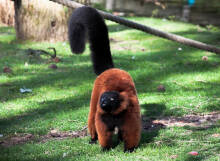
Varecia rubra,Red Ruffed Lemur
The red-collared lemur (scientific name: Varecia rubra), whose foreign name is Red Ruffed Lemur, is one of two types of collared l···
 LC
LC
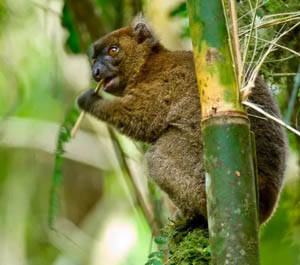
Prolemur simus,Greater Bamboo Lemur
Greater Bamboo Lemur (scientific name: Prolemur simus) is a monotypic species of the genus Prolemur, with only about 140 individua···
 LC
LC
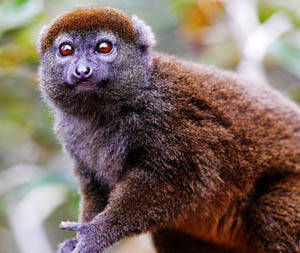
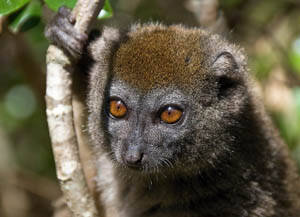
Hapalemur simus,Greater Bamboo Lemur
The Greater Bamboo Lemur (scientific name: Hapalemur simus) is the largest lemur in the genus Hapalemur.The natural forests of Mad···
 LC
LC
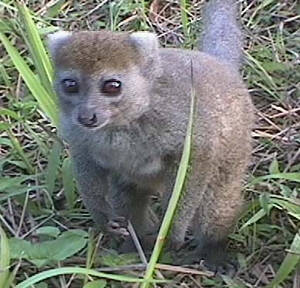
Hapalemur occidentalis
The Sanhe tame lemur (scientific name: Hapalemur occidentalis) lives in tropical rainforests or dry forests or shrubs. Some live i···
 LC
LC
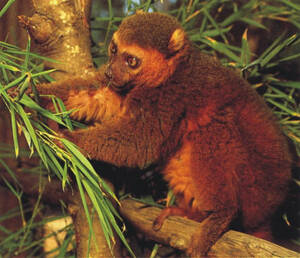
Hapalemur griseus,Alaotran Gentle Lemur, Alaotra Reed Lemur
The scientific name of the gray lemur is Hapalemur griseus, and its foreign names are Alaotran Gentle Lemur and Alaotra Reed Lemur···
 LC
LC
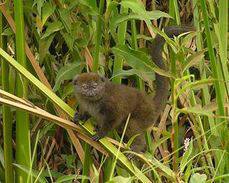
Hapalemur aureus,Golden Lemur
Golden Bamboo Lemur (scientific name: Hapalemur aureus) is a small lemur.Golden Bamboo Lemurs live in groups, with 2-6 members, us···
 LC
LC
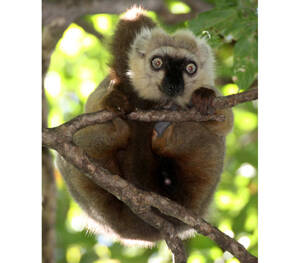
The Alaotra Lake tame lemur (scientific name: Hapalemur alaotrensis) is listed as "critically endangered" on the IUCN Re···
 LC
LC
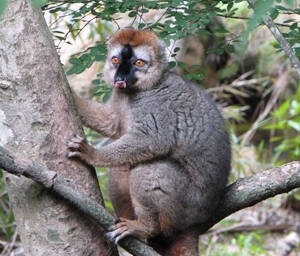
Eulemur sanfordi,Sanford's Brown Lemur
Sanford's Brown Lemur (scientific name: Eulemur sanfordi) is called Sanford's Brown Lemur in foreign language. It has no s···
 LC
LC
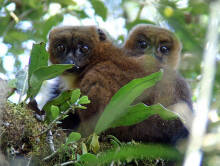
Eulemur rufus,Red Brown Lemur,Red-fronted lemur
Red Brown Lemur (scientific name: Eulemur rufus) lives in small groups, usually 8-10 individuals. Although the body shape and limb···
 LC
LC
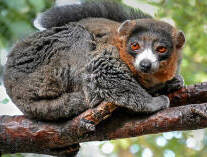
Eulemur rubriventer,Red-bellied Lemur,Red-bellied lemur
Red-bellied Lemur (scientific name: Eulemur rubriventer) is called Red-bellied Lemur in foreign language. It has no subspecies and···
 LC
LC
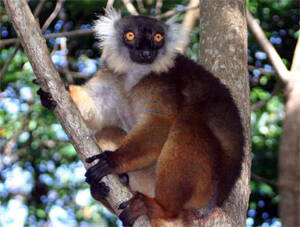
Eulemur mongoz,Mongoose Lemur,Mongoose lemur
Mongoose Lemur (scientific name: Eulemur mongoz) is called Mongoose Lemur in foreign language. It has no subspecies and is a mediu···
 LC
LC
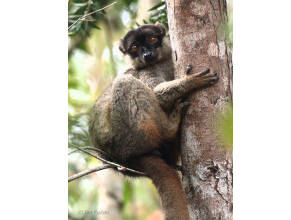
Eulemur macaco,Black Lemur
Black Lemur (scientific name: Eulemur macaco) is mainly found in the humid tropical rainforests of Madagascar, and some prefer to ···
 LC
LC
Eulemur fulvus,Brown Lemur
Brown Lemur (scientific name: Eulemur fulvus) is a medium-sized lemur.Brown Lemur is active at different times throughout the day ···
 LC
LC
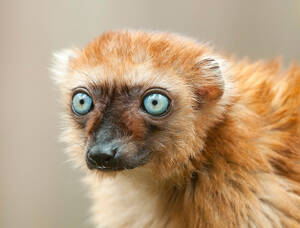
Eulemur flavifrons,Blue-eyed Black Lemur
Blue-eyed Black Lemur (scientific name: Eulemur flavifrons) is known as Blue-eyed Black Lemur in English. It was confirmed as an i···
 LC
LC
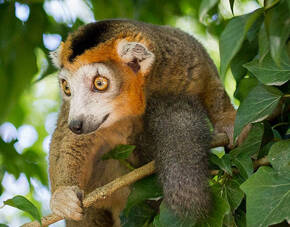
Eulemur coronatus,Crowned Lemur
Crowned Lemur (scientific name: Eulemur coronatus) is the smallest species in the genus.Crowned Lemurs live in groups, but the gro···