An anteater is a specialized mammal that feeds mainly on ants and termites. It is best known for its long snout, powerful claws, sticky tongue, and unusual feeding style. Anteaters live in Central and South America, where they search forests, grasslands, wetlands, and savannas for insect nests. Although people often think of the giant anteater first, there are several anteater species, each adapted to a slightly different habitat and lifestyle.
Anteaters are among the most distinctive mammals in the world. They do not have the kind of teeth most mammals use for chewing, and instead rely on a long narrow head and an extraordinary tongue to capture prey. Their body shape may look strange at first, but every part of it helps them survive on a diet of social insects.
In this guide, you will learn what an anteater is, where it lives, what it eats, how big it gets, and why it is so well adapted to feeding on ants and termites.
Quick facts
| Feature | Anteater |
|---|---|
| Animal type | Mammal |
| Main diet | Ants and termites |
| Range | Central and South America |
| Main body traits | Long snout, sticky tongue, large claws, strong forelimbs |
| Best-known species | Giant anteater |
| Other species | Northern tamandua, southern tamandua, silky anteater |
| Teeth | No true teeth |
| Main defense | Powerful claws and strong forelimbs |
What is an anteater?
An anteater is a mammal specialized for eating ants and termites. The name may sound simple, but it describes a highly unusual animal with a body built almost entirely around opening insect nests and collecting thousands of tiny prey items quickly.
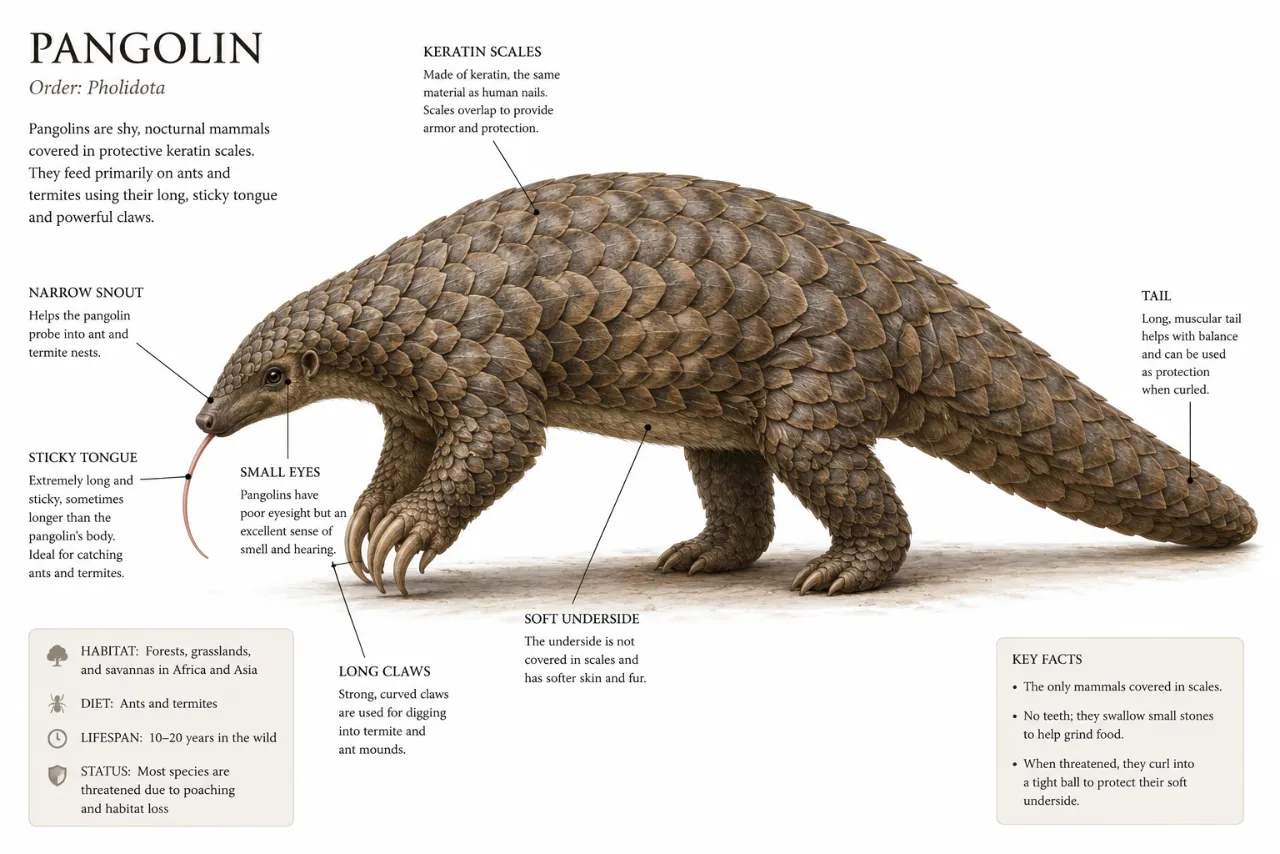
Anteaters belong to a group of mammals from the Americas that also includes sloths and armadillos as more distant relatives. They are not related to the aardvark of Africa or the echidna of Australia, even though those animals also eat ants. This is a good example of different animal groups evolving similar feeding strategies independently.
In everyday English, people often write the name as anteater, although ant eater is still sometimes used informally.
Where do anteaters live?
Anteaters live in Central and South America. Their range depends on the species, but overall they are associated with tropical and subtropical environments, including forests, savannas, grasslands, scrub, and wetlands.
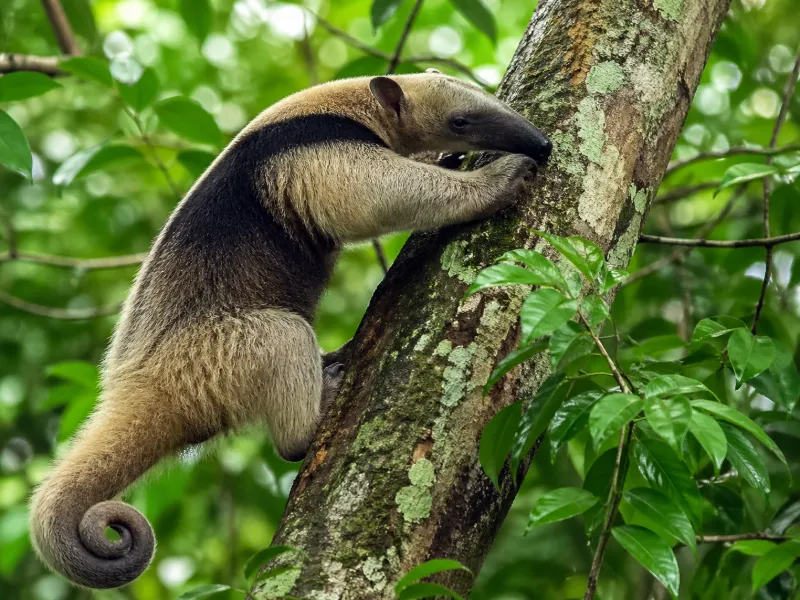
The giant anteater is often linked with open habitats such as grasslands, savannas, and marshy areas, although it can also use forest edges. Tamanduas are more flexible and often spend time both on the ground and in trees, especially in wooded habitats. The silky anteater is the most tree-dwelling of all and is closely tied to tropical forest life.
Because ant and termite colonies are widespread in warm environments, anteaters can survive in a range of habitats as long as food, shelter, and enough undisturbed land remain available.
What do anteaters eat?
Anteaters mainly eat ants and termites. These insects are abundant, nutritious in large numbers, and available in many warm environments. A single feeding session may involve the anteater tearing open a nest and flicking its tongue in and out rapidly to gather prey.
Different species may emphasize slightly different insect sources depending on habitat, but the overall diet remains similar. Giant anteaters, for example, are especially well known for feeding from ground-based ant and termite nests, while arboreal species may also exploit nests found in trees.
Anteaters do not usually stay at one nest for too long. This helps them avoid severe bites or stings from defending insects and may also allow the colony to recover rather than being destroyed all at once.
How does an anteater eat without teeth?
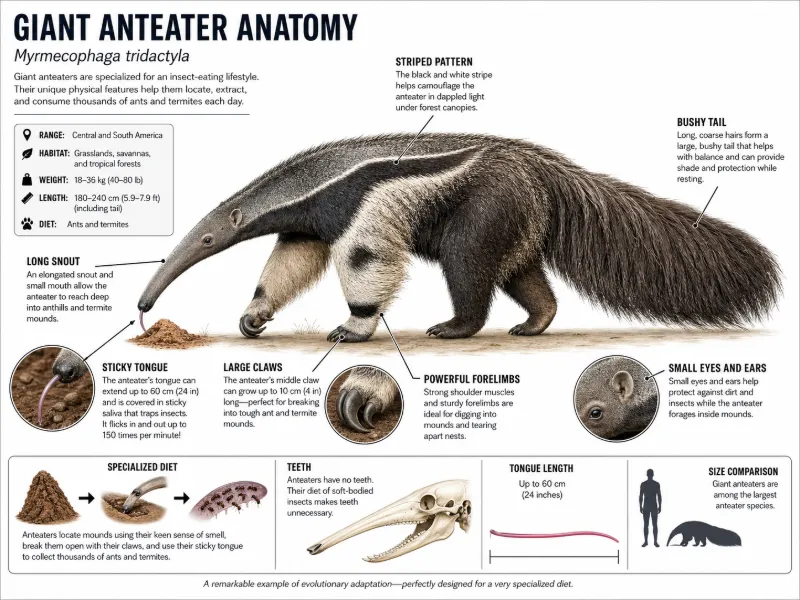
Anteaters have no true teeth, which is one of their most unusual features. Instead of chewing food, they use a long sticky tongue to collect prey and then swallow the insects whole.
Once swallowed, the food is processed in the digestive system. The stomach helps break down the insects, and the tough walls of the insect bodies are handled internally rather than by chewing. This works because ants and termites are small and can be eaten in large numbers.
The lack of teeth is not a weakness. It is part of a very specialized feeding system that allows anteaters to focus on speed, efficiency, and insect capture rather than biting or chewing.
Why is the anteater’s tongue so important?
The tongue is one of the most important adaptations an anteater has. It is long, narrow, sticky, and built for rapid movement. This allows the animal to insert it deep into nests, tunnels, and crevices where ants and termites are hiding.
When feeding, an anteater can flick its tongue in and out extremely quickly. The tongue is coated with sticky saliva, so insects cling to it and are pulled back into the mouth. This lets the animal gather large numbers of prey in a short time.
Without this tongue, anteaters would not be able to exploit their food source so effectively. It is the key tool that makes their entire lifestyle possible.
Why do anteaters have such large claws?
Anteaters have strong forelimbs and large claws because they need to break open ant nests, termite mounds, rotting wood, and other insect-rich structures. These claws are powerful digging and tearing tools.
In large species such as the giant anteater, the claws are especially impressive and can look almost oversized. Because they are so long, giant anteaters often walk with the claws curled inward to protect them.
The claws are also important for defense. Although anteaters are not predators in the usual sense, a large anteater can be dangerous if cornered and may use its forelimbs and claws to fend off threats.
How big is an anteater?
Anteater size depends strongly on the species. The giant anteater is by far the largest and can be a very impressive mammal, with a long body, bushy tail, and elongated head. Tamanduas are medium-sized and much smaller than the giant anteater. The silky anteater is tiny by comparison and is one of the smallest specialized insect-eating mammals in its group.
Because the tail can be long and prominent, especially in giant anteaters, the animal may appear even larger than people expect. The giant anteater’s body shape is stretched out and distinctive, making it one of the easiest mammals to recognize at a glance.
So when people ask how big an anteater is, the answer ranges from very small tree-dwelling species to a large ground-dwelling insect specialist.
Types of anteaters
There are four living anteater species usually recognized in common discussions: the giant anteater, the northern tamandua, the southern tamandua, and the silky anteater.
The giant anteater is the largest and most famous. It is mostly terrestrial and is well known for its long bushy tail and striking black-and-white shoulder pattern.
The tamanduas are medium-sized anteaters that spend time both on the ground and in trees. They are often described as more flexible in habitat use than the giant anteater.
The silky anteater is very small and strongly arboreal. It lives in trees and is much less familiar to the general public than the larger species.
What does a giant anteater look like?
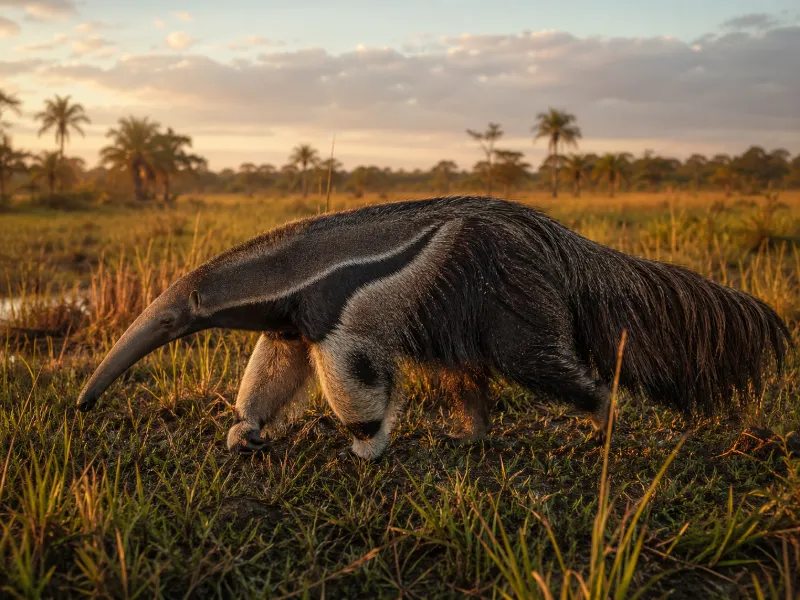
The giant anteater has one of the most unusual body shapes of any mammal. It has a very long narrow head, a tube-like snout, tiny eyes, a large bushy tail, strong limbs, and a coat that often looks shaggy or coarse.
Its black-and-white markings, especially the diagonal shoulder stripe, make it especially recognizable. The front claws are very large, and the animal uses them not only for feeding but also for defense and movement.
At first glance, the giant anteater almost looks like a mammal assembled from several different animals, but every trait is tied to its specialized lifestyle.
Are anteaters dangerous?
Anteaters are not hunting people or large prey, and they generally prefer to avoid conflict. However, that does not mean they are harmless in every situation. A cornered or threatened anteater, especially a giant anteater, can defend itself with powerful forelimbs and claws.
This means they should be treated with respect in the wild and not approached casually. Their body is built for tearing open termite nests, and that same power can be dangerous if directed at a threat.
So the best answer is that anteaters are not aggressive predators, but large individuals can defend themselves effectively if they feel trapped or attacked.
How do anteaters protect themselves?
Their first defense is usually avoidance. Anteaters often rely on camouflage, quiet movement, and staying away from danger rather than actively fighting. Some species are more secretive than people realize, especially those living in forests.
If necessary, an anteater may stand up partly on its hind legs and use its forelimbs to strike. This posture can look dramatic, and it shows how powerful the front part of the body really is.
The giant anteater’s tail may also help with concealment and rest, while tree-living species depend more on climbing and staying in complex vegetation where predators may have trouble reaching them.
Do anteaters climb trees?
Some do, and some do not very often. The giant anteater is mostly a ground-dwelling species and is not the classic climbing type. Tamanduas, by contrast, are much better climbers and often move through trees in search of food or rest sites. The silky anteater is the most specialized tree climber of the group.
This difference matters because people sometimes imagine all anteaters as large ground mammals. In reality, the group includes both terrestrial and arboreal lifestyles.
Tree-climbing ability also affects diet, predator avoidance, and where each species is most likely to be found.
Are anteaters related to aardvarks?
No. Anteaters and aardvarks are not close relatives, even though they look somewhat similar and both eat ants and termites. This similarity is the result of convergent evolution, which means unrelated animals independently evolved similar adaptations for similar diets.
The aardvark lives in Africa and belongs to a very different mammal lineage. Anteaters evolved in the Americas and are part of a separate evolutionary branch.
This is a useful reminder that animals can end up looking alike when they solve the same ecological problem in similar ways.
Why are anteaters important in the ecosystem?
Anteaters help regulate insect populations, especially ants and termites. Because they feed regularly on social insects, they are part of the ecological balance of grasslands, forests, and wetland systems.
They also play a role as medium to large mammals within their ecosystems, interacting with vegetation, soil, predators, and insect colonies. Even animals that seem highly specialized can still matter broadly in the habitats where they live.
Protecting anteaters often means protecting large natural landscapes, since many species need extensive habitat and healthy insect communities to survive well.
Are anteaters endangered?
Conservation status depends on the species and region, but some anteaters face real pressure from habitat loss, road mortality, fire, and human disturbance. Large species such as the giant anteater can be especially vulnerable when grasslands and forest edges are heavily altered.
Smaller forest species may be harder to study, but they can also be affected when tropical habitats are cleared or fragmented. Because anteaters depend on suitable habitat and food availability, environmental change can have serious effects.
In many places, conservation depends on preserving connected natural areas and reducing direct human-caused threats.
Final takeaway
An anteater is a highly specialized mammal built for eating ants and termites. Its long snout, sticky tongue, large claws, strong forelimbs, and unusual toothless mouth all work together to help it exploit insect nests efficiently. Anteaters live in Central and South America and include several species, from the huge giant anteater to the small tree-dwelling silky anteater. Strange-looking though they may be, anteaters are remarkable examples of how evolution can shape a mammal around one very specific way of life.
FAQs
What does an anteater eat?
Anteaters mainly eat ants and termites, though the exact balance depends on the species and habitat.
Where do anteaters live?
Anteaters live in Central and South America in habitats such as forests, savannas, grasslands, and wetlands.
Do anteaters have teeth?
No. Anteaters do not have true teeth and swallow their insect prey whole.
Are anteaters dangerous?
They are not typical aggressive animals, but a threatened anteater, especially a giant anteater, can defend itself with powerful claws.