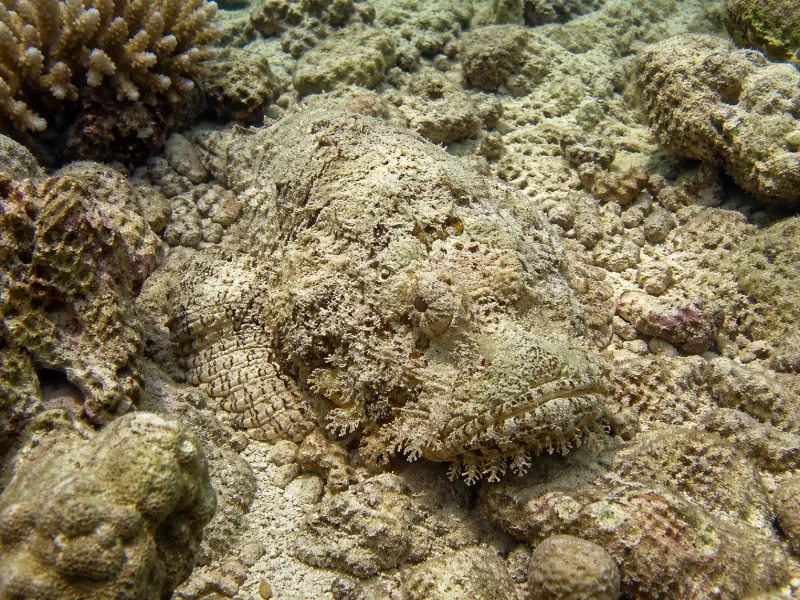
The stonefish is a venomous marine fish best known for its incredible camouflage and extremely painful sting. It usually lies motionless on the seafloor, where its rough body can look so much like a rock or lump of coral that people and predators may not notice it at all. Stonefish live mainly in warm coastal waters of the Indo-Pacific region, and they are considered among the most dangerous fish in the world because of the venom delivered through their dorsal spines.
Although the stonefish has a fearsome reputation, it is not an aggressive hunter of humans. Its danger comes mostly from defense. When stepped on or pressed, its sharp spines can inject venom that causes intense pain and serious medical problems.
In this guide, you will learn what a stonefish is, where it lives, how it hunts, why it is so venomous, and how to stay safe in places where stonefish occur.
Quick facts
| Feature | Stonefish |
|---|---|
| Animal type | Venomous marine fish |
| Main range | Indo-Pacific coastal waters |
| Habitat | Reefs, rocky bottoms, shallow lagoons, sandy or muddy seafloors |
| Main defense | Venomous dorsal spines |
| Main hunting method | Ambush predation |
| Appearance | Rock-like, rough, lumpy, heavily camouflaged |
| Diet | Small fish and crustaceans |
| Main danger to humans | Painful and potentially serious venomous sting |
What is a stonefish?
A stonefish is a venomous bottom-dwelling fish famous for looking almost exactly like part of the seafloor. Its body is thick, rough, and irregular, often covered in textures and colors that resemble rock, coral rubble, algae-covered stone, or encrusted reef surfaces.
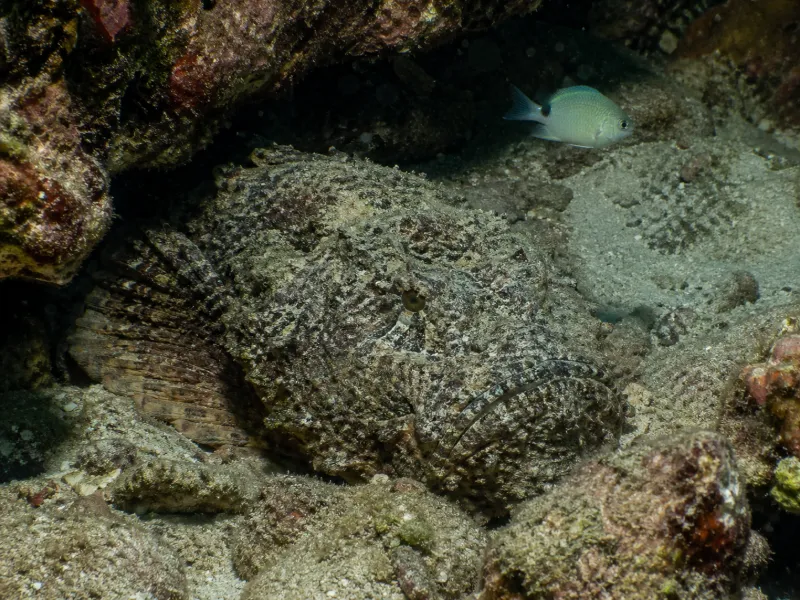
This camouflage is so effective that a stonefish may remain nearly invisible even when it is in plain sight. That is one reason it is such a successful ambush predator and also why it is dangerous to people wading in shallow water.
Stonefish belong to a group of fishes that includes some other highly venomous reef species, but the stonefish is often considered the most extreme example because of both its camouflage and the severity of its sting.
Why is it called a stonefish?
The name comes from its appearance. A stonefish looks like a stone, a lump of reef, or a patch of broken rock on the ocean floor. Its shape is uneven, its skin is textured, and its colors usually blend with the surrounding environment.
Instead of swimming openly through the water like many fish, it often stays still on the bottom and depends on remaining unnoticed. To a small prey animal, it may look like harmless scenery. To a person, it may look like just another rock under the water.
This resemblance is not accidental. It is one of the animal’s most important survival adaptations.
Where do stonefish live?
Stonefish live mainly in warm coastal waters of the Indo-Pacific region. They are especially associated with tropical and subtropical marine habitats, including shallow lagoons, coral reefs, rocky bottoms, estuaries, and sandy or muddy coastal zones.
Some species are found in very shallow water, which increases the chance of accidental encounters with people. Others may occur slightly deeper, but they are generally linked with the seafloor rather than open water.
Because they rely on camouflage, stonefish are most likely to be found where rocks, coral fragments, algae, and uneven seafloor textures give them a visual advantage.
What does a stonefish look like?
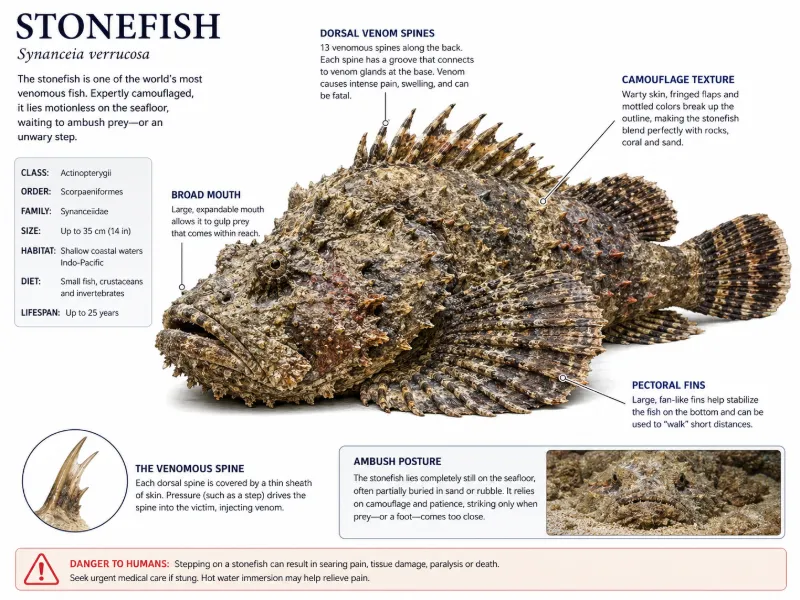
A stonefish usually has a heavy, squat body with a broad head, upward-facing mouth, small eyes, and rough skin covered with lumps, ridges, and irregular projections. Its colors often include brown, gray, yellowish, reddish, or mottled tones that match reef or rocky surroundings.
It does not look sleek or elegant like many fish. Instead, it looks almost misshapen, which is exactly what helps it disappear into the background. Some individuals appear crusted over or algae-stained, making them even harder to notice.
Along the back are the dorsal spines, which are the structures responsible for delivering venom. These spines are one of the most dangerous features of the fish.
How does a stonefish hunt?
The stonefish is an ambush predator. Rather than chasing prey over long distances, it stays motionless and waits for small fish or crustaceans to come close enough to capture.
When prey comes within range, the stonefish can strike with surprising speed. Its mouth opens rapidly, creating suction that pulls the prey inward. This means it can catch animals before they have much chance to react.
Its hunting strategy depends on patience, camouflage, and explosive short-range feeding rather than active pursuit.
What does a stonefish eat?
Stonefish mainly eat small fish and crustaceans. The exact diet depends on species, size, and habitat, but in general they target animals that pass near the seafloor.
Because they are ambush predators, they do not need to eat constantly. A well-hidden stonefish may wait quietly for the right opportunity and then feed in a sudden burst of action.
This feeding style fits perfectly with a body designed for concealment rather than long-distance swimming.
Why is the stonefish so venomous?
The stonefish is highly venomous mainly as a form of defense. It is not using venom to chase large prey or attack people. Instead, the venom helps protect a slow-moving, bottom-dwelling fish that might otherwise be vulnerable to predators or accidental trampling.
Its dorsal spines act like sharp defensive weapons. When pressure is applied, such as from a foot or another animal pressing down on the fish, the spines can puncture tissue and deliver venom.
This defensive system is extremely effective because any predator, or any person, that tries to step on or grab the fish may suffer immediate consequences.
How dangerous is a stonefish sting?
A stonefish sting is considered a medical emergency because it can cause intense pain and serious physical effects. The pain is often described as extreme and may spread quickly from the sting site. Swelling, tissue injury, shock-like symptoms, weakness, and other complications can occur depending on the amount of venom and the location of the injury.
In severe cases, prompt medical treatment is very important. The risk is especially serious if multiple spines penetrate or if treatment is delayed.
Stonefish are among the fish most widely feared for venom, not because they actively attack people, but because accidental stings can be so severe.
Can a stonefish kill a human?
A stonefish sting can be very serious and, in rare circumstances, potentially life-threatening, especially without quick treatment. However, not every sting is fatal, and survival chances are much better with rapid medical care.
The severity depends on how much venom is delivered, where the sting occurs, the overall health of the person, and how quickly treatment begins. Pain is usually immediate and severe even in nonfatal cases.
So the safest summary is that stonefish are not guaranteed killers, but their venom is dangerous enough that every sting should be treated urgently.
Why do people step on stonefish?
People step on stonefish because the fish is so well camouflaged. In shallow water, especially over reef flats, rocky lagoons, or sandy areas with coral rubble, a stonefish can look almost exactly like the surrounding ground.
A barefoot person wading through such an area may never realize the fish is there until contact happens. Unlike more visible animals that flee quickly, the stonefish often remains still, increasing the risk of accidental pressure from above.
This is why caution is so important in habitats where stonefish are known to occur.
How can people avoid stonefish?
The best way to avoid stonefish is to be careful where you step in shallow tropical coastal waters. Protective footwear can reduce risk, though no method is perfect in all situations.
It also helps to avoid placing hands on rocks, reef surfaces, or the seafloor without looking carefully first. Divers, snorkelers, and tide-pool visitors should remember that something that looks like a harmless rock may actually be a living fish.
Respect for the habitat is one of the most effective safety tools. If you know stonefish may be present, move slowly and stay alert.
What should you do after a stonefish sting?
A stonefish sting requires urgent medical attention. The first priority is to get out of the water safely and seek professional medical care as soon as possible.
Hot water is often mentioned in first-aid discussions for venomous marine stings because heat may help with pain from some fish venoms, but this should not replace real medical treatment. A serious stonefish sting should always be treated as an emergency.
The safest rule is simple: do not try to handle the situation casually. Get medical help fast.
Are stonefish aggressive?
No. Stonefish are not aggressive hunters of humans and do not normally chase people. Their danger is defensive and accidental rather than aggressive.
If left alone, a stonefish usually remains still and depends on camouflage. Human injuries usually happen because the fish is stepped on, touched, or otherwise pressed.
This distinction matters. The stonefish is dangerous, but not because it is actively seeking conflict.
How does the stonefish compare to other venomous fish?
Many fish are venomous, including lionfish, scorpionfish, and certain catfish and rays. What makes the stonefish especially notorious is the combination of very strong venom and near-perfect camouflage.
Some venomous fish are easier to see or are more likely to warn you through visible spines or movement. The stonefish is often harder to detect, which makes accidental contact more likely.
That combination of concealment and venom is why it is so often described as one of the world’s most dangerous fish.
Why is the stonefish important in the ecosystem?
Despite its dangerous reputation, the stonefish is part of the normal ecology of reef and coastal systems. As an ambush predator, it helps regulate populations of smaller fishes and crustaceans.
It is also part of a much broader web of life in tropical marine habitats, where camouflage, venom, and ambush hunting are common survival strategies. In that sense, the stonefish is not a monster of the reef, but one more highly specialized participant in it.
Its extreme biology simply makes it more memorable than many other bottom-dwelling fishes.
Final takeaway
The stonefish is a venomous marine fish famous for looking almost exactly like a rock on the seafloor. It lives mainly in warm Indo-Pacific coastal waters, hunts by ambush, and uses venomous dorsal spines for defense. It is considered one of the most dangerous fish in the world because an accidental sting can cause extreme pain and serious medical complications. Even so, it is not an aggressive animal. Its danger comes from camouflage, stillness, and powerful defense rather than active attack.
FAQs
Is a stonefish the most venomous fish?
It is widely considered one of the most venomous and dangerous fish in the world, especially because of the severity of its sting.
Where do stonefish live?
Stonefish live mainly in warm Indo-Pacific coastal waters, including reefs, lagoons, rocky bottoms, and shallow seafloor habitats.
What happens if you step on a stonefish?
You can be stung by venomous dorsal spines, causing intense pain and a serious medical emergency.
Do stonefish attack people?
No. Stonefish are not aggressive toward people. Most injuries happen when the fish is stepped on or touched accidentally.