The geoduck is often called the world’s most NSFW mollusk because its long exposed siphon gives it a very unusual and suggestive appearance. But behind the jokes is a real biological marvel: a giant burrowing clam that can live for more than a century, filter huge amounts of seawater, and thrive deep in coastal sediments. In other words, the geoduck is not just weird-looking. It is one of the most remarkable shellfish on Earth.

Many animals become famous because they are dangerous, colorful, or cute. The geoduck became famous because it looks so strange that people often cannot believe it is real. Its appearance has made it a viral internet animal, but its biology is far more interesting than the jokes suggest.
In this guide, you will learn what a geoduck is, why it looks the way it does, where it lives, how it feeds, how long it lives, and why it matters in coastal ecosystems.
Quick answer
| Feature | Geoduck |
|---|---|
| Animal type | A large burrowing clam |
| Why it looks unusual | Its siphon extends far beyond the shell |
| Main habitat | Coastal seafloor in sandy or muddy sediment |
| How it feeds | Filter feeding on plankton and organic particles |
| Typical lifespan | Extremely long-lived, often many decades |
| Main claim to fame | Its unusual body shape and exceptional longevity |
What is a geoduck?
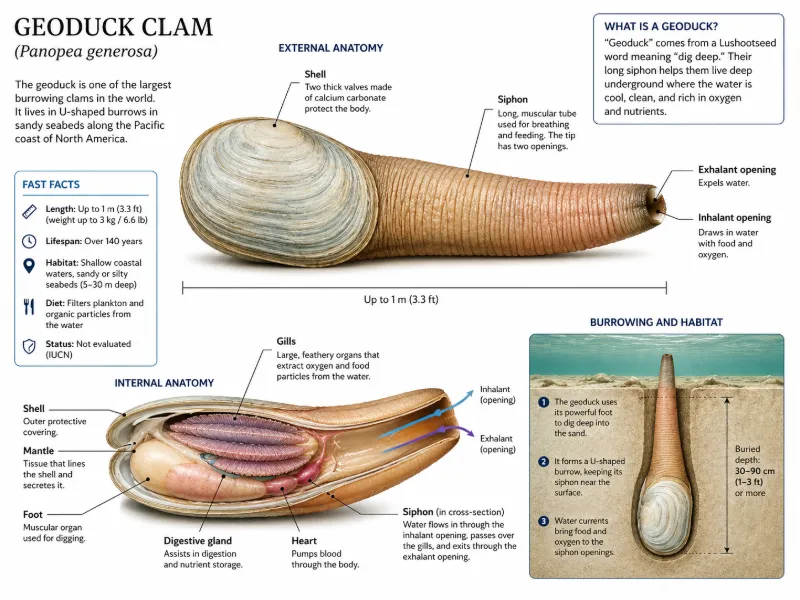
A geoduck is a very large marine clam native to the Pacific coast of North America. Although many people first notice its appearance, biologically it is a bivalve mollusk, which means it belongs to the same broader animal group as clams, mussels, oysters, and scallops.
Like other bivalves, it has a shell made of two hinged halves. However, unlike the neat, fully enclosed clam shape many people imagine, the geoduck’s body extends far beyond the shell. This is why it looks so unusual compared with more familiar clams.
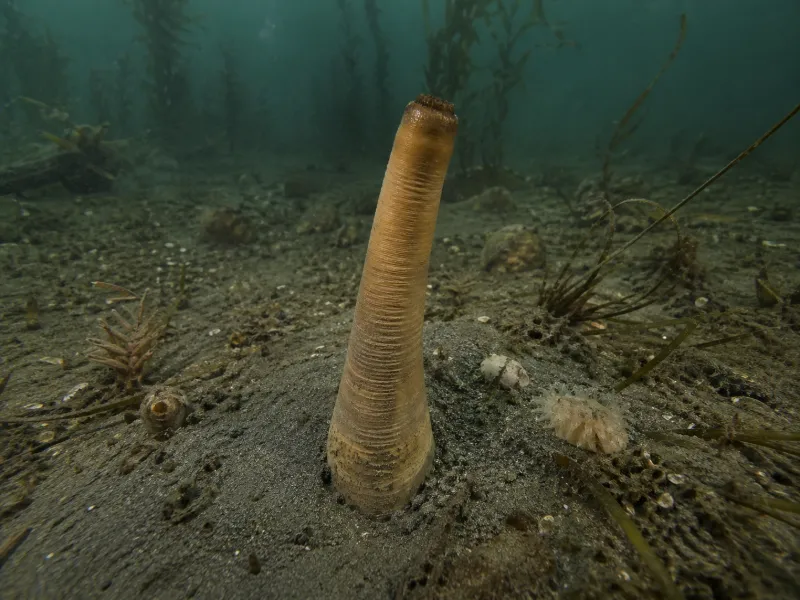
The geoduck spends most of its life buried in sediment, with only part of its long siphon reaching upward toward the water above. Its awkward-looking body plan is actually an adaptation for a very specific lifestyle.
Why is the geoduck called the world’s most NSFW mollusk?
The nickname comes almost entirely from its appearance. The geoduck has a large fleshy siphon that can be much longer than its shell, and many people think this gives it a shape that looks unintentionally explicit.
That visual similarity has turned the geoduck into one of the internet’s favorite joke animals. It often appears in “strangest animals” lists, meme collections, and bizarre food discussions because people are shocked by how it looks.
But the geoduck is not “designed” to be provocative. Its odd form is simply the result of evolution shaping a clam for deep burrowing and filter feeding. The funny nickname says more about human reactions than about the animal itself.
Why does the geoduck look like that?
The geoduck’s body shape makes sense once you understand how it lives. This clam burrows deep into sand or mud, often much deeper than many other shellfish. Because it stays buried, it needs a long siphon to reach the surface.
The siphon acts like a flexible tube system. One opening draws water in, and the other sends water out. As water passes through the animal, the geoduck filters out food such as plankton and fine organic particles.
Its shell does not fully close around the siphon because the siphon is simply too large. Instead of carrying a fully sealed shell around the whole body, the geoduck relies on staying deep in the sediment for protection.
How big is a geoduck?
The geoduck is one of the largest burrowing clams in the world. Its shell may look modest compared with its total body size, but the full animal can be impressively large because of the long siphon.
In many individuals, the siphon extends far beyond the shell and creates most of the animal’s visible bulk. This makes the geoduck look even stranger, because people expect a clam to be mostly shell, not mostly soft tissue.
Large geoducks can weigh several pounds, and especially large individuals can be much heavier. Their size, combined with their odd anatomy, is one reason they stand out so strongly from more familiar shellfish.
Where do geoducks live?
Geoducks live in coastal marine environments, especially along parts of the northeastern Pacific. They are typically associated with protected bays, inlets, and shallow coastal waters where the seafloor has the right kind of sediment for burrowing.
They prefer sandy, muddy, or mixed soft-bottom habitats. These environments allow them to bury themselves deeply while still extending the siphon upward into the water column.
Because they are buried, geoducks are not usually seen walking around like crabs or attached to rocks like mussels. Most of the animal stays hidden below the surface for most of its life.
How does a geoduck feed?
The geoduck is a filter feeder. It draws seawater in through one part of the siphon, passes that water across its feeding structures, and traps tiny food particles such as plankton and suspended organic matter.
After feeding, it expels the used water through the other part of the siphon. This constant water movement allows the geoduck to stay buried while still feeding efficiently.
Filter feeding is one reason geoducks matter ecologically. By processing large amounts of seawater, they help link water-column productivity with life in the seafloor sediment.
How does a geoduck breathe?
Like many bivalves, a geoduck uses gills not only for feeding but also for respiration. As water passes through the body, oxygen is taken up and carbon dioxide is released.
This means the siphon is doing multiple jobs at once. It helps the geoduck feed, breathe, and remain connected to the world above the sediment while the rest of the body stays safely buried below.
So even though the geoduck looks absurd to many people, its body is actually a highly practical survival system for life underground.
Why doesn’t the geoduck just hide inside its shell?
The short answer is that it cannot. The geoduck’s siphon is too large to retract fully into the shell the way a smaller clam might. Its shell protects only part of the body.
Instead of depending on a tightly closing shell, the geoduck relies on depth. By burrowing far into the sediment, it stays out of reach of many predators. The shell helps, but the real defense is burial.
This is a good example of how evolution often produces trade-offs. The geoduck gives up the classic fully protected clam shape in exchange for a deep-burrowing lifestyle and a highly effective feeding system.
How long do geoducks live?
One of the most impressive facts about geoducks is their longevity. They are extremely long-lived animals and can survive for many decades. Some individuals are known to live well over a hundred years.
This long lifespan makes the geoduck even more remarkable. It is not just a bizarre-looking clam. It is also one of the longest-lived marine invertebrates in its environment.
Because growth rings can be studied, geoducks are sometimes useful for understanding long-term environmental patterns as well. A single animal may record decades of life in coastal waters.
Are geoducks active animals?
Not in the way most people think of activity. A geoduck does not chase prey, swim through the water, or crawl across the seafloor like some other marine animals. It is mostly sedentary.
Once settled in a suitable place, it remains buried and lives by filtering water. Its activity is internal and continuous rather than dramatic. It pumps water, feeds, breathes, and maintains its position in the sediment.
This quiet lifestyle is common among many bivalves, but the geoduck’s strange form makes people forget that it is basically a highly specialized clam.
What eats geoducks?
Geoducks are better protected as adults than as young individuals because large adults burrow deeply into the sediment. However, they are still part of the coastal food web.
Eggs, larvae, and juveniles are especially vulnerable to predators. Smaller geoducks near the surface may also be at risk from animals capable of digging or disturbing the sediment.
The deep-burrowing lifestyle reduces danger, but it does not remove it entirely. Like many shellfish, geoducks are safest once they become large and well established underground.
Are geoducks important in the ecosystem?
Yes. Geoducks are part of coastal benthic ecosystems, meaning they help support life on and in the seafloor. As filter feeders, they move energy from plankton-rich seawater into the sediment-based food web.
Their burrowing can also affect sediment structure and local habitat conditions. In this way, geoducks are not just passive animals sitting in the mud. They interact with the physical and biological environment around them.
Healthy populations of large bivalves can play meaningful roles in coastal ecosystem function, especially in areas where water quality, sediment stability, and food cycling are closely linked.
Do people eat geoducks?
Yes. Geoducks are considered edible and are highly valued in some seafood markets. Their unusual appearance often surprises people even more when they realize they are also a sought-after shellfish.
The siphon is especially well known in cooking, and the animal is eaten in a range of preparations depending on region and culinary tradition. This has made the geoduck important not only biologically but also economically.
Its combination of strange anatomy, culinary value, and extreme longevity has helped make it one of the most talked-about shellfish in the world.
Why the geoduck matters beyond the joke
It is easy to laugh at the geoduck because its appearance is so unusual. But reducing it to a visual joke misses what makes it truly interesting.
The geoduck is a giant burrowing clam with an extraordinary life strategy, a very long lifespan, and a real ecological role in coastal waters. It shows how evolution can create body forms that seem absurd at first glance but work extremely well in a specific environment.
That is part of what makes natural history so fascinating. Some of the most memorable animals are not the fastest or fiercest. They are the ones that seem impossible until you understand how they live.
Final takeaway
The geoduck is called the world’s most NSFW mollusk because its long exposed siphon gives it an unintentionally shocking appearance. But biologically, it is far more than a punchline. It is a giant burrowing clam built for deep sediment life, filter feeding, and exceptional longevity. Strange-looking though it may be, the geoduck is one of the most impressive and specialized shellfish in the ocean.
FAQs
What kind of animal is a geoduck?
A geoduck is a large burrowing clam, which means it is a bivalve mollusk.
Why does the geoduck look so strange?
It looks unusual because its long siphon extends far beyond the shell, an adaptation that helps it feed and breathe while buried in sediment.
How long can a geoduck live?
Geoducks are very long-lived and can survive for many decades, with some individuals living well over a hundred years.
Do people eat geoducks?
Yes. Geoducks are edible and are considered valuable seafood in some markets.