Aquatic reptiles are reptiles that spend much or most of their lives in water, including sea turtles, sea snakes, marine iguanas, crocodilians, and many freshwater turtles. Unlike fish, aquatic reptiles breathe air with lungs, but they can stay underwater for long periods by slowing their metabolism, storing oxygen efficiently, and using special adaptations for swimming, diving, and salt regulation.
Quick Facts About Aquatic Reptiles
| Feature | Details |
|---|---|
| Animal group | Reptiles adapted to aquatic or semi-aquatic life |
| Examples today | Sea turtles, sea snakes, marine iguanas, crocodiles, alligators, caimans, freshwater turtles |
| Examples from prehistory | Ichthyosaurs, plesiosaurs, mosasaurs, placodonts, marine crocodyliforms |
| Breathing method | Air-breathing with lungs |
| Body temperature | Mostly ectothermic, meaning they rely on external heat sources |
| Skin type | Dry, scaly skin that helps protect the body |
| Main habitats | Oceans, coral reefs, mangroves, estuaries, rivers, lakes, swamps, and wetlands |
| Swimming adaptations | Flippers, flattened tails, streamlined bodies, webbed feet, or powerful limbs |
| Saltwater adaptations | Some marine species have salt glands to remove excess salt |
| Main threats | Habitat loss, pollution, fishing bycatch, climate change, hunting, boat strikes, and egg collection |
What Are Aquatic Reptiles?
Aquatic reptiles are reptiles that have adapted to live in water for feeding, movement, protection, or reproduction. Some are fully marine for most of their lives, such as sea turtles and many sea snakes. Others are semi-aquatic, such as crocodiles, alligators, caimans, terrapins, and many freshwater turtles.
These animals evolved from land-dwelling reptile ancestors. Over time, different reptile groups developed bodies better suited for swimming, diving, and hunting in water. Their adaptations vary widely depending on whether they live in oceans, rivers, lakes, mangroves, estuaries, or tropical wetlands.
Modern aquatic reptiles are only a small part of reptile diversity, but they are ecologically important. They can be predators, grazers, scavengers, seed dispersers, and ecosystem engineers. In prehistoric oceans, marine reptiles were even more diverse and included some of the largest ocean predators of their time.
Main Characteristics of Aquatic Reptiles
Aquatic reptiles share several important features with other reptiles. They are vertebrates, breathe air with lungs, have scaly skin, and are generally ectothermic. This means their body temperature is strongly influenced by the surrounding environment.
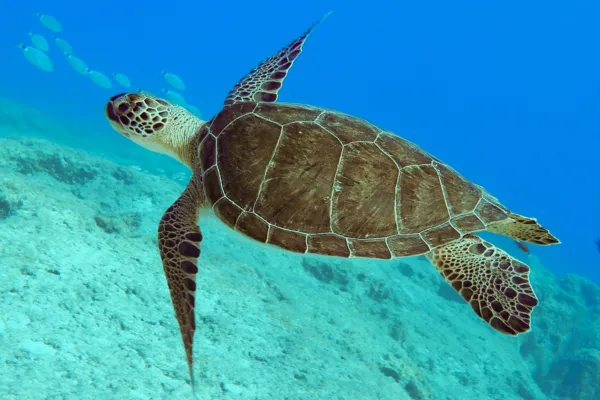
Their aquatic lifestyle has produced many specialized traits. Sea turtles have streamlined shells and flipper-like limbs. Sea snakes have paddle-shaped tails. Crocodiles have powerful tails, eyes and nostrils positioned high on the head, and bodies built for ambush hunting. Marine iguanas have strong claws for gripping rocks and flattened tails for swimming.
Many aquatic reptiles also have special adaptations for staying underwater. They can slow their heart rate, reduce energy use, and tolerate low oxygen conditions better than most land reptiles. Some turtles can absorb small amounts of oxygen through specialized tissues, although they still rely mainly on lungs.
Saltwater species face an additional challenge: they must deal with excess salt. Sea turtles, sea snakes, and marine iguanas have salt-excreting glands that help remove salt from the body. This allows them to survive in marine environments where drinking seawater would be dangerous for many animals.
How Do Aquatic Reptiles Breathe?
Aquatic reptiles breathe with lungs. They cannot extract oxygen from water through gills like fish. Even species that spend most of their lives in the ocean must come to the surface to breathe air.
However, many aquatic reptiles can stay underwater for surprisingly long periods. They do this by lowering their metabolic rate, slowing their heartbeat, and using oxygen more efficiently. When a reptile reduces its activity underwater, it needs less oxygen and can dive for longer.
Some species can also tolerate temporary oxygen shortage by using anaerobic metabolism, a process that allows cells to produce energy when oxygen is limited. This is especially useful during long dives, cold periods, or when an animal remains hidden underwater to avoid danger.
Sea snakes have long lungs that extend through much of the body, helping them store air and control buoyancy. Sea turtles can remain submerged for long periods when resting, although they surface more often when active. Crocodilians can hold their breath while waiting underwater for prey, often leaving only the eyes and nostrils exposed.
How Long Can Aquatic Reptiles Stay Underwater?
The amount of time an aquatic reptile can stay underwater depends on the species, water temperature, activity level, stress level, and body size. A resting animal can usually stay submerged much longer than one that is swimming fast or escaping danger.
Sea turtles may remain underwater for long periods while resting, but they surface more frequently during active swimming. Sea snakes often dive for several minutes at a time and may remain submerged longer when conditions are calm. Crocodiles can stay underwater quietly while hunting or hiding, then surface quickly to breathe.
Freshwater turtles can also remain underwater for extended periods, especially in cool conditions when their metabolism slows. Some turtles can absorb limited oxygen through the lining of the mouth, throat, or cloacal tissues, but this does not replace lung breathing completely.
Types of Aquatic Reptiles
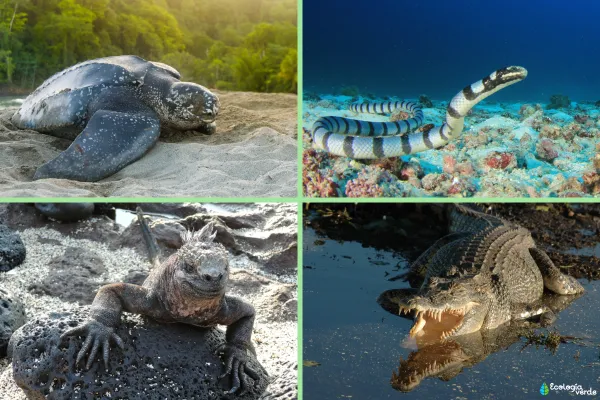
Aquatic reptiles can be grouped by lifestyle, habitat, and body structure. Some are mainly marine, some are freshwater species, and others move between land and water throughout the day.
Sea Turtles
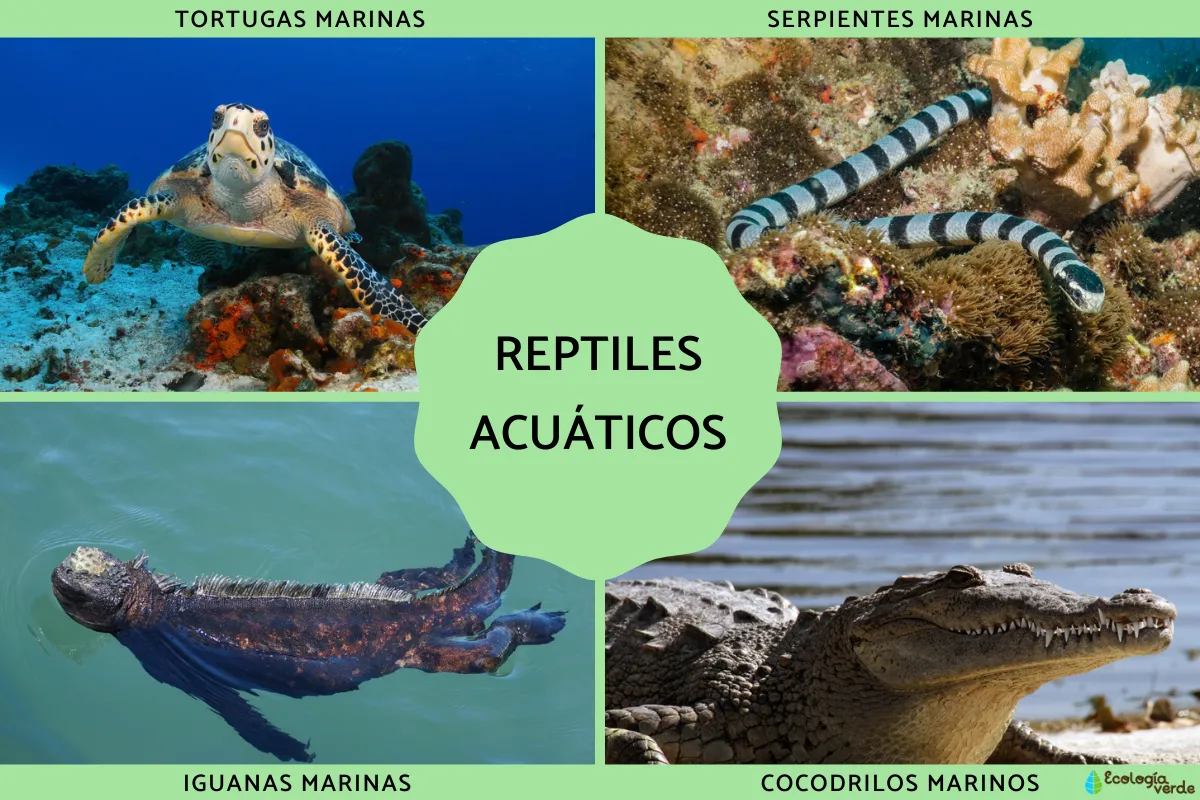
Sea turtles are among the best-known marine reptiles. They have streamlined bodies, large flippers, and shells adapted for life in the ocean. Unlike land tortoises, sea turtles cannot pull fully into their shells, but their body shape allows efficient long-distance swimming.
Most sea turtles spend nearly their entire lives in the ocean, although females return to sandy beaches to lay eggs. Their diets vary by species. Green sea turtles feed largely on seagrass and algae as adults, while leatherback turtles specialize in jellyfish. Hawksbill turtles often feed on sponges and reef invertebrates.
Sea Snakes
Sea snakes are highly specialized marine reptiles. Many species have flattened, paddle-like tails that help them swim through the water. They are generally strong divers and feed mainly on fish, eels, fish eggs, and small marine animals.
Most true sea snakes give birth to live young in the water and rarely, if ever, come onto land. Sea kraits, which are closely related, are more amphibious and often return to land to rest, digest food, or lay eggs.
Sea snakes are venomous, but most species are not aggressive toward humans unless handled or threatened. They play an important role as predators in coral reef and coastal ecosystems.
Marine Iguanas
The marine iguana is the only living lizard that feeds in the ocean. It is found only in the Galápagos Islands. Unlike most lizards, it dives into the sea to graze on marine algae.
Marine iguanas have flattened tails for swimming, strong claws for gripping volcanic rocks, and salt glands that help remove excess salt from the body. After feeding in cold ocean water, they often bask on rocks to raise their body temperature.
Crocodilians
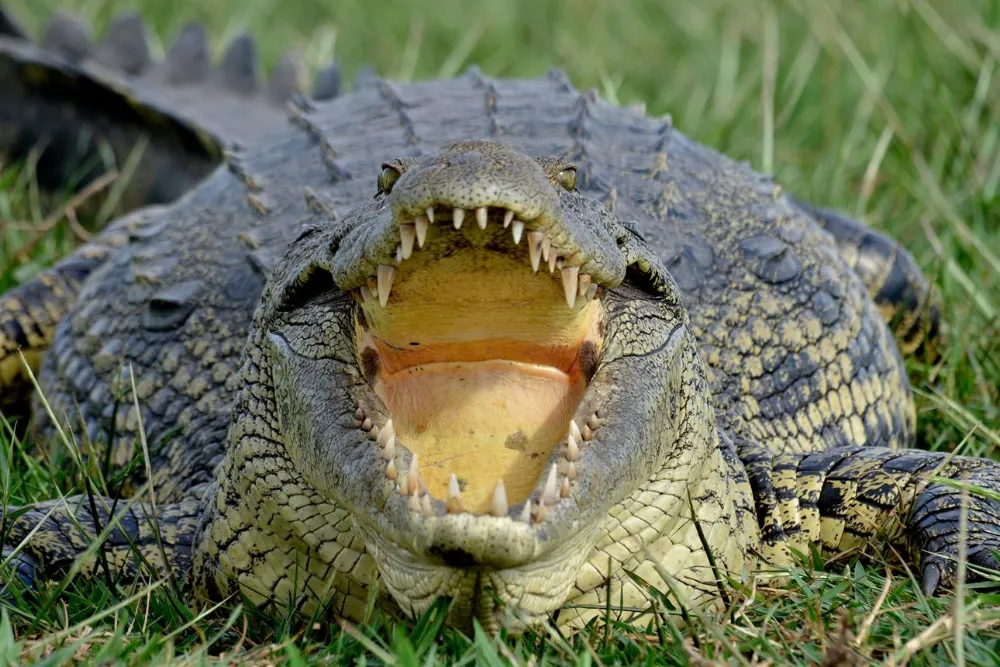
Crocodilians include crocodiles, alligators, caimans, and gharials. Many are semi-aquatic predators that live in rivers, lakes, swamps, estuaries, and mangroves. Their eyes, ears, and nostrils sit high on the head, allowing them to stay mostly hidden below the water surface.
The saltwater crocodile is the largest living reptile and can tolerate marine and brackish water. However, even saltwater crocodiles are more commonly associated with coastal rivers, mangroves, estuaries, and lagoons than with the open ocean.
Freshwater Turtles and Terrapins
Many turtles are aquatic or semi-aquatic. Freshwater turtles live in ponds, rivers, lakes, marshes, and wetlands. Some have webbed feet for swimming, while others have more streamlined shells that help them move through water.
Freshwater turtles may eat plants, insects, fish, carrion, mollusks, crustaceans, or a mixed diet depending on the species. Many bask on logs or rocks to warm their bodies and regulate their metabolism.
Examples of Living Aquatic Reptiles
| Group | Example Species | Main Habitat | Key Adaptation |
|---|---|---|---|
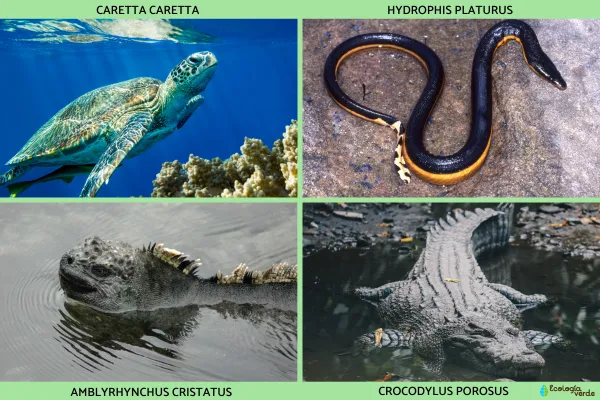
| Sea turtle | Green sea turtle (Chelonia mydas) | Tropical and subtropical oceans | Flippers and streamlined shell |
| Sea turtle | Leatherback sea turtle (Dermochelys coriacea) | Open ocean | Large body and deep-diving ability |
| Sea snake | Yellow-bellied sea snake (Hydrophis platurus) | Warm ocean waters | Paddle-shaped tail |
| Sea krait | Banded sea krait (Laticauda colubrina) | Coral reefs and coastal areas | Moves between land and sea |
| Marine lizard | Marine iguana (Amblyrhynchus cristatus) | Galápagos rocky shores | Feeds on marine algae |
| Crocodilian | Saltwater crocodile (Crocodylus porosus) | Estuaries, rivers, mangroves, coastal waters | Powerful tail and salt tolerance |
| Freshwater turtle | Common snapping turtle (Chelydra serpentina) | Lakes, ponds, rivers, wetlands | Strong jaws and aquatic ambush lifestyle |
Prehistoric Aquatic Reptiles
Today’s aquatic reptiles are impressive, but prehistoric oceans were home to even more diverse and dramatic marine reptiles. These animals were not dinosaurs, although they lived during the same broad era as many dinosaurs. They belonged to different reptile lineages that independently adapted to life in the sea.
Ichthyosaurs
Ichthyosaurs were marine reptiles that appeared during the Triassic Period and became highly adapted for open-water life. Their bodies resembled dolphins or fast-swimming fish, with streamlined shapes, flipper-like limbs, pointed snouts, and powerful tails.
Many ichthyosaurs had large eyes, which may have helped them hunt in deep or dim water. They were active predators that likely fed on fish, squid-like animals, and other marine prey. Some species were small, while others reached enormous lengths.
Plesiosaurs
Plesiosaurs appeared during the Jurassic Period and became some of the most recognizable prehistoric marine reptiles. They had broad bodies and four strong flippers. Some had very long necks and small heads, while others had short necks and massive skulls.
Long-necked plesiosaurs may have hunted smaller fish and soft-bodied prey, while short-necked forms, often called pliosaurs, were powerful predators capable of attacking larger animals. Their four-flipper swimming style was very different from that of fish, whales, or sea turtles.
Mosasaurs
Mosasaurs lived during the Late Cretaceous Period and were among the dominant marine predators of their time. They were related to monitor lizards and snakes, but their bodies were long, muscular, and adapted for swimming.
Mosasaurs had strong jaws, sharp teeth, and powerful tails. Some species became gigantic ocean predators. They likely fed on fish, turtles, ammonites, other marine reptiles, and almost any prey they could overpower.
Placodonts
Placodonts were Triassic marine reptiles known for their heavy bodies and broad crushing teeth. Many species fed on hard-shelled animals such as mollusks. Their dense bones suggest that they often lived in shallow coastal waters, where extra weight helped them stay near the seafloor while feeding.
Some placodonts had armor-like body protection, making them look somewhat turtle-like, although they were not true turtles. They are a good example of how different reptile groups developed unique solutions for aquatic life.
Marine Crocodyliforms
During the Jurassic Period, some crocodyliforms evolved into highly marine forms. These animals were related to the broader crocodile lineage, but they were not identical to modern crocodiles.
Some marine crocodyliforms had smooth bodies, paddle-like limbs, and tail adaptations that helped them swim efficiently in the ocean. They show that the crocodile lineage has experimented with aquatic lifestyles many times across evolutionary history.
How Aquatic Reptiles Adapt to Saltwater
Marine reptiles face a serious problem: salt. Drinking seawater or swallowing salty prey can cause excess salt to build up in the body. To solve this problem, several marine reptiles have evolved salt glands.
Sea turtles have salt glands near the eyes. When they remove salt, it can look as if the turtle is crying. Marine iguanas sneeze salt out through nasal glands, often leaving white salt crusts on the head. Sea snakes also use specialized glands to help regulate salt balance.
These adaptations allow marine reptiles to live in environments that would quickly dehydrate or poison many land animals. Without salt regulation, long-term life in the ocean would be impossible.
How Aquatic Reptiles Swim
Different aquatic reptiles swim in different ways. Sea turtles use their front flippers like wings, moving through the water with powerful strokes. Sea snakes use side-to-side body waves and flattened tails. Crocodiles mainly use their muscular tails for propulsion, while their legs may be held close to the body during swimming.
Marine iguanas swim by moving their bodies and tails from side to side, similar to many lizards and crocodilians. Freshwater turtles often use webbed feet, while softshell turtles have flattened shells that reduce drag in the water.
These swimming styles reflect different evolutionary histories. Aquatic reptiles did not all come from one single aquatic ancestor. Instead, many reptile groups independently returned to the water and evolved their own solutions for movement.
How Aquatic Reptiles Reproduce
Most aquatic reptiles still have strong links to land during reproduction. Sea turtles must come ashore to lay eggs in sandy nests. Many freshwater turtles and crocodilians also lay eggs on land, often in nests near water.
Crocodilians build nests from vegetation, mud, or sand, and many species show parental care. Female crocodilians may guard the nest and help hatchlings reach the water after they emerge.
Sea snakes vary in their reproductive strategies. True sea snakes generally give birth to live young in the water, while sea kraits lay eggs on land. This difference shows that even closely related aquatic reptiles may solve reproductive challenges in different ways.
Why Aquatic Reptiles Matter
Aquatic reptiles play important roles in ecosystems. Sea turtles help maintain seagrass beds, coral reef balance, and jellyfish populations. Crocodilians influence wetland food webs and can create nesting and resting areas used by other animals. Sea snakes help regulate fish populations in reefs and coastal habitats.
Because many aquatic reptiles are long-lived and sensitive to habitat change, their population trends can reveal problems in aquatic ecosystems. Declines may indicate pollution, overfishing, coastal disturbance, climate stress, or loss of nesting sites.
Protecting aquatic reptiles often means protecting entire habitats, including beaches, reefs, mangroves, rivers, wetlands, and coastal waters.
Threats to Aquatic Reptiles
Many aquatic reptiles face serious threats. Sea turtles are affected by plastic pollution, fishing bycatch, egg collection, coastal development, artificial beach lighting, and climate change. Rising sand temperatures can even affect the sex ratio of hatchlings in many turtle species.
Sea snakes may be threatened by reef degradation, pollution, fishing nets, and habitat loss. Crocodilians can suffer from hunting, wetland destruction, conflict with humans, and pollution. Freshwater turtles are among the most threatened reptiles in many regions because of habitat loss, road mortality, illegal trade, and overcollection.
Climate change is an increasing concern. Warmer oceans, stronger storms, sea-level rise, changing rainfall patterns, and habitat shifts can affect nesting beaches, wetlands, food sources, and breeding success.
Interesting Facts About Aquatic Reptiles
Aquatic reptiles breathe air with lungs, even when they live mostly in water.
Sea turtles use flippers rather than feet for swimming.
Sea snakes have flattened tails that work like paddles.
Marine iguanas are the only living lizards that regularly feed in the ocean.
Saltwater crocodiles are the largest living reptiles.
Many marine reptiles have salt glands to remove excess salt from their bodies.
Prehistoric marine reptiles such as mosasaurs and ichthyosaurs were not dinosaurs.
Some freshwater turtles can survive long periods underwater by slowing their metabolism.
Most aquatic reptiles still depend on land or shallow nesting areas for reproduction.
Healthy aquatic reptile populations often indicate healthier marine, coastal, or freshwater ecosystems.
Aquatic Reptiles FAQs
Are aquatic reptiles fish?
No. Aquatic reptiles are reptiles, not fish. They have lungs, scaly skin, and reptile ancestry. Unlike fish, they must surface to breathe air.
Do aquatic reptiles have gills?
No. Aquatic reptiles do not have gills. They breathe with lungs, although some turtles can absorb limited oxygen through specialized tissues while underwater.
What are examples of aquatic reptiles?
Examples include sea turtles, sea snakes, marine iguanas, saltwater crocodiles, freshwater turtles, alligators, caimans, and terrapins.
Can aquatic reptiles live on land?
Some can spend time on land, while others are almost fully aquatic. Sea turtles come ashore to lay eggs, crocodilians bask and nest on land, and sea kraits move between land and sea. True sea snakes are much more fully marine.
How do sea turtles breathe underwater?
Sea turtles do not breathe underwater. They hold their breath while submerged and return to the surface to inhale air through their nostrils.
Are crocodiles aquatic reptiles?
Yes. Crocodiles are semi-aquatic reptiles. They live in rivers, lakes, wetlands, estuaries, mangroves, and in some cases coastal waters.
Were mosasaurs dinosaurs?
No. Mosasaurs were marine reptiles, not dinosaurs. They lived during the Late Cretaceous Period and were powerful ocean predators.
Why do aquatic reptiles need salt glands?
Marine reptiles swallow salt through seawater and salty prey. Salt glands help remove excess salt and keep the body’s internal balance stable.
Are aquatic reptiles endangered?
Many aquatic reptiles are threatened or endangered, especially sea turtles and many freshwater turtles. Major threats include habitat loss, pollution, fishing bycatch, climate change, hunting, and illegal wildlife trade.
What is the largest living aquatic reptile?
The saltwater crocodile is the largest living aquatic reptile and the largest living reptile overall. Large males can reach impressive lengths and weights, making them top predators in their habitats.