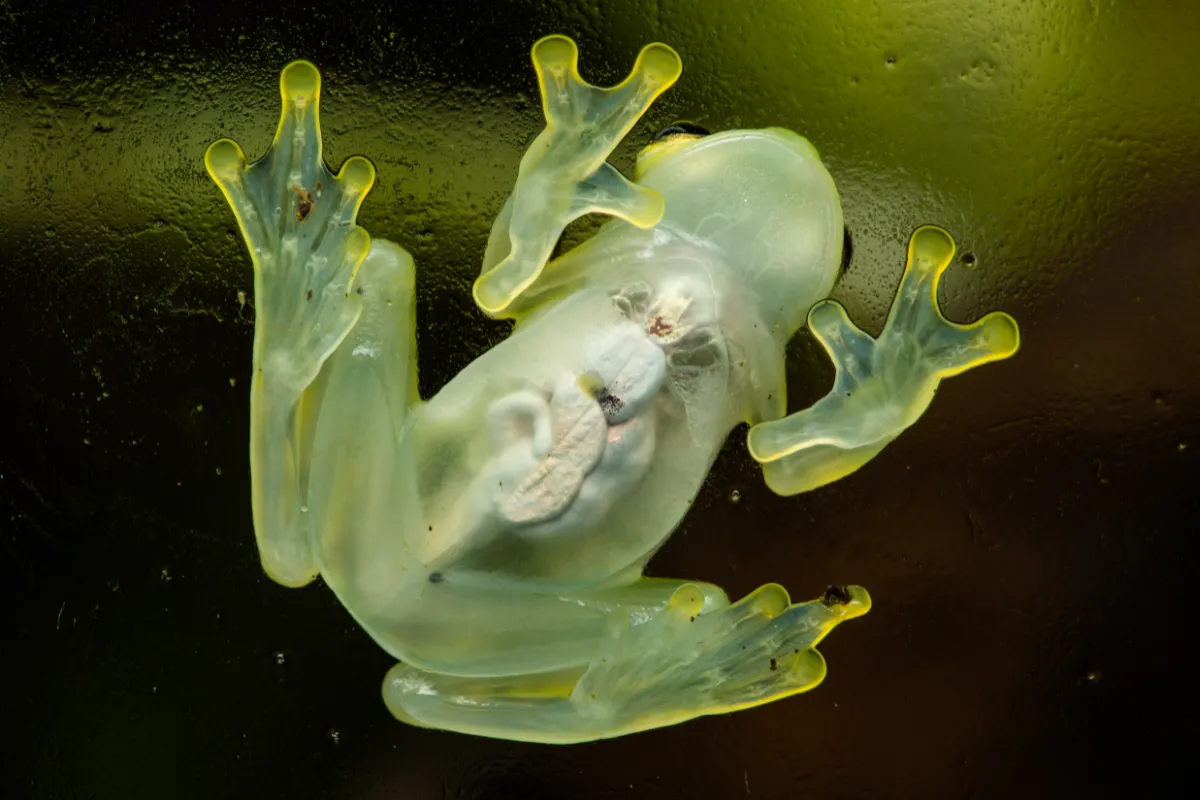
The glass frog is a small tropical frog best known for its semi-transparent belly, through which the heart, liver, intestines, and other internal organs may be visible. Glass frogs live mainly in the rainforests of Central and South America, often near clean streams. They are nocturnal, insect-eating amphibians that lay eggs on leaves above or beside running water.
Quick Facts About the Glass Frog
| Feature | Details |
|---|---|
| Common name | Glass frog |
| Animal group | Amphibian |
| Order | Anura |
| Family | Centrolenidae |
| Average size | Most species are about 2–3 cm long |
| Body color | Usually light green, yellow-green, or translucent green |
| Most famous feature | Semi-transparent belly that may show internal organs |
| Distribution | Central and South America, from southern Mexico to parts of the Andes and Amazon region |
| Habitat | Tropical rainforests, cloud forests, and vegetation near streams |
| Diet | Small insects, spiders, and other tiny invertebrates |
| Activity pattern | Mainly nocturnal |
| Reproduction | Eggs are often laid on leaves above or near streams |
| Main threats | Deforestation, habitat loss, agriculture, pollution, climate change, and disease |
What Is a Glass Frog?
A glass frog is not a single species, but a group of small tropical frogs belonging to the family Centrolenidae. These frogs are famous for their unusual translucent skin, especially on the underside of the body. In many species, the belly is so clear that you can see parts of the internal organs, including the heart and digestive system.
From above, most glass frogs look like delicate green tree frogs. Their green backs help them blend into leaves, moss, and rainforest vegetation. From below, however, their semi-transparent bodies make them one of the most unusual-looking amphibians in the world.
Glass frogs are strongly associated with humid forests and clean streams. They are usually found on vegetation close to flowing water, because their eggs and tadpoles depend on nearby aquatic habitats.
Why Are Glass Frogs Transparent?
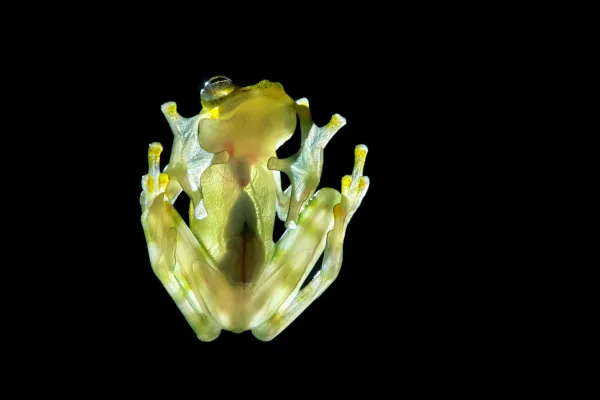
Glass frogs are not completely transparent like clear glass. Instead, many species have a semi-transparent belly and partially translucent tissues. Their backs are usually green, while the underside may reveal the outline of the heart, liver, intestines, and other organs.
This transparency may help glass frogs avoid predators. When a frog rests on a leaf, a solid-colored body can create a clear shadow or outline. A semi-transparent belly can soften the frog’s body shape and make it harder for predators to detect from below.
The green upper body also works as camouflage. During the day, glass frogs often rest on the underside of leaves, where their color and transparency help them disappear into the rainforest background.
What Do Glass Frogs Look Like?
Most glass frogs are very small, usually around 2 to 3 centimeters long. Some species may be larger, but glass frogs are generally delicate, lightweight amphibians with slim bodies and long limbs.
Their backs are often pale green, lime green, or yellow-green. Some species have tiny spots, dots, or markings that help break up the body outline. Their toe pads help them cling to wet leaves, branches, and smooth surfaces near streams.
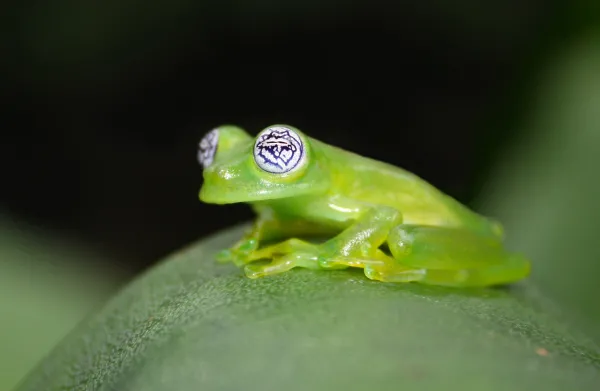
One of their most distinctive features is the position of the eyes. Many glass frogs have forward-facing or slightly upward-facing eyes, giving them a different facial appearance from many other tree frogs. This eye position may help them watch for prey, rivals, and predators while resting on leaves.
In some species, males have small bony spines or hardened structures near the upper arms. These may be used during fights with other males, especially when competing for calling sites, territory, or access to females.
Where Do Glass Frogs Live?
Glass frogs are native to Central and South America. Their range extends from southern Mexico through Central America and into South America, including countries such as Panama, Colombia, Ecuador, Venezuela, Peru, Bolivia, and parts of the Amazon and Andean regions.
They are most often found in tropical rainforests, cloud forests, and humid mountain forests. Many species live close to streams, rivers, and small forest creeks. This close relationship with water is important because glass frogs usually reproduce near running water.
During the day, glass frogs may hide on the undersides of leaves, where they remain still and camouflaged. At night, they become more active, moving through vegetation to hunt, call, mate, or guard their eggs.
What Do Glass Frogs Eat?
Glass frogs are carnivorous. Their diet consists mainly of small insects and other tiny invertebrates. Common prey may include flies, mosquitoes, moths, ants, small beetles, crickets, spiders, and other small arthropods.
Like many frogs, glass frogs hunt by waiting quietly and watching for movement. When a suitable prey animal comes close, the frog quickly flicks out its sticky tongue and pulls the prey into its mouth.
Because most glass frogs are small, they usually target small prey. Larger species may occasionally take slightly bigger animals, but insects and other invertebrates make up the main part of their diet.
How Do Glass Frogs Reproduce?
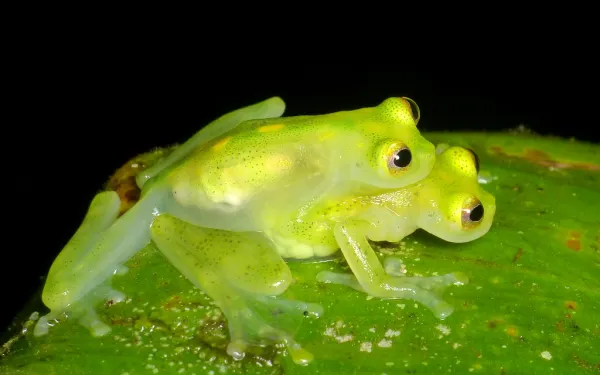
Glass frog reproduction usually begins with the male’s call. During the breeding season, males call from leaves, branches, rocks, or vegetation near streams. These calls attract females and may also warn rival males to stay away.
After a female approaches, mating takes place through external fertilization. The female lays eggs, usually on a leaf or surface close to flowing water, and the male fertilizes them outside the body.
Many glass frogs lay eggs on leaves above streams. This strategy helps protect the eggs from some aquatic predators. When the embryos develop and hatch, the tadpoles drop from the leaves into the water below, where they continue their larval development.
Some glass frog species show remarkable parental care. In several species, males guard the eggs after they are laid. They may defend the egg clutch from insects, parasites, and other small predators. In some cases, the male may also help keep the eggs moist by sitting close to them or covering them with his body.
Are Glass Frogs Poisonous?
Glass frogs are not generally considered dangerous to humans. They are not famous for strong skin toxins like poison dart frogs. Their main defense is not poison, but camouflage, nocturnal behavior, and their ability to hide on leaves near streams.
However, wild amphibians should not be handled unnecessarily. Frogs have delicate skin that can absorb oils, chemicals, sunscreen, soap, and bacteria from human hands. If you see a glass frog in the wild, the best choice is to observe it without touching or disturbing it.
What Predators Eat Glass Frogs?
Glass frogs face many predators in rainforest ecosystems. Snakes, birds, large spiders, predatory insects, small mammals, and other frogs may eat adult glass frogs or juveniles.
The eggs are also vulnerable. Ants, wasps, flies, mites, and other small animals may attack egg clutches. This is one reason why male egg-guarding behavior is so important in some species.
Tadpoles face another set of dangers after they fall into the water. Aquatic insects, fish, shrimp, and other stream predators may feed on them. From egg to adult, glass frogs must survive many stages of predation.
Why Do Glass Frogs Lay Eggs on Leaves?
Many glass frogs lay their eggs on leaves because this location provides both protection and access to water. A leaf above a stream keeps the eggs away from many aquatic predators, while still allowing the tadpoles to drop into water once they hatch.
This reproductive strategy depends on clean, healthy forest streams. If the surrounding vegetation is removed, or if the stream becomes polluted or dries out, glass frog reproduction can be seriously affected.
The placement of eggs also shows how closely glass frogs are tied to rainforest structure. They need leaves, humidity, shade, and nearby flowing water. Losing any part of this habitat can reduce their ability to reproduce successfully.
Are Glass Frogs Endangered?
The conservation status of glass frogs depends on the species. Some species are still relatively widespread, while others have very small ranges and may be at higher risk. Because many glass frogs live in specific forest habitats, they can be vulnerable to rapid environmental change.
The main threats to glass frogs include deforestation, agricultural expansion, road building, urban development, water pollution, and habitat fragmentation. When forests are cleared, the shaded and humid streamside habitats that glass frogs need may disappear.
Pollution is another serious problem. Agricultural runoff, chemicals, sediment, and other contaminants can damage the streams where tadpoles develop. Since glass frogs depend on clean water, changes in stream quality can directly affect their survival.
Climate change may also threaten some species by altering rainfall patterns, stream flow, temperature, and humidity. Amphibian diseases, including fungal infections, are another concern for many frog populations around the world.
Why Are Glass Frogs Important?
Glass frogs are important members of rainforest ecosystems. As predators, they help control populations of insects and other small invertebrates. As prey, they provide food for birds, snakes, spiders, and other rainforest animals.
They may also serve as indicators of environmental health. Amphibians are sensitive to changes in water quality, humidity, disease, and habitat structure. If glass frog populations decline, it may be a sign that the surrounding ecosystem is under stress.
Protecting glass frogs means protecting more than one unusual amphibian group. It also means protecting tropical forests, clean streams, and the many species that depend on these habitats.
Interesting Facts About Glass Frogs
Glass frogs are named for their semi-transparent belly skin.
In some species, the heart and digestive organs can be seen through the underside of the body.
Most glass frogs are small, often only a few centimeters long.
They are mainly nocturnal and become active after dark.
Many species rest on the undersides of leaves during the day.
Some male glass frogs guard their eggs from predators.
Glass frog tadpoles often hatch from leaf-mounted eggs and fall into streams below.
Their green backs help them blend into rainforest leaves.
They are closely associated with clean, flowing water.
Habitat loss is one of the biggest threats to many glass frog species.
Glass Frog FAQs
Are glass frogs real?
Yes. Glass frogs are real amphibians found in Central and South America. They are famous for their semi-transparent belly, which may reveal internal organs.
Why are glass frogs called glass frogs?
They are called glass frogs because many species have translucent skin on the underside of the body. This can make parts of the internal organs visible, giving the frog a glass-like appearance.
Where do glass frogs live?
Glass frogs live in tropical rainforests, cloud forests, and humid forests of Central and South America. They are usually found near streams and rivers.
What do glass frogs eat?
Glass frogs eat small insects, spiders, and other tiny invertebrates. They hunt mostly at night and catch prey with a quick flick of the tongue.
Are glass frogs poisonous?
Glass frogs are not generally considered dangerous or strongly poisonous to humans. They rely mainly on camouflage and hiding rather than powerful toxins.
Can you keep a glass frog as a pet?
Glass frogs are not suitable pets for most people. They need very specific humidity, temperature, water quality, and habitat conditions. Wild glass frogs should not be collected from nature.
Why do glass frogs lay eggs on leaves?
Many glass frogs lay eggs on leaves above streams. This helps protect the eggs from some aquatic predators, while allowing the tadpoles to drop into water after hatching.
Are glass frogs endangered?
Some glass frog species are at risk, while others are more stable. The main threats include deforestation, habitat loss, pollution, agriculture, climate change, and amphibian disease.
Do glass frogs glow?
Glass frogs do not glow like lights. Their bodies are semi-transparent in certain areas, especially the belly, which can make them look unusual under natural or artificial light.
Why are glass frogs important?
Glass frogs help control insect populations and provide food for other rainforest animals. They are also useful indicators of healthy forest and stream ecosystems.