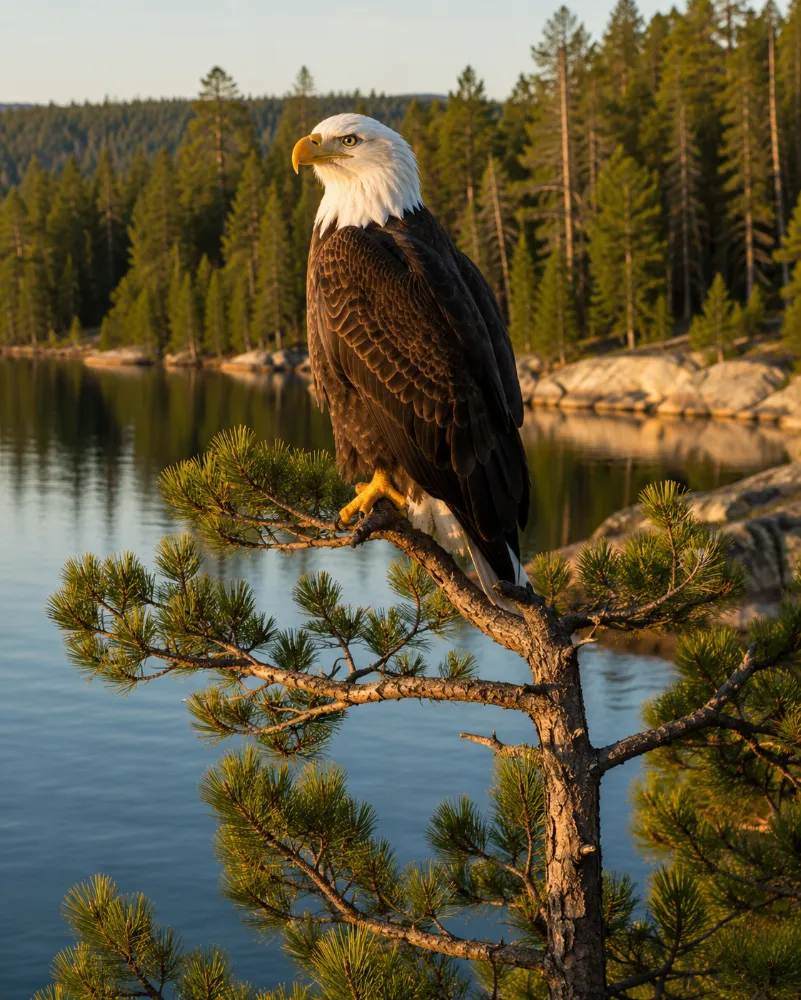
The bald eagle is a large North American bird of prey known for its white head, white tail, dark brown body, yellow bill, and powerful fish-hunting ability. Despite its name, it is not bald; “bald” originally meant white-headed. Bald eagles live mostly near lakes, rivers, coasts, wetlands, and reservoirs, where they hunt fish, scavenge carrion, steal food, and build enormous stick nests.
| Feature | Bald Eagle | Key Detail |
|---|---|---|
| Scientific name | Haliaeetus leucocephalus | A North American sea eagle |
| Family | Accipitridae | Same broad family as hawks, kites, harriers, and Old World vultures |
| Adult appearance | White head and tail, dark brown body, yellow bill and feet | Adults are unmistakable in good light |
| Juvenile appearance | Mostly dark brown with mottled white patches | Young birds do not get full adult plumage for several years |
| Wingspan | About 6 to 8 feet | Females are usually larger than males |
| Diet | Fish, waterbirds, mammals, carrion, and stolen prey | Fish are often the most important food |
| Habitat | Lakes, rivers, coasts, wetlands, reservoirs, and forested shorelines | They usually need water, prey, and tall nesting trees |
| Nest | Huge stick nest, often reused and enlarged for years | Among the largest nests built by any bird |
| Range | North America | Found in the United States, Canada, Alaska, and parts of northern Mexico |
| Conservation story | Major recovery after pesticide decline, legal protection, and habitat conservation | One of North America’s best-known conservation success stories |
What Is a Bald Eagle?
The bald eagle is a large bird of prey native to North America. It is a sea eagle, meaning it is strongly associated with water and often hunts fish. Its scientific name, Haliaeetus leucocephalus, refers to its sea-eagle identity and white head.
Adult bald eagles are famous for their white head and tail, dark chocolate-brown body, large yellow bill, yellow eyes, and powerful yellow feet. Their hooked beak tears food, while their strong talons grip fish, birds, mammals, and carrion.
Although the bald eagle is often described as a symbol of power, freedom, and wilderness, it is also a practical opportunist. It hunts, scavenges, steals food from other birds, and gathers where fish or carrion are abundant.
Why Is It Called a Bald Eagle?
The bald eagle is not actually bald. Its head is covered with white feathers. The word “bald” comes from an older English meaning of “white” or “white-headed.” This name makes sense when you see an adult bird: the bright white head stands out sharply against the dark body.
Young bald eagles do not look like the classic national-symbol bird. Juveniles are mostly dark brown with irregular white mottling. Their head and tail gradually become whiter as they mature, and full adult plumage usually appears after several years.
Scientific Classification
| Category | Classification |
|---|---|
| Kingdom | Animalia |
| Phylum | Chordata |
| Class | Aves |
| Order | Accipitriformes |
| Family | Accipitridae |
| Genus | Haliaeetus |
| Species | Haliaeetus leucocephalus |
Bald eagles are related to other sea eagles, including the white-tailed eagle of Eurasia. They are not closely related to true eagles in every traditional sense, but they are large raptors within the hawk and eagle family.
What Does a Bald Eagle Look Like?
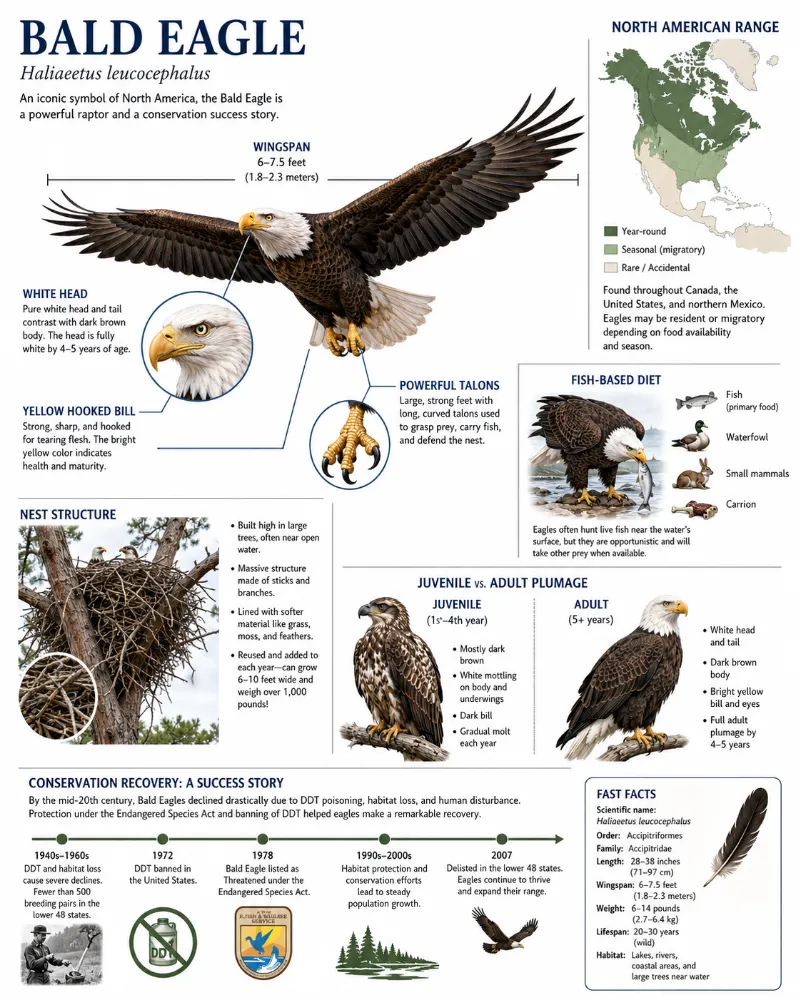
An adult bald eagle is one of the easiest North American birds to recognize. The white head, white tail, dark body, and yellow bill create a bold pattern visible even from a distance.
Important identification features include:
White head in adults
White tail in adults
Dark brown body and wings
Large yellow hooked bill
Yellow eyes
Yellow feet with long talons
Broad wings held flat when soaring
Large head that projects strongly in flight
In flight, bald eagles often look broad-winged and heavy-headed. They usually soar with their wings held nearly flat, unlike turkey vultures, which often hold their wings in a shallow V-shape.
Juvenile Bald Eagle Appearance
Juvenile bald eagles are often mistaken for golden eagles because they lack the white head and white tail of adults. Young bald eagles are dark brown with scattered white patches on the wings, belly, tail, or underbody. Their bill may look darker than an adult’s bright yellow bill.
As they age, young bald eagles gradually show more white on the head and tail. The transition can look messy and uneven. This is why immature bald eagles can be difficult to identify, even for beginner birdwatchers.
| Age Stage | Appearance | Identification Note |
|---|---|---|
| Juvenile | Mostly dark brown with mottled white areas | No clean white head or tail yet |
| Subadult | Patchy white and brown head, tail, and body | Can look confusing and uneven |
| Adult | White head, white tail, dark body, yellow bill | Classic bald eagle appearance |
How Big Is a Bald Eagle?
Bald eagles are large raptors, but their size varies by sex and region. Females are usually larger than males. Northern birds, especially those in Alaska and Canada, tend to be larger than many southern birds.
Typical bald eagle measurements include:
Length: about 28 to 38 inches
Wingspan: about 6 to 8 feet
Weight: about 6 to 14 pounds
Sex difference: females are usually larger and heavier than males
Their broad wings allow efficient soaring. Instead of flapping constantly, bald eagles use rising air currents to glide, circle, and search for food over water, shorelines, and open country.
Bald Eagle Wingspan
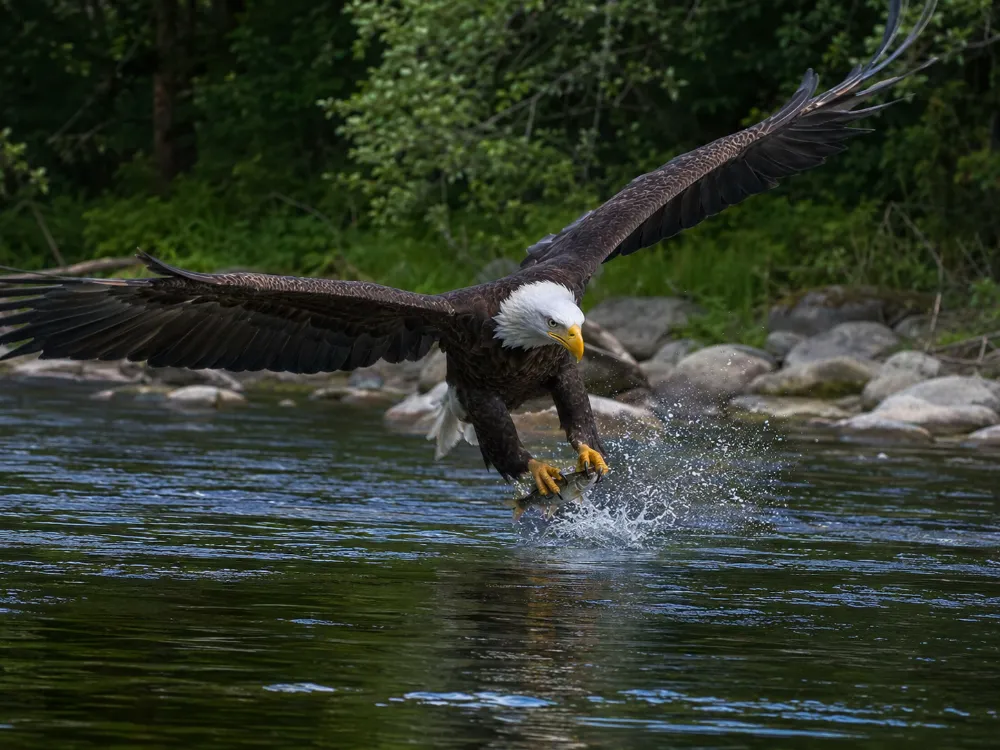
The bald eagle’s wingspan is one of its most impressive features. A large female can have a wingspan close to 8 feet. This broad-winged design is ideal for soaring, gliding, and carrying prey over short distances.
Bald eagle wings are long and broad with distinct finger-like primary feathers at the tips. These separated feathers reduce turbulence and improve control during slow soaring and landing.
When an eagle approaches a nest or perch, its wings, tail, and feet work together like an aircraft landing system. The wings slow the body, the tail adjusts direction, and the talons reach forward to grip the branch or nest edge.
Where Do Bald Eagles Live?
Bald eagles live across North America. They are found in Alaska, Canada, the contiguous United States, and parts of northern Mexico. They are especially common near large bodies of water where fish are available.
Common habitats include:
Lakes
Rivers
Coasts
Reservoirs
Wetlands
Marshes
Forested shorelines
Large open waterways
Areas near dams where fish concentrate
Bald eagles usually need three things: reliable food, tall nesting or perching sites, and enough space to avoid constant disturbance. They may tolerate some human activity, especially where food is abundant, but nesting pairs can be sensitive to disturbance near the nest.
Bald Eagle Habitat
The ideal bald eagle habitat combines water, fish, tall trees, and low disturbance. Forested shorelines are especially valuable because they provide nest sites, perches, and nearby feeding areas.
They often perch in tall trees with open views over water. From these perches, they watch for fish near the surface, waterbirds, carrion, or opportunities to steal food from other birds.
Bald eagles can also use human-altered landscapes. They may feed near reservoirs, fish hatcheries, landfills, dams, harbors, and open agricultural areas when food is available. However, long-term breeding success still depends on safe nesting sites and healthy prey populations.
What Do Bald Eagles Eat?
Bald eagles are best known as fish hunters, but they are opportunistic predators and scavengers. Their diet changes with season, location, and food availability.
Common foods include:
Fish
Waterfowl
Small mammals
Crabs and other aquatic animals
Carrion
Roadkill
Food stolen from ospreys and other birds
Fish are often the most important food, especially near lakes, rivers, and coasts. Bald eagles may catch live fish, pick up dead fish, steal fish from other birds, or scavenge fish remains.
How Bald Eagles Hunt
Bald eagles hunt mainly by sight. Their sharp vision helps them detect fish, birds, or carrion from great distances. When hunting fish, an eagle may watch from a perch or soar above water before dropping down with its talons extended.
They usually catch fish near the surface rather than diving deeply underwater. The eagle’s feet strike the fish, the talons close, and the bird lifts away if the fish is not too heavy.
Important hunting behaviors include:
Perch hunting from tall trees
Soaring over water
Low flight over shorelines
Snatching fish from the surface
Scavenging dead fish and carrion
Stealing prey from ospreys, gulls, or other eagles
Bald eagles are powerful, but they are not always graceful hunters. They often rely on opportunity. A dead salmon, injured waterbird, or distracted osprey may be easier than a fast live fish.
Do Bald Eagles Steal Food?
Yes. Bald eagles are famous for stealing food, a behavior called kleptoparasitism. They may chase ospreys, gulls, or other birds until the victim drops its fish. The eagle then catches or retrieves the stolen meal.
This behavior is not laziness. In nature, energy matters. If stealing food costs less energy than catching it, an eagle may choose the easier option. Bald eagles are both hunters and scavengers, and their flexibility is one reason they succeed in many environments.
Bald Eagle Nest
Bald eagles build enormous stick nests. A pair may reuse the same nest for many years, adding new sticks, grass, moss, and lining material each season. Over time, the nest can become massive.
Typical nest sites include:
Tall trees near water
Large conifers or deciduous trees
Cliffs in some regions
Artificial platforms where natural nest sites are limited
Remote shoreline areas
A bald eagle nest is more than a pile of sticks. It is a long-term breeding structure that must support eggs, growing chicks, adult movement, wind, rain, and repeated seasonal use.
How Big Is a Bald Eagle Nest?
Bald eagle nests are among the largest bird nests in the world. A new nest may be modest at first, but reused nests can grow extremely large as the pair adds material year after year.
Large nests may become several feet wide and several feet deep. Some can weigh hundreds of pounds or more. If the supporting tree is weak or the nest becomes too heavy, it may collapse, and the pair may rebuild nearby.
The large nest protects the eggs and chicks, gives adults space to feed nestlings, and provides a stable platform high above many ground predators.
Bald Eagle Breeding and Family Life
Bald eagles are often monogamous and may stay with the same mate for years, especially if both birds survive and the nesting territory remains successful. Pairs perform aerial displays, call to each other, defend territories, and maintain nest sites.
A typical breeding cycle includes:
Pair bonding and nest repair
Egg laying
Incubation by both parents
Hatching of eaglets
Feeding and guarding young
Wing exercise and branching
First flight, called fledging
Post-fledging care while young learn to hunt
Both parents help care for the young. They bring food to the nest, shade or warm the chicks, and defend the nesting area from threats.
Bald Eagle Eggs and Eaglets
A bald eagle pair usually lays one to three eggs. Two eggs are common in many nests. The eggs are white and are incubated carefully by the parents.
Newly hatched eaglets are small, weak, and covered with down. They depend completely on their parents for warmth, protection, and food. As they grow, their appetite increases rapidly, and the adults must bring frequent meals.
Eaglets grow quickly. They develop stronger legs, larger wings, darker feathers, and more coordinated movement. Before fledging, young eagles often stand on the nest edge, flap their wings, hop, and move onto nearby branches.
When Do Bald Eagles Get a White Head?
Bald eagles do not hatch with a white head. Juveniles are dark and mottled. The clean white head and tail develop gradually as the bird matures.
Many bald eagles begin to show more adult-like plumage after several years, but the full white head, white tail, yellow bill, and dark adult body usually appear when the bird reaches sexual maturity.
This gradual color change helps explain why young bald eagles are often misidentified. A large dark eagle near water may still be a bald eagle even if it does not look like the classic adult.
Bald Eagle Call
The bald eagle’s real call surprises many people. In movies, eagles are often given the powerful scream of a red-tailed hawk. The actual bald eagle call is a series of high-pitched whistles, chirps, or laughing notes.
Bald eagles use calls during pair communication, nest defense, food interactions, and territorial encounters. The call may not sound as fierce as people expect, but it is an important part of their social behavior.
Bald Eagle vs Golden Eagle
Bald eagles and golden eagles are both large raptors, but they differ in appearance, habitat, and behavior. Adult bald eagles have white heads and tails, while golden eagles are mostly dark brown with golden feathers on the back of the head and neck.
| Feature | Bald Eagle | Golden Eagle |
|---|---|---|
| Adult head | White | Golden-brown nape |
| Adult tail | White | Dark or subtly banded |
| Bill | Very large and yellow in adults | Darker bill with yellow cere |
| Typical habitat | Waterways, lakes, coasts, rivers | Open mountains, cliffs, grasslands, deserts |
| Main diet | Fish, carrion, waterbirds | Mammals, birds, carrion |
Juvenile bald eagles are the hardest to separate from golden eagles. Look for the bald eagle’s larger head, heavier bill, broad wings, and frequent association with water.
Bald Eagle vs Osprey
Bald eagles and ospreys both hunt fish, but they are different birds. Ospreys are slimmer, have long narrow wings, a white underside, a dark eye stripe, and specialized feet for catching fish. Bald eagles are heavier, broader-winged, and more likely to scavenge or steal food.
Ospreys often dive feet-first into water and may submerge briefly. Bald eagles usually snatch fish near the surface and do not normally plunge deeply like ospreys.
Bald eagles may chase ospreys and steal their fish. This interaction is common enough that ospreys often react strongly when an eagle appears nearby.
Bald Eagle Behavior
Bald eagles are adaptable and intelligent raptors. They can be solitary, paired, or gathered in groups depending on food availability. In winter, many eagles may congregate near open water, salmon runs, dams, or carrion sources.
Common behaviors include:
Soaring over water
Perching in tall trees
Calling near the nest
Defending nesting territory
Chasing other birds for food
Scavenging carrion
Gathering in winter feeding areas
Pair bonding through flight displays
They are powerful predators, but they are also cautious. A bald eagle may abandon a feeding attempt if disturbed by people, vehicles, boats, or other eagles.
Migration and Seasonal Movement
Some bald eagles are year-round residents, while others migrate or move seasonally. Movement depends strongly on food and open water. In northern regions, eagles may move south when lakes and rivers freeze. In milder coastal or river areas, they may remain all year.
Young eagles often wander widely before settling into a breeding territory. These movements help them find food, avoid competition, and eventually locate suitable habitat.
Seasonal gatherings may occur where fish are abundant, such as salmon streams, ice-free rivers, reservoirs, or dam outflows.
How Long Do Bald Eagles Live?
Bald eagles can live for decades, especially if they survive the dangerous early years. Young eagles face many risks, including starvation, collisions, severe weather, territorial conflict, and difficulty learning to hunt.
Adults have higher survival rates, especially in protected habitats with abundant food. Long-term survival depends on safe nesting areas, clean food sources, low disturbance, and reduced exposure to toxins such as lead.
Predators and Threats
Adult bald eagles have few natural predators, but eggs and young can be vulnerable. Nestlings may be threatened by severe weather, nest collapse, starvation, sibling competition, raccoons, ravens, owls, or other predators, depending on location.
Major modern threats include:
Lead poisoning from scavenged carcasses or gut piles containing lead ammunition fragments
Vehicle collisions
Power line collisions or electrocution
Habitat loss near nesting areas
Human disturbance around nests
Illegal shooting
Entanglement in fishing line
Environmental contamination
Even though bald eagles have recovered dramatically, they still need protection from preventable threats.
Bald Eagle Conservation
The bald eagle is one of North America’s most famous conservation success stories. The species declined severely in the twentieth century because of hunting, habitat loss, and especially the effects of DDT, a pesticide that caused eggshell thinning and reproductive failure.
Legal protection, the banning of DDT, habitat conservation, nest protection, and public support helped bald eagle populations recover. The species was removed from the U.S. federal endangered species list in 2007, but it remains protected under eagle-specific laws and migratory bird laws.
This recovery shows that conservation can work when science, law, habitat protection, and public awareness come together.
Why Bald Eagles Are Still Protected
Even though bald eagles are no longer federally listed as endangered in the United States, they are still legally protected. It is illegal to harm, harass, kill, disturb, possess, or take bald eagles, their eggs, or their nests without proper authorization.
Nest disturbance is especially important. Getting too close to an active nest can cause stress, reduce feeding, or lead to nest failure in sensitive situations. Photographers, boaters, hikers, and drone users should keep a respectful distance.
Bald Eagle Symbolism
The bald eagle is the national bird and national symbol of the United States. Its striking appearance, large size, soaring flight, and North American range helped make it a symbol of strength, independence, and wilderness.
For many Indigenous peoples, eagles also hold deep cultural and spiritual significance. Their feathers, presence, and flight can carry meanings connected to respect, prayer, leadership, courage, and connection with the natural world.
Because of this symbolism, the bald eagle is more than a biological species. It is also a cultural icon, a conservation symbol, and a reminder that human choices can either damage or restore wildlife populations.
Are Bald Eagles Dangerous?
Bald eagles are wild predators and should not be approached, handled, or fed. However, they are not a normal danger to people. They usually avoid direct contact with humans unless they are defending a nest, trapped, injured, or habituated to food sources.
The greater risk is usually to small animals near eagle habitat, especially if pets are left unsupervised outdoors. While bald eagles mainly eat fish and carrion, they can take birds or small mammals when opportunities arise.
The best rule is simple: admire bald eagles from a distance, never feed them, and keep pets supervised in areas where large raptors are active.
How to Watch Bald Eagles Responsibly
Bald eagles are exciting birds to observe, but responsible viewing matters. Disturbing a bird repeatedly can waste its energy, interrupt feeding, or disrupt nesting behavior.
Responsible viewing tips include:
Use binoculars or a zoom lens instead of approaching closely.
Stay far from active nests.
Do not fly drones near eagles or nests.
Do not feed eagles.
Keep dogs leashed near nesting or feeding areas.
Respect closed areas and wildlife signs.
Avoid loud behavior near nests.
Report injured eagles to licensed wildlife rehabilitators or local wildlife authorities.
Interesting Facts About Bald Eagles
Bald eagles are not bald; their name refers to the white head of adults.
Females are larger than males.
Young bald eagles do not have the classic white head and tail.
Bald eagles often steal fish from ospreys and other birds.
They build some of the largest nests of any bird.
They can gather in large numbers where food is concentrated.
Their real call is much higher and weaker-sounding than many movie eagle screams.
They are strongly associated with water but can also feed inland.
Their comeback is one of the best-known wildlife recovery stories in North America.
Common Myths About Bald Eagles
Myth: Bald eagles are bald.
Fact: Their heads are covered with white feathers.Myth: Bald eagles only eat fish.
Fact: Fish are important, but they also eat birds, mammals, carrion, and stolen prey.Myth: Every dark eagle is a golden eagle.
Fact: Juvenile bald eagles are dark and mottled, so they are often confused with golden eagles.Myth: Bald eagles make the dramatic scream heard in movies.
Fact: Movie eagle screams are often red-tailed hawk calls.Myth: Recovered means no protection is needed.
Fact: Bald eagles still need legal protection, safe habitat, and reduced poisoning risks.
Final Takeaway
The bald eagle is a powerful North American sea eagle with a white head, white tail, broad wings, sharp talons, and a strong connection to water. It is a skilled fish hunter, opportunistic scavenger, food thief, devoted nesting parent, and one of the most recognizable birds in the world.
Its recovery from severe decline is a major conservation success, but the story is not finished. Bald eagles still face threats from lead poisoning, habitat disturbance, collisions, and human activity near nests.
To understand the bald eagle is to see both sides of wildlife conservation: the damage people can cause, and the recovery that becomes possible when people protect habitat, reduce pollution, and respect wild animals from a safe distance.
FAQs About the Bald Eagle
What is a bald eagle?
A bald eagle is a large North American bird of prey and sea eagle. It is known for its white head and tail, dark brown body, yellow bill, broad wings, and strong association with water.
Why is it called a bald eagle?
It is called a bald eagle because “bald” once meant white-headed. The bird is not hairless or featherless; adults have a head covered in white feathers.
What is the scientific name of the bald eagle?
The scientific name of the bald eagle is Haliaeetus leucocephalus.
Where do bald eagles live?
Bald eagles live in North America, especially near lakes, rivers, coasts, wetlands, reservoirs, and forested shorelines where fish and nesting sites are available.
What do bald eagles eat?
Bald eagles eat mainly fish, but they also eat waterbirds, small mammals, turtles, carrion, roadkill, and food stolen from other birds such as ospreys.
How big is a bald eagle?
A bald eagle is usually about 28 to 38 inches long, with a wingspan of about 6 to 8 feet. Females are usually larger than males.
When do bald eagles get white heads?
Bald eagles gradually develop white heads and tails over several years. Full adult plumage usually appears when they reach maturity.
Are juvenile bald eagles brown?
Yes. Juvenile bald eagles are mostly dark brown with white mottling. They can look very different from adults and are sometimes mistaken for golden eagles.
Do bald eagles mate for life?
Bald eagles often stay with the same mate for many years if both birds survive and the nesting territory remains successful. If one mate dies, the surviving bird may find a new partner.
How big is a bald eagle nest?
Bald eagle nests can become enormous because pairs often reuse and enlarge them for years. Large nests may be several feet wide and very heavy.
Are bald eagles endangered?
Bald eagles recovered enough to be removed from the U.S. federal endangered species list in 2007. They are still protected by other laws and remain vulnerable to threats such as lead poisoning and nest disturbance.
Why did bald eagles decline?
Bald eagles declined because of hunting, habitat loss, and pesticides such as DDT, which caused eggshell thinning and poor reproductive success.
Do bald eagles migrate?
Some bald eagles migrate or move seasonally, especially when northern waters freeze. Others remain year-round where food and open water are available.
Are bald eagles dangerous to humans?
Bald eagles are powerful wild predators, but they are not normally dangerous to people. They should be observed from a distance and never fed or approached.
What is the difference between a bald eagle and a golden eagle?
Adult bald eagles have white heads and tails and are often found near water. Golden eagles are mostly dark brown with golden neck feathers and are more often associated with open mountains, cliffs, grasslands, and deserts.