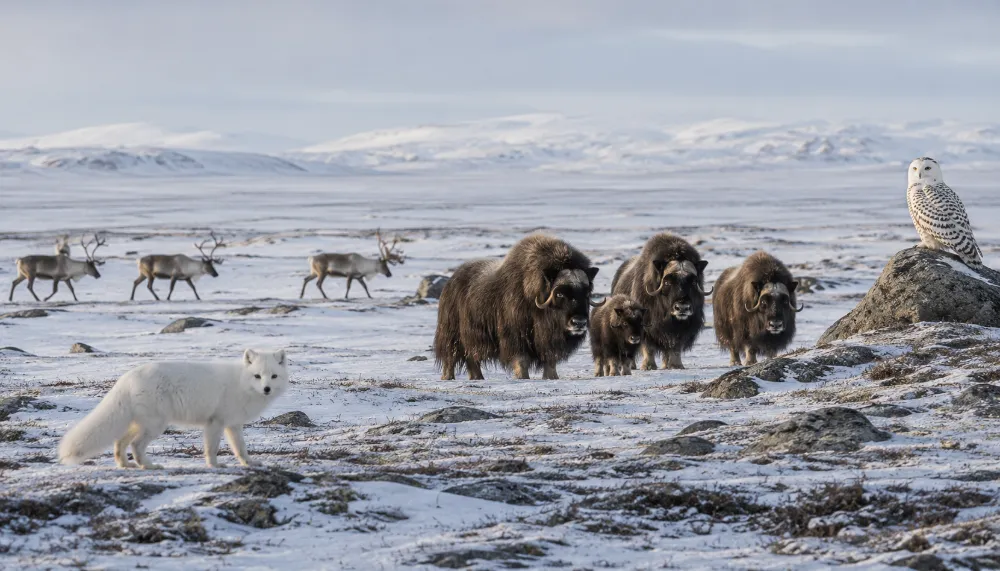
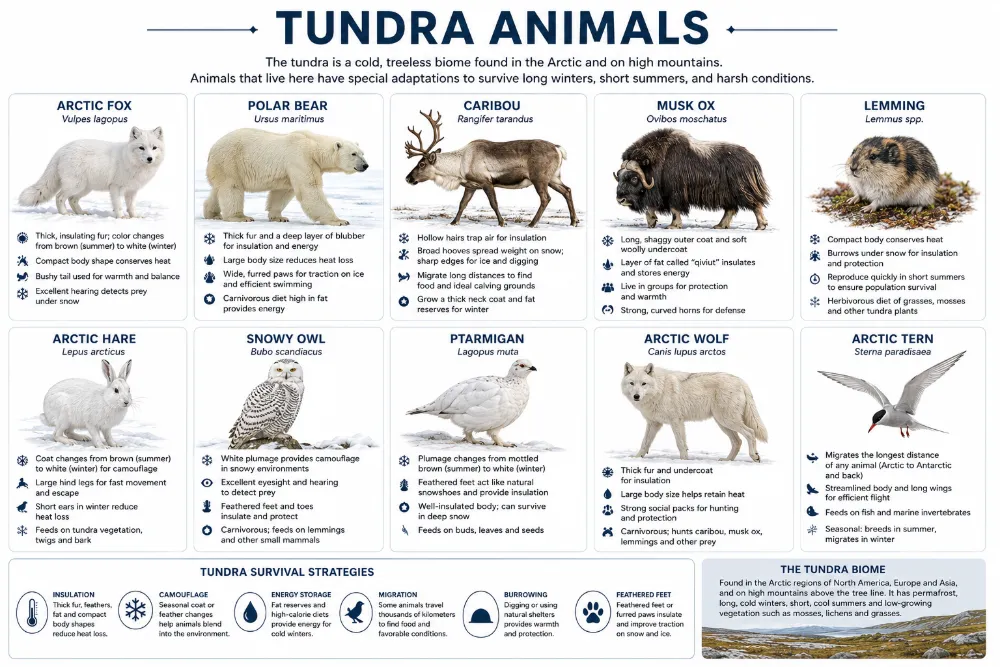
Tundra animals are wildlife species adapted to cold, windy, treeless environments where winters are long, summers are short, and food can be scarce. Famous tundra animals include Arctic foxes, polar bears, caribou, musk oxen, snowy owls, lemmings, Arctic hares, ptarmigan, wolves, and migratory birds. They survive with thick fur or feathers, seasonal camouflage, fat storage, migration, burrowing, and efficient feeding strategies.
Quick Facts About Tundra Animals
| Feature | Tundra Animals |
|---|---|
| Main habitat | Arctic tundra and alpine tundra |
| Climate | Cold, windy, dry, with short growing seasons |
| Vegetation | Mosses, lichens, grasses, sedges, dwarf shrubs, low flowering plants |
| Common mammals | Arctic fox, caribou, musk ox, lemming, Arctic hare, wolf |
| Common birds | Snowy owl, ptarmigan, snow bunting, Arctic tern, geese, shorebirds |
| Marine-linked species | Polar bear, seals, walrus, seabirds |
| Key adaptations | Insulation, camouflage, migration, fat storage, burrowing, seasonal breeding |
| Main challenges | Cold, wind, snow, low food availability, predators, short summers |
| Major threats | Climate change, habitat disturbance, pollution, industrial development, shifting food webs |
What Is the Tundra?
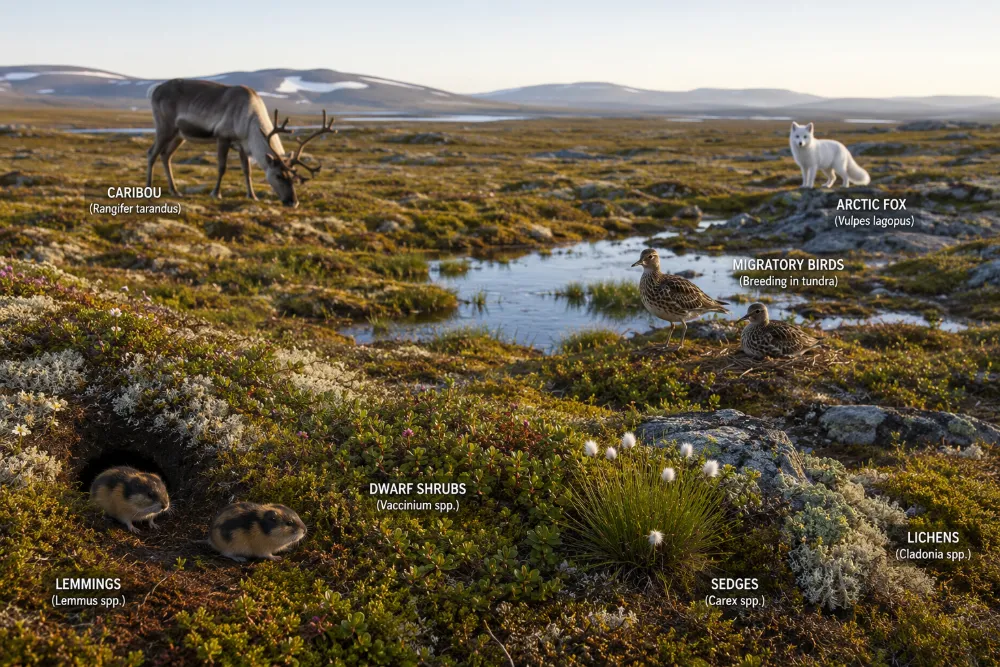
The tundra is a cold, open biome where tree growth is limited by low temperatures, strong winds, frozen soil, and a short growing season. It may look empty at first, but it supports a specialized community of animals, plants, fungi, microbes, and seasonal migrants.
There are two main types of tundra. Arctic tundra occurs in northern regions around the Arctic, including parts of Alaska, Canada, Greenland, Scandinavia, and Russia. Alpine tundra occurs high in mountains above the tree line, where conditions are too cold or exposed for forests to grow.
Both tundra types are harsh, but not lifeless. Tundra animals have evolved remarkable ways to survive in landscapes where winter can dominate most of the year.
What Are Tundra Animals?
Tundra animals are species that live in, breed in, migrate through, or depend on tundra ecosystems. Some live there year-round, while others arrive only during summer to feed and reproduce.
Year-round tundra residents include animals such as Arctic foxes, musk oxen, lemmings, ptarmigan, and some wolves. Seasonal visitors include many birds, such as geese, ducks, shorebirds, and Arctic terns, which travel long distances to use the tundra’s brief but productive summer.
Some animals, such as polar bears, are closely linked to tundra regions but depend heavily on nearby sea ice and marine prey. This shows that tundra food webs often connect land, freshwater, and ocean ecosystems.
Arctic Fox
The Arctic fox is one of the most iconic tundra animals. It has a compact body, short ears, short muzzle, thick fur, and a bushy tail that can wrap around the body for warmth. These features reduce heat loss and help the fox survive extreme cold.
Many Arctic foxes change color with the seasons. In winter, they may be white, blending into snow and ice. In summer, they may become brown or grayish, matching rocks, soil, and tundra vegetation. Some populations have a darker “blue” color morph that remains gray-brown through much of the year.
Arctic foxes eat lemmings, voles, birds, eggs, carrion, berries, fish, and scraps left by larger predators. Their population can rise and fall with lemming cycles, making them closely tied to small rodent abundance.
Polar Bear
The polar bear is often associated with the Arctic tundra, although it is best understood as a marine mammal of the sea ice. Polar bears use sea ice as a hunting platform, mainly to catch seals. They may also come ashore on tundra coasts, especially when sea ice is absent or during denning seasons.
Polar bears are built for cold. They have thick fur, a dense layer of fat, large paws for walking on snow and swimming, and a powerful sense of smell. Their white appearance helps them blend into snowy and icy environments.
Although polar bears may travel across tundra landscapes, their survival depends strongly on the availability of sea ice and marine prey. This makes them one of the tundra-region animals most affected by changing Arctic conditions.
Caribou and Reindeer
Caribou and reindeer are the same species, Rangifer tarandus. In North America, wild populations are usually called caribou. In Eurasia, and for domesticated or semi-domesticated animals, the name reindeer is often used.
Caribou are famous for long-distance migration. Some herds travel hundreds or even thousands of miles between wintering areas and summer calving grounds. Tundra summers provide fresh vegetation and fewer biting insects in some regions, making them important for reproduction.
Caribou have broad hooves that help them walk on snow, soft ground, and wet tundra. They feed on lichens, grasses, sedges, leaves, and shrubs. Unlike most deer species, both male and female caribou can grow antlers.
Musk Ox
The musk ox is a large, shaggy Arctic herbivore adapted to cold tundra environments. Its long outer hair and dense underwool help protect it from freezing temperatures and strong winds. The soft underwool, called qiviut, is one of the warmest natural fibers produced by any mammal.
Musk oxen feed on grasses, sedges, willows, mosses, and other tundra plants. In winter, they may dig through snow with their hooves to reach buried vegetation.
When threatened by wolves or other predators, musk oxen may form a defensive circle or line, with adults facing outward and calves protected inside or behind them. This group defense is one of the most dramatic behaviors in tundra wildlife.
Lemmings
Lemmings are small rodents that play a huge role in tundra ecosystems. They feed on grasses, sedges, mosses, roots, and other low vegetation. Although small, they are a major food source for predators such as Arctic foxes, snowy owls, weasels, jaegers, gulls, and wolves.
Lemming populations can fluctuate dramatically. In some years, they become abundant, supporting high breeding success for predators. In other years, their numbers drop, and predators may produce fewer young or shift to other prey.
The famous myth that lemmings intentionally jump off cliffs is false. Real lemmings may disperse when populations are high, but they do not commit mass suicide.
Arctic Hare
The Arctic hare is a large hare adapted to open, cold environments. It has thick fur, relatively short ears compared with many warmer-climate hares, and powerful hind legs for rapid escape.
In winter, Arctic hares are often white, helping them blend into snow. In summer, some populations become gray-brown or show darker patches that match exposed rock and tundra vegetation.
Arctic hares eat woody plants, mosses, lichens, buds, leaves, roots, and other tundra vegetation. They may dig through snow to reach food and often rest in shallow depressions that provide some shelter from wind.
Snowy Owl
The snowy owl is one of the tundra’s most recognizable birds. Unlike many owls, it is often active during the day, especially in Arctic summer when daylight may last nearly 24 hours.
Snowy owls nest on the ground in open tundra. They feed heavily on lemmings, but they also take voles, birds, hares, fish, and carrion when available. Their breeding success can depend strongly on rodent abundance.
Adult males are often nearly white, while females and young birds usually have more dark barring. This difference helps with camouflage and may also reflect age and sex differences.
Ptarmigan
Ptarmigan are tundra and mountain birds related to grouse. They are famous for seasonal camouflage. In winter, many ptarmigan are white, blending into snow. In summer, they become mottled brown, gray, and reddish, matching rocks, soil, and vegetation.
Ptarmigan have feathered feet that act like natural snowshoes, helping them walk across snow. They feed on buds, leaves, berries, seeds, and other plant material.
In Arctic and alpine ecosystems, ptarmigan are important prey for foxes, owls, hawks, eagles, and other predators. Their survival depends heavily on camouflage, stillness, and quick flight.
Arctic Wolf
The Arctic wolf is a cold-adapted wolf found in parts of the high Arctic. It has thick fur, a compact body, and social hunting behavior that helps it survive in harsh conditions.
Arctic wolves may hunt musk oxen, Arctic hares, caribou, lemmings, and birds. They often live in packs, which improves their ability to hunt large prey and defend territories.
Compared with wolves in more southern regions, Arctic wolves may encounter fewer humans, but they still face challenges from climate change, prey shifts, and disturbance in some areas.
Ermine and Weasels
Ermines, also called stoats, are small predators that can live in tundra and subarctic habitats. They have long slender bodies, short legs, and excellent hunting ability. Their shape allows them to enter tunnels and burrows in search of rodents.
In winter, ermines may turn white, except for the black tip of the tail. This seasonal coat helps them blend into snowy environments. In summer, they are usually brown above and pale below.
Ermines feed on lemmings, voles, birds, eggs, insects, and other small animals. Despite their small size, they are energetic and highly effective predators.
Arctic Ground Squirrel
The Arctic ground squirrel is one of the tundra’s most remarkable hibernators. It lives in burrows and survives winter by entering deep hibernation, during which its body temperature can drop extremely low.
During the short summer, Arctic ground squirrels feed actively on seeds, leaves, flowers, berries, and other plant material. They must build fat reserves quickly before winter returns.
They are important prey for foxes, wolves, raptors, and other predators. Their burrows also affect soil structure and create microhabitats for other organisms.
Snow Bunting
The snow bunting is a small songbird that breeds in Arctic tundra and rocky northern habitats. It is one of the northernmost breeding songbirds in the world.
Snow buntings feed on seeds, insects, and other small invertebrates. During breeding season, insects become especially important for feeding chicks.
Their pale plumage helps them blend into snowy and rocky landscapes. Like many tundra birds, they migrate south after the breeding season to escape the harshest winter conditions.
Arctic Tern
The Arctic tern is a famous long-distance migrant. It breeds in Arctic and subarctic regions during the northern summer, then migrates toward Antarctic waters, experiencing more daylight than almost any other animal.
On tundra breeding grounds, Arctic terns nest on the ground and defend their nests fiercely. They feed on small fish and marine invertebrates, linking tundra nesting sites with ocean food webs.
The Arctic tern shows that not all tundra animals stay year-round. Some use the tundra briefly but depend on it critically for reproduction.
Migratory Birds of the Tundra
Every summer, the tundra becomes a breeding ground for millions of migratory birds. Geese, ducks, sandpipers, plovers, loons, jaegers, gulls, and songbirds arrive to nest and raise young during the short burst of seasonal productivity.
Long daylight hours help plants grow quickly and support huge numbers of insects. These insects become food for chicks and adult birds. Wetlands, ponds, thaw lakes, and marshy tundra provide nesting and feeding sites.
Many tundra birds migrate thousands of miles each year. Their survival depends not only on Arctic breeding grounds but also on stopover wetlands, coastal habitats, and wintering areas far away.
Alpine Tundra Animals
Alpine tundra occurs high in mountains above the tree line. It is cold, windy, and exposed, but it differs from Arctic tundra because it is found at high elevation rather than high latitude.
Common alpine tundra animals may include pikas, marmots, mountain goats, bighorn sheep, snow finches, ptarmigan, and high-elevation insects. These animals must cope with cold, low oxygen, strong winds, and short growing seasons.
Alpine animals often use rocks, burrows, cliffs, and seasonal movement to survive. Some move to lower elevations during winter, while others remain active under snow or hibernate.
How Tundra Animals Stay Warm
Insulation is one of the most important tundra adaptations. Many tundra animals have thick fur, dense feathers, fat layers, or compact body shapes that reduce heat loss.
Small ears, short tails, and short limbs are common in cold-adapted mammals because these features reduce exposed surface area. Arctic foxes, Arctic hares, and musk oxen all show this principle in different ways.
Birds use feathers as insulation. Some fluff their feathers to trap warm air. Others tuck their heads, stand on one leg, or shelter from wind to conserve heat.
Camouflage in the Tundra
Many tundra animals change color with the seasons. White winter coats or feathers help animals blend into snow, while brown, gray, or mottled summer colors match tundra plants, rocks, and soil.
Arctic foxes, Arctic hares, ptarmigan, and ermines are classic examples of seasonal camouflage. This helps predators approach prey and helps prey avoid predators.
Camouflage is especially important in the tundra because there are few trees or tall plants to hide behind. In such open landscapes, being the right color can mean the difference between life and death.
Migration as a Survival Strategy
Some tundra animals survive by leaving. Caribou migrate between seasonal ranges. Many birds nest in the tundra during summer but fly south before winter. Some insects and fish also use seasonal movement to cope with changing conditions.
Migration allows animals to exploit the tundra’s short summer abundance without enduring the full severity of winter. However, migration is risky. Animals must find food, avoid predators, cross barriers, and arrive at the right time.
Climate change can disrupt migration by shifting the timing of plant growth, insect emergence, snowmelt, and predator-prey interactions.
Burrowing and Life Under Snow
For many small tundra animals, survival depends on life under the snow. Snow can act as insulation, creating a subnivean zone between the ground and snowpack. This hidden layer can be warmer and less windy than the surface.
Lemmings, voles, and some insects use this space to move, feed, and avoid predators. Arctic foxes and owls may listen for prey moving beneath the snow.
Burrows are also important. Ground squirrels, foxes, and other animals use burrows for shelter, reproduction, food storage, and hibernation.
Tundra Food Web
The tundra food web begins with low-growing plants, lichens, mosses, algae, and microbes. Herbivores such as lemmings, hares, caribou, musk oxen, and insects eat this plant material.
Predators such as Arctic foxes, snowy owls, wolves, jaegers, weasels, and bears feed on herbivores and other animals. Scavengers and decomposers recycle nutrients from dead plants and animals back into the ecosystem.
Because the growing season is short, tundra food webs can be sensitive. A change in lemming numbers, snow conditions, plant growth, or insect timing can affect many other species.
How Climate Change Affects Tundra Animals
Tundra animals are strongly affected by warming temperatures, changing snow patterns, melting permafrost, shifting vegetation, and altered sea ice conditions. Some species may temporarily benefit from more shrubs or longer growing seasons, while others lose the cold, open conditions they are adapted to.
Polar bears are affected by changes in sea ice. Caribou can be affected by freezing rain that locks food under ice. Arctic foxes may face increased competition from red foxes moving north. Migratory birds may arrive at times that no longer match peak insect abundance.
The tundra is changing quickly in many regions. Because tundra animals are specialized, even small environmental shifts can have large effects.
Why Tundra Animals Matter
Tundra animals are important because they show how life adapts to extremes. Their bodies and behaviors reveal solutions to cold, darkness, wind, seasonal food shortage, and open landscapes.
They also support Indigenous cultures, local food systems, scientific research, and global biodiversity. Species such as caribou, musk oxen, Arctic foxes, and migratory birds are deeply connected to northern ecosystems and human communities.
Protecting tundra animals means protecting entire landscapes: permafrost soils, wetlands, coasts, sea ice, migration routes, nesting grounds, and predator-prey relationships.
Common Tundra Animals List
| Animal | Type | Key Adaptation |
|---|---|---|
| Arctic fox | Mammal | Thick fur and seasonal camouflage |
| Polar bear | Mammal | Fat layer, large paws, cold adaptation |
| Caribou / reindeer | Mammal | Migration and broad hooves |
| Musk ox | Mammal | Long guard hairs and warm underwool |
| Lemming | Mammal | Burrowing and rapid reproduction |
| Arctic hare | Mammal | White winter coat and strong legs |
| Snowy owl | Bird | Insulating feathers and strong hunting vision |
| Ptarmigan | Bird | Seasonal plumage and feathered feet |
| Arctic wolf | Mammal | Pack hunting and thick coat |
| Arctic tern | Bird | Extreme long-distance migration |
Final Verdict: Tundra Animals
Tundra animals are some of the most cold-adapted wildlife on Earth. They survive in open, treeless landscapes through insulation, camouflage, migration, burrowing, fat storage, social behavior, and precise seasonal timing.
From tiny lemmings under the snow to musk oxen in Arctic winds and migratory birds crossing the planet, tundra wildlife shows how diverse and resilient animals can be. Yet these species are also vulnerable because tundra ecosystems are changing. Understanding tundra animals is an important step toward protecting one of the planet’s most extreme and fascinating biomes.
FAQs About Tundra Animals
What are tundra animals?
Tundra animals are species that live in or depend on tundra habitats, including Arctic foxes, caribou, musk oxen, lemmings, snowy owls, Arctic hares, wolves, ptarmigan, and many migratory birds.
What is the most famous tundra animal?
The Arctic fox, polar bear, caribou, and musk ox are among the most famous tundra animals. The polar bear is especially iconic in Arctic regions, although it depends heavily on sea ice as well as tundra coasts.
How do animals survive in the tundra?
Tundra animals survive through thick fur or feathers, fat storage, compact bodies, seasonal camouflage, migration, burrowing, hibernation, and feeding strategies adapted to short summers and long winters.
Do many animals live in the tundra?
Yes, but tundra biodiversity is lower than in forests or tropical ecosystems. The animals that do live there are highly specialized, and many migratory birds use the tundra during summer.
What do tundra animals eat?
Herbivores eat grasses, sedges, mosses, lichens, shrubs, and flowers. Carnivores eat rodents, birds, eggs, fish, carrion, seals, or larger mammals depending on the species.
Are polar bears tundra animals?
Polar bears are often associated with tundra regions, especially Arctic coasts, but they are more accurately described as marine mammals that depend heavily on sea ice for hunting seals.
What small animals live in the tundra?
Small tundra animals include lemmings, voles, Arctic ground squirrels, insects, spiders, and small birds such as snow buntings.
What birds live in the tundra?
Tundra birds include snowy owls, ptarmigan, snow buntings, Arctic terns, geese, ducks, shorebirds, loons, jaegers, and gulls. Many arrive only for the summer breeding season.
What is the difference between Arctic tundra and alpine tundra animals?
Arctic tundra animals live in far northern regions, while alpine tundra animals live high in mountains above the tree line. Some adaptations are similar, but the species are often different.
Why are tundra animals threatened?
Tundra animals are threatened by climate change, habitat disturbance, changing snow and ice conditions, pollution, industrial development, and shifts in food webs.