The spectacled caiman is one of the most widespread and adaptable crocodilians in the Americas. It lives in rivers, marshes, ponds, flooded grasslands, and other freshwater habitats, where it feeds on fish, insects, crustaceans, birds, reptiles, and small mammals.

At first glance, the spectacled caiman may look like a small alligator or a crocodile, but it is actually a caiman in the alligator family. It is named for the bony ridge between the eyes, which can look a little like a pair of spectacles.
In this guide, you will learn the most important spectacled caiman facts, including its size, habitat, diet, appearance, behavior, and range.
Quick facts
| Feature | Spectacled Caiman |
|---|---|
| Scientific name | Caiman crocodilus |
| Group | Caiman in the alligator family |
| Range | Central and South America |
| Habitat | Rivers, marshes, swamps, ponds, lakes, flooded grasslands |
| Diet | Carnivorous |
| Typical prey | Insects, crustaceans, fish, frogs, birds, reptiles, small mammals |
| Typical size | Usually medium-sized; males are larger than females |
| Main trait | Bony ridge between the eyes and strong adaptability |
What is a spectacled caiman?
The spectacled caiman is a medium-sized crocodilian native to Central and South America. It belongs to the caiman branch of the alligator family, which means it is more closely related to alligators than to true crocodiles.
It is one of the best-known caiman species and is often the caiman people see in wildlife photos, documentaries, and wetland habitats across tropical America. Because it can live in many types of freshwater environments, it has a broader ecological reach than some more specialized crocodilians.
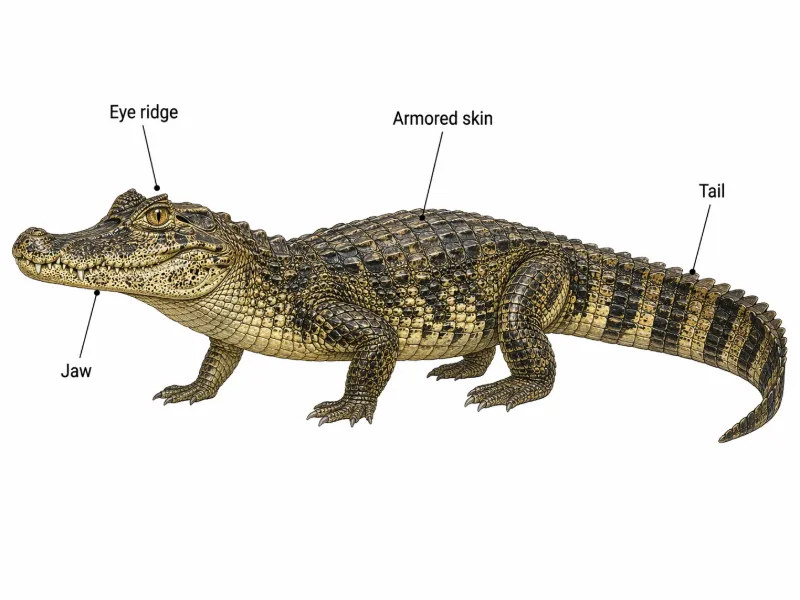
The name “spectacled caiman” comes from the bony ridge between the eyes. From certain angles, this ridge can resemble a pair of glasses, giving the animal its common name.
How big is a spectacled caiman?
The spectacled caiman is much smaller than a black caiman and usually does not reach the enormous size associated with the largest crocodilians. It is generally considered a medium-sized crocodilian.
Adult males are larger than females and can grow to several meters in length, with large males being much more impressive than younger animals. Females are smaller on average and more lightly built.
Size varies by region, local food supply, sex, and subspecies. Many individuals are modest in size compared with large crocodiles or black caimans, which is one reason people often think of the spectacled caiman as a smaller crocodilian.
Even so, a large spectacled caiman is still a powerful predator and should not be underestimated.
What does a spectacled caiman look like?
The spectacled caiman has a long body, strong tail, armored skin, and a fairly broad head. Its color is often olive, brownish, gray, or yellowish-green, depending on age, light, and habitat conditions.
The most distinctive feature is the ridge between the eyes. This bony ridge can make the face look slightly more angular and gives rise to the species’ common name.
Young spectacled caimans often show darker bands or markings along the body and tail. These markings can help with camouflage in vegetation and shallow water. Adults may look more uniform in color, though patterning can still be visible.
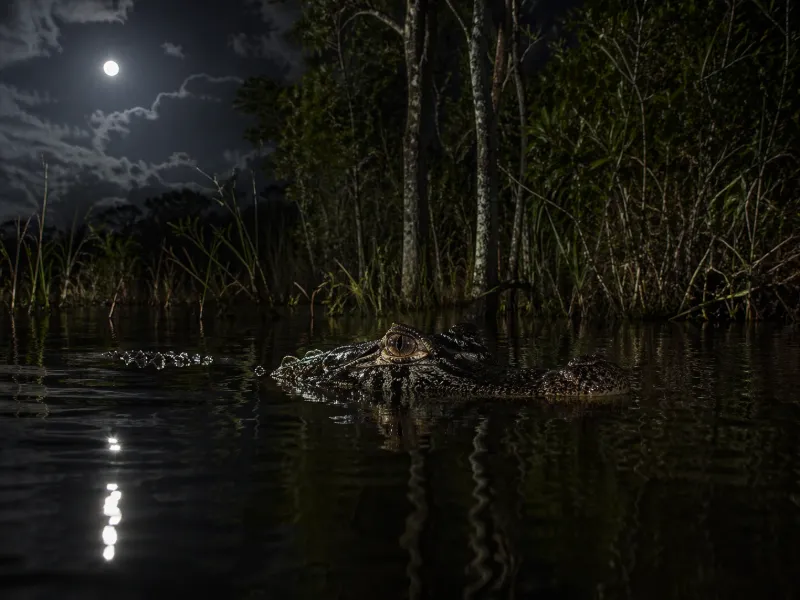
Like other crocodilians, the eyes and nostrils are positioned high on the head, allowing the animal to remain almost fully submerged while watching the world above the waterline.
Where do spectacled caimans live?
Spectacled caimans live across a broad area of Central and South America. Their range includes countries from southern Mexico through Central America and into much of northern and central South America.
They are highly adaptable and can be found in many kinds of freshwater habitat, including slow-moving rivers, swamps, marshes, ponds, lakes, canals, flooded forests, and seasonally flooded plains. In some places, they also tolerate brackish water better than some other caimans, although they are mainly freshwater animals.
This flexibility helps explain why the spectacled caiman is so widespread. It can survive in both natural wetlands and some disturbed or human-modified environments, as long as there is water, cover, and prey.
What does a spectacled caiman eat?
The spectacled caiman is a carnivore and an opportunistic feeder. Its diet changes as it grows.
Young spectacled caimans often eat insects, spiders, snails, crustaceans, tadpoles, and small fish. At this size, they focus on prey that is easy to catch and swallow.
As they grow larger, they begin eating more fish, frogs, aquatic birds, snakes, turtles, and small mammals. Larger adults can take bigger prey, but they are generally not as dominant or massive as black caimans.
Because the species is adaptable, its diet often reflects what is most available in the local wetland. In one area fish may dominate, while in another area invertebrates or amphibians may be more important.
How does a spectacled caiman hunt?
Like other crocodilians, the spectacled caiman is mainly an ambush hunter. It often waits quietly in the water or at the edge of vegetation until prey comes close.
When the time is right, it strikes quickly with its jaws and pulls the prey into the water or holds it firmly until it can be swallowed. Small prey may be eaten immediately, while larger prey may require more handling.
Spectacled caimans are often active at night, when they patrol shallow water and use stealth to catch fish and other animals. Their eyeshine makes them easier for researchers and guides to spot during nighttime surveys.
Are spectacled caimans dangerous?
Spectacled caimans are wild predators and should be treated with caution. Even medium-sized individuals can bite hard and react quickly if threatened or handled.
They are generally less formidable than the largest black caimans or the biggest crocodile species, but that does not mean they are harmless. A defensive adult, a nesting female, or an animal cornered near shore can be dangerous.
As with any crocodilian, the safest approach is to observe from a distance, avoid feeding them, and stay out of the water where large individuals are known to occur.
How is the spectacled caiman different from a black caiman?
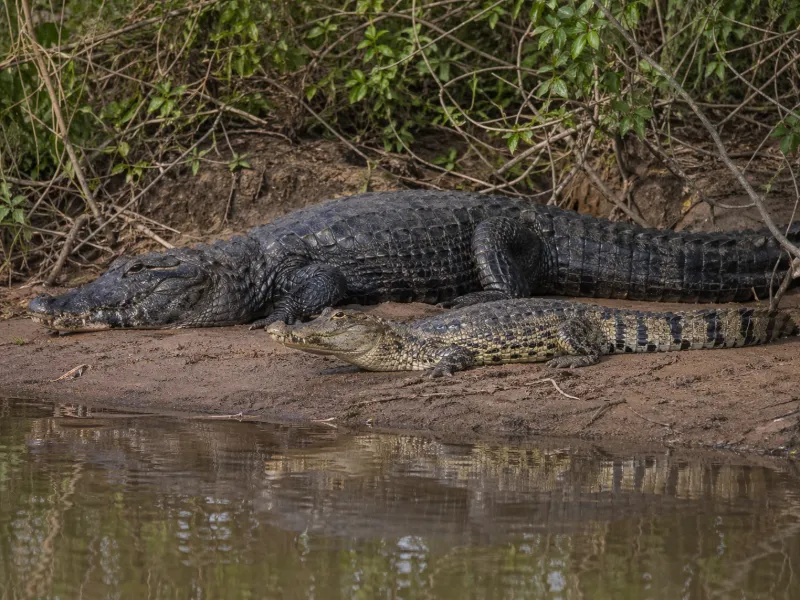
The most obvious difference is size. The black caiman is much larger and more powerful overall, while the spectacled caiman is usually smaller and more lightly built.
The spectacled caiman also tends to show the characteristic ridge between the eyes more clearly, especially in close view. Its overall appearance can be slimmer and less imposing than that of a mature black caiman.
In simple terms, if the animal looks extremely large, dark, and dominant in a South American wetland, it may be a black caiman. If it is smaller to medium-sized and shows the classic “spectacled” head ridge, it is more likely a spectacled caiman.
Do spectacled caimans live alone?
Spectacled caimans may be seen alone or near other individuals, depending on habitat, water level, food availability, and season. In rich wetland environments, multiple caimans can sometimes be found in the same general area.
Young animals may be more tolerant of living near one another in suitable habitat, while larger adults may space themselves out more. Breeding season and nesting conditions can also affect how closely they occur together.
So they are not strictly solitary all the time, but they also do not live in tightly coordinated groups like social mammals.
How do spectacled caimans reproduce?
Like other crocodilians, spectacled caimans reproduce by laying eggs. Females build nests using vegetation, mud, and other natural material in suitable nesting areas near water.
After laying a clutch of eggs, the female may guard the nest. Once the young hatch, they face many dangers from birds, fish, snakes, mammals, and even larger reptiles.
Only a small number survive to adulthood, which is why nest protection and safe wetland habitat are important for long-term population health.
What is the conservation status of the spectacled caiman?
The spectacled caiman has generally done better than some larger crocodilians because of its wide range and adaptability. In many regions it remains relatively common compared with more threatened crocodilian species.
However, that does not mean it faces no threats. Habitat loss, wetland drainage, illegal hunting, pollution, and conflict with people can still affect local populations. Conditions also vary from one region to another.
Its broad distribution and flexible habitat use have helped it remain one of the more successful crocodilians in the Americas.
Why is the spectacled caiman important?
The spectacled caiman is an important part of tropical wetland ecosystems. It helps regulate populations of fish, amphibians, invertebrates, and other prey, while also serving as prey for larger predators when young.
Because it is widespread and adaptable, it also helps scientists understand how crocodilians respond to changing wetlands, seasonal flooding, and human pressure.
In many places, the spectacled caiman is one of the most visible reptile predators in freshwater habitats, making it an important symbol of tropical rivers and marshes.
Final takeaway
The spectacled caiman is a medium-sized crocodilian of Central and South America known for the bony ridge between its eyes, flexible habitat use, and opportunistic diet. It lives in rivers, marshes, ponds, flooded forests, and other wetlands, where it hunts a wide range of prey from insects and fish to birds and reptiles.
It may not be as enormous as the black caiman, but it is one of the most successful and recognizable caimans in the Americas.
FAQs
Why is it called a spectacled caiman?
It is called a spectacled caiman because of the bony ridge between the eyes, which can look a little like a pair of spectacles.
Where does the spectacled caiman live?
It lives in Central and South America in rivers, swamps, marshes, ponds, lakes, and other freshwater wetlands.
What does a spectacled caiman eat?
It eats insects, crustaceans, fish, frogs, birds, reptiles, and small mammals, depending on its age and local habitat.
Is a spectacled caiman dangerous?
Yes. It is a wild predator and can be dangerous if approached, cornered, or handled.