Quick answer
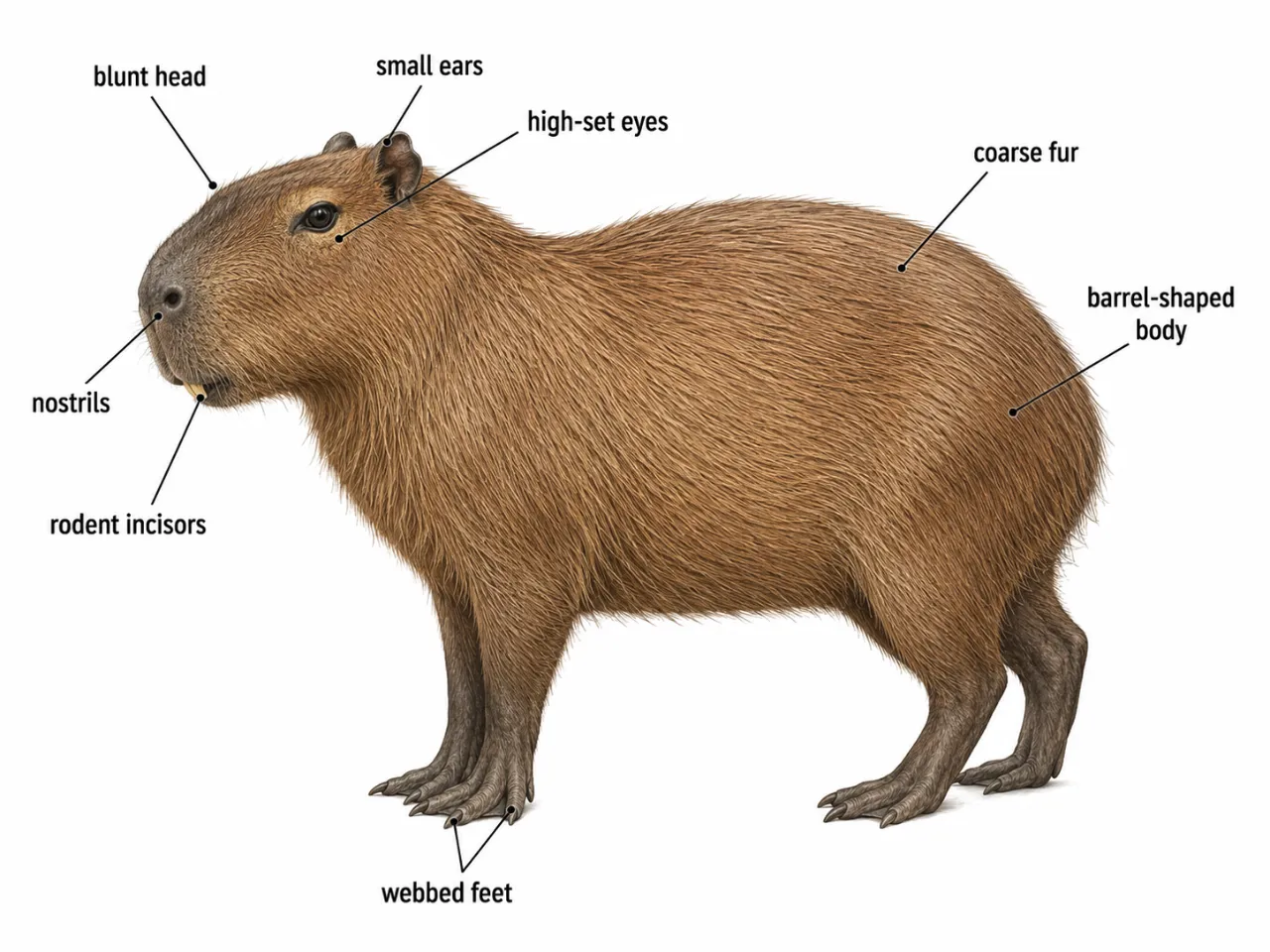
The capybara is a large, semi-aquatic rodent native to South America. Its scientific name is Hydrochoerus hydrochaeris. It is closely related to guinea pigs and rock cavies, but it is much larger. Adult capybaras can weigh as much as a medium-sized dog, and their barrel-shaped bodies, short legs, blunt heads, and webbed feet make them easy to recognize.
Capybaras are best known for being social, calm-looking, and strongly tied to water. They live in groups, graze on grasses and aquatic plants, and escape predators by running into water. Although they often look relaxed, they are not lazy animals. Their lifestyle is carefully adapted to wetlands, riversides, and open grassy habitats where food and water are close together.
Summary table
| Feature | Capybara Animal Facts |
|---|---|
| Common name | Capybara |
| Scientific name | Hydrochoerus hydrochaeris |
| Animal type | Mammal; rodent |
| Special title | Largest living rodent in the world |
| Native range | Much of South America, especially near water |
| Habitat | Wetlands, marshes, riverbanks, lakesides, flooded grasslands, and savannas |
| Diet | Mainly grasses, aquatic plants, reeds, sedges, bark, and other plant material |
| Social behavior | Usually lives in groups, often with a dominant male, females, juveniles, and young |
| Swimming ability | Excellent swimmer with partially webbed feet |
| Main predators | Jaguars, pumas, caimans, anacondas, large birds of prey, and humans in some areas |
What is a capybara animal?
A capybara is a large herbivorous rodent that lives in warm, wet regions of South America. It belongs to the rodent order, the same broad mammal group that includes mice, rats, squirrels, beavers, porcupines, and guinea pigs. However, the capybara is much larger than most familiar rodents.

Its body is heavy and rounded, with a large head, small ears, short limbs, and no obvious tail. The eyes, ears, and nostrils sit high on the head, which helps the animal see, hear, and breathe while much of its body remains submerged in water.
Capybaras are sometimes described as giant guinea pigs, and the comparison is understandable. They have a similar blunt face and grazing lifestyle. Still, capybaras are not simply oversized pets. They are wild wetland mammals with complex social behavior and specialized habitat needs.
How capybara bodies work
The capybara’s body is built for a semi-aquatic life. Its dense, barrel-shaped torso helps it move steadily through water and rest comfortably on muddy banks. Its partially webbed feet help with swimming and walking across soft wet ground.
The fur is coarse and usually reddish-brown, yellow-brown, or grayish-brown. This color helps capybaras blend into dry grasses, muddy shorelines, and wetland vegetation. Their skin can dry out under strong sun, so water and mud are important for comfort and temperature control.
Like other rodents, capybaras have continuously growing front teeth. These incisors are useful for cutting grasses and tough plants. Regular feeding helps wear the teeth down naturally. If a rodent’s teeth do not wear properly, serious health problems can occur.
How capybaras live near water
Water is central to capybara life. Capybaras are usually found near rivers, lakes, ponds, marshes, swamps, and flooded grasslands. They use water for drinking, feeding, cooling off, escaping predators, and sometimes mating.
When threatened, a capybara may run into water and swim away. It can also remain mostly submerged with only the eyes, ears, and nostrils above the surface. This behavior makes it harder for land predators to catch them.
Capybaras are strong swimmers and can move through water with surprising ease. They may cross rivers, rest in shallow water, or hide among aquatic plants. Their close relationship with water is one of the clearest differences between capybaras and many other rodents.
How capybaras communicate
Capybaras are vocal animals. They communicate with barks, whistles, squeals, purr-like sounds, clicks, and other calls. These sounds help group members stay in contact, warn each other of danger, maintain social bonds, and coordinate movement.
A sharp bark may signal alarm when a predator or human approaches. Softer sounds may be used between mothers and young or among relaxed group members. Young capybaras are especially vocal and may call frequently when separated from the group.
Capybaras also use body language and scent. Males have scent glands, including a raised gland on the nose called a morillo in mature males. Scent marking can help communicate identity, status, and territory within a group.
Which capybara trait is strongest?
The capybara’s strongest survival trait is probably its combination of social living and water adaptation. It is not the fastest animal on land, and it does not have horns, claws, or armor. Instead, it survives by staying alert, living in groups, using water as shelter, and grazing efficiently.
Group living gives capybaras more eyes and ears to detect danger. While some individuals graze, others may notice predators. When one animal gives an alarm call, the whole group can react quickly.
Water adds another layer of protection. A jaguar, puma, or human may approach on land, but a capybara near water has a better chance of escape. This is why open access to water is so important for the species.

Do all capybaras live the same way?
Not exactly. Capybara behavior can vary by region, season, habitat, group size, and human disturbance. In wet seasons, when water and vegetation are abundant, capybaras may spread out across flooded areas. In dry seasons, they often gather closer to permanent water sources.
Group size can also change. Some groups may include only a few animals, while others may become much larger when food and water are concentrated. A typical group often includes a dominant male, several adult females, younger males, juveniles, and babies, but exact structure varies.
There is also a smaller close relative called the lesser capybara, Hydrochoerus isthmius, found in parts of Panama, Colombia, and Venezuela. It is similar in many ways but generally smaller. Most people using the word “capybara” are referring to the larger common capybara.
What capybaras eat
Capybaras are herbivores. Their diet consists mainly of grasses, aquatic plants, reeds, sedges, and other vegetation. They may also eat bark, fruit, and cultivated crops when available, depending on local conditions.
As grazing mammals, capybaras spend a large part of the day feeding or resting between feeding periods. They often graze in the morning and late afternoon, avoiding the hottest parts of the day in many regions.
Capybaras have a specialized digestive system that helps them process fibrous plant material. Like some other herbivorous mammals, they may re-ingest special soft feces to extract additional nutrients. This behavior may sound strange to humans, but it is a normal part of digestion for many plant-eating rodents.
Where capybaras live
Capybaras are native to South America and are especially associated with wetlands and tropical or subtropical lowlands. They can be found in countries such as Brazil, Venezuela, Colombia, Argentina, Bolivia, Paraguay, Peru, Uruguay, and nearby regions where suitable habitat exists.
They are common in places with open grazing areas near water. Flooded savannas, marsh edges, riverbanks, and lake margins are ideal habitats because they provide both food and escape routes.
Capybaras can sometimes live near farms, ranches, and human settlements if water and vegetation are available. In some areas, they may be tolerated, hunted, managed, or viewed as crop visitors, depending on local culture and land use.
Predators and defense
Capybaras are prey animals, and many predators may hunt them. Jaguars and pumas are important land predators in some regions. Caimans and anacondas may attack in or near water. Young capybaras may also be vulnerable to foxes, ocelots, large raptors, and other predators.
Their main defenses are vigilance, group living, alarm calls, fast movement to water, and swimming. A capybara may remain still in vegetation, flee into water, or dive when threatened. Its eyes and nostrils allow it to stay low in the water while monitoring the surroundings.
Because capybaras are often seen resting calmly near other animals, people sometimes imagine they have no fear. In reality, wild capybaras are alert and can react quickly when they sense danger.
Reproduction and baby capybaras
Capybaras usually give birth to several young at a time, though litter size varies. The babies are well developed compared with many small mammals. They are born with fur, open eyes, and the ability to move soon after birth.
Young capybaras can begin nibbling vegetation early, but they still nurse from their mother. In social groups, several females may have young around the same time, and the group structure can help protect the babies.
Capybara young are vulnerable to predators, especially when small. Staying close to adults and near water improves their chances of survival. Growth rate depends on food quality, climate, predation pressure, and overall habitat conditions.
Why capybaras are successful herbivores
Capybaras are successful because they combine efficient grazing with social awareness and aquatic escape. Their teeth are adapted for cutting plant material, their digestive system helps them process tough vegetation, and their group behavior improves predator detection.
They also use habitats that many animals find challenging. Wetlands, flooded grasslands, and marsh edges can be difficult places for strictly land-based mammals. Capybaras use these habitats well because they can swim, graze, rest in water, and move across muddy ground.
Their success does not mean they are free from risk. Habitat change, hunting, drought, disease, and conflict with agriculture can affect local populations. However, in many suitable habitats, capybaras remain adaptable and widespread.
Are capybaras friendly?
Capybaras often appear calm around each other and sometimes around other animals. Their relaxed posture, social grooming, and tolerance of nearby birds or other wildlife have made them famous online. However, “friendly” can be misleading when applied to wild animals.
A wild capybara is not a domestic pet. It may tolerate nearby animals or people in some places, but it can still bite, flee, or become stressed if approached. Capybaras have strong teeth and should be respected as wild mammals.
In places where capybaras are kept under human care, they need space, water, social companionship, proper diet, veterinary attention, and legal permission. They are not simple household pets, even if they look gentle.
Common myths about capybaras
One common myth is that capybaras are giant rats. They are rodents, but they are not rats. Capybaras belong to a different rodent family and are more closely associated with cavies and guinea pig relatives.
Another myth is that capybaras are always relaxed and never afraid. Their calm appearance can hide alert behavior. In the wild, they constantly monitor their surroundings and respond quickly to alarm calls.
A third myth is that capybaras can live happily alone as pets. Capybaras are highly social animals. A solitary capybara may become stressed or develop poor welfare unless its complex social needs are properly addressed.
Final takeaway
The capybara is the world’s largest living rodent and one of South America’s most recognizable wetland mammals. It is a social, semi-aquatic herbivore with webbed feet, strong teeth, a blunt head, and a body built for grazing near water.
Capybaras survive through group living, sharp awareness, efficient feeding, and excellent swimming. They may look peaceful, and they often are calm within their groups, but they are still wild prey animals shaped by predators, wetlands, seasonal change, and social life. Understanding the capybara means seeing it not just as an internet-famous animal, but as a highly adapted mammal with an important role in South American ecosystems.
FAQs
Is a capybara a rodent?
Yes. The capybara is a rodent and is generally recognized as the largest living rodent in the world. It is related to guinea pigs and other cavy-like rodents, not to pigs or beavers.
What do capybaras eat?
Capybaras eat mainly grasses and aquatic plants. They may also eat reeds, sedges, bark, fruit, and crops when available. Their digestive system is adapted to process fibrous plant material.
Can capybaras swim?
Yes. Capybaras are excellent swimmers. They have partially webbed feet and often use water to escape predators, cool down, rest, and move through wetland habitats.