Quick answer
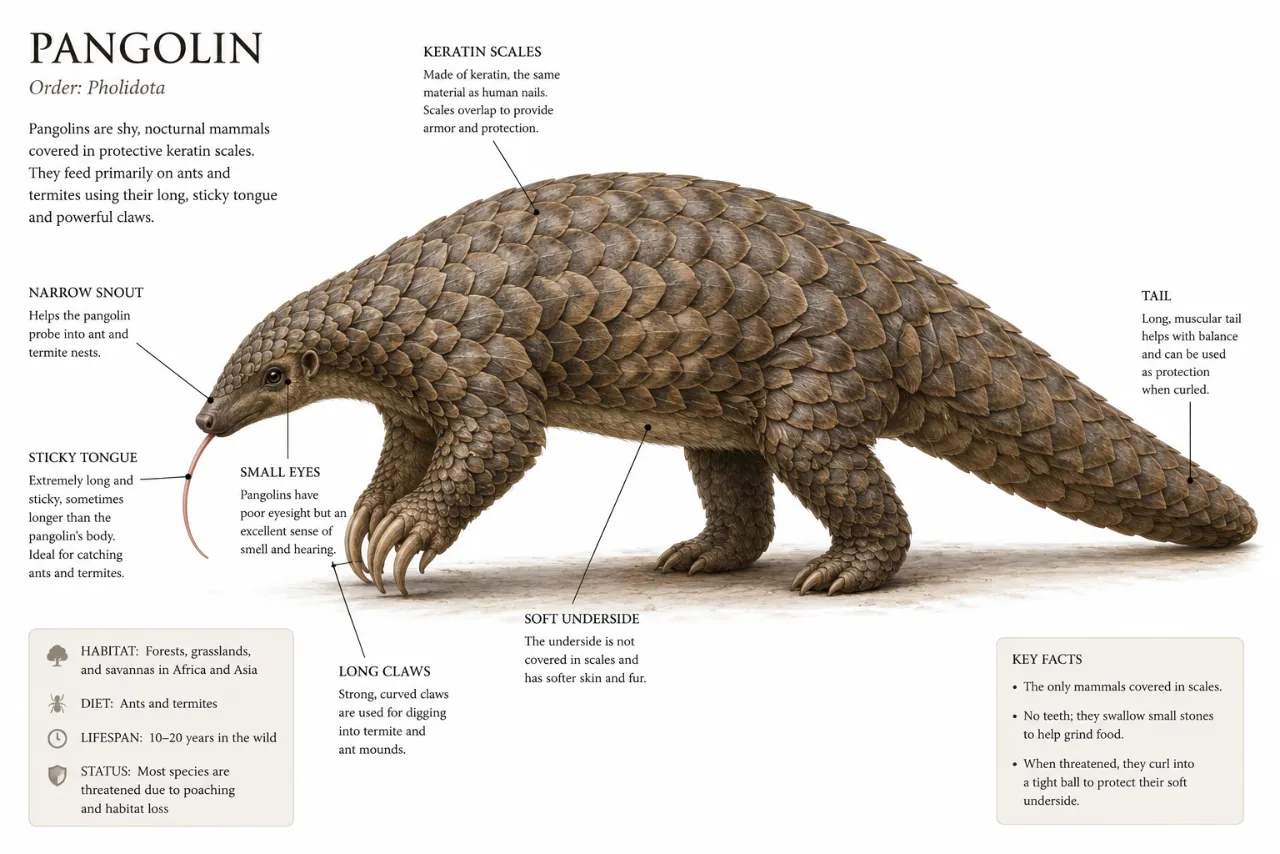
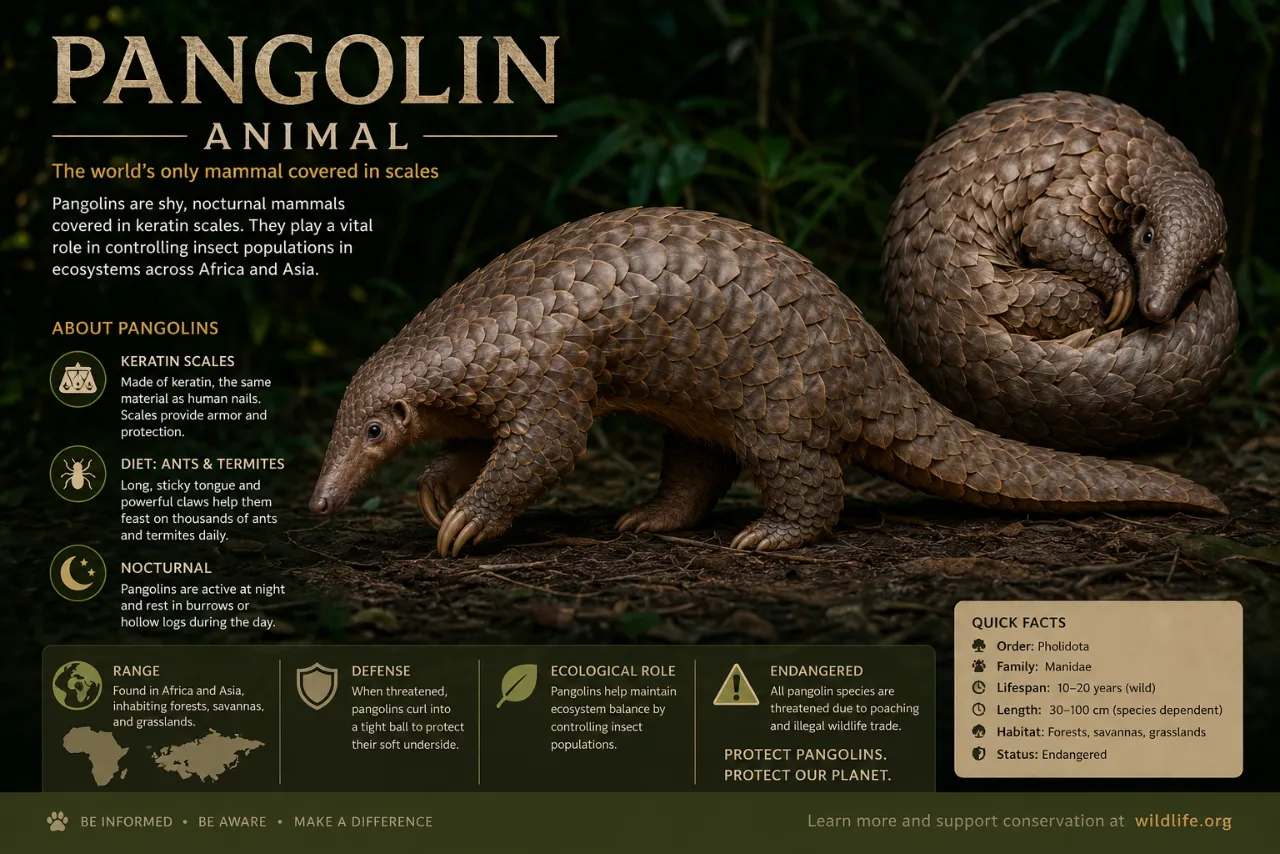
A pangolin is a scale-covered mammal in the order Pholidota. Pangolins are famous for their armor-like bodies, long sticky tongues, strong digging claws, and unusual defensive habit of curling into a ball. Their scales are made of keratin, the same general material found in human fingernails, hair, and animal claws.
There are eight living pangolin species. Four are found in Asia and four are found in Africa. Depending on the species, pangolins may live in forests, savannas, grasslands, woodlands, or scrub habitats. Some species spend much of their time on the ground, while others are skilled climbers.
Pangolins are generally insect-eaters. They feed mostly on ants and termites, using their claws to break into nests and their long tongues to collect prey. They have no teeth, so food is swallowed and processed with help from a muscular stomach.
Summary table
| Feature | Pangolin Animal Facts |
|---|---|
| Animal type | Mammal |
| Order | Pholidota |
| Number of living species | Eight recognized living species |
| Native range | Parts of Africa and Asia |
| Diet | Mainly ants and termites |
| Body covering | Overlapping keratin scales |
| Teeth | No teeth |
| Main defense | Curling into a tight armored ball |
| Activity pattern | Generally nocturnal, though behavior varies by species |
| Major threats | Illegal wildlife trade, habitat loss, hunting, and slow reproduction |
What is a pangolin animal?
A pangolin is a highly specialized mammal adapted for eating social insects. Its body is long and low, with powerful claws, a narrow head, small eyes, and a long tongue. The most recognizable feature is its covering of large overlapping scales, which gives it a pinecone-like or artichoke-like appearance.
Pangolins are sometimes called “scaly anteaters,” but they are not true anteaters. They also are not reptiles, even though their scales can make them look reptile-like at first glance. Pangolins are warm-blooded mammals. Females produce milk for their young, and their bodies are covered partly with hair between or beneath the scales.
The name “pangolin” is often linked to a word meaning “one that rolls up,” which describes their famous defensive posture. When threatened, many pangolins tuck their head inward and wrap the tail around the body, forming a hard protective ball.
How pangolin scales work
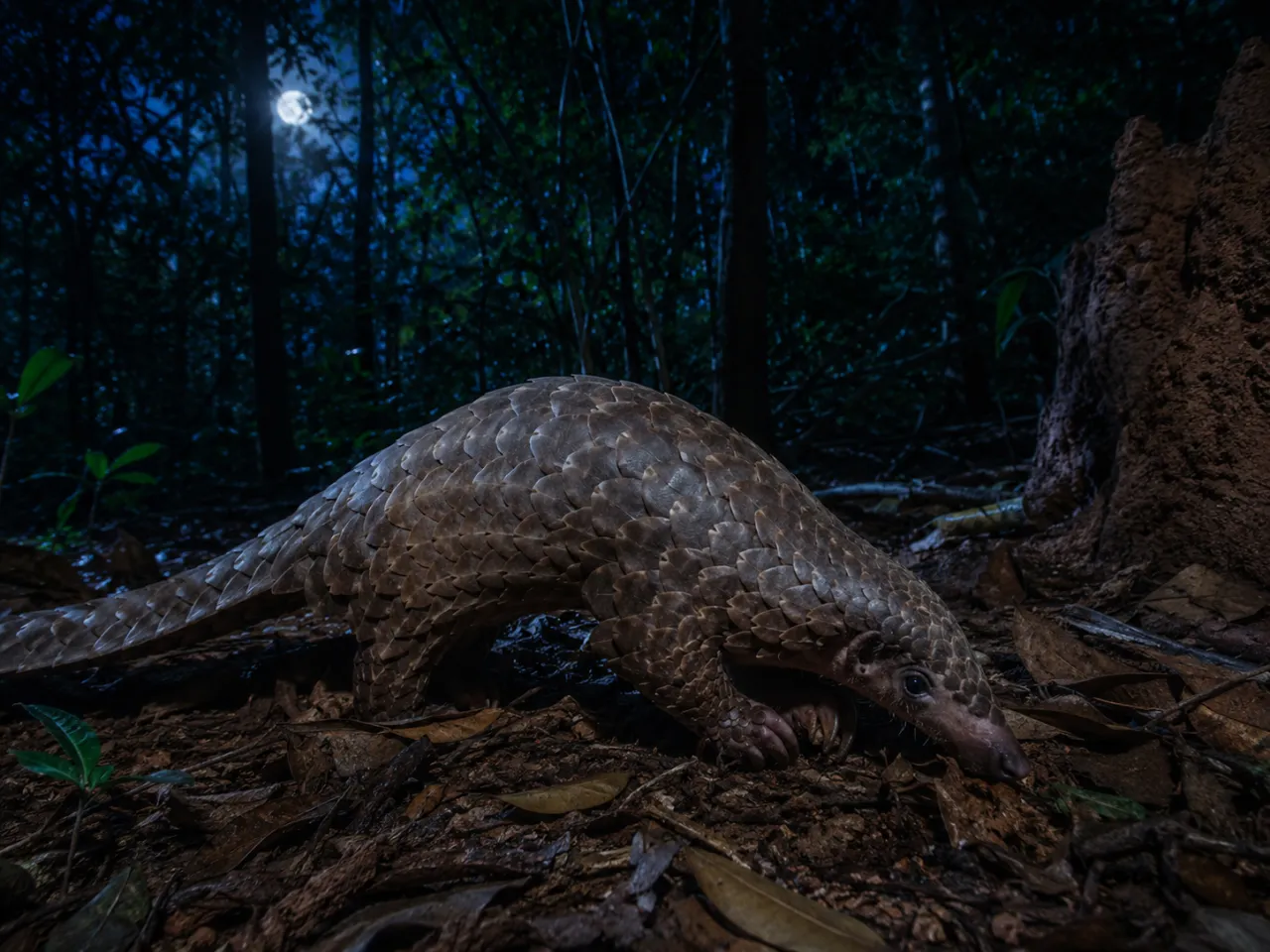
Pangolin scales are made of keratin. This material is tough, lightweight, and flexible enough to form overlapping plates along the animal’s back, sides, tail, and limbs. The scales act like natural armor, helping protect the pangolin from predators such as big cats, hyenas, and other carnivores.
The scales are not the same as reptile scales. Reptile scales develop differently and belong to a different evolutionary history. Pangolin scales are mammalian structures, and pangolins are the only living mammals with this kind of full-body scale armor.
When a pangolin curls up, the scales face outward and create a difficult barrier for many predators. The sharp edges can make it hard for an attacker to bite or pull the animal open. However, this defense is sadly ineffective against humans, which is one reason pangolins are so vulnerable to poaching.
How pangolins find ants and termites
Pangolins rely heavily on smell. Their eyesight is generally poor compared with many daytime mammals, but their sense of smell helps them locate ant nests, termite mounds, underground tunnels, and feeding trails. A pangolin may sniff the ground, logs, soil, or tree bark while searching for insects.
Once a food source is found, the pangolin uses its strong front claws to break into the nest or mound. Then it extends a long sticky tongue into the opening. The tongue can reach deep into narrow spaces where ants and termites hide.
Because pangolins have no teeth, they do not chew in the usual mammalian way. Instead, they swallow insects whole. Small stones and tough structures in the stomach may help grind the food, somewhat like a bird’s gizzard. This makes the pangolin’s feeding system very different from that of most familiar mammals.
How pangolins move and use their claws
Pangolin movement depends on the species and habitat. Ground-living pangolins often walk on their hind feet and the outer edges of their front claws, keeping the long claws protected. Their movement can look slow, careful, and slightly awkward, but it is well suited to digging and foraging.
Tree-dwelling pangolins are more agile climbers. They may use their claws to grip bark and their tails to balance or hold onto branches. Some species have prehensile tails, meaning the tail can help grasp supports while climbing.
The claws are essential tools. Pangolins use them to dig burrows, open ant nests, tear into termite mounds, climb trees, and sometimes pull apart rotting wood. The claws are not designed for attacking large animals; they are mainly feeding and digging tools.
Which pangolin senses are strongest?
The strongest pangolin sense is generally smell. A pangolin’s world is likely shaped more by scent than by sharp vision. This makes sense for a nocturnal insect-eating animal that often searches for hidden prey in soil, wood, leaf litter, or termite structures.
Hearing may also help pangolins detect movement and danger, although they are not usually described as sound-based hunters. Touch is important too, especially around the snout, tongue, claws, and tail. These body parts help the animal explore narrow openings and feeding sites.
Vision is usually not their main strength. Many pangolins are active at night, when smell, touch, and memory of feeding areas are more useful than detailed color vision. Their sensory system fits a secretive, low-light lifestyle.
Do all pangolin species live the same way?
No. The eight living pangolin species differ in size, range, habitat, behavior, and climbing ability. Some are mainly terrestrial, spending most of their time on the ground. Others are more arboreal and spend much of their lives in trees.
Asian pangolins include the Chinese pangolin, Sunda pangolin, Philippine pangolin, and Indian pangolin. African pangolins include the giant pangolin, ground pangolin, white-bellied pangolin, and black-bellied pangolin. Each species has its own ecological niche and conservation challenges.
For example, a giant pangolin is much larger and more ground-based than a small tree-dwelling pangolin. A black-bellied pangolin is highly adapted for climbing and has a long tail that helps it move through trees. Because of this diversity, broad pangolin facts should always be understood as general patterns.
Where pangolins live
Pangolins live in warm regions of Africa and Asia. Their habitats can include tropical forests, dry forests, savannas, grasslands, scrublands, agricultural edges, and woodland areas. The exact habitat depends strongly on the species.
Some pangolins sleep in burrows, which they may dig themselves or modify from existing spaces. Others rest in tree hollows, dense vegetation, or hidden cavities. A safe sleeping site is important because pangolins are vulnerable when resting.
Food availability shapes where pangolins can survive. Since they feed mainly on ants and termites, they need habitats with healthy insect communities. Habitat loss, forest clearing, and land conversion can reduce both shelter and food resources.
What pangolins eat
Pangolins eat mainly ants and termites. They may feed on eggs, larvae, workers, and other colony members. Their long sticky tongue can collect insects quickly, while the narrow head allows them to reach into small openings.
Different pangolin species may prefer different insects depending on region and availability. Some may feed more heavily on termites, while others take more ants. Diet can also vary by season, rainfall, habitat type, and local insect abundance.
Pangolins are important natural insect consumers. By feeding on social insects and disturbing nests, they may influence insect populations and soil processes. Their digging can also help aerate soil and create shelter opportunities used by other small animals.
Why pangolins curl into a ball
Curling into a ball is the pangolin’s most famous defense. When frightened, the animal tucks its soft underside inward and presents its hard scales outward. The tail may wrap around the body like a shield.
This defense works well against many natural predators. A lion, leopard, or hyena may find a curled pangolin difficult to bite open. The sharp scale edges and tight posture make the animal hard to handle.
Unfortunately, the same behavior makes pangolins easy for people to pick up. Instead of running away, a threatened pangolin often stays curled. This natural defense, which evolved against wild predators, becomes a weakness when humans are the threat.
Reproduction and baby pangolins
Pangolins generally reproduce slowly. Females usually give birth to one young, although the exact pattern can vary by species. A baby pangolin is sometimes called a pup. At birth, the scales are soft, but they harden as the young animal develops.
The mother nurses her pup with milk, as other mammals do. In some species, the baby may ride on the mother’s tail or back, especially when moving between shelter and feeding areas. If threatened, the mother may curl around the young to protect it.
Slow reproduction makes pangolin populations especially vulnerable. If many adults are removed by hunting or trafficking, populations may not recover quickly. This is one reason conservationists are deeply concerned about pangolin decline.
Why pangolins are endangered
All pangolin species face serious conservation pressure. The biggest threats are illegal wildlife trade, hunting, and habitat loss. Pangolins are trafficked for their scales and meat, even though their scales are made of keratin and have no proven special medical value.
Because pangolins are secretive and mostly nocturnal, scientists still have limited data on many wild populations. This makes conservation difficult. In many regions, researchers must estimate population trends from field signs, camera traps, rescue records, trade seizures, and local knowledge.
Habitat loss adds another layer of risk. Forest clearing, agricultural expansion, road building, and human settlement can reduce feeding areas and shelter. When habitat loss combines with poaching, pangolin populations can decline rapidly.
Common myths about pangolins
One common myth is that pangolins are reptiles. They are not. Pangolins are mammals, even though they have scales. They produce milk, have hair, and belong to a mammalian lineage.
Another myth is that pangolin scales have unique healing power. Pangolin scales are made of keratin, the same general material found in fingernails and hair. There is no reliable scientific basis for treating them as a special medicine.
A third myth is that pangolins are aggressive. Pangolins are generally shy and defensive rather than aggressive. They do not chase people, and their main response to danger is to curl up, hide, or try to escape.
Why pangolins matter in ecosystems
Pangolins matter because they are specialized insect-eating mammals. By feeding on ants and termites, they help shape insect communities. Their digging can disturb soil, open insect nests, and create small habitat changes that may benefit other organisms.
They are also part of the food web. Although their scales protect them from many predators, some large carnivores may still attempt to prey on them. Young pangolins are likely more vulnerable than adults.
Beyond ecology, pangolins are important because they represent a unique branch of mammal evolution. No other living mammal looks or lives quite like a pangolin. Losing them would mean losing an entire and highly distinctive form of mammalian life.
Final takeaway
The pangolin is a remarkable mammal, not a reptile, not an armadillo, and not a true anteater. It is a scale-covered insect specialist with powerful claws, a long sticky tongue, poor eyesight, strong smell, and a famous habit of curling into an armored ball.
Pangolins live in parts of Africa and Asia, where they help control ants and termites and contribute to healthy ecosystems. But all living pangolin species are threatened by illegal trade, hunting, habitat loss, and slow reproduction. Protecting pangolins means protecting both a rare animal and the habitats that allow it to survive.
FAQs
Is a pangolin a mammal or a reptile?
A pangolin is a mammal. Its scales can make it look reptile-like, but it produces milk, has hair, and belongs to a mammalian group. Pangolin scales are made of keratin, not reptile skin.
What does a pangolin eat?
A pangolin eats mainly ants and termites. It uses strong claws to open nests and a long sticky tongue to collect insects. Pangolins do not have teeth, so they swallow their prey and process it with help from the stomach.
Why are pangolins endangered?
Pangolins are threatened mainly by illegal wildlife trade, hunting, and habitat loss. They are poached for their scales and meat, and their slow reproduction makes it hard for populations to recover quickly after heavy losses.